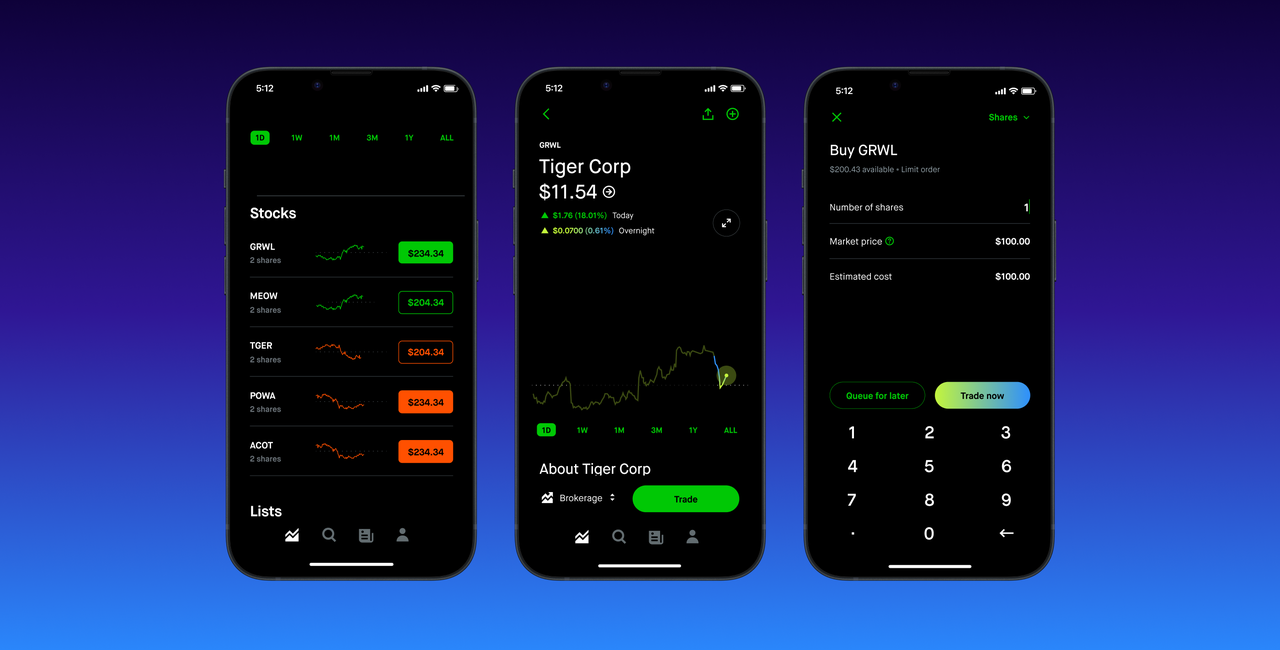
Robinhood Markets (NASDAQ: HOOD) is a financial services platform best known for making stock and options trading accessible through a mobile app. Over time, the company has expanded into cryptocurrency trading, retirement accounts, cash management, and other financial products. Its business model combines transaction-based revenue, interest income, and subscription services.
Robinhood is also expanding beyond traditional brokerage services by developing blockchain infrastructure and tokenized assets. Its Robinhood Chain, an Ethereum Layer 2 network built on Arbitrum technology, aims to bring stocks, exchange-traded funds (ETFs), and other financial assets onto blockchain rails. These initiatives could create new growth opportunities while connecting Robinhood more closely with the crypto and decentralized finance (DeFi) markets.
Data Source: Robinhood
What Is Robinhood? Understanding Robinhood Markets
Robinhood Markets is a U.S.-based financial technology company founded in 2013 by Vlad Tenev and Baiju Bhatt. Its core mission is to make financial markets more accessible by reducing barriers to investing and trading. Robinhood went public on the Nasdaq in July 2021 under the ticker symbol HOOD.
The platform initially gained popularity through commission-free stock and options trading, particularly among younger and self-directed investors. It has since expanded its offerings to include cryptocurrencies, retirement accounts, margin trading, prediction markets, and subscription-based financial services. This broader product range allows Robinhood to serve customers across more aspects of their financial lives.
Robinhood's long-term strategy is to evolve from a retail trading app into a broader financial services platform. Its investments in cryptocurrency infrastructure, tokenized stocks, and Robinhood Chain reflect an effort to combine traditional financial products with blockchain-based services.
How Does Robinhood Make Money?
Robinhood generates revenue from three main sources: transaction-based activities, net interest revenue, and other services such as subscriptions and financial products. This diversified model allows the company to earn income from both customer trading activity and assets held on its platform.
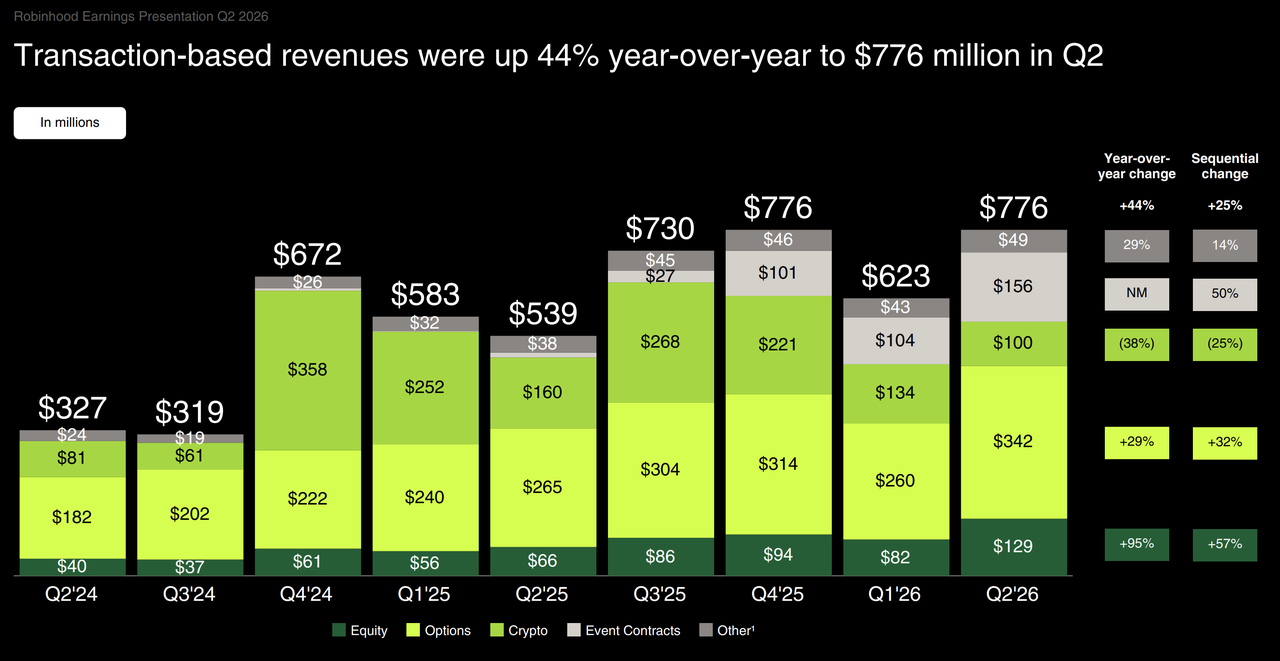
In the second quarter of 2026, Robinhood reported $1.308 billion in total net revenue, up 32% year over year. Transaction-based revenue reached $776 million, net interest revenue was $389 million, and other revenue totaled $143 million. These figures illustrate how trading remains its largest revenue source while interest income and other services contribute meaningfully to the business.
Transaction-Based Revenue From Stocks, Options, and Crypto
Transaction-based revenue is generated when customers trade financial products, including options, equities, cryptocurrencies, and futures. Depending on the product and applicable regulations, Robinhood may earn revenue through payment for order flow, trading-related fees, and other transaction-based arrangements. This makes trading activity an important driver of its financial performance.
Options trading has historically been an important contributor to Robinhood's transaction-based revenue. Cryptocurrency trading adds another source of income, particularly when market volatility and investor participation increase. However, trading revenue can fluctuate considerably as customer activity shifts between asset classes.
In Q2 2026, Robinhood's transaction-based revenue rose 44% year over year to $776 million. However, cryptocurrency transaction revenue declined 38% to $100 million during the quarter, demonstrating that growth in broader business does not necessarily mean every trading category is expanding.
Data Source: Robinhood
Net Interest Revenue and Robinhood Gold
Robinhood earns net interest revenue from sources such as margin lending, interest in cash and securities, cash sweep programs, and credit-related products. For example, customers who borrow funds to trade on margin pay interest, while Robinhood earns interest in certain customer-related balances and corporate investments. The difference between interest income and applicable funding costs contributes to net interest revenue.
Net interest revenue is influenced by factors such as customer margin balances, interest rates, cash balances, and funding costs. This revenue stream can provide a degree of diversification from transaction-based income, although changes in interest rates and customer borrowing activity can affect its performance.
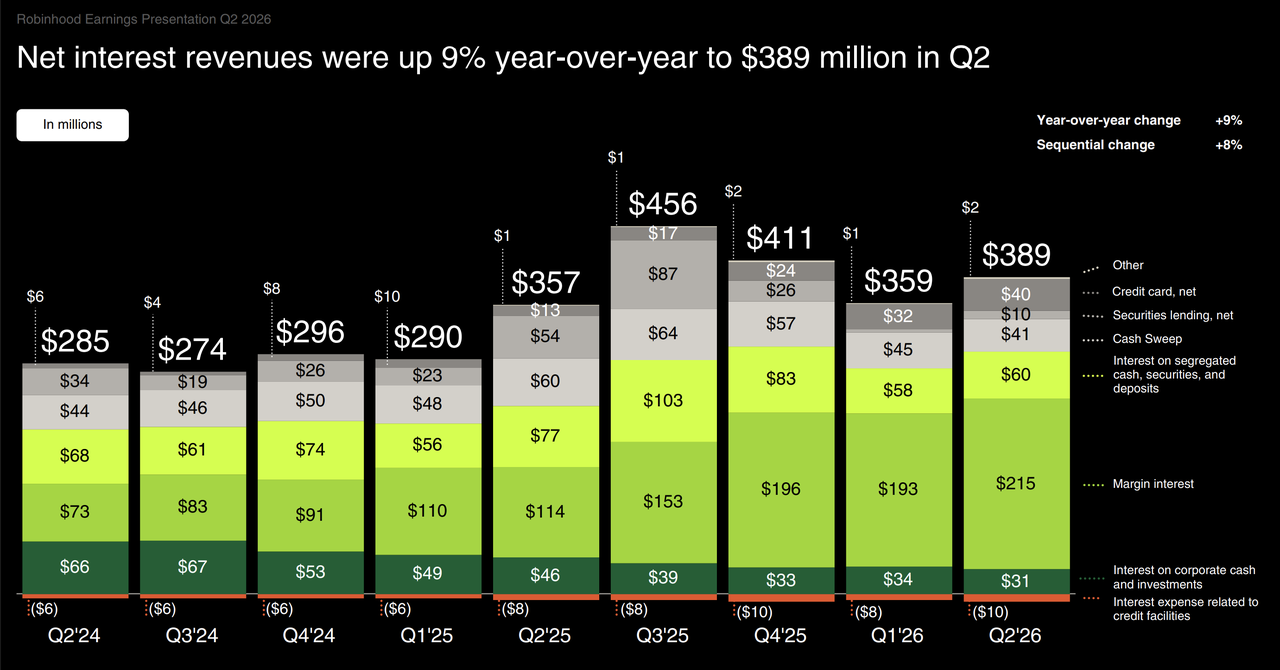
In Q2 2026, Robinhood reported $389 million in net interest revenue, up 9% year over year. This reflects the contribution of interest-generating products to the company's overall revenue and highlights the importance of customer assets and lending activity to its business model.
Data Source: Robinhood
Other Financial Services and Subscription Revenue
Beyond trading and interest income, Robinhood generates revenue from services such as securities lending, credit cards, and other financial products. It also offers Robinhood Gold, a paid subscription service that provides benefits such as enhanced cash yields, retirement account incentives, selected trading discounts, and additional financial tools. These offerings help Robinhood expand its relationship with customers beyond individual trading transactions.
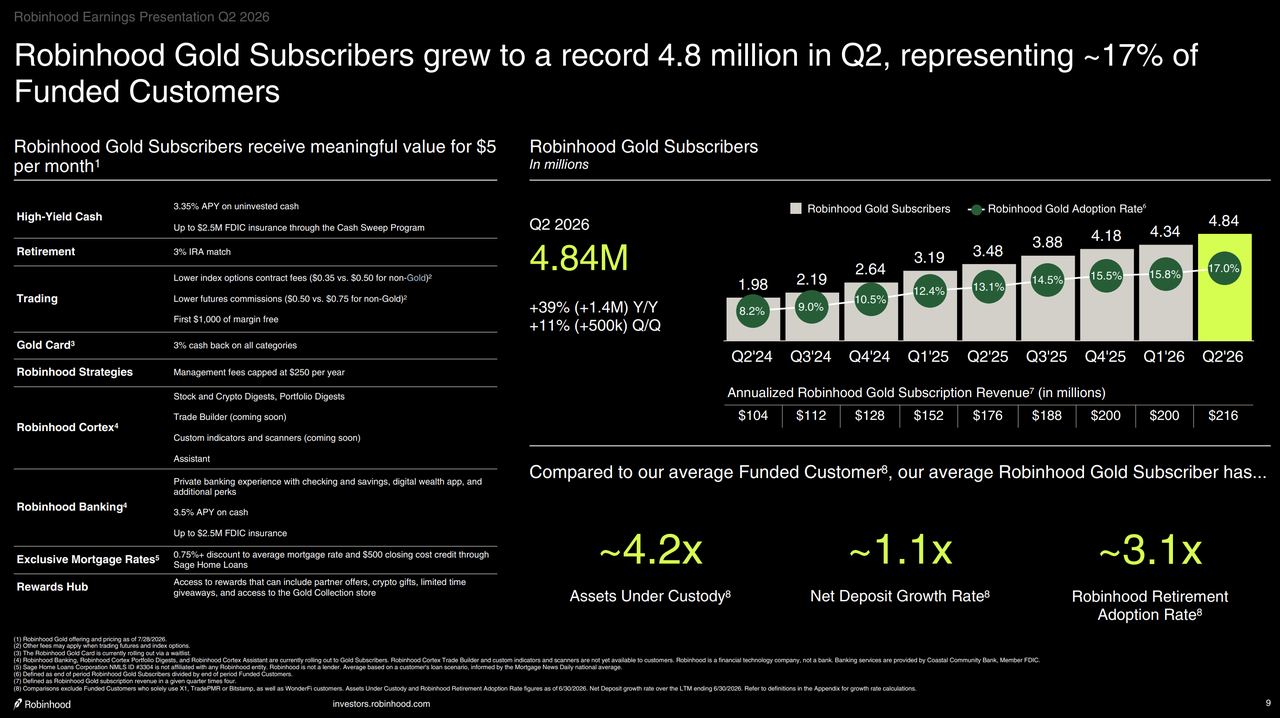
Robinhood Gold provides a recurring subscription revenue stream that is less directly dependent on daily trading volumes. The service may also encourage customers to consolidate more of their assets on the platform and use additional Robinhood products. As of the end of Q2 2026, Robinhood had approximately 4.84 million Gold subscribers, up 39% year over year.
Robinhood has also invested in wealth management and advisory infrastructure, including retirement products and services for independent financial advisers. Its expansion into blockchain infrastructure and tokenized assets could create further revenue opportunities over time. However, the financial contribution of these initiatives will depend on customer adoption, product economics, regulatory requirements, and the company's ability to scale them profitably.
Data Source: Robinhood
Robinhood Crypto: Trading, Wallets, and Onchain Finance
Robinhood Crypto extends the company's platform into digital asset trading, allowing eligible customers to buy and sell supported cryptocurrencies. Crypto gives Robinhood access to a market that operates around the clock and attracts users interested in assets such as Bitcoin and Ethereum. Trading activity and asset prices can therefore have a meaningful impact on its financial results.
The company has also expanded beyond in-app trading through Robinhood Wallet, a self-custody wallet that gives users greater control over supported digital assets and access to decentralized applications. Unlike a conventional brokerage account, a self-custody wallet allows users to manage their own private keys and interact directly with supported blockchain networks. This creates a connection between Robinhood's retail customer base and the broader onchain ecosystem.
Robinhood's acquisition of Bitstamp and expansion of its crypto infrastructure also support its efforts to serve a broader range of customers and markets. The opportunity extends beyond trading commissions or transaction-related revenue to potential services involving tokenized assets, staking, and onchain finance. However, each product remains subject to its own availability, regulatory framework, and operational risks.
Robinhood Chain: How Is Robinhood Building an Ethereum Layer 2?
Robinhood Chain is a permissionless, Ethereum-compatible Layer 2 blockchain designed to connect traditional financial markets with crypto and real-world assets. The company launched its public testnet in February 2026 before introducing the public mainnet in July 2026. The network is intended to support tokenized financial assets and applications that can operate directly onchain.
Unlike a conventional brokerage platform, a public blockchain can allow third-party developers to build applications on top of its infrastructure. Robinhood Chain is designed to support this open development model while drawing on Ethereum's ecosystem and Arbitrum's Layer 2 technology. Its longer-term opportunity depends on whether developers, financial institutions, and users adopt the network.
Robinhood Chain Technology: Built on Arbitrum
Robinhood Chain is built using Arbitrum's Layer 2 technology, which is designed to process transactions more efficiently than relying solely on Ethereum mainnet. Layer 2 networks can reduce transaction costs and improve throughput while settling transactions to Ethereum. Robinhood Chain uses ETH as its native gas token, meaning ETH is used to pay network transaction fees.
The network is Ethereum Virtual Machine (EVM)-compatible, allowing developers to use familiar Ethereum tools and smart contract infrastructure. This can reduce the technical barriers for developers who want to deploy decentralized applications or integrate existing blockchain services.
Robinhood's approach combines established blockchain technology with infrastructure tailored to its financial products. Rather than creating an entirely new blockchain ecosystem from scratch, the company can build on existing Ethereum-compatible tooling while developing a network designed for tokenized assets and financial applications.
Data Source: Arbitrum
Tokenized Stocks and Real-World Assets Onchain
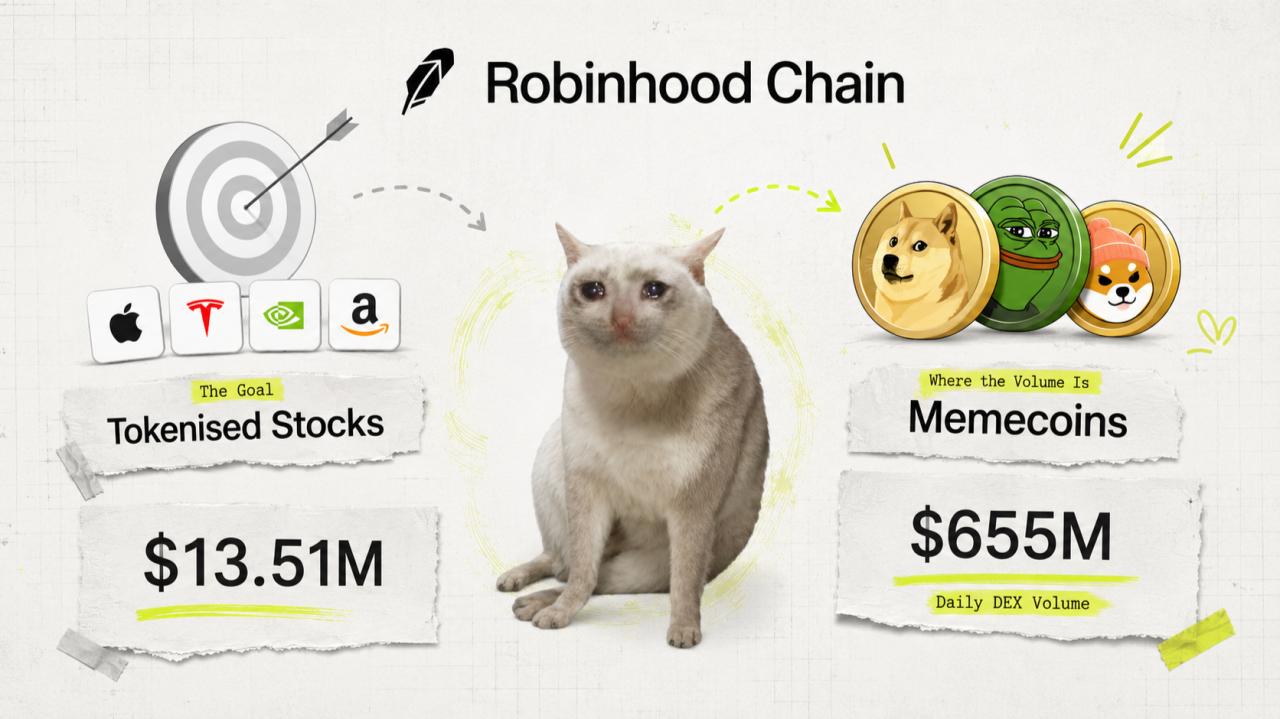
Tokenization involves representing ownership or economic exposure to an asset through blockchain-based tokens. Robinhood has already offered stock tokens to eligible European customers, while Robinhood Chain aims to expand onchain financial activity. One notable innovation is the potential to pair meme assets with tokenized stocks, creating new trading combinations that connect meme-driven market activity with traditional financial assets.
By bringing these assets into a blockchain environment, Robinhood Chain could enable new ways to trade and interact with tokenized financial products through decentralized applications. Blockchain infrastructure may also support transactions beyond conventional stock market hours and allow compatible tokens to interact with smart contracts, subject to product terms and regulatory restrictions. This could open up new possibilities for onchain trading strategies and asset integration.
However, tokenized stocks should not automatically be treated as equivalent to directly held shares. Ownership rights, issuer arrangements, redemption mechanisms, and investor protections depend on the specific product. The long-term potential of combining meme assets with tokenized stocks will also depend on actual product implementation, liquidity, regulatory compliance, and user adoption.
Data Source: The Parallel Economy
DeFi, Lending, and Trading Applications
A public blockchain can support decentralized exchanges, lending protocols, and other applications that operate through smart contracts. If tokenized stocks and other eligible assets become available on Robinhood Chain, developers could potentially build markets where users trade assets or use supported tokens as collateral. This would connect traditional financial exposure with DeFi infrastructure.
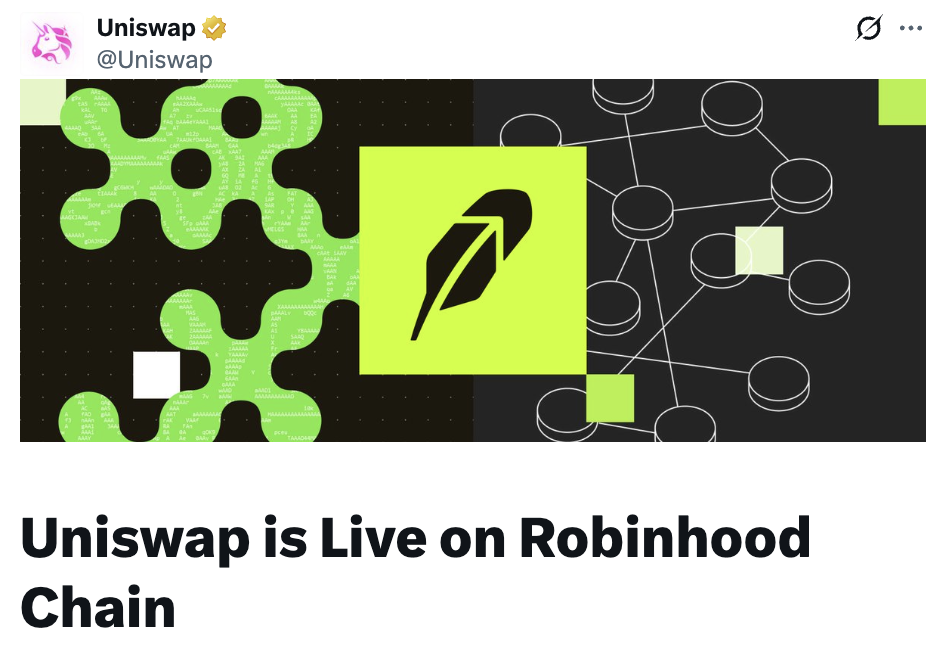
Robinhood has identified DeFi integration as part of its broader blockchain strategy. The company has announced ecosystem partners, including Uniswap, to support decentralized trading, alongside infrastructure providers and other developers. These integrations could help establish liquidity and give users more ways to interact with assets onchain.
Nevertheless, DeFi applications introduce risks such as smart contract vulnerabilities, liquidity shortages, price volatility, and potential liquidation of collateral. The presence of tokenized assets on a blockchain does not guarantee that deep liquidity or sustainable demand will develop. Adoption will depend on the quality of applications, user experience, and the regulatory treatment of the assets involved.
Data Source: Uniswap
What Drives Robinhood Stock Price?
HOOD stock is influenced by Robinhood's financial performance, customer growth, trading activity, and expectations for its future business. Because a substantial portion of revenue is linked to trading and interest income, the company's results can fluctuate with financial market conditions. Investors also assess whether new products can diversify revenue and support long-term earnings growth.
The expansion into crypto and blockchain introduces additional factors that may influence valuation. These include cryptocurrency market cycles, adoption of tokenized assets, the performance of Robinhood Chain, and the company's ability to monetize new services. Competition, regulatory developments, and changes in interest rates can also affect investor expectations.
Trading Volume, Active Users, and Customer Assets
Trading volume is one of the most direct drivers of Robinhood's transaction-based revenue. Higher activity in stocks, options, futures, and other products can increase transaction-related income, although the effect varies by asset class and revenue model. Strong engagement may also encourage customers to use additional Robinhood services.
Customer assets and net deposits provide another important measure of business strength. A larger asset base can support margin lending, interest-generating services, and customer retention. Growth in funded customers and Robinhood Gold subscribers can also indicate whether the platform is attracting and retaining users.
In Q2 2026, Robinhood reported approximately $368.7 billion in total platform assets, up 32% year over year, while net deposits reached $21.7 billion for the quarter. These indicators help investors evaluate the scale of the platform beyond short-term trading revenue.
Crypto Market Conditions and Digital Asset Trading Activity
Cryptocurrency prices and market volatility can influence both customer trading behavior and Robinhood's crypto-related revenue. Bull markets may attract new users and encourage more frequent trading, while prolonged downturns can reduce activity and lower the value of customer crypto holdings. However, crypto revenue does not always move in line with asset prices, as customers may continue trading during periods of falling prices.
The company's results in Q2 2026 illustrate this variability. Although total transaction-based revenue increased 44% year over year, crypto transaction revenue fell 38% to $100 million. This divergence shows why investors should examine Robinhood's revenue by product category rather than treating the company as a pure proxy for cryptocurrency prices.
Robinhood's crypto business may also benefit from expanding its supported assets, improving wallet functionality, and offering services beyond spot trading. Over the longer term, the ability to retain crypto users and connect them with other products may matter as much as short-term trading volume.
Robinhood Chain Adoption and Tokenization Growth
Robinhood Chain creates a potential long-term growth driver beyond the company's existing brokerage business. If developers build useful applications and customers adopt tokenized stocks and other assets, the network could support new services and increase engagement with Robinhood's blockchain products. Adoption by financial institutions could further expand the range of assets and services available onchain.
Investors should monitor indicators such as network activity, the number of applications, tokenized asset availability, liquidity, and the growth of developer partnerships. These measures can help distinguish actual ecosystem adoption from announcements or expectations. The extent to which network activity generates revenue for Robinhood is equally important.
The risks include competition from established blockchains, uncertainty around regulation, and the technical and operational challenges of connecting traditional assets with decentralized applications. Robinhood Chain could become a meaningful growth opportunity, but its long-term contribution to HOOD's valuation will depend on measurable adoption and monetization.
Robinhood Stock Performance: Key Milestones and Market Trends
Robinhood went public on the Nasdaq in July 2021, entering the market during a period of rapid growth in retail investing. Its stock has since experienced significant volatility as investor expectations shifted around trading activity, interest rates, financial performance, and the company's expansion into new products and services.
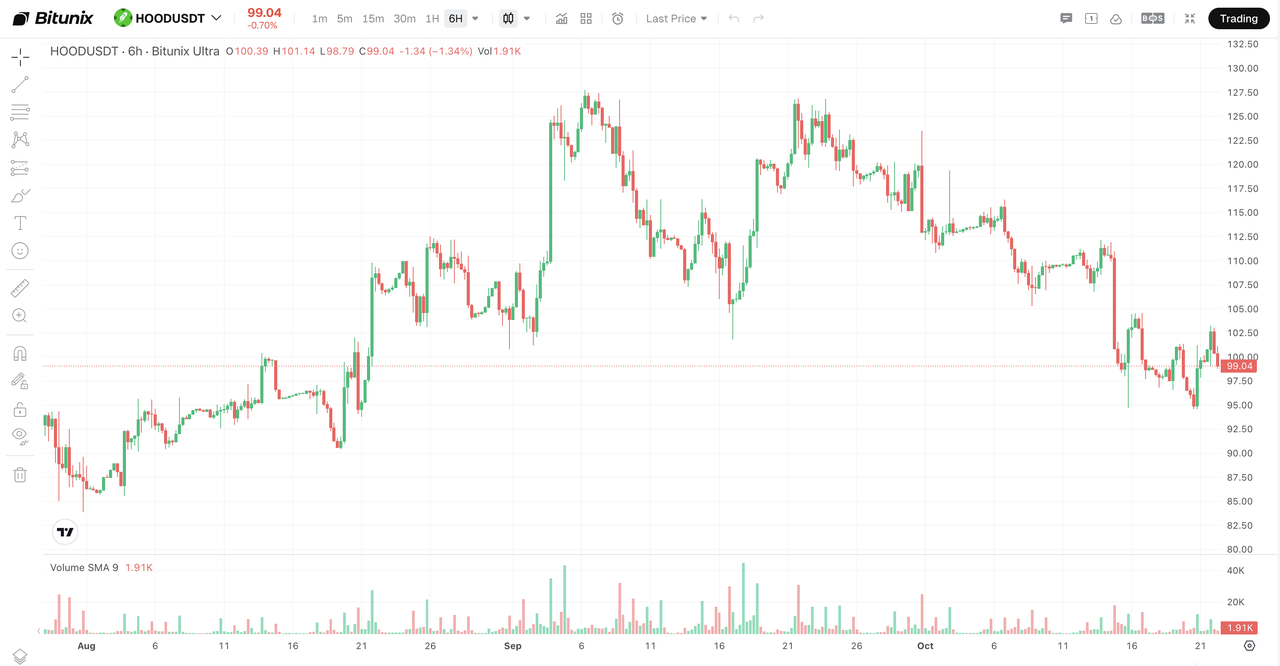
HOOD reached a high of approximately $153 in October 2025 before facing a substantial correction. Pressured by a pullback in cryptocurrency markets and broader market conditions, the stock fell to a low of around $63 over the following six months. It has since rebounded to approximately $100, recovering part of its losses while remaining below its previous peak. This price movement highlights how changes in crypto market sentiment and broader risk appetite can influence investor expectations for Robinhood's growth.
Robinhood's stock performance also reflects factors beyond short-term market movements, including revenue diversification, customer growth, and its expansion into tokenization and blockchain infrastructure. The launch of Robinhood Chain's public testnet in February 2026 and public mainnet in July 2026 marked important steps in its effort to build onchain financial infrastructure. Investors evaluating HOOD should weigh the company's existing financial performance against the execution risks and potential growth opportunities associated with these newer initiatives.
Data Source: Bitunix
How to Trade HOOD
For investors looking to gain exposure to Robinhood, the traditional approach is to purchase HOOD shares through a U.S. stock brokerage account. Investors generally need to open a brokerage account, complete identity verification, deposit funds, and then place an order to buy Robinhood shares on Nasdaq. However, buying U.S. stocks directly may involve brokerage account requirements, cross-border fund transfers, and transaction fees. Traditional stock investing also primarily benefits investors when the stock price rises, which may limit flexibility when market expectations change.
Another option is to trade Robinhood stock contracts through cryptocurrency trading platforms such as Bitunix. Compared with directly purchasing HOOD shares, stock contracts can provide more flexible ways to participate in the market. Traders can establish long positions when they expect Robinhood's stock price to rise or short positions when they expect it to decline. Bitunix HOOD contracts offer leverage of up to 20x, allowing users to gain exposure to larger positions with less initial capital. Before trading, users need to register a Bitunix account and complete identity verification (KYC). As leveraged products can magnify both gains and losses, users should understand the relevant risks and manage their positions carefully.