Nike is one of the world's most recognizable sportswear brands, known for its iconic footwear, athlete endorsements, and influence on global sports culture. Yet its strong brand recognition has not prevented a prolonged stock market decline. After reaching a peak of approximately $175 in 2021, Nike (NYSE: NKE) fell to around $35.35 by October 12, 2026, representing a decline of roughly 80% from its peak.
The sell-off reflects more than a temporary slowdown in consumer spending. Nike has struggled with a direct-to-consumer (DTC) strategy that weakened relationships with wholesale partners, heavy discounting that undermined pricing power, slowing demand in Greater China, and intensifying competition from both established sportswear companies and emerging performance brands. At the same time, investors have questioned whether Nike can restore its product innovation, profitability, and growth momentum.
Nike is now attempting to rebuild its business under CEO Elliott Hill, who returned to the company in 2024. However, its turnaround remains incomplete, and the stock's recovery will depend on whether improvements in distribution, product demand, and financial performance can translate into sustainable growth.
Data Source: Nike
What Is Nike? Understanding the Global Sportswear Brand
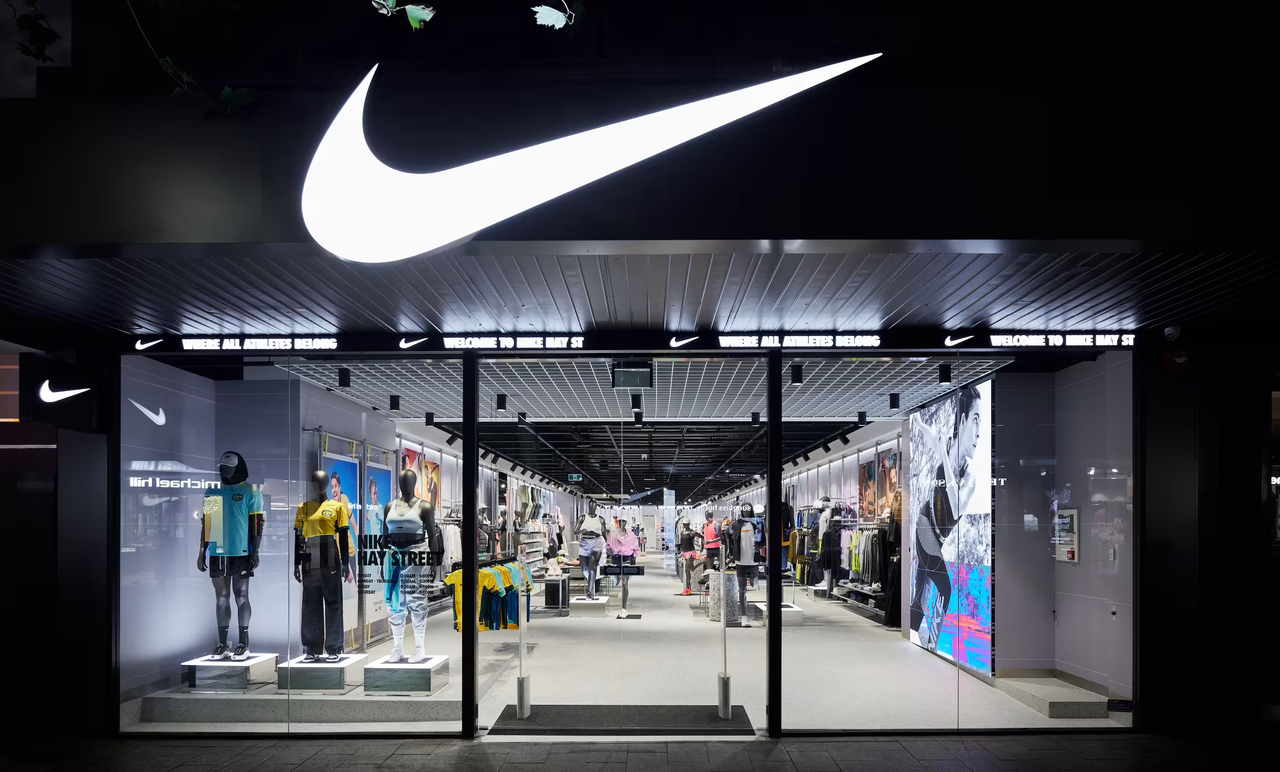
Nike, Inc. is a global sportswear company headquartered in Beaverton, Oregon. Its business includes athletic footwear, apparel, equipment, and related products marketed under the Nike, Jordan, and Converse brands.
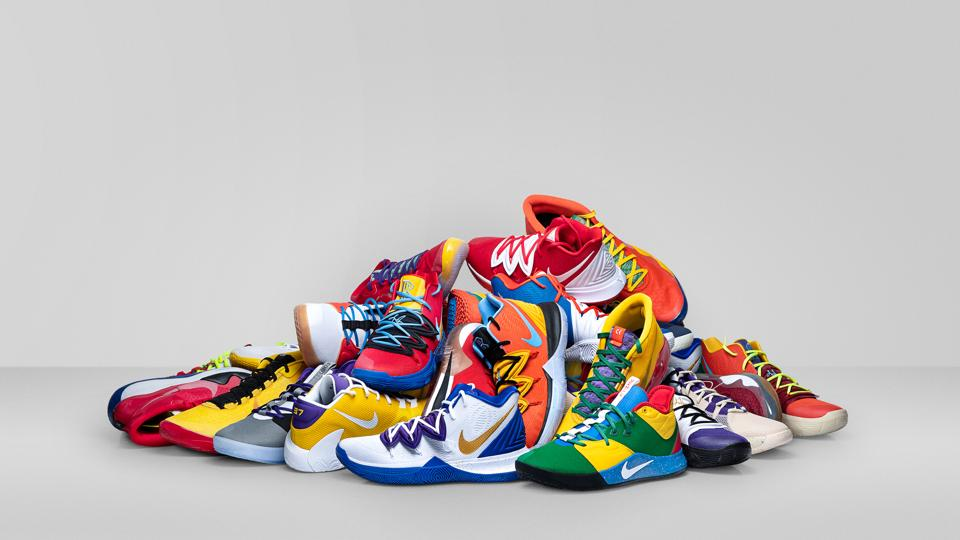
Nike's competitive identity is built around sports performance, product design, athlete partnerships, and lifestyle appeal. Products such as Air Jordan, Air Max, and Pegasus have helped the company establish a presence across basketball, running, training, and everyday fashion. Its global marketing campaigns and athlete sponsorships also allow Nike to connect its products with major sporting events and popular culture.
Nike operates through two main distribution channels: wholesale partnerships and NIKE Direct, which includes its own stores and digital platforms. Wholesale partners help the company reach consumers through established retail networks, while direct sales give Nike greater control over customer experience, product presentation, and pricing.
This combination has historically supported Nike's global scale and brand value. However, the balance between these channels became a major strategic issue when management prioritized direct sales over wholesale distribution. The resulting disruption exposed a critical weakness: even a powerful consumer brand can lose momentum if its products, distribution strategy, and customer demand fall out of alignment.
Data Source: Forbes
What Are Nike's Key Competitive Advantages in the Sportswear Industry?
Nike retains several advantages that could support a recovery, even after its recent struggles.
Global brand recognition and marketing reach. Nike has built a powerful brand through decades of athlete endorsements, sports sponsorships, and advertising. Its association with elite performance and popular culture gives the company a marketing platform that many smaller competitors cannot easily replicate.
Iconic products and established franchises. Air Jordan, Air Max, and other established footwear lines have created long-lasting consumer recognition. These franchises can generate recurring demand, although Nike must carefully manage product releases to prevent oversupply and excessive discounting from weakening their appeal.
Product development and sports science. Nike has substantial experience in footwear engineering, cushioning systems, materials, and athletic apparel. Its ability to translate product research into meaningful performance improvements is particularly important in running, basketball, and other competitive sports categories.
Global distribution and retail infrastructure. Nike's relationships with retailers, direct-to-consumer stores, and digital channels provide broad market access. Rebuilding wholesale partnerships while improving its own retail experience could help the company reach more customers without relying excessively on a single sales channel.
These advantages remain valuable, but they do not guarantee growth. Nike must turn brand recognition into products that consumers actively want to buy at prices that support healthy margins. If competitors offer more relevant designs, stronger performance features, or better value, brand reputation alone may not be enough to protect market share.
Data Source: FoxNews
Nike Financial Analysis: Revenue Growth, Profitability, and Business Outlook
Nike's fiscal 2027 first-quarter results highlight the challenges facing its turnaround. Although the company improved gross margin and reduced operating expenses, declining revenue across key business segments and continued weakness in Greater China indicate that demand has yet to recover. Management is now relying on product portfolio improvements, operational restructuring, and cost savings to strengthen the business over the coming years.
Revenue Declines as Direct Sales Remain Under Pressure
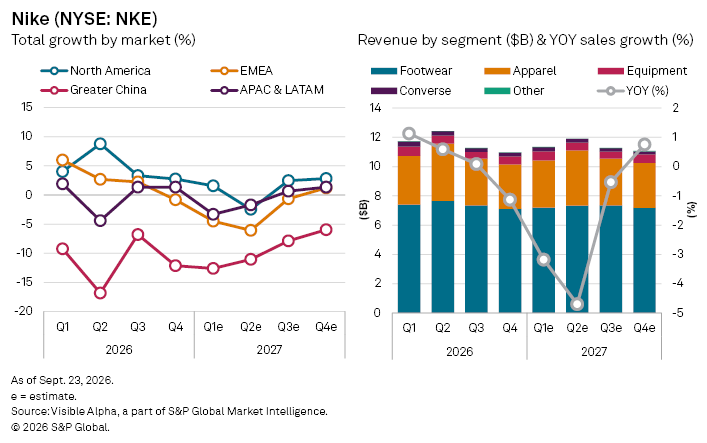
For the first quarter of fiscal 2027, ended August 31, 2026, Nike reported revenue of $11.2 billion, down 4% year over year on a reported basis and 5% on a currency-neutral basis.
NIKE Brand revenue declined 4% to $11.0 billion, primarily due to weakness in Greater China and EMEA, partially offset by growth in North America. Wholesale revenue fell 1% to $6.8 billion, while NIKE Direct revenue dropped 8% to $4.1 billion. On a currency-neutral basis, NIKE Direct revenue declined 9%, reflecting a 13% decrease in NIKE Brand Digital and a 5% decline in company-owned stores.
These figures suggest that Nike's direct-to-consumer business remains a significant source of pressure. Digital sales have weakened, and the company's owned retail stores have also struggled to generate growth. Meanwhile, wholesale revenue has proved more resilient, although it remains vulnerable to weak demand in key markets.
Converse also continued to underperform, with revenue falling 28% to $263 million as sales declined across all territories. The weakness across both NIKE Brand and Converse underscores the challenge Nike faces in restoring growth across its broader product portfolio.
Gross Margin Improves Despite Weak Sales
Despite declining revenue, Nike's gross margin increased by 60 basis points to 42.8%, primarily due to lower warehousing and logistics costs. Selling and administrative expenses fell 3% to $3.9 billion, reflecting lower operating overhead and other administrative costs.
However, not all expenses declined. Demand creation expense increased 5% to $1.3 billion as Nike invested more heavily in brand marketing and key sporting events. This spending reflects the company's efforts to strengthen product demand and reinforce its position across priority sports.
Net income was $0.7 billion, down 2% year over year, while diluted earnings per share came in at $0.48. The effective tax rate increased to 22.7%, compared with 21.1% in the same period last year, partly due to foreign tax audit settlements.
The results show that cost discipline and lower logistics expenses are helping Nike protect profitability despite weaker sales. However, improved gross margin alone does not establish that the business has returned to sustainable growth. Investors will need to see whether Nike can increase revenue and improve operating performance without relying excessively on cost reductions.
Inventory, Cash Position, and the Pace Restructuring Plan
As of August 31, 2026, Nike reported inventory of $7.8 billion, down 3% year over year, primarily reflecting changes in product mix. Cash and equivalents, together with short-term investments, totaled $8.4 billion, approximately $0.2 billion lower than the previous quarter-end level. Cash generated from operations was more than offset by dividend payments and capital expenditures.
Nike has also announced Pace, an operating model transformation designed to accelerate progress in its performance sports business and improve enterprise productivity. The program builds on the cost realignment plan announced in March 2026 and includes supply-chain modernization, the establishment of a new campus in India, a realignment to three geographic regions, and further organizational streamlining.
Nike expects Pace to generate approximately $2.5 billion in cumulative savings through fiscal 2031. The program is also expected to involve approximately $1.0 billion in pretax charges through fiscal 2031, primarily related to employee costs, in addition to approximately $300 million in severance expenses recognized in fiscal 2026. Nike expects to recognize approximately $300 million of these charges in fiscal 2027.
While the restructuring could improve long-term efficiency, the projected savings are estimated and exclude potential future reinvestment. The program also introduces near-term costs, meaning that its success will depend on whether the savings can be achieved without weakening product innovation, marketing effectiveness, or local market responsiveness.
Data Source: S&P Global
Key Factors Affecting Nike Stock Price
Nike's stock price reflects the market's expectations for future revenue, profitability, competitive positioning, and the success of management's turnaround. Four interconnected issues help explain its prolonged decline.
Brand Strength, Product Demand, and Sports Marketing
Nike's brand has long been one of its greatest assets, but brand recognition does not automatically translate into strong sales. Consumers must continue to see its products as desirable, innovative, and worth their prices.
One problem has been Nike's reliance on established lifestyle franchises and retro footwear. These products have supported sales for years, but excessive releases and discounting can reduce their perceived exclusivity. In October 2026, CEO Elliott Hill acknowledged that Nike had oversupplied iconic retro products and expected them to do too much for the business. The company has since been working to reduce the frequency of some retro releases and reinvigorate product innovation.
Competition has also become more demanding. Brands such as Adidas continue to compete across lifestyle and performance categories, while On and HOKA have attracted attention to performance running. These challengers have helped raise consumer expectations for specialized products, comfort, and design.
Chinese sportswear companies, including Anta, Li-Ning, and Xtep, have also strengthened their product offerings and local market positioning. Their growth increases the pressure on Nike to deliver products that resonate with consumers rather than relying primarily on global brand recognition.
Nike's marketing reach remains an advantage, but advertising and sponsorships cannot fully compensate for products that fail to generate demand. A durable recovery requires renewed product relevance, successful launches, and evidence that consumers are willing to pay closer to full price.
Direct-to-Consumer Sales and Wholesale Partnerships
Nike's shift toward direct-to-consumer sales is one of the most important factors behind its recent difficulties.
Under former CEO John Donahoe, Nike prioritized its own digital platforms and stores while reducing its dependence on wholesale partners. The strategy was intended to give Nike greater control over customer relationships, product presentation, and margins. In principle, direct sales can offer better access to consumer data and allow a company to capture more of the retail value chain.
The problem was that Nike's direct channels did not fully replace the reach and sales volume lost through wholesale distribution. Retail partners have helped Nike place products in front of consumers across different markets and price points. Reducing those relationships too aggressively limited distribution opportunities, while the company also faced growing competition and weaker demand.
Heavy promotions created another problem. Frequent discounting can move inventory in the short term, but it can also train consumers to wait for sales and make full-price products less attractive. When new products are discounted soon after launch, the perceived value of the brand may weaken, putting pressure on margins and long-term pricing power.
Nike has subsequently moved to rebuild relationships with wholesale partners and improve the balance between direct and third-party distribution. Its fiscal 2026 results showed wholesale revenue rising 6% while NIKE Direct revenue fell 6%. However, the latest quarterly results indicate that neither channel is yet delivering a broad-based recovery.
The lesson is not that DTC is inherently a bad strategy. Rather, Nike's experience shows that direct sales work best when they complement a strong wholesale network instead of replacing it faster than consumer demand can support.
Inventory Management, Profit Margins, and Competition
Inventory management is closely connected to Nike's distribution problems. When a company produces or distributes more merchandise than consumers want to buy, it may need to offer discounts, shift products between channels, or reduce future orders. These actions can lower average selling prices and affect profitability.
Nike has been working to reduce excess inventory and improve the quality of its product assortment. However, clearing older merchandise can create tension between two objectives: moving inventory quickly and protecting the brand's premium positioning. Excessive discounting may solve the immediate inventory problem while making it harder to sell future products at full price.
Competition adds to this pressure. On and HOKA have expanded their presence in running, while Adidas and Chinese sportswear brands compete across multiple product categories. Nike must continue investing in research, design, marketing, and athletic partnerships to maintain its position. If sales weaken while these costs remain significant, operating profit can fall faster than revenue.
External costs also have complicated recovery. Tariffs, foreign exchange movements, and supply-chain changes can affect product costs and margins. Nike's reported results should therefore be assessed by separating improvements in underlying demand from temporary benefits or costs related to pricing, currency, and trade policy.
In October 2026, Nike announced its multi-year Pace operating model transformation, which includes further cost reductions and organizational changes. The company expects approximately $1 billion in additional pretax charges associated with the program, on top of severance costs recognized in fiscal 2026. Most of the expected savings will take time to materialize.
Cost reductions may support future margins, but they cannot independently restore consumer demand. Investors should watch whether Nike's restructuring is accompanied by stronger sales, healthier inventory levels, fewer promotions, and renewed product momentum.
Greater China and the Challenge of Local Competition
Greater China has become one of Nike's most significant regional challenges. The market was previously an important source of growth, but weaker consumer demand, changing preferences, and stronger local competition have made recovery more difficult.
Nike's business in China has also faced reputational headwinds since the 2021 Xinjiang cotton controversy, which triggered consumer backlash and calls for boycotts. The extent to which this episode explains Nike's subsequent performance is difficult to isolate, but it forms part of the broader context for the brand's relationship with Chinese consumers.
The company's latest results show the scale of the challenge. In the first quarter of fiscal 2027, Greater China revenue declined 26% on a currency-neutral basis. Wholesale revenue fell 31%, while NIKE Direct revenue dropped 18%. These declines indicate that the weakness extends across distribution channels rather than being limited to one sales format.
Local competitors have also become more sophisticated in product design, performance technology, marketing, and consumer engagement. Nike must respond with products and campaigns that reflect local preferences while maintaining its global brand identity.
A recovery in China would be an important positive signal for investors. However, the key indicators are sustained sales improvement, healthier channel inventory, stronger full-price sell-through, and better profitability—not simply the announcement of new products or marketing initiatives.
How to Trade Nike (NKE) Stock
For investors looking to gain exposure to Nike, the traditional approach is to purchase NKE shares through a U.S. stock brokerage account. Investors generally need to open an account, complete identity verification, deposit funds, and place an order to buy Nike shares on the New York Stock Exchange. Depending on the brokerage and the investor's location, fees, account eligibility, and cross-border fund transfers may apply.
Another option is to trade Nike stock contracts through cryptocurrency trading platforms such as Bitunix. Stock contracts can provide an alternative way to express a bullish or bearish view on Nike's share price without directly purchasing the underlying shares. Traders may establish long positions if they expect the price to rise or short positions if they expect it to fall. Availability, leverage limits, and contract specifications should be checked on the platform before trading. Users must register a Bitunix account and complete identity verification (KYC) where required.