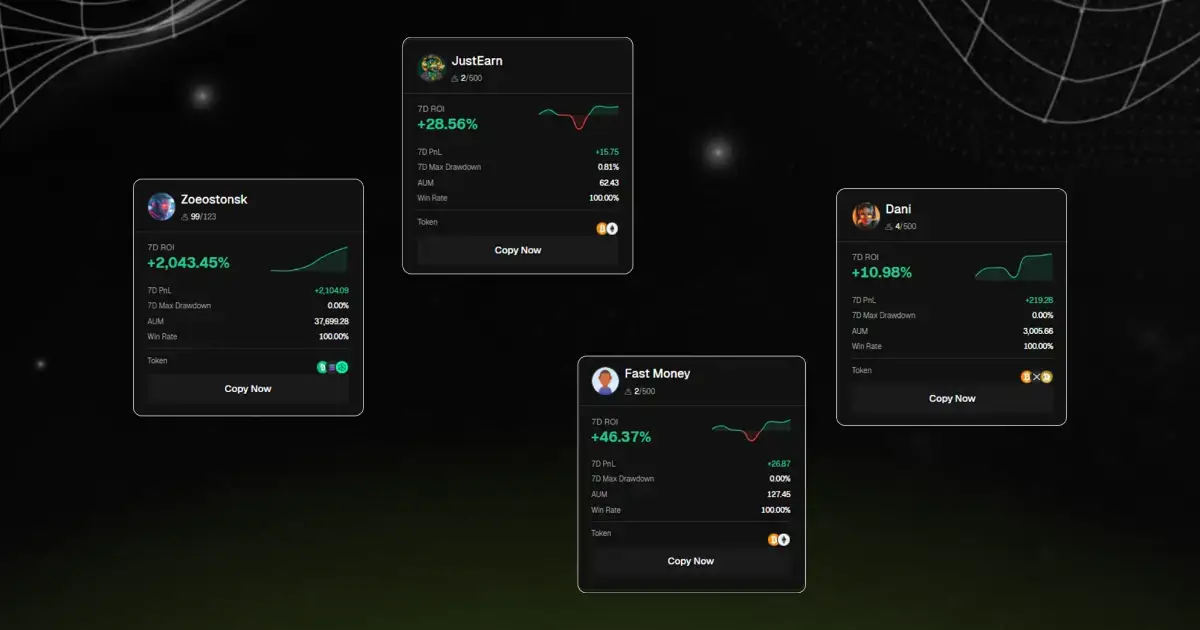
In 2026, crypto markets move faster than ever and not every trader has the time, skill, or experience to keep up. That’s why copy trading is booming. Copy trading provides access to a wide variety of financial markets, including cryptocurrencies, forex, stocks, and commodities, allowing you to diversify and leverage expert strategies. Whether you’re new to crypto or looking for smarter ways to trade, learning how to start copy trading can put you on the path to smarter, data-driven profits without managing every trade manually.
This guide will walk you through what copy trading is, how to set it up, and the best copy trading apps and features available — especially through platforms like Bitunix that are purpose-built for both beginners and serious traders. Consider this article the first step in your copy trading journey, giving you the knowledge and confidence to start trading with the guidance provided here.
What Is Copy Trading and How Does It Work?

Direct Answer: Copy trading is an automated investment mechanism where a follower's trading account mirrors the real-time position orders—including order size, leverage, stop-loss, and take-profit—executed by a selected professional trader (Lead Trader).
When you link your wallet to a lead trader on an exchange like Bitunix, you do not transfer ownership of your funds. Instead, an automated API engine listens to the lead trader's trade triggers and duplicates those orders proportionally inside your own sub-account.
The Technical Mechanism Behind Execution
To understand how copy trading works in live cryptocurrency markets, consider this execution breakdown:
Signal Generation: The lead trader opens a 10x leveraged Long position on BTC/USDT using $5,000 USDT (representing 10% of their total balance).
API Replication Engine: Bitunix calculates your relative account balance. If you allocated $1,000 USDT to this trader, the engine automatically calculates 10% of your budget ($100 USDT) at 10x leverage.
Order Placement: The system routes your market or limit order directly into the order book with near-zero latency, minimizing slippage.
Position Synchronization: When the lead trader modifies their stop-loss, partial take-profit, or closes the position entirely, your follower account executes the exact same closing order simultaneously.
Copy Trading vs. Signal Services vs. Mirror Trading
Beginners frequently confuse these three automated trading methodologies. Understanding their technical and operational differences is crucial before committing capital:
Feature Dimension | Copy Trading | Crypto Signal Services | Mirror Trading |
Execution Speed | Automated (Milliseconds) | Manual (Requires human copy-pasting) | Automated (Algorithmic execution) |
Trading Source | Verified Human Trader | Discord/Telegram Group Signals | Pre-coded Quantitative Bots / Indicators |
User Control | High (Custom SL/TP, max daily caps) | Maximum (User places trades manually) | Low (Pure programmatic rule execution) |
Slippage Risk | Low to Moderate (Exchange native) | High (Manual latency delays) | Low (Systematic platform routing) |
Skill Requirement | Beginner-friendly | Intermediate (Requires fast order entry) | Intermediate to Advanced |
Best Suited For | Hands-off traders buying human intuition | Learners wanting full trade authority | Systematic / Quant-focused traders |
Why Copy Trading Is Essential for Beginner Traders in 2026

Navigating crypto markets in 2026 requires more than basic chart reading. Between shifting macro liquidity, complex funding rate arbitrage, and rapid altcoin cycles, trading manually demands full-time attention. Copy trading bridges this execution gap through four core advantages:
Eliminates the Steep Learning Curve
Instead of spending hundreds of hours mastering Wyckoff logic, order flow charts, or Fibonacci retracements, beginners can immediately participate in active market setups. By observing live trades, you learn how professionals manage risk during unexpected volatility.
Removes Destructive Trading Psychology
The vast majority of beginner capital loss stems from emotional impulses: FOMO (Fear Of Missing Out), panic selling at market bottoms, and "revenge trading" after a loss. Copy trading automates execution rules, removing human emotion from trade entries and exits.
Complete Portfolio Transparency
Leading copy trading exchanges provide verified, immutable performance data. You can inspect a trader's historical trade logs, real-time liquidation thresholds, leverage usage history, and average holding times before risking a single dollar.
Non-Custodial Capital Protection
Your crypto assets remain safely in your personal exchange account. You retain absolute control to adjust risk parameters, pause replication, close open positions manually, or disconnect from a lead trader at any given moment.
How to Choose the Right Lead Trader: A 6-Metric Evaluation Framework
Selecting the wrong lead trader is the single biggest mistake new followers make. A high short-term Return on Investment (ROI) often masks dangerous, high-leverage gambling strategies.
Use this quantitative framework to screen lead traders on Bitunix:
Selection Funnel Workflow:
Step 1: Filter for traders with > 60 Days Active History
Step 2: Ensure Maximum Drawdown (MDD) is < 20%
Step 3: Verify Sharpe Ratio is > 1.5
Step 4: Confirm Controlled & Steady Leverage Usage (5x-15x)
Maximum Drawdown (MDD) — Target: Under 20%
Max Drawdown measures the largest percentage decline from an account's peak equity to its lowest trough. A trader with a +500% ROI but an 80% Max Drawdown is taking catastrophic liquidation risks. Look for smooth equity curves with MDD kept below 15% to 20%.
Trading Track Record — Target: Minimum 60+ Days
Short-term performance can be sheer luck. A minimum 60-day active trading record (with over 100 executed orders) proves that a trader's strategy can survive different market regimes (ranging, trending, and volatile sell-offs).
Sharpe Ratio & Profit Factor — Target: Sharpe > 1.5
Sharpe Ratio: Measures risk-adjusted return. A higher Sharpe ratio indicates the trader achieves high gains without taking disproportionate risk.
Profit Factor: Gross Profits divided by Gross Losses. A profit factor above 1.8 indicates a highly robust trading model.
Leverage Usage & Margin Type
Examine whether the lead trader uses Isolated or Cross Margin, and verify their average leverage. Traders who consistently stack 50x to 100x leverage on volatile altcoins carry an unacceptably high risk of sudden liquidation for followers.
Assets Under Management (AUM) & Follower Capacity
A high AUM demonstrates that other market participants trust this trader with substantial capital. However, ensure the trader isn't slipping on execution due to overcrowded pool capacity.
Profit-Sharing Percentage
Lead traders typically receive an 8% to 15% cut of net profits generated for their followers. Ensure the profit-sharing terms align with the trader's historical performance stability.
Step-by-Step Guide: Setting Up Copy Trading on Bitunix
Follow this step-by-step walk-through to initiate your automated copy trading account safely.
Step 1: Account Creation & Security Setup
Register an account on the official Bitunix website or mobile app.
Complete Identity Verification (KYC Level 1 or Level 2) to unlock full platform withdrawal limits and copy trading access.
Enable Two-Factor Authentication (2FA via Google Authenticator or YubiKey) to secure your wallet funds.

Step 2: Transfer Capital to Your Copy Trading Wallet
Navigate to your Assets / Wallet Overview.
Click Transfer and move funds from your Spot Wallet to your Futures / Copy Trading Wallet.
Use USDT (Tether) as your primary settlement asset for maximum market pair compatibility.
Step 3: Configure Replication & Risk Parameters

Once you select a qualified lead trader on the Bitunix Leaderboard, click Copy to open the risk configuration menu and apply this recommended parameter blueprint:
Recommended Risk Parameter Blueprint ($1,000 Total Allocation)
Allocation Amount ($1,000 USDT): The total capital balance reserved exclusively for this lead trader.
Copy Mode (Fixed Amount vs. Proportional Ratio):
Fixed Amount ($50 USDT per trade): Places a fixed dollar value into every copied position, regardless of the lead trader's portfolio size.
Proportional Ratio: Automatically scales your position size to match the exact percentage of balance used by the lead trader.
Max Daily Position Cap ($300 USDT): Restricts the total capital exposed in a 24-hour period to prevent over-trading during sudden market volatility.
Account Stop-Loss Threshold (15% / $150 Max Loss): An automated circuit breaker that closes all active copied positions and disconnects from the trader if your allocated capital drops by 15%.
Max Slippage Cap (0.5%): Rejects order execution if the market entry price drifts more than 0.5% away from the lead trader's entry price, protecting you from bad fills.
Advanced Follower Strategies: Managing Your Copy Portfolio Like an Institutional Investor
To achieve long-term profitability, treat copy trading as an active portfolio management discipline rather than a static investment.
Build a Multi-Trader Strategy Matrix
Never put all your capital behind one single trader. Spread your allocated funds across complementary trading styles:
Trader A (60% Budget - Core Conservative): Low leverage (3x-5x), trades high-market-cap assets (BTC/ETH), swing trading style, MDD < 10%.
Trader B (30% Budget - Growth Scalper): Medium leverage (5x-15x), active intraday scalper, trades major altcoins, MDD < 20%.
Trader C (10% Budget - High Beta / Satellite): Tactical trend trader targeting volatile narratives, tight trailing stop-loss enforced.
Implement the "Profit Harvest" Protocol
As your lead traders accumulate profits, systematically transfer gains out of the copy trading sub-account into your main cold wallet or spot balance. Sweeping profits weekly prevents your compound capital from being wiped out during sudden tail-risk market events.
Monitor for "Strategy Drift"
Check your copy trading logs at least once a week. If a historically disciplined lead trader suddenly doubles their leverage, increases trade frequency dramatically, or stops using stop-loss orders after a losing streak, disconnect immediately. This behavior—known as strategy drift—is a primary cause of trader blow-ups.
5 Critical Copy Trading Mistakes to Avoid
Chasing 1000%+ Short-Term ROI: Astronomical gains are almost always funded by extreme leverage or dangerous martingale sizing strategies. They inevitably lead to a 100% loss.
Manually Interfering with Open Positions: Closing a copied position manually out of fear breaks the lead trader's mathematical risk-to-reward strategy and mess up risk calculations.
Ignoring Asset Correlation: Copying three different lead traders who are all holding 100% long positions on high-beta meme coins offers zero true diversification.
Over-Allocating Margin Per Trade: Placing 30% or 50% of your total budget into a single trade entry leaves your account vulnerable to instant liquidation if the market gaps down.
Failing to Account for Execution Slippage: Copying high-frequency scalpers can erode your net profit due to latency delays between order signals and market fills.
Why Bitunix Is Built for Crypto Copy Traders

Bitunix has engineered a high-throughput copy trading architecture designed specifically to address latency and security concerns:
Ultra-Low Latency Signal Matching: Engine throughput ensures follower orders execute within milliseconds of the lead trader's entry, preventing slippage losses.
Transparent E-E-A-T Trader Metrics: All lead trader data—including real-time open positions, leverage history, and historical PnL curves—is cryptographically verified.
Custom Position Protection Rules: Complete freedom to set custom position scaling, hard stop-losses, and maximum position caps per trading pair.
24/7 Liquidity & Security Standards: Deep order book liquidity across 30+ margin pairs with institutional-grade asset protection protocols.
To learn how to copy trade effectively, check out our Copy Trading Strategies Guide for practical tips on low-risk traders, diversification, andavoiding common mistakes.
About Bitunix
Bitunix is a global cryptocurrency derivatives exchange trusted by over 5 million users across more than 150 countries/districts. The platform is committed to providing a transparent, compliant, and secure trading environment for every user. Bitunix offers a fast registration process and a user-friendly verification system supported by mandatory KYC to ensure safety and compliance.
With global standards of protection through Proof of Reserves (POR) and the Bitunix Care Fund, Bitunix prioritizes user trust and fund security. The K-Line Ultra chart system delivers a seamless trading experience for both beginners and advanced traders, while leverage of up to 200x and deep liquidity make Bitunix one of the most dynamic platforms in the market.
Bitunix Global Accounts
X | Telegram Announcements | Telegram Global | CoinMarketCap | Instagram | Facebook | LinkedIn | Reddit | Medium
Frequently Asked Questions
What is copy trading?
Copy trading is a form of automated investing where your trades replicate the positions of an experienced trader in real time.
How do I start copy trading?
Choose a copy trading app (like Bitunix), open an account, fund it, pick a trader, and start copying their trades based on your chosen risk level. Is copy trading profitable? It can be — but success depends on choosing the right trader, using risk controls, and reviewing performance consistently. Can I stop copy trading at any time? Yes. Bitunix allows you to pause or stop copying a trader instantly without penalty. What’s the best copy trading app for beginners? Bitunix offers one of the most beginner-friendly copy trading apps in 2025, with clear stats, SL/TP settings, and demo testing.
Can I lose more money than I allocate to copy trading?
No. When copy trading on Bitunix, your losses are strictly capped at the capital amount you specifically allocate to that chosen lead trader or strategy pool. Your main wallet balance remains completely untouched.
Why is my profit percentage slightly different from the lead trader's PnL?
Minor discrepancies occur due to three main factors:
1. Execution Slippage: Small entry price variations caused by fast market movements.
2. Trading Fees: Standard exchange taker/maker trading fees applied to execution.
3. Profit Sharing Deductions: The performance fee automatically paid to the lead trader upon successful profitable trade settlement.
What happens if a lead trader gets liquidated?
If a lead trader reaches liquidation, your copied position will also be liquidated proportionally based on your margin allocation. You can prevent total loss by setting a custom Follower Stop-Loss Limit (e.g., capping losses at 15%).
Can I close a copied trade manually before the lead trader closes it?
Yes. You retain full control over your portfolio at all times. You can manually exit any open trade or terminate the copying relationship immediately via your Bitunix Copy Trading Dashboard.
Is copy trading suitable for spot trading or just futures?
While copy trading is most popular in perpetual futures markets (due to leverage flexibility), platforms like Bitunix also support spot copy trading for long-term investors seeking zero-leverage asset accumulation.