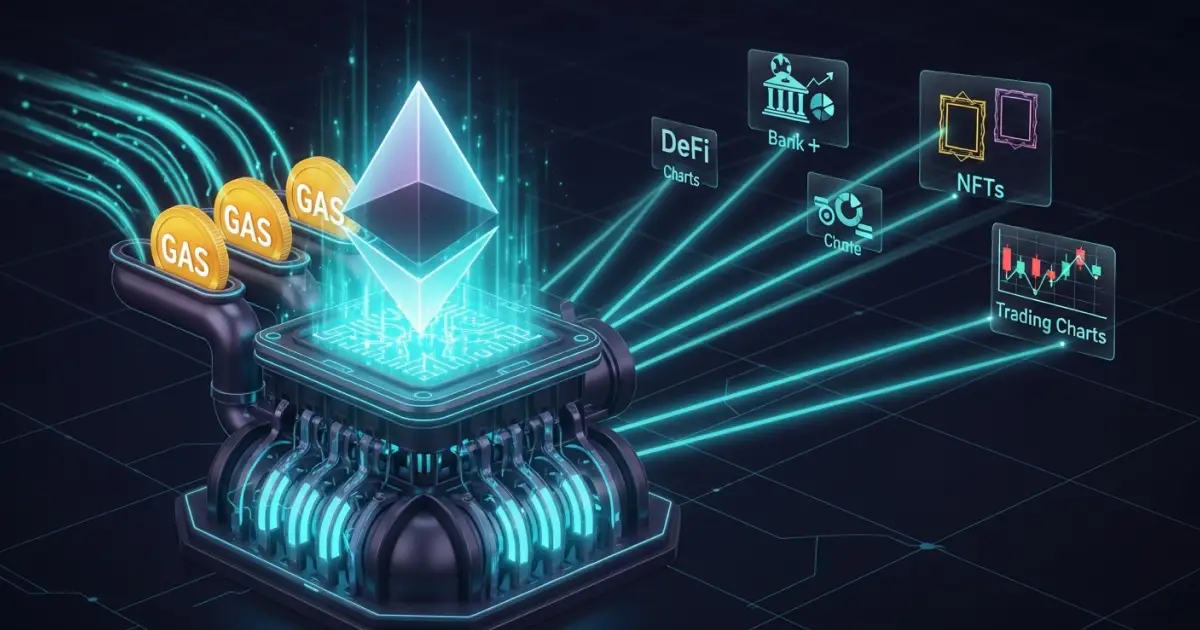
Ask ten traders about Ethereum's future and you'll get ten different price targets — and almost none of them will mention the protocol changes that actually determine whether those targets are realistic. That's backwards.
Before ETH becomes a number on a chart, it's a piece of infrastructure going through the most consequential rewrite of its execution and data layers since the Merge. Understanding that engineering roadmap is the only way to form a real view on Ethereum's future, rather than one borrowed from an X thread.
This piece walks through where the network actually stands: the Fusaka upgrade that's already live, the Glamsterdam and Hegota forks queued up behind it, what EIP-1559 does to circulating supply, and where real demand for blockspace is coming from. Let's strip away the hype and look at the raw mechanics.
Overview: What is the Ethereum Network and Its Layer-2 Modular Strategy
What is the Ethereum network, mechanically speaking? It's a decentralized, proof-of-stake settlement layer that orders transactions, stores state, and — critically — guarantees that once something is written to it, it stays written. That guarantee is the entire product. Everything else, including how fast or cheap it feels to use, is an engineering decision layered on top of that base security promise.
Transitioning from Monolithic Architecture to Modular Execution
For most of its history, Ethereum tried to do everything itself: execute transactions, order them, and store the resulting data, all within a single chain. That's a monolithic design, and it hits a hard ceiling — you can't scale throughput without either centralizing block production or pricing out ordinary users through gas fees.
Ethereum's answer was to split the job up. Rollups handle execution off-chain and post compressed proofs back to Ethereum, which focuses on what it's best at: settlement and data availability. Here's the visual to keep in mind:
Architecture Model | Monolithic Blockchain | Ethereum's Modular Stack |
Execution | Processed directly on the base chain | Handled primarily by L2 rollups that settle back to Ethereum |
Settlement & security | Managed entirely by the same blockchain | Ethereum mainnet provides settlement and inherited security |
Data availability | Execution and data availability are bundled together | Rollups use Ethereum blob space for data availability, with future improvements from PeerDAS |
Scaling lever | Increase L1 block capacity and execution performance | Expand rollup throughput and reduce transaction costs |
Trade-off | Higher throughput may require stronger hardware assumptions | Greater scalability with additional cross-layer coordination complexity |
The Role of Layer-2 Rollups in Scaling Ecosystem Throughput
Rollups execute thousands of transactions off-chain and compress them into a single proof that Ethereum verifies. The cost of that proof — not the number of transactions inside it — is what determines the user's gas fee.
That's why expanding Ethereum's blob space (the dedicated data lane for rollups introduced in the Dencun upgrade and expanded in Fusaka) has a direct, outsized effect on how cheap it is to transact on Arbitrum, Base, or Optimism, even though the transactions themselves never touch Ethereum's execution layer.
The Upgrade Timeline: From Fusaka to the Next Ethereum Network Upgrade
If you're wondering when is the next Ethereum upgrade or tracking ethereum network upgrade timeline, here's the current state of the roadmap.
Key Improvements Introduced in the Fusaka Upgrade
The Ethereum Fusaka upgrade went live on the mainnet on December 3, 2025, following Pectra from May 2025. Fusaka bundles thirteen EIPs around three goals: scaling Layer-2 data capacity, tightening Layer-1 execution efficiency, and smoothing out the developer experience.
Its headline mechanism is PeerDAS (peer data availability sampling), which lets nodes verify that blob data is available without downloading every byte of it — a prerequisite for scaling data throughput without forcing every validator to run enterprise-grade hardware.
Layered on top is EIP-7892, the Blob Parameter Only (BPO) fork mechanism, which lets Ethereum raise blob capacity through lightweight, scheduled forks instead of bundling every capacity bump into a full network upgrade.
The first two BPO forks pushed blob targets from 6/9 per block toward 14/21 within Fusaka's first month live, and rollup teams now get predictable visibility into future capacity rather than waiting on the next major hard fork.
Key takeaway: Fusaka didn't touch Ethereum's execution layer much — it was a data-availability and rollup-scaling release. The execution-layer overhaul is what comes next.
What to Expect from Upcoming Protocol Enhancements

(Source: ethereum.org)
With Fusaka shipped, developer attention has moved to two forks: Glamsterdam and Hegota. Both extend a roadmap phase known as The Surge (scaling) and The Verge (statelessness), and together they represent the biggest architectural shift to Ethereum's base layer since the 2022 transition to proof-of-stake.
Glamsterdam and Hegota: Scaling Ethereum to 100,000 TPS
Combined, these two forks are what actually gets Ethereum's ecosystem — L1 plus its rollups — toward the throughput levels that would let it compete with high-speed chains on raw transaction volume.
Glamsterdam: Optimizing Execution and Parallelization
Glamsterdam is a coordinated update to Ethereum's execution layer (codenamed Amsterdam) and consensus layer (codenamed Gloas), targeted for activation in the second half of 2026. Its two headline proposals:
Enshrined Proposer-Builder Separation, ePBS (EIP-7732): Block-building auctions currently run through external relays that a handful of professional builders dominate. ePBS hardcodes those bidding rules directly into the protocol, removing the reliance on trusted third-party relays and giving smaller, home-staked validators a fairer shot at competing with specialized block builders.
Block-Level Access Lists, BALs (EIP-7928): Ethereum has always processed transactions serially, one after another. BALs require a block to pre-declare which accounts and storage slots its transactions will touch, so nodes can identify non-conflicting transactions in advance and execute them in parallel across multiple CPU cores instead of one at a time.
Parallel execution is what makes a materially higher gas limit safe to ship — Glamsterdam's repricing bundle (grouped under EIP-8007, including EIP-7904's gas-cost recalibration) is designed to open the door toward a 200 million gas limit, more than triple the roughly 60 million ceiling Ethereum operates under today, while keeping node hardware requirements from spiraling.
Hegota: Advancing Data Availability and Statelessness
Hegota is Ethereum's next fork after Glamsterdam, currently targeted for late 2026, and it tackles a different problem entirely: the ever-growing size of Ethereum's state. Today, every full node has to store a complete copy of every account, balance, and smart contract Ethereum has ever recorded — a burden that keeps growing and gradually pushes out smaller node operators.
Hegota's centerpiece is the move from Merkle Patricia Trees to Verkle Trees, a cryptographic data structure that compresses state proofs dramatically — early estimates put the storage reduction at roughly 90%. That's the technical foundation for stateless clients: nodes that verify blocks by checking compact proofs instead of holding the entire chain's history, which lowers the hardware bar for running a validator and supports decentralization.
Hegota also absorbs a censorship-resistance feature that was originally scoped for Glamsterdam and pushed back to keep that fork's timeline intact: FOCIL (Fork-Choice Enforced Inclusion Lists, EIP-7805). FOCIL randomly assigns a rotating group of validators the power to force inclusion of any valid transaction in the next block, closing a gap exposed when block builders were shown to be capable of filtering transactions under regulatory pressure.
Fork | Target Window | Core Focus | Headline EIPs |
Frontier | Live — Jul 30, 2015 | Ethereum mainnet launch | Initial Ethereum protocol launch, introduced smart contracts and decentralized applications |
Homestead | Live — Mar 14, 2016 | Network stabilization | EIP-2 – Homestead protocol improvements EIP-7 – DELEGATECALL opcode |
Byzantium | Live — Oct 16, 2017 | Privacy, security, and smart contract improvements | EIP-140 – REVERT opcode EIP-196/197 – zk-SNARK cryptographic support EIP-649 – Difficulty bomb delay |
Constantinople | Live — Feb 28, 2019 | Efficiency improvements and PoS preparation | EIP-145 – Bitwise shifting opcodes EIP-1014 – CREATE2 opcode EIP-1234 – Block reward reduction and difficulty bomb delay |
Istanbul | Live — Dec 8, 2019 | Gas optimization and protocol efficiency | EIP-152 – BLAKE2 compression support EIP-1884 – Opcode repricing EIP-2028 – Calldata cost reduction |
Berlin | Live — Apr 15, 2021 | Gas optimization and transaction improvements | EIP-2565 – ModExp gas reduction EIP-2718 – Typed transaction envelope EIP-2929 – State access gas repricing |
London | Live — Aug 5, 2021 | Fee market reform and ETH economics | EIP-1559 – Base fee mechanism and ETH burn EIP-3198 – BASEFEE opcode EIP-3529 – Gas refund changes |
The Merge | Live — Sep 15, 2022 | Proof-of-Stake transition | EIP-3675 – Ethereum consensus upgrade Transitioned Ethereum from Proof-of-Work to Proof-of-Stake |
Shanghai / Capella | Live — Apr 12, 2023 | Staking withdrawals and validator improvements | EIP-4895 – Beacon Chain withdrawals Enabled ETH staking withdrawals |
Dencun (Cancun / Deneb) | Live — Mar 13, 2024 | Layer 2 scaling and data availability | EIP-4844 (Proto-Danksharding) – Blob transactions for cheaper L2 fees EIP-1153 – Transient storage EIP-4788 – Beacon block root access |
Pectra | Live — May 7, 2025 | Account abstraction, validator efficiency, UX improvements | EIP-7702 – Smart account functionality for EOAs EIP-7251 – Increased validator max effective balance EIP-6110 – Validator deposits on execution layer |
Fusaka | Live — Dec 3, 2025 | Blob/data-availability scaling | EIP-7594 (PeerDAS) – Data availability sampling EIP-7892 (BPO Forks) – Incremental blob capacity increases |
Glamsterdam | H2 2026 | Parallel execution, block production, L1 scaling | EIP-7732 (ePBS) – Enshrined proposer-builder separation EIP-7928 (BALs) – Block-level access lists |
Hegotá | Late 2026 | Statelessness, censorship resistance, long-term scalability | Verkle Trees – Foundation for stateless clients EIP-7805 (FOCIL) – Fork-choice enforced inclusion lists |
Ethereum's evolution has been shaped by a series of upgrades, each addressing a different limitation of the network. Early forks focused on security and protocol stability, while later upgrades shifted toward Proof-of-Stake, Layer 2 scalability, and long-term goals such as statelessness and parallel execution.
Stacked together — higher blob throughput from Fusaka, a tripled gas limit from Glamsterdam, and lighter, more efficient state verification from Hegota — this is the combination developers point to when discussing paths toward 100,000 TPS across the Ethereum L1-plus-rollup ecosystem.
It's worth being precise about what that number represents: it's aggregate capacity across Ethereum and its rollups working together, not a single-chain benchmark, and it depends on every stage of the roadmap shipping roughly on schedule.
What is Ethereum Coin (ETH)? Supply Dynamics and EIP-1559 Fee Destruction
What is the Ethereum coin economically? ETH is the network's native asset — it pays for gas, secures the chain through staking, and its supply schedule is directly tied to how much the network gets used.
How EIP-1559 Burns Gas Fees During High Network Activity
Since the London upgrade, every Ethereum transaction pays a base fee that gets permanently destroyed rather than paid out to validators. Validators still earn a separate priority fee (tip) plus staking rewards, but the base fee is gone the moment it's paid. When network activity is high, more ETH gets burned; when it's quiet, burning slows and new issuance from staking rewards can outpace it.
That's why ETH doesn't behave like a fixed-supply asset — there's no hard max supply cap the way Bitcoin has one. Instead, ETH's supply trajectory floats around a dynamic equilibrium set by the balance between issuance (new ETH paid to stakers) and burn (ETH destroyed via EIP-1559). Fusaka's BPO mechanism reinforced this by adding a minimum blob-fee floor, which ensures rollup activity keeps contributing to the burn even during periods of otherwise low fee pressure — a detail the market has taken to calling the difference between "ultrasound money" during high-usage periods and mild net inflation during quiet ones.
Proof-of-Stake Staking Yields and Issuance Equilibrium

(Source: ethereum.org)
As of July 30, 2026, over 41 million ETH — roughly a third of the total supply — is currently locked in Ethereum's proof-of-stake validator set, earning yield from a mix of protocol issuance and transaction tips. Withdrawals have been enabled since the Shanghai upgrade, so staked ETH isn't permanently removed from circulation; validators can exit and unstake.
Still, the scale of ETH parked in staking — often described by allocators as behaving like a yield-bearing instrument rather than a purely speculative asset — is a structural demand source that's independent of short-term trading flows.
>>> Related Reading: What Is Ethereum Staking? How It Works, Rewards & Risks (2026 Update)
Where Can I Use Ethereum? RWA Tokenization and Future Enterprise Demand
Beyond DeFi-native trading, the biggest source of new demand for Ethereum blockspace in 2026 has been institutional, not retail.
Real-World Asset (RWA) Tokenization on Mainnet
Tokenized real-world assets — mostly short-duration US Treasury products so far, alongside a growing slice of commodities and private credit — have scaled sharply on Ethereum mainnet through 2026, with the network consistently holding the largest share of on-chain RWA value of any blockchain.
Asset managers including BlackRock and JPMorgan have launched tokenized Treasury and fund products directly on Ethereum, drawn by its status as the most battle-tested, heavily audited settlement layer available.
The caveat worth flagging: growth so far is concentrated almost entirely in interest-rate-sensitive Treasury products, so the sector's headline numbers are more exposed to Fed policy than to organic diversification into asset classes like real estate or equities — those remain early.
Decentralized Finance (DeFi) and Institutional Settlement Layers
Stablecoins tell a similar story: Ethereum mainnet hosts the largest share of circulating stablecoin supply of any chain, and that stablecoin liquidity is what actually settles most RWA transactions — it's the on-ramp and off-ramp layer underneath the tokenization narrative.
As DeFi TVL and RWA issuance both scale on the same base layer, Ethereum's role shifts from "trading venue" toward something closer to institutional settlement infrastructure — plumbing that traditional finance routes capital through rather than a purely retail speculative venue.
Competitive Risks: Monolithic L1 Performance vs. Validator Centralization
None of this makes Ethereum's path automatic. Two structural risks are worth naming directly.
Throughput Challenges Against High-Speed Layer-1 Competitors
Single-chain, monolithic L1s can post higher raw transactions-per-second numbers than Ethereum's base layer today, because they sacrifice some decentralization guarantees to get there. Ethereum's modular bet — that a secure, credibly neutral settlement layer plus a competitive rollup ecosystem beats a faster but more centralized monolithic chain — is the central thesis of the entire Glamsterdam/Hegota roadmap.
Whether that bet pays off depends on execution: both forks still have EIPs in draft status, and developers themselves have flagged that Glamsterdam is proving slower and more complex to finalize than Fusaka was.
Addressable Security Risks in Staking and Validator Clustering
Block production has become concentrated among a small number of professional builders and relays — a dynamic ePBS is specifically designed to correct. Separately, large staking pools and liquid-staking providers control a growing share of validators, a centralization vector that FOCIL and ongoing research into validator set design are aimed at mitigating rather than eliminating outright. These aren't solved problems; they're the reason Glamsterdam and Hegota exist in the first place.
How Crypto Exchanges Support Node Staking and Base-Layer Liquidity
For traders who want exposure to Ethereum's staking yield and base-layer activity without running validator infrastructure themselves, exchanges play a straightforward role: aggregation and access.
Simplifying Validator Access Through Liquid Staking Options
Running a solo validator requires 32 ETH, dedicated hardware, and uptime discipline — a real barrier for most traders. Beyond the hefty capital requirement, individual operators face strict penalties like slashing if their nodes experience downtime.
Liquid staking and exchange-based staking products exist to lower that barrier, pooling capital across many users to meet validator requirements while keeping positions liquid. That accessibility is exactly the kind of structural demand driver Hegota's stateless-client design is aiming to extend further down to smaller, less specialized operators who are looking to secure a stake in the Ethereum future.
Industry observers note that centralized venues are increasingly stepping in to bridge this operational gap. By aggregating retail assets, platforms like Bitunix enable everyday traders to bypass the technical and capital constraints typically associated with solo validation.
For market participants seeking yield without locking up their tokens indefinitely, options like Bitunix Earn serve as low-barrier alternatives to traditional staking infrastructure. This approach includes structured products such as Dual Investment, which allow users to capture yields tied to underlying market movements—effectively presenting an accessible gateway to base-layer returns without the burden of hardware overhead.
Hedging and Portfolio Flexibility on Modern Exchanges
Separately from staking, active traders managing ETH exposure through upgrade cycles typically want tools to manage downside risk without exiting a position entirely. This is where derivatives platforms come in, letting traders hedge spot exposure, manage leverage deliberately, and react to volatility around scheduled network events rather than being forced into an all-or-nothing stance.
Bitunix provides practical risk management tools for traders navigating these network transitions:
Risk Hedging: Traders can open short positions in the futures market to protect the fiat value of their spot or staked assets during high-volatility events.
Capital Efficiency: Through perpetual contracts offering up to 200x leverage, users can manage their ETH exposure with lower collateral requirements to optimize capital utilization.
Flexible Strategy Execution: High-liquidity instruments like ETHUSDT Futures allow users to adjust their positioning as market sentiment or technical upgrades evolve.
Ultimately, by uniting retail asset aggregation with sophisticated trading venues, modern platforms ensure that market participants can confidently capture ecosystem yields while remaining flexible enough to adapt to the changing landscape of Ethereum's future.
Does Ethereum Have a Future? Long-Term Outlook and Takeaways
This technical clarity arrives at a compelling juncture for the market. Throughout 2026, Ethereum's price performance has repeatedly tested investor patience, with ETH experiencing a notable drawdown from its late-2025 highs to drift into the $1,900–$2,500 liquidity zone.
Yet, this price stagnation stands in stark contrast to record network usage and a massive structural supply crunch, with about 33% of all circulating ETH now locked in staking. Against this backdrop of market skepticism, the fundamental question persists: Does Ethereum have a future?
The honest answer is that the network's roadmap is unusually well-specified for something people still debate in hypotheticals — Fusaka is live, Glamsterdam's scope is largely locked, and Hegota's direction is set even if its exact activation date isn't. The open questions are about execution speed and adoption, not about whether the engineering exists.
Core Value Drivers Supporting Long-Term Viability

Settlement-layer trust: the largest, most decentralized proof-of-stake validator set of any smart contract platform.
Institutional RWA and stablecoin dominance: the base layer traditional finance is choosing to build tokenized products on.
A concrete scaling path: PeerDAS → ePBS/BALs → Verkle Trees is a sequenced roadmap, not a vague promise.
Supply mechanics tied to usage: EIP-1559 burn ties ETH's issuance directly to real network demand rather than a fixed emission schedule.
Strategic Summary for Market Participants
For traders, the practical takeaway is to track the roadmap the way you'd track any other catalyst calendar — Glamsterdam and Hegota testnet activations, BPO fork dates, and RWA issuance data are observable, schedulable events, not narrative noise. Ethereum's future is being built in public, EIP by EIP; the technical trajectory is more knowable right now than most market commentary gives it credit for.
About Bitunix
Bitunix is a global cryptocurrency derivatives exchange trusted by over 5 million users across more than 150 countries/districts. The platform is committed to providing a transparent, compliant, and secure trading environment for every user. Bitunix offers a fast registration process and a user-friendly verification system supported by mandatory KYC to ensure safety and compliance.
With global standards of protection through Proof of Reserves (POR) and the Bitunix Care Fund, Bitunix prioritizes user trust and fund security. The K-Line Ultra chart system delivers a seamless trading experience for both beginners and advanced traders, while leverage of up to 200x and deep liquidity make Bitunix one of the most dynamic platforms in the market.
Bitunix Global Accounts
X | Telegram Announcements | Telegram Global | CoinMarketCap | Instagram | Facebook | LinkedIn | Reddit | Medium