Binance is one of the largest crypto exchanges by volume, but it is not the right fit for every trader. Regional restrictions, account limits and a one-size-fits-all product push many people to look for a solid Binance alternative.
Bitunix and OKX are two common picks. This Bitunix vs OKX guide compares them side by side on fees, copy trading for both followers and lead traders, and safety. Each section starts with the key difference and ends with what it means in practice, so you can see which exchange fits the way you trade.
Are Bitunix and OKX Good Binance Alternatives?
Bitunix and OKX are good Binance Alternatives, with many like-for-like features
Yes, but for different reasons. OKX is the closest like-for-like replacement for Binance: a large, all-in-one crypto exchange with Spot, Futures, options, bots, Earn products and a Web3 wallet. Bitunix is a derivatives-focused exchange built for active traders, with chart-based execution tools and a simple copy trading model.
Bitunix launched in 2021 and offers leverage of up to 200x on BTC and ETH perpetuals. OKX launched in 2017 and serves users worldwide.
Here is the overall comparison:
| Bitunix | OKX |
Founded | 2021 | 2017 |
Focus | Derivatives-focused, crypto + TradFi Futures | All-in-one exchange, options, Web3 wallet |
Spot fees (base maker / taker) | 0.08% / 0.10% | 0.08% / 0.10% |
Futures fees (base maker / taker) | 0.02% / 0.06% | 0.02% / 0.05% |
Entry VIP tier | 300 USDT in assets | Based on assets or 30-day volume |
Copy trading | Futures; default 10% profit share; 10x leverage cap | Futures, Spot and bots; profit share 10%–30% by lead trader level |
Charting and alerts | Ultra Chart Trading + Super Alert | Native and TradingView charts, trading bots |
Proof of Reserves | Live page, Merkle tree; ratios at or above 100% | Monthly reports, zk-STARK; Sept 2026: BTC 109%, ETH 101%, USDT 105% |
User protection | $30M Care Fund | Reserves and risk controls |
Sources: Bitunix fee schedule, Bitunix copy trading rules, OKX fee notice, OKX profit sharing rules.
If you want one account for everything, OKX is the simpler choice. If you mainly trade Futures or copy other Futures traders, Bitunix gives you more control per trade.
Bitunix vs OKX Fees: Which Crypto Exchange Is Cheaper?
At the base tier, the two are almost tied. Spot fees match exactly, and OKX is 0.01% cheaper on Futures taker orders. Bitunix closes that gap with a VIP tier you can reach with a small balance.
Spot Trading Fees
Same base rates on both. The difference is how you move down the fee ladder.
Spot fees | Bitunix | OKX |
Base maker / taker | 0.08% / 0.10% | 0.08% / 0.10% |
$1,000 market buy | $1.00 | $1.00 |
$1,000 resting limit order | $0.80 | $0.80 |
How to reach VIP | VIP 1 from 300 USDT in assets (0.07% / 0.09%); VIP 8 down to 0.0048% / 0.018% | Account assets or 30-day trading volume |
Extras | VIP+1 trial pass for traders moving from another exchange | Zero-fee stablecoin pairs (e.g. USDC-USDT) |
Bitunix: VIP 1 needs any one of 300 USDT in assets, 100,000 USDT in 30-day Spot volume or 1M USDT in 30-day Futures volume. Traders moving from another exchange can apply for a VIP+1 trial pass by submitting proof of their VIP status elsewhere (terms apply).
OKX: VIP tiers are based on account assets or 30-day trading volume. OKX also lists some zero-fee pairs, mainly stablecoin pairs, which may not be available in every region.
For Spot, cost alone will not decide it. Bitunix's VIP 1 is within reach of almost any active account; OKX's zero-fee pairs help if you move between stablecoins often.
Futures Trading Fees
OKX is cheaper at the base tier on taker orders; Bitunix VIP 1 matches it. Futures fees are charged on the full position size, so small rate differences add up fast. Here is a round trip on a $10,000 BTCUSDT position:
Futures fees | Bitunix VIP 0 | Bitunix VIP 1 | OKX Regular |
Maker | 0.02% | 0.02% | 0.02% |
Taker | 0.06% | 0.05% | 0.05% |
$10,000 round trip, taker in and out | $12 | $10 | $10 |
$10,000 round trip, maker in and out | $4 | $4 | $4 |
Bitunix rates from its fee schedule; OKX Regular-tier rates on standard pairs, from its fee notice of August 20, 2026
Bitunix: VIP 8 charges 0% maker and 0.026% taker on Futures.
OKX: VIP 5 charges 0.005% maker and 0.026% taker on standard pairs, in the fee schedule effective September 9, 2026.
Trading fees are only part of your cost. Spread, slippage and funding rates often matter more on large or frequent trades, so compare order book depth on the pairs you actually trade.
Deposit and Withdrawal Fees
Crypto deposits are free on both exchanges. Withdrawals carry a flat network fee that depends on the coin and chain:
Bitunix: about 0.000035 BTC for Bitcoin withdrawals, per its withdrawal fee page (updated August 13, 2026). On a 0.05 BTC withdrawal, that is about 0.07%.
OKX: network fees are listed per coin and chain on its fee page and shown on the withdrawal screen before you confirm.
On both platforms, choose a low-cost network your wallet supports, such as TRC-20 or BEP-20 for USDT, and batch small withdrawals, so a flat fee takes a smaller share.
Best Crypto Exchange for Copy Trading: Bitunix vs OKX Deep Dive
Copy trading is where the two exchanges differ most. OKX offers more markets to copy and a higher profit-share ceiling for top lead traders. Bitunix builds a fixed leverage cap and a flat default profit share into every copied position.
Bitunix Copy Trading: Features, Trader Filters and Limits
Bitunix copy trading mirrors lead traders' Futures positions on supported pairs into your account. You browse lead traders in Copy Square, choose a copy mode, set your risk limits, and track positions and real-time P&L in My Copy.
Each lead trader profile shows the numbers you need to judge them: ROI, PnL, maximum drawdown (MDD), win rate, assets under management (AUM), margin balance, trading duration and net profit for copiers, plus the profit-share ratio.
Here is how the copy trading limits compare:
Copy trading rule | Bitunix | OKX |
Markets you can copy | Futures (supported pairs) | Futures, Spot and trading bots |
Copy modes | Fixed amount: 10–1,000 USDT per order; Fixed ratio: 100–100,000 USDT | Fixed amount: 10–100,000 USDT per order; Proportional: 0.01–100x |
Lead traders you can follow | Up to 10 | Up to 10 in hedge mode, 1 in one-way mode |
Max leverage on copied trades | Capped at 10x | Set by the follower, up to the pair's normal maximum |
Strategy-level stop loss | Optional, 5%–95% | "Total stop loss for trader" |
Price protection | Order fails if slippage exceeds tolerance | Trade skipped if your price is over 0.5% worse than the lead trader's |
Profit-share settlement | Weekly, Monday 00:00 UTC | Weekly, Monday 00:00 UTC+8 |
Sources: Bitunix Futures Copy Trading Rules; OKX Futures copy trading limits, copy trading guidebook and profit sharing rules.
Three Bitunix rules matter most to followers:
10x leverage cap on copied trades. A lead trader cannot drag your copied positions into 50x or 100x territory.
Optional strategy stop loss. Set it between 5% and 95% to cap how much a single strategy can cost you. When it triggers, copying stops and the copied positions close at market.
Slippage protection. If market slippage goes beyond tolerance, the copy order fails instead of filling at a bad price.
OKX's main advantage is breadth. You can copy Spot traders and bot strategies, not just Futures, and per-order amounts go much higher, which suits larger accounts. OKX leaves leverage to the follower, so check your own settings before you start.
If you want firm limits set for you, Bitunix's 10x cap does that by default. If you want more markets and higher per-order sizes and are comfortable setting your own limits, OKX gives you more room.
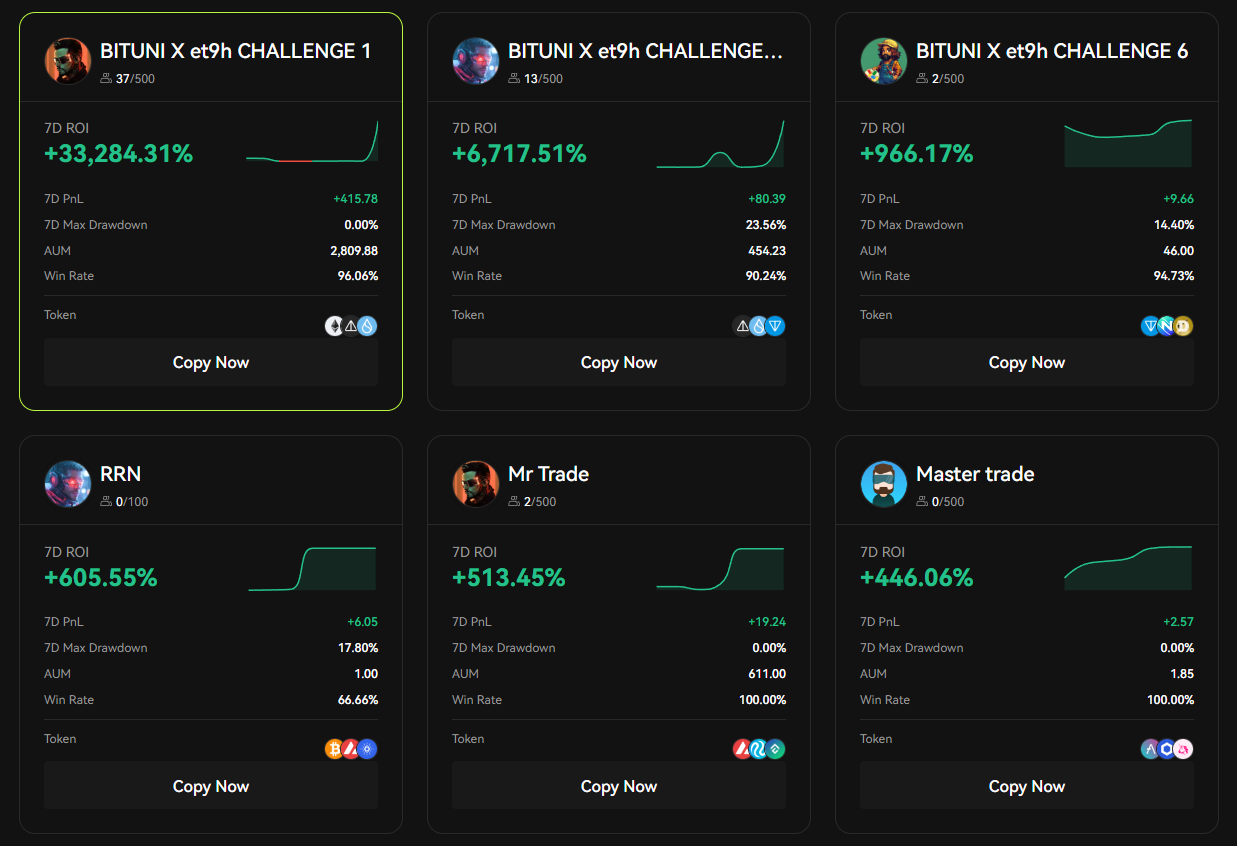
Bitunix Copy Square lets you compare lead traders on risk metrics, not just ROI.
Copy Trading Costs: What Followers Really Pay
On both exchanges, a follower pays normal Futures trading fees on each copied trade, funding on positions held past the funding time, and a profit share to the lead trader when the period ends in profit. The main difference is the profit-share rate.
| Bitunix | OKX |
Profit share | Default 10% | 10%–30% for Futures and Spot, set by each lead trader within their level's limit |
Settlement | Weekly, Monday 00:00 UTC | Weekly, Monday 00:00 UTC+8 |
Charged in a losing period | No | No |
Extra rules | Settlement postponed if it would trigger a liquidation | Ratio can change up to 3 times a month; Futures settlement waits until you hold no open copied positions from that lead trader |
Here is what that means in the same week. Say your copied trades make 500 USDT, minus 30 USDT in trading fees and 10 USDT in funding, leaving 460 USDT:
Profit-share ratio | Paid to lead trader | You keep |
10% (Bitunix default) | 46 USDT | 414 USDT |
20% | 92 USDT | 368 USDT |
30% (OKX top-level maximum) | 138 USDT | 322 USDT |
In a losing week, no profit share is charged on either platform, but trading fees and funding still apply. Always check the profit-share ratio on a lead trader's profile before you copy.
>>> See more: Bitunix Copy Trading Fees Explained: What Followers Pay
Becoming a Lead Trader: Requirements and Earnings
Both exchanges let skilled traders earn a share of their followers' profits. OKX offers a higher ceiling for established traders; Bitunix has a simple entry point for Futures traders building a following.
Lead trader rule | Bitunix | OKX |
How to apply | Copy Trading > Become a lead trader; reviewed by Bitunix | Lead trader application on OKX |
Requirements | Minimum 500 USDT initial copy trading amount | Completed identity verification; Futures or Advanced Multi-currency account mode; no active copy trades |
Copiers | Up to 100 per copy trading strategy | Depends on level; up to 1,700 for Futures at the top level |
Profit share | Default 10% | 10% to 30% by level; ratio can be changed up to 3 times a month |
Settlement | Weekly | Weekly |
Sources: Bitunix Futures Copy Trading Rules; OKX lead trader requirements and trader tiers.
On earnings, the math is simple. If your copiers have 50,000 USDT under management and make a net 5% in a week, that is 2,500 USDT of profit. At a 10% share, you earn 250 USDT for that week. At a 20% share, the same result pays 500 USDT.
OKX suits established lead traders who want a higher profit-share ceiling and the option to lead Spot or bot strategies. Bitunix suits Futures traders building a following, with a clear 500 USDT entry amount and room for up to 100 copiers per strategy.
Which Is the Best Crypto Exchange for You? Bitunix or OKX by Trader Type
The best crypto exchange depends on how you trade. Here is a quick match by trader type:
Trader type | Better fit | Why |
Active Futures trader | Bitunix | Ultra Chart Trading, Super Alert, VIP from 300 USDT |
Copy trading follower (Futures) | Bitunix | 10% default profit share, 10x copy leverage cap, optional strategy stop loss |
Established lead trader | OKX | Profit share up to 30%; Spot and bot strategies |
New Futures lead trader | Bitunix | 500 USDT entry amount, up to 100 copiers per strategy |
All-in-one user (options, Web3 wallet, Earn) | OKX | Broader product range under one account |
EU resident | OKX | MiCA authorization via Malta |
Active Futures traders get the most out of Bitunix. Ultra Chart Trading turns the chart into the order ticket: you place limit, conditional and trailing stop orders on the chart, drag TP/SL, and see liquidation, margin call and break-even levels before you commit. Multi-chart layouts let you watch several markets at once.
Super Alert does the watching for you. It offers price, indicator, candlestick, drawing, template and combo alerts, so you can set triggers on RSI or MACD, on candlestick patterns, or on your own support and resistance lines, and combine conditions in a Combo Alert to cut false signals. When one fires, you open the chart and the trade is one drag away.
OKX suits traders who want everything in one place. If you also trade options, use on-chain tools, or copy Spot and bot strategies, its wider product range is the main reason to choose it.
Conclusion
Bitunix vs OKX: Both are credible Binance alternatives, built for different traders. OKX is the broader platform: one account covers Spot, Futures, options, bots, Earn and a Web3 wallet, copy trading extends to Spot and bot strategies, and it publishes monthly Proof of Reserves reports. Its base Futures taker fee is also slightly lower.
Bitunix is the more focused choice for Futures. Ultra Chart Trading and Super Alert cover the full trade on one chart, from Spotting the setup to managing the exit, and its VIP 1 tier from 300 USDT brings Futures fees in line with OKX. Its copy trading comes with built-in limits: a default 10% profit share, a 10x leverage cap and an optional strategy stop loss.
In short, choose OKX if you want breadth under one account, and Bitunix if you want a sharper setup for Futures and Futures copy trading. Either way, check each platform's regulatory status in your region before you sign up.
Compare live fees and order books on the pairs you trade most, then pick the platform that matches your style.
>>> You may be interested: Bitunix vs. Bitget Review: Which Crypto Exchange is Right for You in 2026