Choosing between cross margin vs isolated margin is one of the first risk management decisions traders face when using crypto derivatives.
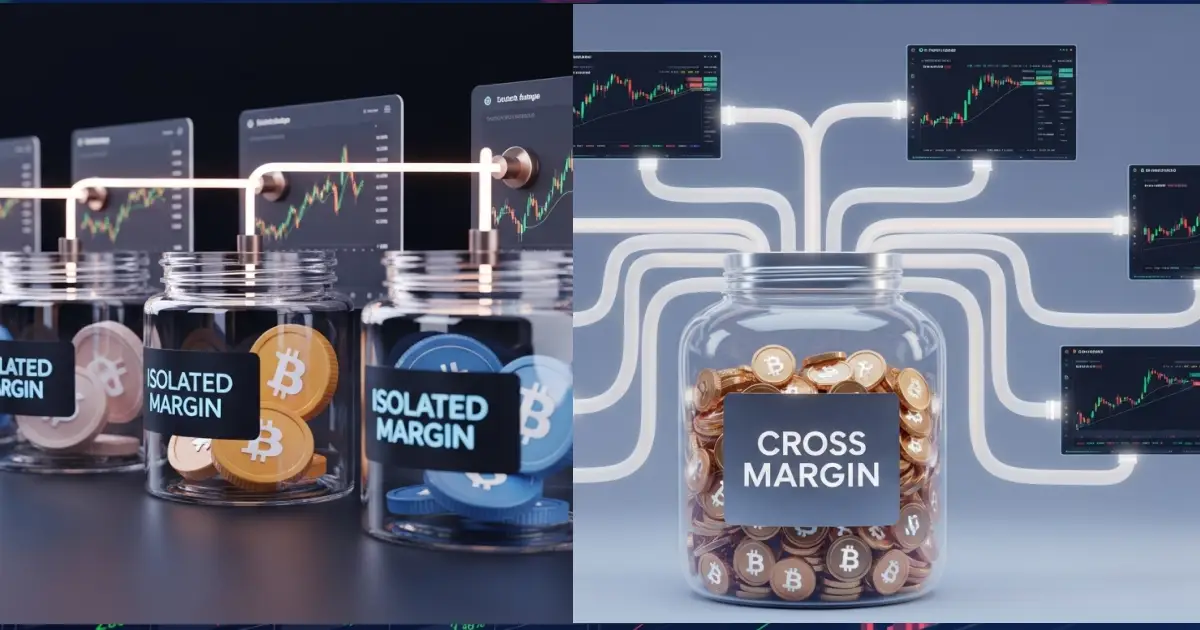
Cross margin shares available collateral across positions, while isolated margin assigns a fixed amount of collateral to a single position. The main difference is how each mode manages liquidation risk and capital allocation.
For traders, the right margin mode depends on factors such as position size, trading strategy, risk tolerance, and how actively they monitor their accounts.
This guide explains how cross margin and isolated margin work, their key differences, advantages and limitations, and how traders can choose the appropriate model for different scenarios.
What Is Cross Margin Trading?

Cross margin trading uses the available balance in a margin account as shared collateral for open positions.
Instead of assigning separate margin amounts to each trade, cross margin combines available funds into one margin pool. If one position experiences losses, the remaining account balance can help maintain the position before reaching liquidation conditions.
For example:
A trader has 5,000 USDT available in a futures account and opens several leveraged positions using cross margin. The entire available balance may be used to support those positions rather than limiting each trade to a separate margin amount.
Benefits of Cross Margin
Better capital efficiency when managing multiple positions.
Allows profits from one position to offset losses from another position.
Provides more flexibility for portfolio-level strategies.
Risks of Cross Margin
Losses from one position can affect the available margin supporting other positions.
Total account exposure can become harder to evaluate when multiple trades are open.
Poor risk management can lead to broader account-level losses.
When account equity falls below the required maintenance margin level, the platform may trigger a margin call or liquidation process.
Cross margin can be useful for traders managing multiple positions, but it requires careful monitoring of total exposure and available collateral.
What Is Isolated Margin Trading?

Isolated margin trading assigns a specific amount of collateral to an individual position.
Unlike cross margin, losses from one isolated position generally do not affect other open positions because each trade has its own margin allocation.
For example:
A trader opens a BTC/USDT position with 500 USDT of isolated margin. If the position reaches liquidation, the risk is limited to the margin assigned to that position rather than the trader’s entire futures account balance.
Benefits of Isolated Margin
Limits risk exposure to a single position.
Makes position-level risk easier to calculate.
Provides clearer control over how much collateral is allocated to each trade.
Risks of Isolated Margin
A position with insufficient margin may reach liquidation faster.
Traders cannot automatically use profits from other positions to support the trade.
Multiple positions require separate monitoring.
Isolated margin is commonly used by traders who prefer clearly defined risk limits for individual positions.
Cross Margin vs Isolated Margin: Key Differences

The main difference between cross margin and isolated margin is how collateral is allocated.
Feature | Cross Margin | Isolated Margin |
Collateral usage | Shared across multiple positions | Assigned to one specific position |
Risk exposure | Account-level exposure | Position-level exposure |
Liquidation impact | Multiple positions may be affected | Usually limited to the affected position |
Capital management | More flexible for portfolio strategies | More controlled for individual trades |
Risk monitoring | Requires tracking total account exposure | Easier to monitor individual position risk |
Neither mode is universally better. The appropriate choice depends on the trader’s strategy, account structure, and risk management approach.
How Margin Call Events Work in Crypto

A crypto margin call happens when your account equity falls below the required maintenance margin level. It signals that your position no longer has enough collateral support and may require action to avoid liquidation.
Margin calls are closely related to liquidation risk in leveraged trading. The exact process depends on the margin mode you use, because cross margin and isolated margin handle collateral differently.
Margin Call Process in Cross Margin
In cross margin trading, all available collateral in the account supports open positions.
When one position moves against you, the platform may use your remaining available margin to maintain the position. This gives traders more room before liquidation, but it also means losses from one trade can affect the entire account.
Example:
A trader has 5,000 USDT in a futures account and opens multiple positions using cross margin:
Position | Unrealized PnL | Impact |
BTC/USDT long | -$800 | Reduces total account equity |
ETH/USDT short | +$400 | Offsets part of the loss |
SOL/USDT long | -$500 | Further reduces available margin |
Because all positions share the same margin pool, the account’s overall margin ratio determines whether liquidation risk increases.
Margin Call Process in Isolated Margin
In isolated margin trading, each position has its own allocated collateral.
If one trade reaches liquidation conditions, only the margin assigned to that position is affected. Other open positions remain separate.
Example:
A trader opens a BTC/USDT isolated margin position with 500 USDT collateral. If the position reaches liquidation, the maximum loss is generally limited to that allocated margin amount.
This separation makes isolated margin easier for traders who want to define risk on a trade-by-trade basis.
Cross Margin vs Isolated Margin During Liquidation
Feature | Cross Margin | Isolated Margin |
Collateral source | Shared account margin | Assigned position margin |
Liquidation scope | Can affect multiple positions | Usually limited to one position |
Risk management style | Portfolio-level management | Individual trade management |
Monitoring difficulty | Higher with multiple positions | Simpler per position |
Understanding how margin calls work is one of the first steps toward managing leverage risk effectively.
Cross Margin vs Isolated Margin: Which One Should You Use?
The choice between cross margin and isolated margin depends on your trading strategy, position structure, and risk management preference. Neither margin mode removes risk, but each model solves a different trading problem.
Instead of asking which margin mode is universally better, traders usually consider how they manage positions.
When Cross Margin May Fit Better
Cross margin is commonly used by traders who:
Manage multiple positions at the same time
Use hedging strategies across related assets
Need flexible collateral allocation
Monitor their overall portfolio exposure regularly
For example, a trader holding BTC and ETH positions may use cross margin to allow gains and losses between positions to interact within the same margin account.
This approach can provide more flexibility, but it also requires stronger account-level risk management because a large loss in one position may affect available margin for other trades.
When Isolated Margin May Fit Better
Isolated margin is often preferred by traders who:
Want a clear maximum loss limit for each trade
Trade highly volatile assets
Prefer managing positions independently
Are still learning how leverage affects liquidation risk
For example, a trader opening a short-term altcoin position may choose isolated margin so the risk remains limited to the collateral assigned to that position.
The trade-off is that isolated margin requires more active position management. Traders need to monitor each position separately and adjust margin when necessary.
Why Traders Use Cross Margin

Cross margin remains popular among experienced derivatives traders because it provides greater flexibility when managing multiple positions.
Common reasons traders use cross margin include:
Better Capital Allocation Across Positions
Cross margin allows available collateral to support multiple trades instead of locking a fixed margin amount for each position.
This can be useful for portfolio strategies where positions are connected through hedging or market exposure management.
Easier Portfolio-Level Hedging
Traders managing correlated assets may use cross margin to balance exposure.
For example:
This approach requires continuous monitoring because all positions share the same margin pool.
More Flexibility During Market Volatility
During sharp market movements, cross margin can provide additional time before liquidation compared with isolated positions using the same initial collateral amount.
The extra flexibility comes with higher account-level exposure, so traders need to monitor margin ratio, leverage, and total position size carefully.
Why Traders Choose Isolated Margin
Isolated margin is popular among traders who prioritize position-level risk control.
Clear Risk Boundaries
The biggest advantage of isolated margin is that each position has separate collateral.
If a trade moves significantly against the trader, the loss is generally limited to the margin assigned to that position rather than affecting the entire account balance.
Easier Position Management
For traders managing several independent trades, isolated margin makes it easier to calculate:
How much capital is allocated to each position
How much risk each trade carries
Where liquidation levels may occur
Useful for High-Volatility Assets
Crypto markets can experience rapid price movements, especially among smaller-cap assets.
Some traders use isolated margin when trading these assets because a single position's liquidation does not automatically put other positions at risk.
Hybrid Margin Strategies: Using Both Models Together
Many experienced traders use both cross margin and isolated margin depending on the purpose of each position.
The decision does not always need to be either-or. Different margin modes can serve different roles within the same trading account.
Common examples include:
Strategy | Margin Mode Example | Reason |
Long-term hedge positions | Cross margin | Allows flexible collateral management |
Short-term speculative trades | Isolated margin | Limits risk to individual positions |
Multiple correlated assets | Cross margin | Helps manage combined exposure |
High-risk individual trades | Isolated margin | Creates clearer loss boundaries |
For example, a trader may use cross margin for BTC and ETH hedge positions while using isolated margin for smaller, higher-volatility assets.
The appropriate approach depends on how traders structure their positions and manage downside risk.
Tips to Manage Crypto Margin Call Risks
Margin trading requires continuous risk management. The margin mode you choose is only one part of controlling liquidation risk.
Consider these risk management practices:
Set a clear stop-loss plan before opening leveraged positions.
Monitor your margin ratio and liquidation price regularly.
Avoid using maximum leverage without understanding the potential impact.
Keep enough available margin to handle market fluctuations.
Use position sizing strategies that match your risk tolerance.
Understand how your exchange calculates maintenance margin requirements.
On Bitunix, traders can use features such as reduce-only orders to help manage existing positions without unintentionally increasing exposure.
No margin model can eliminate market risk. Understanding how collateral, leverage, and liquidation mechanisms work is essential before using leveraged products.
Cross Margin vs Isolated Margin: Which Margin Mode Fits Your Strategy?
There is no single margin mode that works for every crypto trader. Cross margin and isolated margin solve different risk management challenges, and the better choice depends on how you structure positions and manage exposure.
Cross margin focuses on account-level flexibility. It allows available collateral to support multiple positions, which can be useful for traders managing hedges or a broader portfolio.
Isolated margin focuses on position-level control. It separates collateral for each trade, making it easier to define risk limits and prevent one position from directly affecting others.
Factor | Cross Margin | Isolated Margin |
Main purpose | Flexible portfolio management | Individual trade risk control |
Collateral usage | Shared across positions | Assigned to one position |
Risk exposure | Account-level | Position-level |
Suitable for | Multi-position strategies and hedging | Defined-risk individual trades |
Management style | Requires monitoring total exposure | Requires monitoring each position |
A practical approach is to select the margin mode based on the purpose of each trade:
The margin mode itself does not determine trading success. Position sizing, leverage management, and risk controls remain the key factors when using crypto derivatives.
How Bitunix Supports Cross and Isolated Margin Trading
Bitunix provides both cross margin and isolated margin options for eligible futures contracts, allowing traders to choose a margin structure that matches their trading approach.
With margin mode selection, traders can manage how collateral is allocated before entering a position:
For traders who frequently adjust their strategies, understanding how each margin mode affects liquidation risk, available balance, and position management can help them make more informed decisions.
Before opening a leveraged position, traders should review:
For more details about leverage and margin mechanics, read our guide on crypto margin trading and learn how maintenance margin affects liquidation risk in leveraged positions.