In crypto markets, few price moves are as violent as a short squeeze. The basic idea is simple: when too many traders are positioned short and the price starts moving higher, some shorts close their positions to limit losses. Their buy orders can push the price higher, forcing more shorts to cover or get liquidated.
For traders tracking derivatives, this is where crypto funding rates become useful. Funding can reveal whether short positioning is becoming crowded, but it should be read alongside open interest, price action, liquidity, and liquidation data rather than treated as a standalone squeeze signal.
GameStop remains the most recognizable short-squeeze example in traditional markets. Crypto has its own version of the same market mechanism, amplified by perpetual futures, leverage, 24/7 trading, and automated liquidation systems.
Note: A short squeeze is a market-structure event, not a chart pattern. No indicator can predict exactly when one will start or how far it will run.
What Is a Short Squeeze in Crypto?

A crypto short squeeze happens when a sharp price increase forces short sellers to buy back their positions, creating additional buying pressure that can push the price even higher.
A short position benefits when an asset falls. If the price rises instead, the short position loses money. A trader may close manually, hit a stop-loss, or reach a liquidation threshold if leverage and margin conditions leave insufficient collateral.
Each short position that closes requires buying. When many positions are closed around the same time, those buy orders can reinforce the original price move.
The basic feedback loop looks like this:
Crowded shorts → upward price catalyst → short covering → more buying pressure → liquidations → more forced buying → price acceleration
This mechanism is particularly relevant in crypto derivatives markets. Binance describes rising open interest with weak price action, deeply negative perpetual funding, and a short-heavy long/short ratio as conditions that can increase squeeze risk.
Short Squeeze vs. Normal Price Increase
Not every sharp rally is a short squeeze.
A normal price increase can come from stronger spot demand, improving fundamentals, macroeconomic news, or fresh capital entering the market. A short squeeze adds another source of demand: short sellers being forced to buy.
The distinction matters because a squeeze can produce a move that is much faster than the underlying catalyst would normally justify. Once the pool of vulnerable shorts is reduced, that additional buying pressure can fade just as quickly.
Short Squeeze vs. Liquidation Cascade
The two terms are related but aren't identical.
A short squeeze specifically refers to rising prices forcing short positions to close, creating additional buying pressure.
A liquidation cascade is broader. It can involve large-scale forced closures on either side of the market. A short squeeze can form part of a larger liquidation event, but not every liquidation cascade is a short squeeze.
How Does a Crypto Short Squeeze Work?

A short squeeze usually develops through several stages rather than appearing from nowhere.
1. Short Positioning Builds
The first ingredient is a large pool of short exposure.
In crypto, open interest measures the total value or number of outstanding derivatives positions, depending on how the data provider reports it. Rising OI tells you that more derivatives exposure is being created, but OI by itself does not tell you whether the new positions are mostly long or short.
That distinction is important. Traders should combine OI with funding rates, long/short positioning data, price action, and other market information.
2. A Catalyst Pushes Price Higher
The squeeze needs an initial move against the crowded side.
Possible catalysts include:
Positive project or market news
Strong spot buying
A technical breakout above a widely watched level
Unexpected macroeconomic developments
Large orders entering a relatively thin market
The catalyst doesn't have to be dramatic. When positioning is already stretched, a relatively modest price move can be enough to put highly leveraged shorts under pressure. Binance similarly identifies concentrated short positioning, thin liquidity, and an upward catalyst as key conditions for a potential squeeze.
3. Short Sellers Start Covering
As the price rises, some traders close their shorts manually.
Closing a short requires a buy order. That adds demand to the market and can accelerate the upward move.
Other traders may have predefined stop-loss orders that are triggered as price reaches specific levels. During a fast market, those orders can also contribute to upward pressure.
4. Leveraged Shorts Reach Liquidation Levels
Highly leveraged positions have less room to absorb adverse price movement.
When a short position reaches its liquidation threshold, the exchange's liquidation system can close it automatically according to the platform's margin rules. The resulting buy-side flow can push price toward the next group of vulnerable positions.
This is where a squeeze can turn into a liquidation cascade.
5. The Feedback Loop Accelerates
More forced buying pushes price higher.
Higher prices pressure more shorts.
More shorts close or get liquidated.
The process repeats until the pool of vulnerable short positions is substantially reduced or fresh selling pressure overwhelms the buying flow.
Crypto's 24/7 market structure and widespread use of leveraged perpetual futures can make this process develop very quickly.
How to Detect Short Squeeze Risk Before It Happens
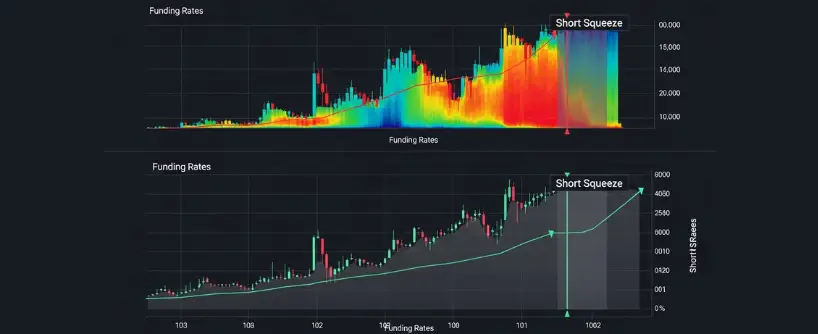
A squeeze cannot be predicted with certainty. What traders can do is identify conditions that make a squeeze more plausible.
The strongest setups usually involve several signals pointing in the same direction.
Rising Open Interest With Weak Price Action
Open interest becomes more informative when read together with price.
For example, if price remains stuck near support while derivatives OI continues to rise, the market may be accumulating more leveraged exposure without resolving the underlying directional pressure.
If the market then breaks upward and OI falls sharply while price rises, that can be consistent with short positions being closed or liquidated.
The key is the relationship between price and OI, not simply whether OI is high.
Negative Funding Rates
Funding rates on perpetual futures indicate which side of the market is paying the other side.
When funding is negative, shorts generally pay longs. Persistently or sharply negative funding can indicate that bearish positioning is crowded.
That makes negative funding useful when assessing squeeze risk, but it is not a timing signal by itself. A market can remain negatively funded for an extended period without producing a squeeze.
Bitunix's futures data also uses funding rates to show the balance between long and short positioning.
Long/Short Positioning
A heavily skewed long/short ratio can provide another view of market positioning.
If multiple derivatives indicators show strong short-side concentration while price refuses to make new lows, the market may be vulnerable to an upside reversal.
Still, ratios vary by data source and methodology. Treat them as context rather than a precise measure of total market exposure.
Technical Pressure
Price structure matters because short positions often cluster around obvious invalidation levels.
Watch for:
Repeated tests of support without a breakdown
Higher lows after an extended decline
A breakout above a well-defined resistance level
Increasing volume during an upside move
A resistance breakout is more informative when it occurs alongside a positioning imbalance. Technical price action alone doesn't prove a squeeze.
Liquidity and Order-Book Depth
Liquidity determines how much price can move when large buy orders hit the market.
When order-book depth is thin, forced short covering can have a larger price impact. Weekend sessions, smaller-cap assets, and periods of unusually low participation can therefore produce sharper moves.
This is one reason the same amount of forced buying can create a modest move in one market and a violent spike in another. Binance notes that thinner liquidity can amplify the effect of forced short covering.
Volume and Liquidation Data
A sharp price increase accompanied by unusually high volume and a rapid reduction in open interest can provide stronger evidence that positions are being closed.
Liquidation data can add another layer of confirmation.
A practical sequence to watch is:
Price rises + volume expands + OI falls + short liquidations increase
That combination is more informative than any single metric.
Whale and Spot Buying Activity
Large spot purchases can act as the initial catalyst for a squeeze, especially when derivatives positioning is already crowded.
On-chain transfers, exchange inflows/outflows, and large spot-market orders can provide useful context, but they should not be treated as proof that a particular trader or "whale" is about to trigger a squeeze.
A Practical Short Squeeze Checklist
Before interpreting a sharp upward move as a potential squeeze, check the market from several angles:
Signal | What to look for | What it may indicate |
Price | Breakout or sustained move higher | Initial pressure against shorts |
Open Interest | High OI, followed by a sharp decline during the rally | Positions may be closing |
Funding | Persistently negative funding | Crowded short positioning |
Volume | Sudden increase during the breakout | Stronger participation |
Liquidations | Short liquidations increase | Forced buying may be accelerating |
Liquidity | Thin order-book depth | Greater price impact |
Catalyst | News, spot buying, or technical breakout | Possible trigger |
The strongest signal is alignment. When several of these conditions appear together, squeeze risk may be elevated. None of them guarantees that a squeeze will occur.
How to Defend Against a Crypto Short Squeeze
If you're already short, the goal isn't to predict the exact top of the squeeze. It's to keep an adverse move from turning into an uncontrolled loss.

Use Position-Specific Risk Limits
Position size matters more than trying to find the perfect liquidation level.
A smaller short position gives you more room to withstand adverse price movement. Avoid sizing a trade around the maximum leverage available on the platform.
Understand Your Margin Mode
Isolated and cross margin behave differently.
With isolated margin, the margin assigned to a position is separated from other available account funds. Cross margin can use available account equity across positions according to the platform's rules.
Bitunix provides both margin approaches for futures trading, with isolated margin calculating position margin independently and cross margin sharing available margin across positions.
If a short squeeze is moving rapidly, knowing which margin mode you're using matters because it changes how much collateral is exposed to the position.
Keep Leverage Under Control
High leverage leaves less room for an adverse move before liquidation.
Bitunix currently supports leverage as high as 200x for BTC/USDT and ETH/USDT perpetual futures, while other contracts can have different limits. Maximum leverage is not a risk-management target.
Set an Exit Plan Before the Trade
A stop-loss can help define where a short thesis is no longer valid, but execution during a fast squeeze can differ from the trigger price because of slippage and market conditions.
Don't treat a stop as a guarantee of a specific exit price.
Watch Liquidation Levels
Liquidation heatmaps and similar tools can show areas where leveraged positions may be vulnerable.
They don't tell you exactly what will happen at a given price. Use them to identify potential pressure zones, then compare them with actual price, OI, volume, and liquidity data.
Avoid Adding to a Losing Short Without a Defined Rule
A squeeze can move much farther than expected.
Adding to a short simply because the price “looks too high” increases exposure precisely when the market is moving against you. If the original thesis has failed, increasing the position can turn a manageable loss into a much larger one.
How to Trade a Short Squeeze Without Chasing It

Short squeezes can create long-side opportunities, but trying to buy the exact start of a squeeze is difficult.
1. Build the Setup Before the Move
Look for a combination of:
Crowded short positioning
Negative funding
Elevated open interest
Price holding above important support
A potential catalyst
Sufficient liquidity to support the trade
This is a watchlist setup, not a signal to enter immediately.
2. Wait for Price Confirmation
Instead of assuming that negative funding will automatically lead to a squeeze, wait for evidence that buyers are actually taking control.
Examples include a resistance breakout, expanding volume, or a sustained move accompanied by falling OI.
3. Don't Chase a Vertical Candle
A squeeze can accelerate quickly, but that doesn't mean every late entry is attractive.
Once the most leveraged shorts have been closed, the forced-buying component of the move can weaken. Traders entering after a large vertical move face the risk of a sharp retracement.
4. Define Where the Trade Is Wrong
A squeeze trade still needs an invalidation point.
The fact that the market is moving quickly doesn't remove the need for position sizing, exit planning, or an assessment of slippage.
5. Take Partial Exposure Into Account
If a position is already profitable after a rapid move, reducing exposure can lower the amount of capital exposed to a reversal.
There is no reliable way to identify the exact top of a squeeze, so risk management matters more than trying to capture the final percentage of the move.
Historical Examples of Crypto Short Squeezes
Short squeezes have appeared across crypto market cycles, although not every large rally should be classified as one.
Bitcoin Short Squeezes
Bitcoin has experienced multiple periods in which heavily positioned derivatives markets were followed by rapid upward moves and large short liquidations.
More recent market data continues to show how funding rates, open interest, and liquidations can diverge during sharp BTC moves. Bitunix's 2026 market reports, for example, track OI-weighted funding rates alongside Bitcoin price to show how derivatives positioning can change during volatile periods.
Ethereum and Altcoin Squeezes
Ethereum and smaller-cap tokens can also experience squeeze dynamics.
Lower liquidity can make the price response more extreme when a large amount of leveraged short exposure needs to be closed. The effect can be particularly visible when derivatives OI is large relative to available spot liquidity.
GameStop as a Traditional-Market Reference
GameStop in January 2021 remains one of the best-known short squeezes in traditional markets.
The episode is useful for understanding the basic mechanism, but crypto markets have different trading structures. Crypto perpetual futures, automated liquidation engines, 24/7 trading, and funding rates create a different environment.
How Bitunix Features Support Short Squeeze Risk Management

When monitoring squeeze conditions, traders need market data and position-management tools that work together.
Bitunix's futures interface provides access to several of the metrics and controls relevant to squeeze analysis:
Funding Rate: Helps assess whether long or short positioning is paying funding.
Open Interest: Shows how much derivatives exposure remains in the market.
Liquidation and Position Data: Helps traders assess how leveraged positions are being affected by fast price moves.
Isolated Margin: Separates the margin assigned to an individual position under the platform's margin rules.
Stop-Loss and Take-Profit: Allows traders to define position-management rules before or during a trade.
Bitunix's current futures interface also displays funding rate and open interest alongside contract information, making them easier to monitor while trading.
These tools don't predict a squeeze. Their value is in helping traders see how positioning and risk are changing as the market moves.
Common Mistakes When Trading Short Squeezes
Treating Negative Funding as a Buy Signal
Negative funding means shorts are paying longs. It can indicate crowded bearish positioning, but crowded trades can remain crowded for a long time.
Assuming High Open Interest Means Shorts Are Trapped
OI measures outstanding derivatives exposure, not the exact direction of every position.
Always combine OI with funding, price action, long/short positioning, and liquidation data.
Confusing a Squeeze With a New Bull Market
A short squeeze can create a rapid rally without changing the longer-term trend.
Once forced short covering slows, price can retrace sharply.
Using Maximum Leverage
High leverage makes liquidation thresholds closer and reduces the amount of room available for normal market noise.
The availability of high leverage doesn't mean it is appropriate for a particular trade.
Chasing the Move After Liquidations Peak
A large liquidation event can mark intense forced positioning, but it doesn't automatically mean the price will continue higher.
The market can become more balanced once the most vulnerable shorts have exited.
Ignoring Liquidity
A squeeze can produce significant slippage when order-book depth is thin.
The price shown on the chart isn't necessarily the price at which a large position can be closed.
Short Squeeze vs. Long Squeeze
A short squeeze and a long squeeze are mirror-image market events.
Feature | Short Squeeze | Long Squeeze |
Initial move | Price rises | Price falls |
Crowded position | Shorts | Longs |
Forced closure | Short positions buy | Long positions sell |
Price pressure | More buying | More selling |
Typical signal | Negative funding + short crowding | Positive funding + long crowding |
Cascade direction | Upward | Downward |
Understanding both sides helps traders avoid looking at a single market move in isolation.
Conclusion
A crypto short squeeze is driven by a simple market mechanism with potentially extreme consequences: short positioning meets upward price pressure, forced buying follows, and the move can feed on itself.
The most useful way to analyze squeeze risk is to look beyond a single indicator. Negative funding can reveal crowded shorts. Open interest shows how much derivatives exposure is sitting in the market. Price, volume, liquidity, and liquidation data help determine whether that positioning is actually being unwound.
For traders holding shorts, the priority is controlling exposure before the market moves against them. For traders watching for upside opportunities, the challenge is avoiding the assumption that every crowded short market will squeeze.
Understanding the mechanics doesn't make a squeeze predictable. It does make the market's behavior easier to read when positioning starts to unwind.