Buying Bitcoin on the spot market and opening a Bitcoin futures position may look similar on a trading screen, but they involve two fundamentally different transactions. In spot trading, you purchase the actual cryptocurrency. In derivatives trading, you hold a financial contract whose value is linked to the underlying asset.
The difference affects more than ownership. It determines how much capital you need, whether you can take positions in both rising and falling markets, what costs you may incur while holding a position, and how your exposure changes when leverage is involved.
For beginners, understanding these differences is an important first step before choosing a crypto trading method.
What Is Spot Trading in Crypto?
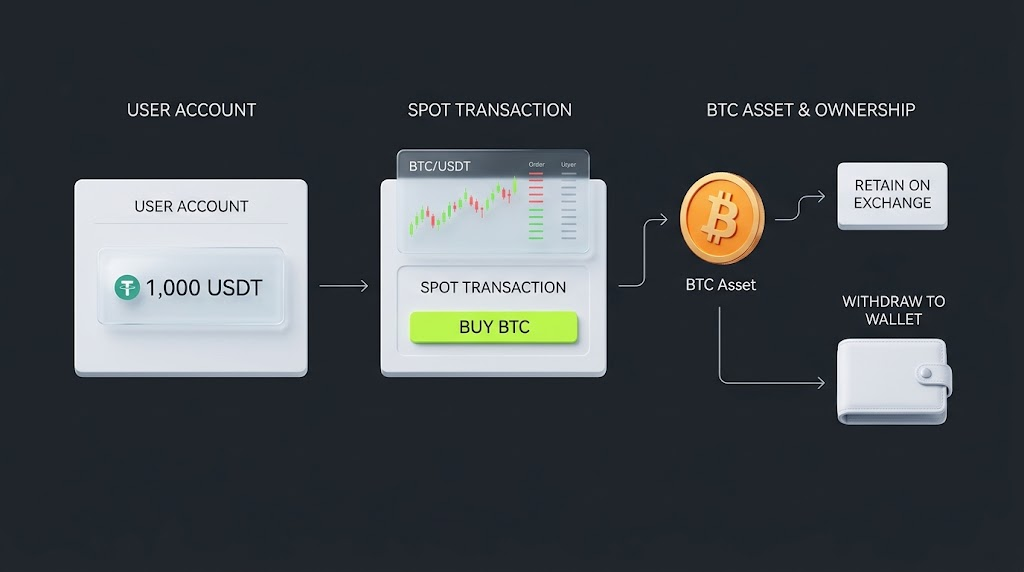
Crypto spot trading allows users to buy and own digital assets, which can be held on an exchange or withdrawn to a personal wallet.
Spot trading is the direct buying and selling of cryptocurrencies at current market prices. When you buy BTC with USDT on a spot market, you exchange one asset for another and receive the corresponding BTC once the transaction is completed.
For example, if Bitcoin trades at $60,000 and you spend $1,000 to buy BTC, you receive approximately 0.01667 BTC, excluding trading fees and execution differences.
You now hold the purchased Bitcoin rather than a contract tracking its price. You can keep it in your exchange account, transfer it to a personal wallet, or sell it later.
How Spot Trading Works
A typical spot trade follows a straightforward process:
Select a cryptocurrency trading pair, such as BTC/USDT.
Choose whether to buy or sell the asset.
Enter the order quantity or amount.
Submit the order at the market price or specify a limit price.
Once executed, the purchased asset is credited to your spot account.
The process is relatively easy to understand because the transaction involves exchanging assets directly rather than managing a derivative contract.
One important distinction concerns custody. Buying cryptocurrency on a centralized exchange does not automatically mean the asset is transferred to your personal wallet. It is generally held within your exchange account until you withdraw it. If you transfer it to a self-custody wallet, you take responsibility for managing the wallet's private keys and security.
Advantages of Spot Trading
Spot trading offers several practical advantages:
Direct asset ownership: You hold the cryptocurrency you purchase and can transfer or use it according to the asset's supported functions.
Straightforward mechanics: There is no need to manage futures expiration, funding payments, or margin requirements in ordinary unleveraged spot trading.
No leveraged liquidation: A standard spot purchase does not face liquidation simply because the market price falls. The asset can still lose substantial value, including potentially its entire market value.
Suitable for longer holding periods: Traders who want exposure to an asset over time can hold their purchased cryptocurrency without maintaining a leveraged position.
These features make spot trading a common starting point for people who are learning how cryptocurrency markets work.
Limitations of Spot Trading
Spot trading also has limitations.
First, buying cryptocurrency requires paying its full purchase value upfront. If you want to buy $5,000 worth of BTC, you generally need $5,000 in available funds, excluding fees.
Second, an ordinary spot purchase benefits primarily from an increase in the asset's price. If BTC falls after you buy it, the value of your holdings declines. Selling an asset you already own can realize a loss, but taking a short position through spot trading generally requires additional mechanisms, such as borrowing or margin trading.
Finally, owning cryptocurrency does not remove market or custody risks. Prices can fluctuate sharply, and assets held on an exchange remain subject to the exchange's operational and custody arrangements.
What Is Derivatives Trading in Crypto?
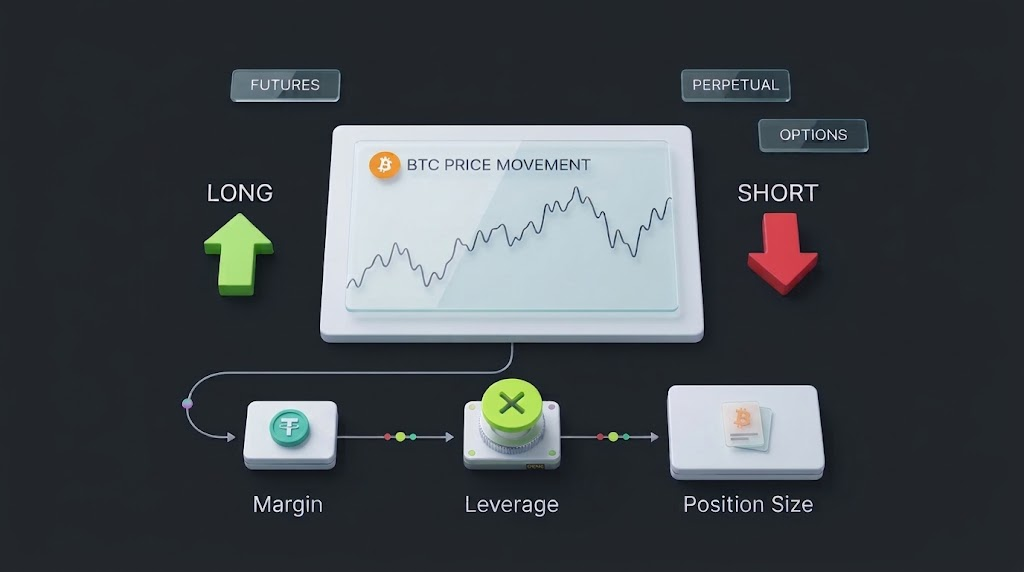
Crypto derivatives let traders gain exposure to price movements through contracts, including long and short positions, without directly owning the underlying asset.
Crypto derivatives trading involves buying and selling financial contracts whose value is derived from an underlying cryptocurrency, such as Bitcoin or Ethereum.
Unlike spot trading, you do not need to purchase or hold the underlying cryptocurrency to gain exposure to its price movements. Your profit or loss depends on how the derivative's price changes relative to your entry price and the terms of the contract.
For example, a trader who expects BTC to rise can open a long futures position. If BTC falls instead, the position loses value. A trader who expects BTC to decline can open a short position and potentially benefit from a downward price movement.
Derivatives are not limited to leveraged futures. Different instruments have different settlement rules, obligations, and risk profiles.
Common Types of Crypto Derivatives
1. Futures
A futures contract is an agreement based on the future price of an underlying asset. Traditional dated futures have specified expiration dates and settlement terms. Traders can close a position before expiration or hold it until settlement, depending on the contract.
2. Perpetual Futures
Perpetual futures are a type of futures contract without a fixed expiration date. They are widely used in crypto markets because traders can maintain positions without rolling into a new dated contract.
Perpetual futures use a funding rate mechanism to help keep the contract price aligned with the underlying spot market or reference price. Depending on the funding rate and position direction, traders may pay or receive funding payments at scheduled intervals.
3. Options
Crypto options give the buyer the right, but not the obligation, to buy or sell an underlying asset at a specified price within a defined period or at expiration, depending on the contract.
Unlike futures, an option buyer's maximum loss is generally limited to the premium paid for the option. Option sellers have different and potentially greater obligations and risk exposure.
These instruments serve different purposes. Before trading any derivative, users should understand its contract specifications, settlement method, expiration rules, and potential costs.
Spot vs. Derivatives Trading: Key Differences
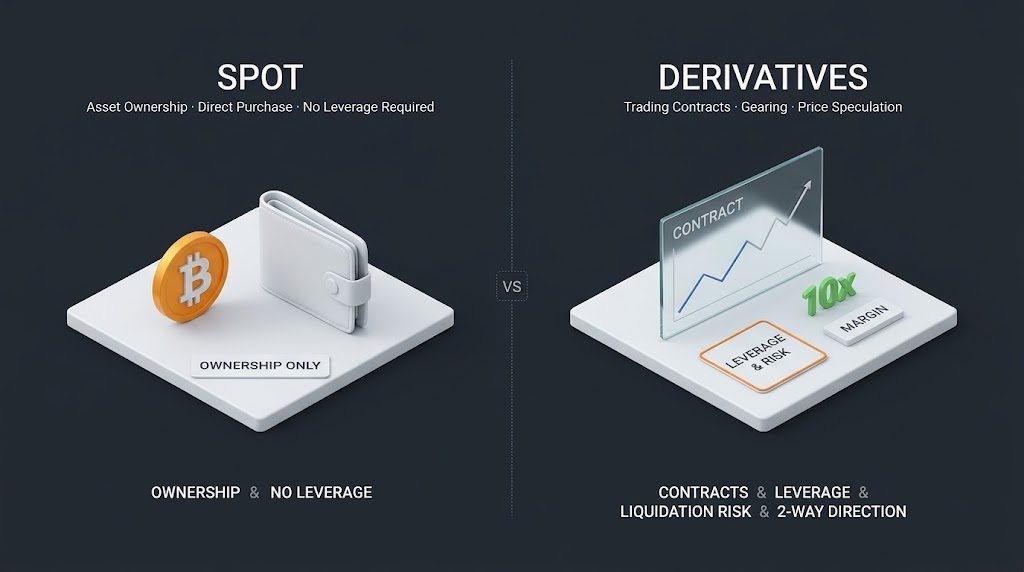
Spot and derivatives trading differ in asset ownership, leverage, market exposure, and risk management.
The most important difference is that spot trading involves the underlying cryptocurrency, while derivatives trading involves a contract linked to its price.
The following comparison highlights how that distinction affects the trading experience.
Trading Feature | Spot Trading | Derivatives Trading |
Asset ownership | You purchase and hold the underlying cryptocurrency | You hold a contract linked to the asset's price |
Capital requirements | Generally requires the full purchase value | May require only a portion of the position value as margin |
Leverage | Not inherent in ordinary spot trading | Common in leveraged futures trading |
Market direction | Ordinary spot buying benefits from rising prices | Long and short positions can provide exposure to rising or falling prices |
Liquidation | No leveraged position liquidation in standard spot trading | Leveraged positions may be liquidated if margin becomes insufficient |
Trading costs | Trading fees, spreads, and possible withdrawal costs | Trading fees, spreads, funding payments for perpetuals, and other contract-specific costs |
Expiration | No contract expiration | Dated futures and options have expiration rules; perpetual futures do not have a fixed expiry |
Common use cases | Buying, holding, and transferring cryptocurrency | Speculation, hedging, and managing price exposure |
Neither method is automatically better in every situation. Spot trading provides direct exposure to the asset, while derivatives offer more ways to manage or express a view on price movements.
The appropriate choice depends on what you want to achieve and how well you understand the associated risks.
How Do Spot and Derivatives Trading Affect Your Potential PnL?
One of the clearest ways to understand the difference is to compare how the same market movement affects two positions.
Suppose Bitcoin is trading at $60,000. A trader has $1,000 available and expects BTC to rise by 5%.
Example 1: Buying Bitcoin Through Spot Trading
The trader uses the full $1,000 to purchase BTC.
Initial capital: $1,000
BTC purchase price: $60,000
Position size: Approximately 0.01667 BTC
BTC price after the move: $63,000
The BTC holdings are now worth approximately $1,050.
Profit: $50, or 5% of the initial capital.
If BTC falls by 5% instead, the holdings would be worth approximately $950, resulting in a $50 loss.
Example 2: Opening a Leveraged Futures Position
Now suppose the trader uses the same $1,000 as initial margin to open a BTC futures position with 5x leverage.
The position's approximate profit is $250 before trading fees, funding payments, and other adjustments.
If BTC falls by 5% instead, the approximate loss is also $250.
Metric | Spot Position | Futures Position |
Initial capital / margin | $1,000 | $1,000 |
Market exposure | $1,000 | $5,000 |
Leverage | 1x | 5x |
PnL after a 5% increase | +$50 | +$250 |
PnL after a 5% decrease | -$50 | -$250 |
The comparison illustrates how leverage increases exposure relative to the capital committed to a position. A 5% price movement produces a larger percentage gain or loss on the futures margin.
This is also why leveraged trading requires careful position sizing. A relatively small adverse market move can consume a significant portion of the margin supporting a futures position.
The example is simplified and assumes the position tracks BTC's price movement directly. Actual results depend on contract specifications, execution prices, fees, funding payments, and margin requirements. Liquidation can also occur before the entire initial margin is lost.
Pros and Cons of Spot vs. Derivatives Trading
Both trading methods offer different advantages. Understanding their limitations is just as important as understanding what they can do.
Advantages and Limitations of Spot Trading
Advantages
Direct ownership of the purchased cryptocurrency.
Relatively simple buying and selling process.
No leverage or margin requirements in standard spot trading.
No leveraged position liquidation mechanism.
Suitable for traders who want to hold assets over longer periods.
Limitations
Requires the full purchase value upfront in ordinary spot trading.
Buying and holding generally benefits from rising prices rather than falling markets.
Asset values can decline substantially during market downturns.
Exchange custody and wallet security require consideration.
Low-liquidity trading pairs may experience wider spreads and greater slippage.
Spot trading is generally easier to understand, but simplicity does not eliminate the risk of losing money when cryptocurrency prices fall.
Advantages and Risks of Derivatives Trading
Advantages
Provides exposure to cryptocurrency prices without directly purchasing the underlying asset.
Supports both long and short positions.
Leverage can increase market exposure relative to the margin committed.
Can be used to hedge existing cryptocurrency holdings.
Offers different instruments and strategies for managing market exposure.
Risks
Leverage amplifies losses as well as gains.
Insufficient margin can lead to forced liquidation.
Perpetual futures may involve recurring funding payments.
Dated contracts and options have expiration-related considerations.
More complex contract mechanics require additional knowledge and risk management.
The U.S. Commodity Futures Trading Commission (CFTC) warns that leverage can amplify the risks of virtual currency futures trading and that losses may exceed the initial investment in certain leveraged account structures. The actual loss limits depend on the product, platform, and applicable account rules.
Is Spot or Derivatives Trading Better for Beginners?
For most people who are new to cryptocurrency trading, spot trading is generally the simpler place to start. It involves fewer moving parts and allows beginners to understand price movements, order execution, and asset management without first learning how leverage and margin work.
That does not mean derivatives are unsuitable for every beginner. It means they require a stronger understanding of the risks before a trader opens a position.
When Spot Trading May Be More Suitable
Spot trading may be a better fit if you:
Want to buy and hold cryptocurrencies rather than trade short-term price movements.
Prefer direct exposure to an asset without using leverage.
Are still learning how market orders, limit orders, and trading pairs work.
Want to avoid the liquidation mechanism associated with leveraged positions.
Have a longer investment horizon and can tolerate price volatility.
For example, someone who wants to accumulate BTC over time may find spot purchases more straightforward than managing a leveraged futures position.
When Derivatives Trading May Be Appropriate
Derivatives may be worth exploring if you:
Understand how futures contracts, margin, and leverage work.
Want to trade both rising and falling markets.
Need to hedge an existing cryptocurrency position.
Have a defined trading plan and understand how to manage potential losses.
Can monitor positions and account for fees, funding, and liquidation requirements.
For example, a trader holding BTC in a spot account may open a short BTC futures position to offset some downside exposure. This is a form of hedging, although the effectiveness of the hedge depends on position size, price correlation, contract specifications, and execution.
Beginners interested in learning futures mechanics should first understand how crypto futures trading works before considering leveraged positions.
How to Choose Between Spot and Derivatives Trading
Choosing between spot and derivatives trading becomes easier when you start with your objective rather than the potential return.
Consider the following questions before deciding:
1. Do you want to own cryptocurrency or trade its price movements?
If you want to purchase BTC and hold it, spot trading provides direct exposure to the asset. If you want to speculate on price changes without purchasing BTC itself, derivatives may be more relevant.
2. How much capital are you prepared to commit?
Ordinary spot trading generally requires the full purchase value. Leveraged derivatives can provide larger exposure with less initial margin, but this does not make the position less risky.
3. Do you understand the risks of leverage and liquidation?
If you cannot explain how margin, maintenance margin, and liquidation work, avoid opening leveraged positions until you understand these mechanisms.
You can review how liquidation prices are calculated in crypto futures trading to understand why margin management matters.
4. How long do you plan to hold the position?
Spot assets can be held without a futures expiration date or recurring perpetual funding payments. Derivatives have additional considerations, such as funding for perpetual futures or expiration for dated futures and options.
5. Do you have a clear risk-management plan?
Before entering any trade, determine your position size, acceptable loss, and exit conditions. A trading method should fit your ability to manage its risks, not just the amount of exposure it offers.
There is no single trading method that works best for everyone. The better choice is the one whose mechanics, costs, and risks you understand and can manage.