Perpetual futures are crypto derivatives that let traders take long or short exposure without owning the underlying asset. The key difference from traditional futures is simple: there is no fixed expiration date.
Because a perpetual contract never reaches a scheduled expiry, it needs another mechanism to keep its price close to the underlying spot market. That mechanism is the funding rate. Settlement, margin, mark price, and liquidation rules then determine how the position's profit, loss, and collateral are handled while it remains open.
What Are Perpetual Futures?

Perpetual futures, also called perpetual contracts or perps, are derivatives that track the price of an underlying asset without a fixed expiration date.
A trader doesn't receive the underlying BTC simply by opening a Bitcoin perpetual position. Instead, the position gains or loses value as the contract price changes, subject to the exchange's margin, funding, and liquidation rules.
The main characteristics are:
No fixed expiry: A position can remain open indefinitely if margin requirements continue to be met.
Long and short exposure: Traders can take positions that benefit from either rising or falling prices.
Margin and leverage: Traders post collateral rather than paying the full notional value of the position.
Funding payments: Long and short holders periodically exchange payments to help keep the perpetual price aligned with the underlying market.
Continuous trading: Crypto perpetual markets are generally designed for continuous trading rather than fixed settlement calendars.
The no-expiry design is what makes the funding mechanism necessary. Traditional futures have an expiration date, and the contract price normally converges toward the underlying asset as settlement approaches. A perpetual has no such deadline, so funding provides an ongoing economic incentive for the contract price to stay close to spot.
How Do Perpetual Futures Work?
A perpetual future combines margin-based exposure with a funding mechanism that helps keep its contract price close to the underlying spot market.
Consider a simple BTC perpetual position:
A trader deposits margin.
The trader opens a long or short position.
The position's unrealized profit or loss changes as the contract's mark price moves.
Funding is periodically calculated according to the venue's rules.
The trader either pays or receives funding when the relevant funding event occurs.
If available margin falls below the required threshold, the position may be liquidated.
This process continues until the trader closes the position, the contract is delisted, or the venue's risk engine closes the position.
Long and Short Positions
A long position generally benefits when the perpetual contract price rises.
A short position generally benefits when the perpetual contract price falls.
For example, suppose a trader opens a $10,000 BTC perpetual position with $2,000 of margin. The trader controls $10,000 of notional exposure, but the $10,000 position does not mean the trader owns $10,000 worth of BTC.
If BTC moves 5% in the trader's favor, the position's gross P&L would be approximately $500 before funding, fees, and other adjustments. A 5% move against the position would produce an approximately $500 loss.
The actual liquidation point depends on the venue's margin model, leverage, maintenance margin, fees, and other risk parameters.
The Role of Funding Rates

Funding is the mechanism that helps a perpetual contract stay anchored to its underlying market because the contract itself has no expiration date.
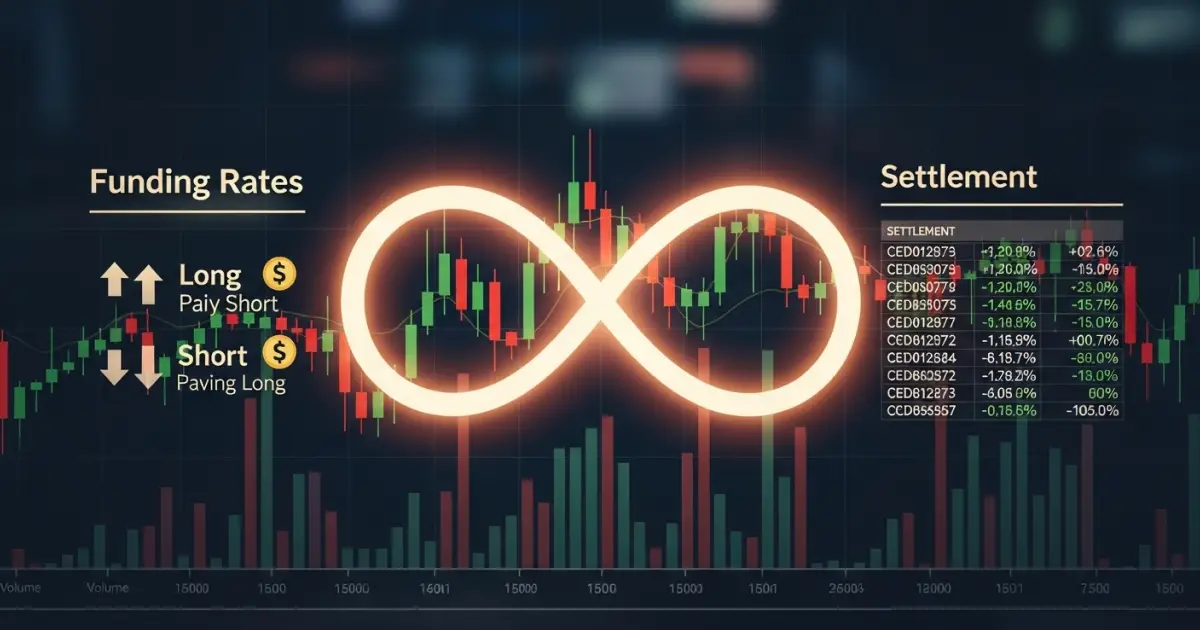
When the perpetual trades above the relevant spot reference, funding will generally be positive. Long position holders pay short position holders.
When the perpetual trades below the reference, funding will generally be negative. Short position holders pay long position holders.
Perpetual vs. Spot | Typical Funding Direction | Who Pays? |
Perpetual trades above spot | Positive | Longs pay shorts |
Perpetual trades below spot | Negative | Shorts pay longs |
The payment is generally transferred between traders rather than collected as a normal exchange trading fee.
Why Does Funding Keep Perpetuals Close to Spot?
The mechanism is based on incentives.
If a perpetual trades at a persistent premium to spot, positive funding makes it more expensive for traders holding long positions. This can encourage some traders to reduce long exposure while creating an incentive for the short side to participate.
If the perpetual trades below spot, negative funding shifts the payment in the opposite direction.
Arbitrage traders can also take opposing positions in spot and perpetual markets when the pricing difference is large enough to justify the costs and risks. This activity can help push the two markets back toward alignment. Kraken and Coinbase both describe funding as a mechanism designed to keep perpetual prices anchored to their underlying spot markets.
Funding doesn't guarantee that the perpetual and spot prices will match at every moment. During volatile or illiquid markets, temporary differences can still occur.
How Is the Perpetual Funding Rate Calculated?
There is no single funding-rate formula used by every crypto exchange.
The exact calculation can depend on the exchange, contract, underlying index, interest-rate component, premium calculation, funding cap, and funding interval. Coinbase, for example, currently calculates some international perpetual funding rates hourly, while Kraken uses different funding intervals depending on product and region.
A simplified representation is:
Funding Payment = Position Notional × Funding Rate
For example:
If the trader holds a long position and the funding rate is positive, the $1 payment would generally be paid to the short side at the applicable funding event.
The calculation above is intentionally simplified. Actual funding calculations can use mark prices, index prices, premium components, interest-rate assumptions, caps, floors, or other venue-specific rules.
Funding Intervals Are Not Universal
The original version of this article stated that funding occurs every eight hours on most exchanges, including Bitunix.
That statement is too broad for a 2026 evergreen guide.
Funding schedules differ across platforms and products. Coinbase International Exchange currently applies funding hourly, while Kraken's June 2026 guide states that its funding interval is eight hours for U.S. clients and one hour for clients in the EEA and other regions.
Always check the specific contract's funding interval before calculating the expected holding cost.
A displayed funding rate is only meaningful when its time interval is known.
For example, 0.01% every eight hours and 0.01% every hour are very different holding costs.
A Simple Funding Cost Example
Suppose a trader holds a $20,000 BTC perpetual position and the applicable funding rate is +0.01%.
The simplified funding payment would be:
$20,000 × 0.01% = $2
If the same rate remained unchanged for three eight-hour funding events, the cumulative payment would be approximately $6.
This is an illustration, not a forecast. Funding rates change over time, and the actual amount can depend on the venue's calculation method, position notional, mark price, and funding schedule.
The key point is that funding is calculated on position exposure, not simply on the amount of margin deposited.
A trader using more leverage may post less initial margin while still carrying a large notional position. That can make funding costs meaningful relative to the trader's actual collateral.
Settlement in Perpetual Futures

The word settlement can be confusing when discussing perpetual futures.
Traditional futures have a scheduled expiration and final settlement. Perpetual futures don't normally have that expiry event. Instead, the position is continuously marked to market, while funding payments occur according to the contract's schedule.
In practical terms:
Unrealized P&L changes: The position's value changes as the relevant mark price moves.
Margin is monitored: The account must maintain enough collateral under the venue's rules.
Funding is exchanged: The applicable funding payment is credited or debited at scheduled intervals.
Liquidation can occur: If the position no longer meets the required margin conditions, the venue's risk engine can close it.
This is why "perpetual futures settle continuously" is useful as a shorthand, but it shouldn't be interpreted as meaning every gain or loss is immediately withdrawn as cash. The exact treatment of realized P&L, unrealized P&L, funding, and margin depends on the platform.
Mark Price, Index Price, and Perpetual Price
One detail that often gets skipped in beginner guides is that a perpetual trading interface may show several different prices.
Price | Main Purpose |
Index Price | Reference price derived from the underlying spot market or a basket of spot markets. |
Perpetual/Last Price | The price at which the derivative is currently trading or was last traded. |
Mark Price | A risk-management reference commonly used for unrealized P&L and liquidation calculations. |
The exact construction of each price varies by venue.
This distinction matters during volatile markets. A trader might see the last traded price move sharply while the mark price used by the liquidation engine follows a different calculation.
Before opening a leveraged perpetual position, traders should understand which price the platform uses to calculate P&L, funding, and liquidation.
Funding Rate vs. Settlement: What's the Difference?
Funding and settlement solve different problems.
Funding is a price-alignment mechanism. Settlement describes how the financial obligations of a derivative position are accounted for.
Feature | Perpetual Futures | Traditional Futures |
Expiration | No normal expiry | Fixed expiration date |
Price alignment | Funding mechanism | Convergence toward expiry |
Funding payments | Yes, depending on contract | Generally no perpetual-style funding |
Position rollover | Not normally required | May be required to maintain exposure |
Margin monitoring | Continuous | Continuous, subject to contract rules |
Final settlement event | No normal expiry settlement | Yes |
This difference is the core reason perpetual futures became so widely used in crypto. Traders can maintain exposure without repeatedly closing an expiring contract and opening another one.
Why Funding Rates Matter to Traders
Funding isn't just a cost displayed beside a trading pair. It can also provide information about positioning in the perpetual market.
Funding as a Market Positioning Signal
Persistently positive funding can indicate that long exposure is expensive and that demand for perpetual longs is strong.
Persistently negative funding can indicate stronger demand for short exposure.
But funding should not be treated as a standalone market-direction indicator.
Coinbase Institutional's research notes that funding can provide information about positioning, while also pointing out that funding rates can be affected by base interest-rate components and exchange-specific calculation rules. It also found that funding changes can sometimes follow market momentum rather than lead it.
A better approach is to read funding alongside:
Open interest: How much derivative exposure remains open.
Price: Whether the market is trending or consolidating.
Volume: Whether participation is expanding or fading.
Basis: How dated futures are priced relative to spot.
Liquidations: Whether leveraged positions are being forced out.
Market liquidity: Whether relatively small orders can move price.
A high positive funding rate with rising open interest and accelerating price may describe a crowded long market. It doesn't automatically mean a reversal is coming.
Funding Rate Arbitrage and Delta-Neutral Strategies
One common use of funding data is delta-neutral arbitrage.
A simplified example:
A trader buys BTC in the spot market.
The trader opens a short BTC perpetual position with similar notional exposure.
The spot position gains when BTC rises while the short derivative loses, largely offsetting directional exposure.
If the perpetual funding rate is positive, the short position may receive funding.
The trader's return then depends on funding received, trading costs, basis changes, execution, collateral requirements, and other risks.
The objective is to reduce directional BTC exposure rather than simply bet on Bitcoin rising or falling.
Kraken's 2026 perpetual futures guide specifically describes delta-neutral arbitrage as a strategy that can use opposing spot and perpetual positions to capture pricing differences and funding payments.
This isn't free money. Funding can turn negative, spreads can change, execution can fail, and the two legs can carry different liquidity or counterparty risks.
Why Funding Costs Can Matter More Over Time

A small funding rate can look insignificant when viewed over one payment.
The picture changes when a position remains open for weeks or months.
For a $50,000 notional position:
0.005% funding = $2.50 per applicable funding event
0.01% funding = $5 per applicable funding event
0.05% funding = $25 per applicable funding event
Those figures aren't forecasts because the funding rate can change between payment events.
The practical lesson is simple: when evaluating a perpetual position, don't look only at the entry price. Estimate the potential funding drag relative to the position size and expected holding period.
Advantages of Perpetual Futures

Perpetual futures have several structural advantages:
No normal expiry: Traders don't need to roll a position simply because a calendar date has arrived.
Long and short exposure: The same contract can be used for directional positioning or hedging.
Capital efficiency: Margin allows traders to control a position without paying its full notional value upfront.
Continuous access: Crypto perpetual markets are designed around a market that trades around the clock.
Deep market participation: Perpetuals have become a central part of crypto derivatives markets. Chainalysis reported in January 2026 that perpetual futures often account for the majority of crypto derivatives trading volume.
These advantages explain their popularity, but they don't remove the risks created by leverage, funding, liquidation, or venue-specific rules.
Risks of Perpetual Futures
Perpetual futures introduce several risks that aren't present in the same form when simply holding the underlying asset.
Funding Cost Risk
A position can lose money through funding even when the underlying price barely changes.
This is especially relevant when funding remains elevated for an extended period.
Liquidation Risk
Leverage means a relatively small adverse price move can have a large effect on account equity.
If margin falls below the venue's maintenance requirement, the position can be automatically closed.
Volatility Risk
Crypto prices can move rapidly. During sharp market moves, spreads can widen and execution conditions can change.
Venue and Counterparty Risk
A perpetual position is governed by the exchange or protocol's margin engine, price sources, insurance mechanisms, and other rules.
Traders should understand what happens during extreme volatility, including how liquidation, auto-deleveraging, insurance funds, and negative balances are handled where applicable.
Funding Formula Risk
The funding number shown on one platform isn't necessarily comparable with the number shown on another.
Different calculation methods and intervals can produce very different effective holding costs.
Perpetual Futures vs. Traditional Futures
The biggest difference is the way each contract keeps its price connected to the underlying asset.
Traditional futures have an expiration date. As that date approaches, the contract naturally moves toward final settlement.
Perpetual futures remove the expiration date and replace that anchoring mechanism with funding.
Factor | Traditional Futures | Perpetual Futures |
Expiry | Fixed | None under normal contract design |
Price convergence | Expiry and settlement | Funding mechanism |
Funding payments | No perpetual funding mechanism | Periodic funding |
Holding exposure | May require rolling | No normal rollover |
Main ongoing consideration | Basis and rollover | Funding and margin |
Typical use cases | Hedging, basis trades, event-specific exposure | Active trading, hedging, arbitrage |
The two products aren't interchangeable in every strategy. A trader holding exposure for a specific calendar period may prefer a dated future because the expiration is known. A trader who doesn't want a rollover date may prefer a perpetual.
How Bitunix Supports Perpetual Futures Trading
Bitunix provides tools that help traders monitor perpetual positions and manage the mechanics discussed above.
These include:
Funding rate information: Traders can monitor applicable funding data through the trading interface.
Adjustable leverage: Position exposure can be configured according to the trader's margin and risk parameters.
TradingView charts: Price action can be analyzed across multiple timeframes.
Order types: Stop and conditional orders can be used as part of a broader risk-management plan.
Mobile access: Positions and market information can be monitored while away from a desktop.
Product specifications such as funding intervals, leverage limits, eligible markets, and risk controls can change. Traders should check the current contract information before opening a position.
How to Manage Funding Costs in Perpetual Futures
A practical funding checklist can help prevent a small recurring cost from becoming an overlooked drag on a position.
1. Check the Current Funding Rate
Look at the current rate and the next estimated rate where available.
Don't assume the current number will remain unchanged.
2. Check the Funding Interval
A 0.01% rate means something very different when it applies hourly versus every eight hours.
Always read the interval alongside the rate.
3. Calculate Funding Against Notional
Use the position's notional value rather than only the margin deposited.
Estimated Funding = Position Notional × Funding Rate
4. Consider the Holding Period
A funding payment that looks small for one interval can become material over weeks of exposure.
5. Watch Funding With Open Interest
Funding becomes more informative when paired with open interest and price.
A rising funding rate alongside rapidly increasing open interest can indicate that leverage and positioning are building.
6. Know the Liquidation Rules
Understand the venue's maintenance margin, mark price, liquidation process, and margin mode before relying on a leveraged position.
How to Read Funding Rates Without Overinterpreting Them
Funding is useful because it tells you something about the cost of positioning in perpetual markets.
It is less useful when treated as a simple prediction tool.
A more complete framework looks like this:
Funding | Open Interest | Price Action | Possible Interpretation |
Rising positive | Rising | Rising | Long positioning may be increasing |
Very positive | High or rising | Flat/weak | Long positioning may be crowded |
Negative | Rising | Falling | Short positioning may be increasing |
Very negative | High | Stabilizing | Short positioning may be crowded |
Near zero | Stable | Range-bound | Perpetual positioning may be relatively balanced |
These are observations, not trading signals.
Market structure can change quickly, and funding can remain positive or negative for longer than expected. Coinbase Institutional's research also cautions that funding can be influenced by calculation mechanics and may reflect momentum rather than predict it.
Conclusion
Perpetual futures solve a specific problem in crypto derivatives: how to maintain a futures-style position without a fixed expiration date.
The answer is the funding mechanism. Longs and shorts periodically exchange payments based on the relationship between the perpetual contract and its underlying market. That process helps keep the contract close to spot while creating an ongoing holding cost or credit for traders.
For anyone trading perpetuals, funding shouldn't be viewed in isolation. The funding rate, funding interval, position notional, open interest, mark price, margin requirements, and liquidation rules all affect the real cost and risk of maintaining a position.
Understanding those mechanics is more useful than simply knowing whether the latest funding rate is positive or negative.