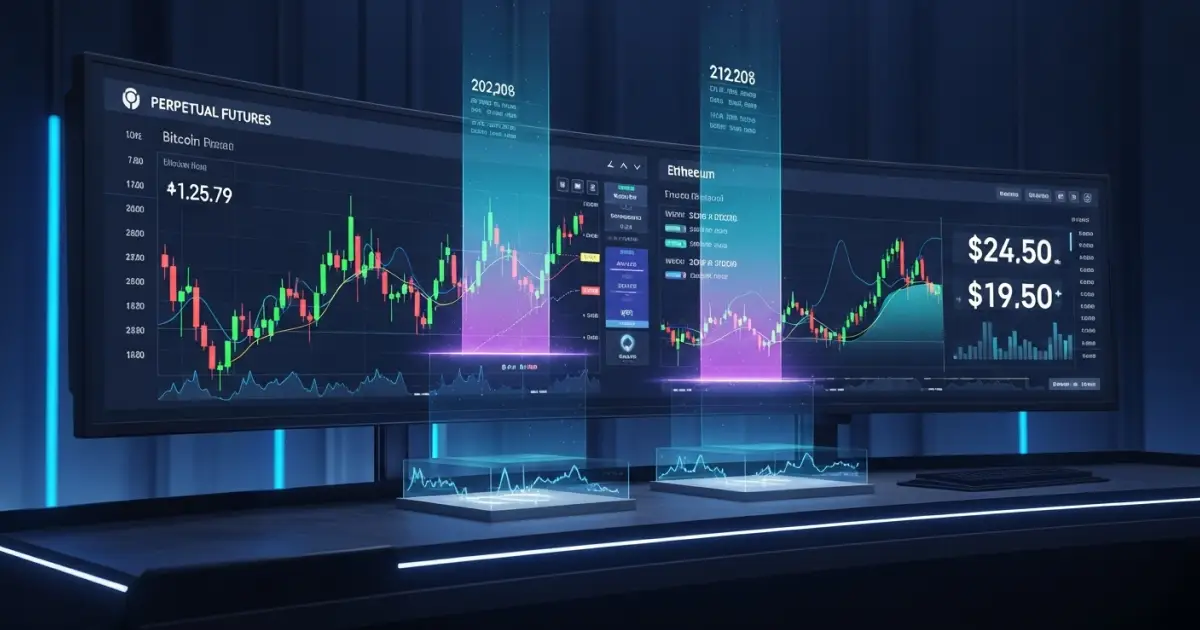
Have you ever wondered how traders manage exposure during periods of extreme cryptocurrency volatility? What if there was a derivative instrument that allowed them to hedge positions without dealing with traditional futures expiration dates?
This is where perpetual futures contracts come into play.
Unlike traditional futures contracts, perpetual futures do not have a fixed settlement date. Traders can maintain positions for as long as margin requirements are satisfied, making them one of the most widely used derivatives products in crypto markets.
However, perpetual futures are more than simply a way to speculate on price movements. They are also used by some traders and institutions for portfolio management, market exposure adjustment, and hedging strategies.
In this guide, we’ll explain:
What perpetual futures are and how they work
How funding rates keep perpetual contracts aligned with spot prices
Differences between perpetual futures, traditional futures, and spot trading
How traders use perpetual futures for hedging
Key risks including leverage, funding costs, and liquidation
What Are Perpetual Futures?

Perpetual futures, also known as perpetual contracts or perpetual swaps, are derivative contracts that allow traders to gain exposure to the price movement of an underlying asset without owning the asset directly.
Unlike traditional futures contracts, perpetual futures do not have an expiration date. A trader can maintain a long or short position indefinitely, provided that the account maintains sufficient margin to support the position.
In cryptocurrency markets, perpetual futures are commonly used for assets such as Bitcoin, Ethereum, and other digital assets. They allow traders to speculate on price movements, manage portfolio exposure, or hedge existing positions without directly selling their spot holdings.
For example, a trader holding Bitcoin may open a short Bitcoin perpetual futures position to reduce the impact of a potential price decline while continuing to hold the underlying BTC.
Key Features and Mechanics of Perpetual Futures
Understanding how perpetual futures work requires looking at several core mechanisms that differentiate them from traditional futures contracts.
No Expiration Date
One of the defining characteristics of perpetual futures is that they do not have a fixed expiration date. Traditional futures contracts settle at a predetermined date. When the contract approaches expiration, traders may need to close or roll over their positions.
Perpetual futures remove this requirement, allowing traders to maintain positions continuously as long as they meet margin requirements. This structure is particularly useful in crypto markets, where traders may want continuous exposure without managing contract rollover schedules.
Funding Rate Mechanism
The funding rate is one of the most important features of perpetual futures. Because perpetual contracts do not expire, exchanges use funding payments to help keep the contract price close to the spot market price. Funding payments are exchanged periodically between traders holding long and short positions.
Typically:
When perpetual futures trade above the spot price, funding rates may become positive, meaning long position holders pay short position holders.
When perpetual futures trade below the spot price, funding rates may become negative, meaning short position holders pay long position holders.
The exact funding interval varies by exchange and contract type, with common intervals including every hour, four hours, or eight hours.
Why Funding Rates Matter for Traders
Funding rates affect the cost of maintaining a perpetual futures position over time. For short-term traders, funding payments may have a limited impact. However, for traders holding positions for longer periods, funding costs can become an important factor when evaluating whether a position remains efficient.
For example:
A trader may correctly predict that Bitcoin will decline, but if the position remains open for an extended period while paying unfavorable funding rates, the overall trading result may be affected. Understanding funding rates is therefore an important part of managing perpetual futures positions.
High Leverage and Margin Requirements
Perpetual futures allow traders to open positions using margin rather than paying the full value of the underlying asset.
For example, instead of purchasing $10,000 worth of Bitcoin directly, a trader may open a leveraged perpetual futures position using a smaller amount of initial margin.
However, leverage also increases risk.
When market movements go against a position:
Unrealized losses increase faster.
Available margin decreases.
The liquidation risk becomes higher.
Traders must maintain sufficient margin above the required maintenance margin level to avoid forced position closure.
Mark-to-Market Settlement
Unlike traditional asset ownership, perpetual futures positions are continuously adjusted based on market prices.
The exchange calculates unrealized profit and loss using mechanisms such as:
Mark price
Position size
Entry price
Margin balance
If losses reduce the account balance below required maintenance margin levels, liquidation may occur.
Understanding these mechanisms is important because the market price movement alone does not determine risk — leverage and margin conditions also play a major role.
24/7 Trading
Unlike traditional financial markets that operate during specific trading hours, cryptocurrency perpetual futures markets operate continuously.
This provides flexibility but also introduces additional considerations.
Because crypto markets trade 24/7:
Significant price movements can occur outside traditional market hours.
Traders need to monitor positions during volatile periods.
Risk management becomes especially important for leveraged positions.
Perpetual Futures vs. Traditional Futures vs. Spot Trading

To understand the role of perpetual futures in crypto markets, it helps to compare them with traditional futures contracts and spot trading. Although all three methods provide exposure to asset price movements, they differ in terms of ownership, settlement structure, leverage availability, and risk management requirements.
Perpetual Futures vs. Traditional Futures
Traditional futures contracts are agreements to buy or sell an asset at a predetermined price on a specific future date.
When the contract reaches its expiration date, it is settled according to the contract terms. Depending on the market, settlement may involve cash settlement, physical delivery, or closing the position before expiration.
This structure works well in traditional markets such as commodities and financial products. However, in fast-moving cryptocurrency markets, expiration dates can create additional considerations because traders may need to close or roll over positions to maintain exposure.
Perpetual futures solve this limitation by removing the expiration date.
Instead of settling at a fixed time, perpetual contracts use mechanisms such as funding rates to keep their price close to the underlying spot market.
The main differences include:
Feature | Perpetual Futures | Traditional Futures |
|---|
Expiration date | No expiration | Fixed expiration date |
Price alignment mechanism | Funding rate | Contract settlement |
Position duration | Can be maintained indefinitely | Limited by contract expiry |
Common crypto usage | Speculation, hedging, market exposure | Institutional and professional hedging |
Perpetual Futures vs. Spot Trading
Spot trading involves directly buying or selling the underlying asset at the current market price.
For example, when a trader purchases Bitcoin through spot trading, they own the actual BTC and can hold it in their account or wallet.
Perpetual futures work differently.
Instead of owning the underlying cryptocurrency, traders hold a derivative contract that tracks price movements. This allows traders to open both long and short positions and use leverage, but it also introduces additional risks related to margin and liquidation.
Key differences include:
Feature | Perpetual Futures | Spot Trading |
|---|
Asset ownership | No direct ownership | Own the underlying asset |
Leverage | Available | Usually unavailable |
Short selling | Possible | Generally requires selling owned assets |
Liquidation risk | Exists when using margin | No liquidation from price movement alone |
Main use cases | Hedging, speculation, exposure management | Long-term holding, asset ownership |
How Traders Combine Spot and Perpetual Futures
Professional traders often view spot trading and perpetual futures as complementary tools rather than competing products.
For example:
A trader holding a long-term Bitcoin position may want to maintain ownership of BTC but reduce short-term downside exposure during uncertain market conditions.
Instead of selling the Bitcoin, the trader may open a short Bitcoin perpetual futures position. If Bitcoin declines, gains from the short position may offset some losses from the spot holding.
This approach is commonly known as a crypto hedge strategy.
However, hedging does not eliminate all risks. Traders still need to consider:
Understanding the Relationship Between Spot and Perpetual Markets
Perpetual futures and spot markets are closely connected.
Price differences between the two markets can create opportunities for arbitrage traders who attempt to benefit from temporary price inefficiencies.
For example:
If perpetual futures trade significantly above spot price, traders may take positions expecting the gap to narrow.
If perpetual futures trade below spot price, market participants may adjust positions based on funding conditions and price differences.
These activities help keep perpetual futures prices aligned with the broader crypto market.
Which Trading Method Fits Different Goals?
The most suitable trading method depends on the trader’s objective.
Spot trading may be more suitable for users who:
Want direct ownership of cryptocurrency.
Prefer avoiding leverage-related risks.
Focus on long-term asset exposure.
Perpetual futures may be used by traders who:
Need short-term market exposure.
Want to hedge existing crypto holdings.
Understand leverage and margin mechanics.
Neither method is inherently better than the other. They serve different purposes and involve different risk considerations.
Why Use Perpetual Futures for Hedging?

So why might traders choose perpetual futures for hedging their crypto portfolios?
Consider a simple example:
A trader holds 5 BTC and believes Bitcoin has long-term potential but expects possible short-term volatility.
Instead of selling the BTC, the trader opens a short Bitcoin perpetual futures position with a similar exposure size.
If Bitcoin’s price decreases:
The gains from the futures position may help offset losses from the spot holdings. Because perpetual futures have no expiration date, traders do not need to periodically replace expiring contracts as they would with traditional futures.
Perpetual futures can provide several advantages for hedging:
Flexible position management: Traders can maintain positions without contract rollover.
Capital efficiency: Margin allows traders to manage exposure without using the full position value upfront.
Direct market exposure: Traders can adjust exposure through long or short positions.
However, hedging does not mean eliminating all risk.
A hedge can reduce the impact of adverse price movements, but traders must still manage:
Funding rate expenses
Leverage exposure
Margin requirements
Market changes
Full Hedge vs. Partial Hedge
Not all traders hedge their entire position.
A full hedge aims to offset nearly all price exposure. For example, a trader holding 1 BTC may open a short perpetual futures position equivalent to 1 BTC.
A partial hedge reduces only part of the exposure.
For example:
A trader holding 1 BTC may open a short position equivalent to 0.5 BTC instead. This allows the trader to reduce downside risk while maintaining some exposure if the asset price increases. The appropriate hedge size depends on the trader’s objectives, risk tolerance, and market conditions.
How to Hedge Using Perpetual Futures

Hedging with perpetual futures is a strategy that allows traders to reduce exposure to potential price movements while maintaining their existing cryptocurrency positions.
Unlike selling spot assets, which removes exposure completely, a perpetual futures hedge creates an additional position that may offset potential losses from the original holding.
For example, a trader holding Bitcoin may use a short Bitcoin perpetual futures position to reduce the impact of a potential market decline without selling the underlying BTC. The effectiveness of a hedge depends on several factors, including position size, leverage usage, funding costs, and market conditions.
Step 1: Identify Your Risk Exposure
Before opening a hedge position, traders first need to understand what risk they are trying to manage.
Common scenarios include:
Holding cryptocurrency during periods of high market uncertainty.
Managing a portfolio that has significant exposure to one digital asset.
Receiving crypto payments while wanting to reduce short-term price volatility.
For example:
A business holding BTC as part of its treasury may be concerned that a sudden market decline could reduce the value of its holdings. Instead of immediately selling the BTC, it may explore hedging tools such as perpetual futures to manage short-term price exposure.
The purpose of hedging is not necessarily to predict market direction, but to manage the impact of unexpected price movements.
Step 2: Choose an Appropriate Leverage Level
Leverage allows traders to control a larger position with less initial margin. However, leverage also increases the sensitivity of a position to price movements.
For hedging purposes, traders typically pay close attention to:
A higher leverage position requires less initial capital but provides less room for adverse price movements.
Understanding the relationship between leverage and liquidation risk is essential when using perpetual futures for hedging.
Step 3: Monitor Funding Rates
Funding rates are a key factor when maintaining perpetual futures positions.
Because perpetual futures do not expire, funding payments help keep contract prices aligned with spot markets.
Depending on market conditions:
For example:
A trader using a short perpetual futures position as a hedge may benefit from positive funding conditions, but may incur additional costs when funding rates move against the position.
Funding rates can change over time based on market demand, trader positioning, and price differences between perpetual contracts and spot markets.
Step 4: Maintain Sufficient Margin Buffer
A hedge position still requires active risk management.
Even if the overall strategy is designed to reduce portfolio risk, the perpetual futures position itself can face liquidation if margin requirements are not maintained.
Important factors to monitor include:
For example:
A trader may correctly hedge a Bitcoin holding but still experience liquidation on the futures position if excessive leverage causes the short position to close before the hedge can perform its intended purpose. This is why margin management is a critical part of crypto hedging strategies.
Step 5: Adjust Positions Based on Market Conditions
Market conditions change over time, so hedge positions may require adjustment.
Factors that may influence hedge decisions include:
Changes in portfolio size.
Significant price movements.
Changes in market volatility.
Shifts in investment objectives.
Example:
A trader holds:
If Bitcoin declines to $45,000:
The spot BTC position loses approximately $5,000 in value.
The short perpetual futures position gains value from the price decline.
The hedge may offset part of the spot market loss.
However, the actual result depends on factors such as entry price, funding payments, fees, and position size.
Step 6: Apply Risk Management Practices
Perpetual futures hedging requires careful risk management because leverage can amplify both position changes and potential losses.
Important considerations include:
Avoid using excessive leverage.
Understand liquidation mechanisms before opening positions.
Monitor funding costs over time.
Consider how market volatility affects margin requirements.
Common Mistakes When Hedging With Perpetual Futures
Some common mistakes include:
Using an oversized hedge: A hedge that is larger than the underlying exposure may create a new directional position instead of simply reducing risk.
Ignoring funding costs: A hedge that remains open for a long period may accumulate funding expenses.
Treating hedging as risk elimination: Hedging can reduce certain risks, but it does not remove all market risks. Position management, fees, and liquidation conditions still matter.
Failing to monitor the position: Because crypto markets operate 24/7, significant price movements can happen outside traditional market hours.
Tips for Getting Started with Perpetual Futures on Bitunix
When learning how to use perpetual futures, understanding the trading mechanics is an important first step.
On Bitunix, traders can access crypto perpetual futures markets and manage positions using tools designed for derivatives trading.
Before opening a position, traders typically review factors such as:

For traders monitoring volatile markets, features such as super alert can help track important market movements without requiring constant chart monitoring. However, monitoring tools are designed to support position awareness. They do not remove the risks associated with leverage, derivatives trading, or market volatility.
Risks of Hedging with Perpetual Futures
While perpetual futures can be used as a risk management tool, they also introduce additional risks that traders need to understand.
Unlike spot holdings, perpetual futures positions involve margin requirements, funding payments, and liquidation mechanisms. A hedge may reduce exposure to one type of market risk, but it does not eliminate all risks associated with derivatives trading.
Understanding these risks is an important part of using perpetual futures responsibly.
1. Funding Rate Costs
Funding rates are a core mechanism of perpetual futures markets, but they can also become a cost factor. If funding rates remain unfavorable for a trader’s position over an extended period, accumulated payments may reduce the effectiveness of a hedge.
For example:
A trader opens a short Bitcoin perpetual futures position to hedge a BTC holding. If market conditions cause short positions to consistently pay funding rates, the hedge may become more expensive to maintain.
Funding rates can change based on market demand, trader positioning, and the difference between perpetual contract prices and spot prices.
2. Liquidation Risk
Liquidation is one of the most important risks associated with leveraged perpetual futures. If a position moves significantly against the trader and the margin balance falls below the required maintenance margin level, the exchange may automatically close the position.
Factors that can increase liquidation risk include:
A hedge position can only serve its intended purpose if it remains open during the market movement it is designed to manage.
3. Volatile Funding Conditions
Funding rates are not fixed. During periods of extreme market activity, funding rates may change significantly due to imbalances between long and short positions.
For example:
During a strong bullish market, demand for leveraged long positions may increase, potentially affecting funding conditions.
During sharp market declines, short positioning may become more crowded.
These changes can affect the ongoing cost of maintaining a perpetual futures position.
4. Overleveraging Risk
Leverage can improve capital efficiency, but excessive leverage can make positions more sensitive to small price movements.
A trader using very high leverage may have limited room before liquidation, even if the overall market analysis is correct.
For hedging purposes, traders should understand how factors such as hedge size, leverage level, margin requirements, and liquidation price interact, as each can affect the effectiveness and risk of a perpetual futures position.
5. Regulatory and Platform Risks
Perpetual futures availability and trading conditions may differ depending on region, platform, and regulatory environment.
Users should understand:
Whether derivatives products are available in their jurisdiction.
Platform-specific margin and liquidation rules.
Contract specifications before trading.
Regulatory requirements and product availability may change over time as crypto markets continue to develop.
Risk Management Checklist Before Using Perpetual Futures
Before opening a perpetual futures position, traders may review:
Understanding of the product: Know how perpetual contracts, funding rates, and liquidation mechanisms work.
Position size: Ensure the position matches the intended hedging purpose.
Leverage exposure: Understand how leverage affects liquidation risk.
Funding costs: Consider the potential cost of maintaining the position.
Market conditions: Monitor volatility, liquidity, and major market events.
Perpetual futures can be useful for managing exposure, but they require an understanding of derivatives mechanics and disciplined risk management.
Conclusion
Perpetual futures have become an important part of cryptocurrency derivatives markets, providing traders with flexible ways to gain market exposure, manage positions, and hedge existing crypto holdings. Their key characteristics — including no expiration dates, funding rate mechanisms, and leverage availability — make them different from traditional futures and spot trading.
However, these features also introduce additional risks. Funding costs, liquidation mechanisms, leverage exposure, and market volatility all need to be understood before using perpetual futures.
For anyone learning about crypto perpetual futures, developing a strong understanding of contract mechanics and risk management is essential.
Perpetual futures can be a useful financial instrument for managing market exposure, but they require careful consideration and should be approached with appropriate knowledge of derivatives trading risks.
About Bitunix
Bitunix is a global cryptocurrency derivatives exchange trusted by over 5 million users across more than 150 countries/districts. The platform is committed to providing a transparent, compliant, and secure trading environment for every user. Bitunix offers a fast registration process and a user-friendly verification system supported by mandatory KYC to ensure safety and compliance. With global standards of protection through Proof of Reserves (POR) and the Bitunix Care Fund, Bitunix prioritizes user trust and fund security. The K-Line Ultra chart system delivers a seamless trading experience for both beginners and advanced traders, while leverage of up to 200x and deep liquidity make Bitunix one of the most dynamic platforms in the market.
Bitunix Global Accounts
X | Telegram Announcements | Telegram Global | CoinMarketCap | Instagram | Facebook | LinkedIn | Reddit | Medium