

Article Summary
- This article provides a detailed price prediction and fundamental analysis for the Pyth Network (PYTH) token.
- It explains Pyth Network as a specialized oracle solution designed to deliver high-fidelity, ultra-low latency financial market data directly to smart contracts.
- The bull case focuses on Pyth's dominance in the Solana ecosystem, its unique "first-party" data provider model, and the growing demand for high-frequency trading data in DeFi.
- The bear case highlights the immense challenge of unseating Chainlink, potential vulnerabilities in its data aggregation model, and reliance on the continued success of the Solana network.
- It presents detailed price prediction scenarios (bearish, neutral, bullish) for both 2025 and 2030, based on oracle market share and DeFi ecosystem growth.
As DeFi becomes more complex, it depends less on simple lending pools and basic swaps and more on fast execution, tighter pricing, and data that can keep pace with derivatives, prediction markets, and high-frequency strategies. Pyth Network is built for that part of the market, using direct data from primary sources, rapid updates, and delivery across multiple chains. For traders using a crypto exchange, such as Bitunix, that lists PYTH/USDT, to access infrastructure tokens, this token sits in the layer that enables real-time on-chain pricing.
What matters for investors is whether that technical edge can turn into durable adoption. Pyth is built for high-fidelity data, low latency, and broad market coverage, but it is still competing in a field where Chainlink remains the default name for many builders. The sections below look at Pyth's architecture, its role in Solana DeFi and beyond, and the public forecast ranges that now frame PYTH's 2026 and 2030 outlook.
The Technology and Ecosystem
Pyth's design starts with a different assumption from many older oracle systems. Instead of relying on external node operators to scrape prices from public APIs, it seeks to obtain prices from firms already involved in price discovery. The official whitepaper puts it clearly:
"The Pyth network is a next-generation oracle solution that aims to bring this valuable financial market data to the general public."
That architecture matters because direct sourcing improves both freshness and provenance. Pyth's July 2025 market-data post says prices come directly from top exchanges, market makers, and trading firms rather than public APIs or third-party aggregators, and its April 2026 Data Marketplace launch said more than 120 institutions were contributing data through the network, with 3,000-plus price feeds tied to over $3 trillion in cumulative trading volume. New 2026 publishing partners included Fidelity Investments, Tradeweb, Euronext FX, SGX FX, OTC Markets Group, and Exchange Data International.
The current API reference says each price object includes not only the latest price, but also a conf field for the confidence level, an exponent, and the publish time. That confidence interval helps smart contracts understand how certain or uncertain a price is at a given moment, which is useful when markets move fast and stale or noisy data can break liquidation logic, derivatives pricing, or risk controls.
The delivery model reinforces that speed advantage. Pyth's developer hub says Pyth Core supports 400ms update frequency across 100-plus blockchains and can deliver both pull and push updates. Its fee documentation also explains that price updates can include a protocol fee determined by governance on a per-chain basis, which can compensate data providers and other network functions.
The PYTH token ties governance and network security together, being the native token powering governance and staking across the network, while Oracle Integrity Staking lets users stake PYTH to support data publishers and secure feed integrity. Eligible PYTH can be used for governance, and the protocol parameters are subject to Pyth DAO governance. In December 2025, Pyth added another value-capture layer with the PYTH Reserve, which channels protocol revenue into monthly PYTH purchases and linked that system to Pyth Pro's institutional data revenue, then projected Pyth Pro to hit $1 million in annual recurring revenue.
DeFi Llama's oracle page currently puts Pyth at about $2.945 billion in total value secured, while its protocol page and official docs still frame the network as an institutional data layer built for mission-critical DeFi infrastructure. That is a meaningful scale, but it also shows Pyth is still far smaller than the oracle leader it wants to challenge.
The Bull Case: Dominating High-Frequency DeFi
A bullish Pyth Network price prediction starts from a market that has not settled on a single long-term outcome. CoinMarketCap currently places PYTH near $0.045 with a market cap of around $262 million, 24-hour volume of $14.7 million, and roughly 5.74 billion tokens in circulation.
Public forecast models then start to spread out quite sharply. CoinCodex's forecast places PYTH at about $0.0458 by the end of 2026, and $0.111 by 2030, Kraken's model and MEXC's price prediction remain much more conservative, with 2026 targets around $0.046 and $0.04577, and 2030 estimates near $0.056 and $0.05564, Changelly's forecast is more optimistic, projecting a 2026 range of $0.0722 to $0.0896 and a 2030 range of $0.0604 to $0.185, while CoinLore's model pushes the stretch case much higher with a possible 2026 high near $0.2744 and a 2030 model near $1.21.
1. The Solana Advantage
Pyth's strongest strategic advantage is still its position inside Solana DeFi. DefiLlama's Solana oracle rankings currently show Pyth securing about $1.879 billion on Solana, ahead of Chainlink's roughly $922.66 million on that chain. At the same time, DefiLlama's Solana chain dashboard shows about $15.655 billion in stablecoin market cap, around $1.271 billion in daily DEX volume, and roughly $776.2 million in daily perpetuals volume. That is exactly the sort of environment where faster oracle updates matter more, because traders and protocols care about tight pricing when leverage and rapid execution become normal.
2. Superior Latency
For more advanced DeFi products, Pyth also brings a credible technical advantage, a 400ms update frequency, and each price object includes both price data and a confidence value. That combination is useful for products such as options, structured derivatives, and prediction markets, where speed matters but so does the level of uncertainty around each update.
The April 2026 Polymarket integration helps illustrate that point, since Pyth Pro data was selected to power Polymarket's traditional-asset markets, including metals and equities. That suggests the network can support visible, high-traffic applications where latency and data quality are both critical.
3. Cross-Chain Expansion
Expansion beyond Solana gives the bull case a second leg. Pyth Core already supports 100-plus blockchains, and the April 2026 Data Marketplace launch showed the network expanding from simple feed delivery to a broader institutional distribution layer. That matters because a successful oracle network wins by becoming useful wherever developers need trusted pricing, and Pyth is clearly moving in that direction through Pythnet, Pyth Core, Pyth Pro, and cross-asset data coverage. If that broader footprint keeps growing, Pyth has a path to becoming more than just the default Solana oracle.
The Bear Case: The Chainlink Goliath
A bearish view of PYTH only requires the assumption that growth remains too limited to justify a major rerating. That possibility already shows up in current public models. CoinCodex's 2026 range runs from about $0.03152 to $0.04583, which stays close to current levels, Kraken and MEXC both place 2030 only a little higher than today, and even some of the stronger forecasts, such as TradersUnion's year-end 2030 estimate near $0.0747 or Changelly's 2030 average near $0.0988, still describe a token that remains relatively small unless adoption accelerates meaningfully.
1. The Chainlink Moat
Chainlink remains the biggest obstacle by a wide margin. DeFi Llama's oracle pages currently put Chainlink at about $43.587 billion in total value secured, compared with Pyth's roughly $2.945 billion. That gap reflects first-mover advantage, broader integrations, stronger default mindshare, and the reality that many developers already view Chainlink as the standard choice. For Pyth to close that distance, it needs enough protocols across enough chains to decide that faster, first-party, high-fidelity data is worth switching for.
2. Centralization Concerns
Pyth's first-party model is fast, but it also invites criticism, as the network relies on a smaller group of institutional publishers rather than a broader network of third-party reporters, leading some builders to see it as less decentralized than rival models. The current docs try to address that with Oracle Integrity Staking, slashing rules, and governance control over parameters, but the basic trade-off remains. Pyth leans into source quality and accountability, while critics worry that a publisher-heavy structure concentrates too much importance in too few hands.
3. Ecosystem Dependency
Pyth also remains more exposed to Solana than the broader oracle leaders are. Its Solana position is strong, but outside that core ecosystem, the picture is mixed. DeFi Llama's Base oracle rankings show Chainlink at about $1.582 billion in TVS on Base, while Pyth sits around $85.56 million there, suggesting that Pyth's cross-chain expansion is still uneven. If Solana DeFi slows, or if other chains keep favoring Chainlink or other providers, Pyth's growth can feel much narrower than the bullish story assumes.
Pyth Network Price Prediction Scenarios (2026 & 2030)
Putting the forecast models side by side makes one thing clear: a realistic Pyth Network price prediction has to distinguish between slow, infrastructure-like progress and a true market-share breakout.
The conservative cluster comes from CoinCodex, Kraken, and MEXC, the middle ground comes from TradersUnion and parts of Changelly, and the aggressive upside comes from CoinLore's long-range model. Those sources do not agree on much, but they do agree that PYTH's future depends heavily on whether it becomes a broader oracle standard instead of remaining strongest only in Solana DeFi.
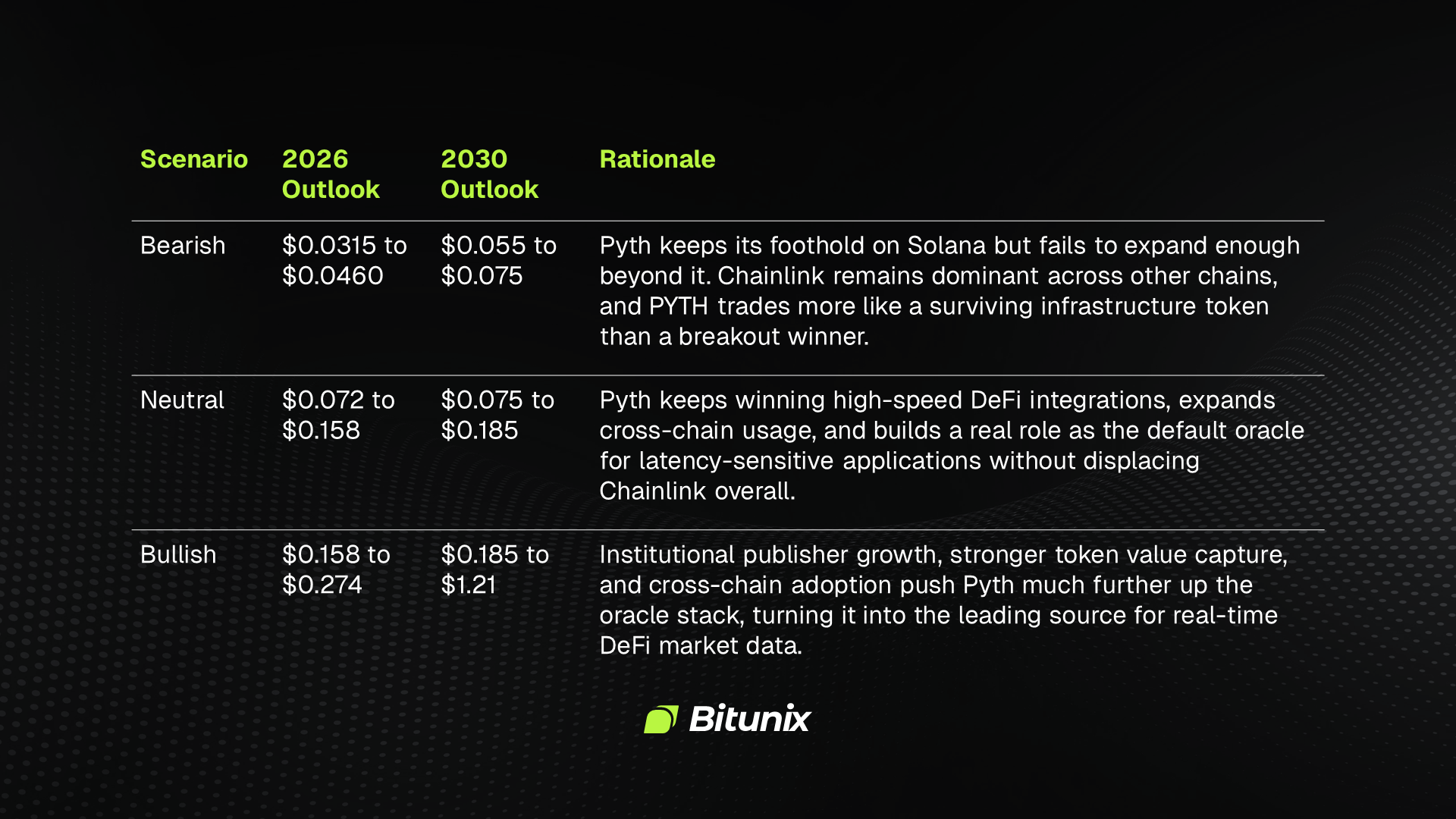
Pyth Network price prediction scenarios for 2026 and 2030, comparing bearish, neutral, and bullish outcomes based on Solana growth, oracle adoption, and cross-chain expansion.
Conclusion: A Bet on High-Speed DeFi
Pyth Network represents a serious attempt to redesign oracle infrastructure for a faster, more data-intensive version of DeFi. It brings first-party publishers, confidence intervals, rapid updates, and a broader institutional data strategy to a part of crypto that usually gets discussed only when it breaks. Those are real strengths, and they help explain why Pyth has become such a visible part of Solana DeFi and a credible name in the wider oracle market.
Investing in PYTH is still a long-term bet on a more complex future for on-chain finance, one where derivatives, prediction markets, and institutional-grade data become more important.
That bullish scenario has substance, but it also comes with clear risks: Chainlink's moat, publisher concentration concerns, and the fact that Pyth still depends heavily on Solana for its strongest lead.
If you want exposure, Bitunix gives you a direct way in through PYTH/USDT, so you can download the Bitunix app, register, and decide whether the current price reflects enough upside for the risk you are taking.
FAQ
What is Pyth Network (PYTH)?
Pyth Network is an oracle network that delivers high-fidelity market data to smart contracts across more than 100 blockchains. The PYTH token supports governance and staking, while the network itself focuses on low-latency pricing from primary market participants.
How does Pyth Network differ from Chainlink?
Pyth focuses on first-party data from exchanges, market makers, and trading firms, while Chainlink is better known for its broader reporter-network model and larger total value secured. Pyth's edge is speed and direct sourcing, while Chainlink's edge is scale and network effects.
What are first-party data providers?
First-party data providers are firms that generate market data as part of their own trading or exchange operations. In Pyth's case, that includes institutional publishers such as Fidelity Investments, Tradeweb, and Euronext FX, as well as earlier participants such as Jane Street and Wintermute.
Why is low latency important for DeFi oracles?
Low latency matters because derivatives, liquidations, prediction markets, and high-frequency trading strategies can break or become unfair when price updates arrive too slowly. Pyth's current developer docs highlight 400ms update frequency, which is built for these faster use cases.
What is a confidence interval in Pyth's data feeds?
A confidence interval in Pyth is the conf value that accompanies a price update. It tells a protocol how uncertain the current price estimate is, which can help smart contracts price assets more conservatively when markets are volatile.
What is the utility of the PYTH token?
The PYTH token powers governance and staking. It is used in Oracle Integrity Staking to support publishers and secure feed integrity, and governance can influence staking parameters, fees, and broader protocol decisions.
Is Pyth Network only available on Solana?
No. Pyth is strongest on Solana, but the current docs say Pyth Core supports more than 100 blockchains. Recent expansion efforts and the Data Marketplace also show the network pushing well beyond a single-chain identity.
Who are the main data providers for Pyth?
Pyth's publisher set includes major trading firms, exchanges, and financial institutions. Current and recent official materials highlight names such as Fidelity Investments, Tradeweb, Euronext FX, Jane Street, Revolut, and Wintermute.
What are the risks of investing in PYTH?
The main risks are Chainlink's dominant position, questions about how decentralized Pyth's publisher model really is, and the fact that Pyth still relies heavily on Solana for its strongest market position. Forecast models also vary widely, which shows that uncertainty remains high.
Where can I buy PYTH tokens?
You can buy PYTH on major centralized exchanges such as OKX, Bitunix, Binance, MEXC, Kraken, and KuCoin. It is also available on Solana-based decentralized exchanges through Jupiter, Orca, or Raydium. Before buying, complete KYC where required and verify the correct Solana contract address.
Glossary
- PYTH token: The native token used for governance and staking across the Pyth Network.
- Pyth Network: A cross-chain oracle network focused on direct market data from primary sources.
- Oracle network: Blockchain infrastructure that delivers outside data, such as prices, to smart contracts.
- High-fidelity data: Market data designed to be timely, direct, and precise enough for sensitive financial use cases.
- Solana DeFi: The decentralized finance ecosystem built on Solana, including trading, lending, and derivatives applications.
- Chainlink competitor: A project that tries to challenge Chainlink's position in the oracle market.
- First-party data provider: A firm that publishes data it generates directly through its own market activity.
- Confidence interval: A measure of uncertainty attached to a price feed, shown in Pyth as the conf field.
- Pull oracle: A model where users request price updates when they need them instead of relying on constant on-chain pushes.
- Pythnet: The application-specific environment that powers Pyth's data aggregation and distribution architecture.
- Oracle Integrity Staking: Pyth's staking system for supporting publishers and securing feed quality through rewards and slashing.
- Total value secured: The amount of on-chain value that depends on an oracle continuing to work correctly.
- Data publisher: A market participant that submits price information into the Pyth Network.
- Pyth Pro: Pyth's institutional-grade subscription product for advanced market-data use cases.
- Cross-chain expansion: Growth across multiple blockchains rather than relying on a single ecosystem.
Disclaimer
This article does not provide:
(i) investment advice or investment recommendations;
(ii) an offer or solicitation to buy, sell, or hold digital assets;
(iii) financial, accounting, legal, or tax advice.
Digital assets, including stablecoins and NFTs, involve high risk and may fluctuate significantly. Consider whether trading or holding digital assets is appropriate for you given your financial situation. Consult a qualified legal, tax, or investment professional when needed. You are responsible for understanding and complying with applicable local laws and regulations.
About Bitunix
Bitunix is a global cryptocurrency derivatives exchange trusted by over 3 million users across more than 100 countries. At Bitunix, we are committed to providing a transparent, compliant, and secure trading environment for every user. Our platform features a fast registration process and a user-friendly verification system supported by mandatory KYC to ensure safety and compliance. With global standards of protection through Proof of Reserves (POR) and the Bitunix Care Fund, we prioritize user trust and fund security. The K-Line Ultra chart system delivers a seamless trading experience for both beginners and advanced traders, while leverage of up to 200x and deep liquidity make Bitunix one of the most dynamic platforms in the market.
Bitunix Global Accounts
X | Telegram Announcements | Telegram Global | CoinMarketCap | Instagram | Facebook | LinkedIn | Reddit | Medium