
What Is Crude Light (CL)? Understanding the Global Crude Oil Market
Crude Light (CL) refers to the NYMEX Light Sweet Crude Oil futures contract, which is based on West Texas Intermediate (WTI) crude oil. WTI is one of the world's major oil benchmarks and is widely used to price crude oil produced in the United States. The term "light" describes crude oil with relatively low density, while "sweet" indicates low sulfur content, making it easier and generally less expensive to refine into products such as gasoline and diesel.
The CL futures contract is traded on the New York Mercantile Exchange (NYMEX), part of CME Group. Its standard contract represents 1,000 barrels of WTI crude oil, with prices quoted in U.S. dollars per barrel. The contract is physically settled, meaning that traders holding positions through expiration may be subject to delivery obligations under exchange rules.
Crude oil attracts participants from across the financial and energy industries, including producers, refineries, airlines, institutional investors, and individual traders. Some use futures to hedge against changes in energy costs, while others seek to profit from price fluctuations. For retail traders, CL provides a way to gain exposure to the crude oil market without directly purchasing and storing physical oil.
Data Source: FXLeaders
Crude Oil Market Size and Global Importance
Crude oil is one of the most important commodities in the global economy because it supports transportation, manufacturing, industrial production, and petrochemical industries. According to OPEC's 2026 Annual Statistical Bulletin, global oil demand reached approximately 105.15 million barrels per day in 2025, increasing by 1.30 million barrels per day compared with 2024. This scale of consumption makes oil a critical component of international trade and economic activity.
Global oil demand comes from several major industries:
Transportation: Gasoline, diesel, and aviation fuel power cars, trucks, ships, and aircraft.
Petrochemicals: Petroleum-based materials are used to produce plastics, synthetic fibers, fertilizers.
Manufacturing: Oil and refined petroleum products provide energy and raw materials for manufacturing.
Construction: Asphalt and other petroleum-derived materials are widely used in infrastructure projects.
Power Generation: Some countries continue to rely on petroleum products for electricity generation.
The global oil market is highly interconnected, with major producers including the United States, Saudi Arabia, Russia, and Canada, while major consumption centers include the United States, China, and India. Changes in production or consumption in one region can influence prices worldwide through international trade and supply chains. As a result, crude oil prices are closely linked to economic growth, inflation, international trade, and geopolitical developments.

Data Source: Rheonics
Crude Light Price Performance Over the Past 10 Years
Over the past decade, WTI crude oil prices have experienced several major market cycles, driven by changes in global supply and demand, economic conditions, and geopolitical events. The following table shows the annual average WTI spot price from 2016 to 2025, providing a reference for understanding the market's longer-term performance.
Year | Average WTI Price (USD/Barrel) | Major Market Developments |
2016 | $43.29 | Recovery from the global oil supply glut |
2017 | $50.80 | OPEC-led production cuts supported prices |
2018 | $65.23 | Stronger prices followed by a late-year decline |
2019 | $56.99 | Trade tensions and demand concerns |
2020 | $39.16 | COVID-19 triggered a historic demand shock |
2021 | $68.13 | Economic reopening supported oil demand |
2022 | $94.90 | Russia-Ukraine conflict intensified supply concerns |
2023 | $77.58 | OPEC+ production cuts and weaker demand expectations |
2024 | $76.63 | Geopolitical risks and demand uncertainty |
2025 | $65.39 | Rising global production pressured prices |
Data Source: U.S. Energy Information Administration (EIA)
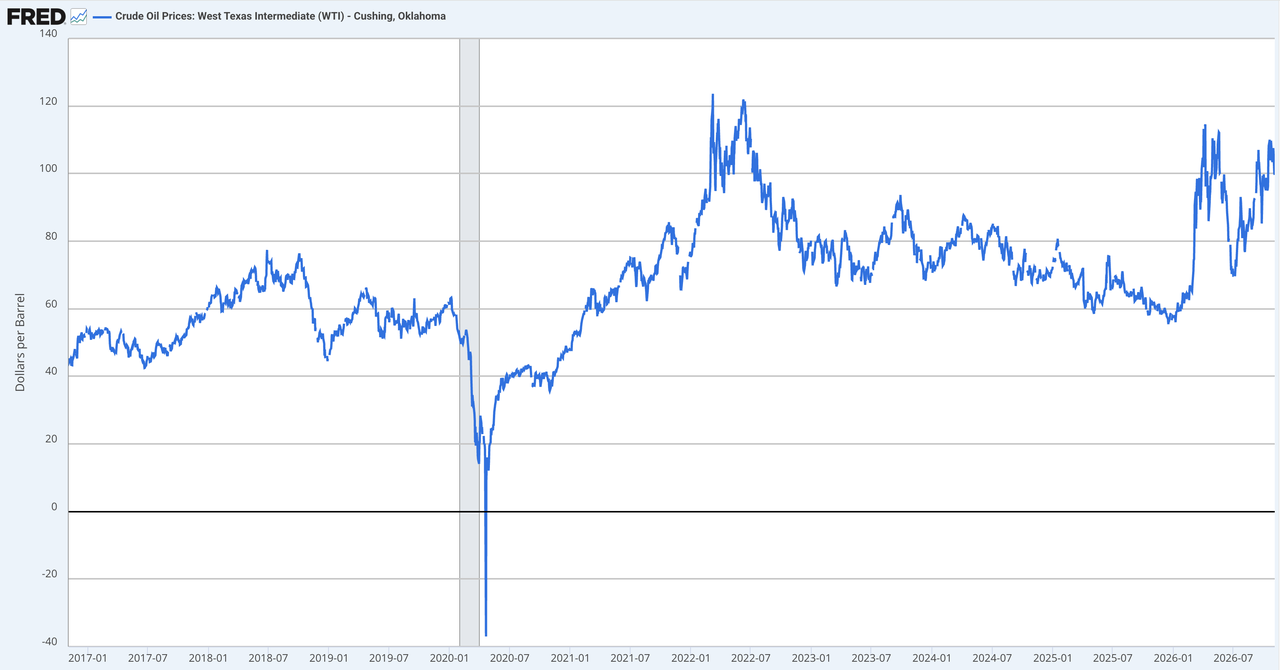
Several events stand out during this period. In 2020, the COVID-19 pandemic caused transportation and industrial demand to collapse, while limited storage capacity contributed to the unprecedented negative settlement of the expiring May WTI futures contract on April 20, when it reached -$37.63 per barrel. In 2022, Russia's invasion of Ukraine intensified concerns about global energy supply, helping push the annual average WTI price to approximately $94.90 per barrel. From 2023 to 2025, increasing production, OPEC+ policy adjustments, and uncertainty surrounding global economic growth contributed to a more volatile market, with the annual average falling to $65.39 in 2025.
Data Source: Federal Reserve Bank
Key Fundamental Factors That Drive Crude Oil Prices
Crude oil prices are primarily influenced by the balance between physical supply and demand, but market expectations also play an important role. Geopolitical developments, production policies, inventory reports, and economic data can all change expectations about future oil availability and consumption. Understanding these fundamental factors can help CL traders evaluate potential price movements.
Geopolitical Tensions and Global Oil Supply Disruptions
Geopolitical tensions are a major source of volatility in crude oil markets because oil production and transportation are concentrated in certain regions. Military conflicts, international sanctions, political instability, and attacks on energy infrastructure can disrupt production or restrict exports. The Middle East is particularly important because it contains several major oil producers and strategic shipping routes.
The Strait of Hormuz is one of the world's most important oil transit chokepoints, making it a key indicator of geopolitical risk. If conflicts threaten shipping routes, pipelines, ports, or production facilities, traders may price in a potential supply disruption even before physical oil deliveries are affected. This geopolitical risk premium can push crude oil prices higher, while easing tensions may reduce the premium.
OPEC+ Production Policy and Global Oil Supply
OPEC+ brings together members of the Organization of the Petroleum Exporting Countries (OPEC) and other major oil-producing countries, including Russia. Through production targets and voluntary output adjustments, the group seeks to influence global oil supply and maintain market stability. Its decisions are closely monitored because changes in output from major producers can affect the global supply-demand balance.
Production cuts generally reduce available supply and may support higher prices, particularly when demand remains strong. Conversely, production increases can put downward pressure on prices if consumption does not grow at the same pace. Traders should monitor official OPEC+ announcements alongside actual production data, export volumes, and compliance with agreed targets, as announced production targets do not always match real output.
Global Oil Supply and Demand Balance
The relationship between global oil supply and demand is the fundamental driver of crude oil prices over the long term. When consumption exceeds production, inventories tend to decline, indicating tighter market conditions and potentially creating upward price pressure. When production exceeds consumption, excess supply may accumulate in storage facilities, increasing the risk of downward price movements.
Demand is influenced by economic growth, industrial activity, transportation needs, seasonal consumption, and energy policies. For example, stronger manufacturing activity in China and expanding transportation demand in India can support global oil consumption. On the supply side, production capacity, investment in new oil fields, technological developments, and output decisions by major producers determine how much crude oil reaches the market.
U.S. Crude Oil Inventories and Strategic Petroleum Reserves
U.S. crude oil inventory data is one of the most closely watched indicators in the energy market. The U.S. Energy Information Administration (EIA) publishes weekly petroleum reports covering crude oil stocks, gasoline inventories, distillate inventories, refinery activity, and domestic production. Larger-than-expected inventory draws may indicate tighter supply or stronger demand, while unexpected inventory builds can suggest weaker consumption or excess supply.
Another important factor is the U.S. Strategic Petroleum Reserve (SPR), a government-controlled emergency stockpile designed to provide additional crude oil during major supply disruptions. Government releases from the SPR can temporarily increase available supply and influence market expectations, while efforts to replenish the reserve may contribute to additional demand. CL traders should examine commercial inventories, SPR developments, refinery utilization, and import data together rather than relying on a single weekly inventory figure.
WTI vs. Brent Crude Oil: Key Differences and Market Benchmarks
WTI and Brent are the two most widely recognized crude oil benchmarks in global energy markets. Although both are classified as light, sweet crude oils and generally move in the same direction, their prices can differ because of variations in quality, geography, transportation costs, and regional supply-demand conditions. WTI primarily represents the North American oil market, while Brent serves as a major benchmark for internationally traded crude oil.
Comparison | WTI Crude Oil | Brent Crude Oil |
Full Name | West Texas Intermediate | Brent Crude |
Main Market | North America | International |
Origin | Primarily the United States | North Sea region |
Key Reference Location | Cushing, Oklahoma | North Sea |
Crude Type | Light, sweet | Light, sweet |
Major Exchange | NYMEX | ICE Futures Europe |
Common Futures Ticker | CL | B (ICE Brent) |
Main Price Influences | U.S. production, inventories, pipelines | Global supply, exports, geopolitical risks |
One important difference is their exposure to regional market conditions. WTI is particularly sensitive to U.S. crude production, domestic inventories, refinery demand, and pipeline capacity, while Brent is more closely connected to international trade flows and supply conditions in major exporting regions. These differences can cause one benchmark to trade at a premium or discount to the other.
The price difference between Brent and WTI is known as the Brent-WTI spread. A positive spread means Brent trades above WTI, which can reflect stronger international demand or differences in regional supply and transportation costs. Traders monitor this spread to evaluate relative market conditions and identify potential opportunities for crude oil derivatives.
How to Trade Crude Light (CL)
CL provides exposure to crude oil price movements without requiring traders to purchase, store, or manage physical oil. Investors seeking exposure to the crude oil market may consider traditional futures contracts, commodity ETFs, or other oil-linked trading products. For retail traders who prefer using cryptocurrency platforms, commodity-linked trading pairs offer another way to participate in oil price movements using digital assets such as USDT.
For most retail traders, accessing crude oil price movements through a cryptocurrency exchange such as Bitunix can be a convenient option. Bitunix offers crude oil-linked perpetual futures, allowing users to trade oil price movements using USDT as the settlement asset. Before trading, users may need to register an account and complete standard Know Your Customer (KYC) verification to meet applicable Anti-Money Laundering (AML) and compliance requirements.
Once your account is verified and funded, you can access the relevant crude oil trading pair on Bitunix and choose whether to open a long or short position based on your market outlook. Before confirming an order, review the current market price, trading fees, funding rate, leverage, and margin requirements. Unlike physical crude oil or traditional CL futures, perpetual futures do not represent ownership of the underlying commodity and generally do not require physical delivery. Leverage can amplify both gains and losses, and positions may be liquidated if the margin balance falls below the required maintenance level. Traders should therefore understand the contract specifications and associated risks before opening a position.