
Strategy Inc. (NASDAQ: MSTR), formerly known as MicroStrategy, is a publicly traded company founded by Michael Saylor in 1989. Originally known for its enterprise analytics and business intelligence software, the company shifted its corporate strategy toward Bitcoin in 2020 under Saylor's leadership, making Bitcoin the centerpiece of its corporate capital allocation model. By combining Bitcoin accumulation with equity issuance, convertible debt, and preferred stock financing, Strategy seeks to increase its Bitcoin exposure over time and create value for shareholders.
Unlike traditional software companies, Strategy's stock valuation is closely linked to Bitcoin prices, the market premium investors assign to its shares, and its ability to raise capital. This makes MSTR a distinctive investment vehicle: its stock can amplify Bitcoin's price movements, but it can also decline sharply when market sentiment weakens or financing conditions deteriorate.
For investors evaluating MSTR, four indicators are particularly important: Bitcoin prices, the company's market premium to net Bitcoin asset value (mNAV), its financing capacity, and Bitcoin Yield. Understanding how these metrics interact helps explain both the potential growth of Strategy's Bitcoin treasury and the risks embedded in its stock.

Data Source: Yahoo
What Is Strategy? Understanding the Bitcoin Treasury Company
Strategy is a US-listed company that combines a Bitcoin treasury operation with an enterprise analytics software business. The company was originally known as MicroStrategy before adopting the Strategy brand in 2025. Its common stock continues to trade on Nasdaq under the ticker MSTR.
The company's transformation into a Bitcoin treasury company began in 2020, when management started using Bitcoin as a primary treasury reserve asset. Since then, Strategy has developed a financing model designed to raise capital through public markets and deploy a substantial portion of the proceeds into additional Bitcoin purchases.
This approach distinguishes Strategy from traditional businesses that primarily invest surplus cash in short-term securities or other conventional financial assets. Bitcoin accumulation is central to its corporate strategy, while its software business continues to provide an additional operating business.
For investors, MSTR offers exposure to Bitcoin through publicly traded equity. However, owning MSTR is not equivalent to holding Bitcoin directly. The company's debt, preferred stock obligations, share issuance, operating expenses, and market valuation can all affect its stock price and returns.

Data Source: Strategy
How Does Strategy's Bitcoin Treasury Model Work?
Strategy's Bitcoin treasury model revolves around raising capital, purchasing Bitcoin, and increasing the amount of Bitcoin attributable to each common share over time. The effectiveness of this approach depends on the cost of financing, the price at which the company issues securities, and the market value of its existing Bitcoin holdings.
Bitcoin Accumulation and Bitcoin Per Share
Bitcoin accumulation is the foundation of Strategy's business model. The company raises funds through capital markets and uses the proceeds to acquire Bitcoin, expanding its treasury holdings as financing conditions permit.
However, the total amount of Bitcoin held by the company is only one part of the investment equation. Investors also need to consider how much Bitcoin exposure is attributable to each share after accounting for potential dilution and senior financial claims.
Strategy uses Bitcoin Yield as one of its key performance indicators. The metric is intended to measure the percentage change in Bitcoin per share over a specified period, based on the company's defined methodology. It is not the same as the return earned by shareholders, nor does it directly measure changes in the market value of Bitcoin holdings.
A positive Bitcoin Yield indicates that the company's Bitcoin-per-share metric has increased under the applicable calculation method. This can occur even when the company issues additional shares, provided the capital raised enables it to acquire enough Bitcoin to increase the relevant per-share measure.
For investors, the distinction is important: accumulating more Bitcoin does not automatically create value per share. The impact depends on how much capital is raised, the terms of financing, the number of shares outstanding, and the value of the assets acquired.
Equity Issuance, Convertible Debt, and Preferred Stock Financing
Strategy uses several financing instruments to support its Bitcoin purchases.
Equity issuance: Through at-the-market (ATM) offering programs, Strategy can sell new common shares into the market and use the proceeds to acquire Bitcoin. This method avoids adding contractual interest payments, but it increases the number of shares outstanding. Its impact on existing shareholders depends partly on the company's valuation when the shares are issued.
Convertible debt: Convertible notes allow Strategy to raise capital through debt that may be converted into common shares under specified conditions. These instruments can provide funding for Bitcoin purchases, but they introduce debt obligations and potential future share dilution. Interest costs, maturity dates, conversion terms, and refinancing conditions all matter.
Preferred stock: Strategy also issues preferred securities to access capital from investors seeking different risk and income characteristics. Depending on security, these instruments may carry dividend obligations or other contractual terms. They can diversify the company's financing sources, but their costs must be considered when assessing the value available to common shareholders.
The central question is whether Strategy can raise capital on terms that support Bitcoin accumulation without imposing excessive financing costs or diluting existing shareholders. When its common stock trades at a sufficiently high premium to the relevant per-share Bitcoin value, issuing shares to purchase additional Bitcoin may increase Bitcoin exposure per share. When that premium narrows or turns into a discount, the same approach may become less attractive.
MSTR's Growth Flywheel
To understand Strategy's growth model, investors should track four key indicators: Bitcoin price, mNAV premium, financing capacity, and Bitcoin Yield.
Bitcoin price: Determines the market value of Strategy's Bitcoin holdings.
mNAV premium: Indicates whether Strategy's shares trade at a premium or discount to the net value of its Bitcoin holdings, helping assess the attractiveness of issuing equity to fund additional purchases.
Financing capacity: Reflects Strategy's ability to raise capital through at-the-market (ATM) equity offerings, convertible debt, and preferred stock.
Bitcoin Yield: Measures changes in Bitcoin per share under Strategy's stated methodology, rather than the returns earned by shareholders.
When Bitcoin prices are supportive, MSTR trades at a premium to its net Bitcoin asset value, and financing remains accessible, Strategy may be able to raise capital and purchase more Bitcoin while increasing its Bitcoin exposure per share. If Bitcoin Yield continues to rise, this process can reinforce investor confidence and support the company's ability to raise additional capital, creating a positive feedback loop.
The flywheel can also work in reverse. A falling Bitcoin price or a narrowing mNAV premium may reduce the attractiveness of equity issuance and constrain access to financing. If Bitcoin accumulation slows or Bitcoin Yield declines, the market may reassess the premium investors are willing to pay for MSTR.
Ultimately, MSTR's growth flywheel depends on the interaction between Bitcoin prices, valuation premiums, financing capacity, and Bitcoin per share. A positive mNAV premium and rising Bitcoin Yield can support the model, but neither guarantees that MSTR's share price will outperform Bitcoin or that the strategy will remain accretive under all market conditions.

Strategy Stock Performance: How Has MSTR Stock Performed Over the Past Year?
MSTR stock is known for its high volatility and sensitivity to Bitcoin market cycles. Because Strategy combines direct Bitcoin exposure with corporate financing and a market-driven valuation premium, its shares can move more sharply than Bitcoin itself in either direction.
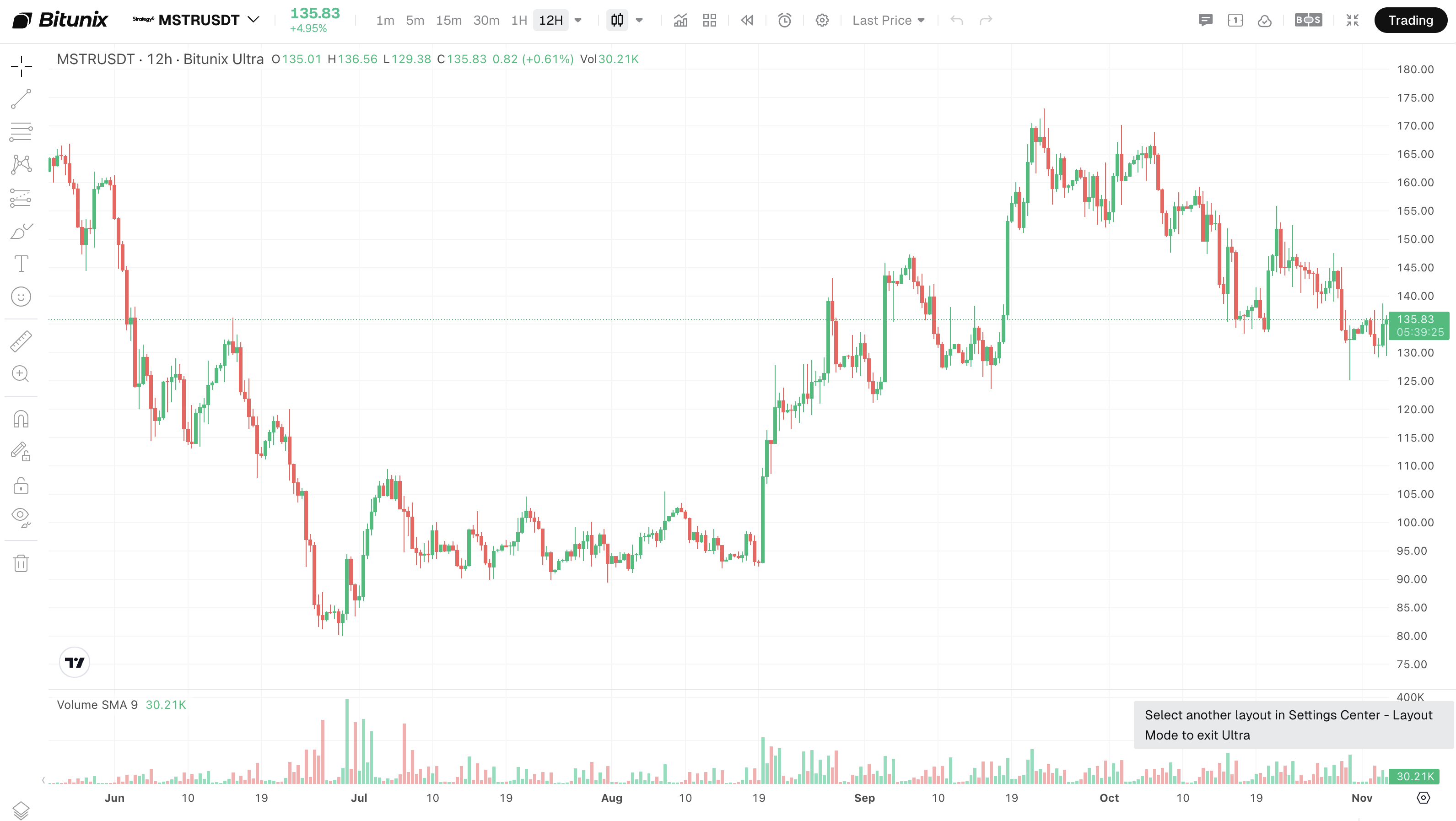
As of October 13, 2026, MSTR closed at approximately $152.18, down around 51.8% over the preceding year, according to MarketBeat's historical performance data. This decline highlights the risks of treating MSTR as a simple substitute for holding Bitcoin.
The difference between MSTR's stock performance and Bitcoin's price performance can reflect several factors, including changes in the company's mNAV premium, equity dilution, financing costs, and investor sentiment. During bullish periods, investors may assign a substantial premium to Strategy's Bitcoin holdings because they expect the company to continue accumulating Bitcoin and increasing Bitcoin exposure per share. During bearish periods, that premium can contract, amplifying losses even when the company's Bitcoin holdings remain substantial.
Investors should therefore evaluate MSTR using both its underlying Bitcoin exposure and its capital structure. Historical returns can provide context, but they do not guarantee future performance.
Data Source: Bitunix
How to Buy and Trade Strategy (MSTR) Stock
For investors looking to gain exposure to Strategy, the traditional approach is to purchase MSTR shares through a U.S. stock brokerage account. Investors generally need to open a brokerage account, complete identity verification, deposit funds, and then place an order to buy Strategy shares on Nasdaq. However, buying U.S. stocks directly may involve brokerage account requirements, cross-border fund transfers, and transaction fees. Traditional stock investing also primarily benefits investors when the stock price rises, which may limit flexibility when market expectations change.
Another option is to trade Strategy stock contracts through cryptocurrency trading platforms such as Bitunix. Compared with directly purchasing MSTR shares, stock contracts can provide more flexible ways to participate in the market. Traders can establish long positions when they expect Strategy's stock price to rise or short positions when they expect the stock to decline. If MSTR contracts are available on the platform, users should check the applicable leverage limits and contract specifications before trading. Before trading, users need to register a Bitunix account and complete identity verification (KYC). As leveraged products can magnify both gains and losses, users should understand the relevant risks and manage their positions carefully.