On August 19, 2026, Bitcoin broke out of a six-week range and ripped roughly 8% in about an hour, running from the $64,000 area to just under $70,000. CoinGlass data put the damage at roughly $2.7 billion in short liquidations over 24 hours against about $264 million on the long side — shorts took more than 90% of the pain.
Then the trade flipped. Bitcoin extended the run to nearly $79,500 over five sessions, a gain of close to 30%, and on August 22 a pullback of roughly 3% to the $77,000 area wiped out more than $475 million in longs, with total crypto liquidations near $547 million. Both sides of the book got cleaned out inside four days, and neither move needed to be large. The leverage did the work.
That is the market you are about to enter. Crypto demo trading exists because learning order mechanics, margin modes and liquidation math during a week like that is expensive tuition. A demo trading account gives you the same live price feed, the same order panel and the same leverage settings, funded with virtual capital instead of your own. Nothing about the market is simulated except the money.
This guide covers what demo trading actually is, how the virtual balance behaves under the hood, how to run a structured practice program in five steps, the habits that make demo results meaningless, and the metrics that tell you when you are genuinely ready for live capital.
What is Crypto Demo Trading and How Does It Work?
Traders use several words for roughly the same idea, and they are not interchangeable. Paper trading, demo accounts, testnets and backtesting sit on a spectrum from "pure theory" to "everything is real except the settlement." Knowing where each one sits tells you what it can and cannot teach you.
Understanding Paper Trading in the Cryptocurrency Market
Paper trading predates crypto by about a century. Floor traders wrote hypothetical entries and exits on paper, then tracked what would have happened. The logic survived into digital markets unchanged: record the decision, let the market resolve it, review the outcome without a P&L consequence.
What changed in crypto is fidelity. A modern crypto demo trading environment does not ask you to imagine a fill. It streams live prices and order book depth, routes your order into a simulated matching engine, applies the same leverage and margin rules as the live venue, and marks your position to market tick by tick. The learning surface is much wider than "was my directional call right." You are also learning where the liquidation price sits, what happens when you flip from isolated to cross margin, and how a stop-market order behaves when the book thins out.
The four common practice methods differ mainly in how much of the real market they reproduce. Here is how they compare:
Method | Market data | Execution | Costs modeled | Genuinely good for | Main blind spot |
Manual paper trading | Real, but read manually | Imagined fills | None unless you add them | Building a journaling habit, testing a thesis cheaply | Hindsight creep — you record the fill you wish you got |
Exchange demo account | Live feed from the exchange's own market | Simulated matching against real-time prices | Fees, funding and liquidation usually replicated | Order mechanics, margin modes, liquidation math, platform muscle memory | Slippage and book impact are usually idealized |
Public testnet | Test network prices, often thin and detached | Real on-chain or matching-engine settlement | Partial | Developers, API and bot integration work | Prices drift from the real market, so P&L is not meaningful |
Backtesting | Historical data | Modeled fills over past candles | Configurable, and often overlooked | Proving an edge existed across many samples | Says nothing about whether you can execute it live |
Backtesting and demo trading are complements, not substitutes. A backtest tells you whether an edge existed historically. A demo account tells you whether you can execute that edge without fumbling the order ticket. Some exchanges now combine both tools in the same trading environment, allowing traders to test strategies historically before practicing execution with live market data.
How Does a Demo Trading Account Work?
Mechanically, a demo account is a parallel ledger. The exchange spins up a separate account object attached to your login, credits it with virtual assets, and routes your orders to a simulation layer rather than to the live matching engine.
Four components do the work:
The live data feed. Prices, order book depth, funding rates and index marks come from the real market with no delay applied. This is why a demo fill at $77,400 on BTC corresponds to an actual moment in the tape you can go back and audit.
The virtual balance. Most venues front-load a generous starting balance. Most venues front-load a generous starting balance, while some use smaller fixed amounts or refillable virtual funds. The exact balance matters less than whether you can size your practice account realistically.
The simulated matching engine. Your order is checked against real-time prices, then filled internally without touching the live order book. This is where realism varies most between platforms, and where almost every simulator is kinder than the real market.
The margin and risk engine. Leverage limits, maintenance margin, funding payments and liquidation logic are usually copied straight from the live system. This is the single most valuable part of the whole exercise, because liquidation math is where most new derivatives traders get hurt. Some exchanges replicate live liquidation rules and real-time funding rates in their demo environments, while others use simplified models. This distinction matters because liquidation and funding are two of the mechanics most likely to affect real-world P&L.
One rule holds everywhere: virtual funds are not redeemable. There is no bridge between the demo ledger and your real wallet, no deposit path into it, and no transfer out. The reset button exists precisely because the balance carries no monetary value.

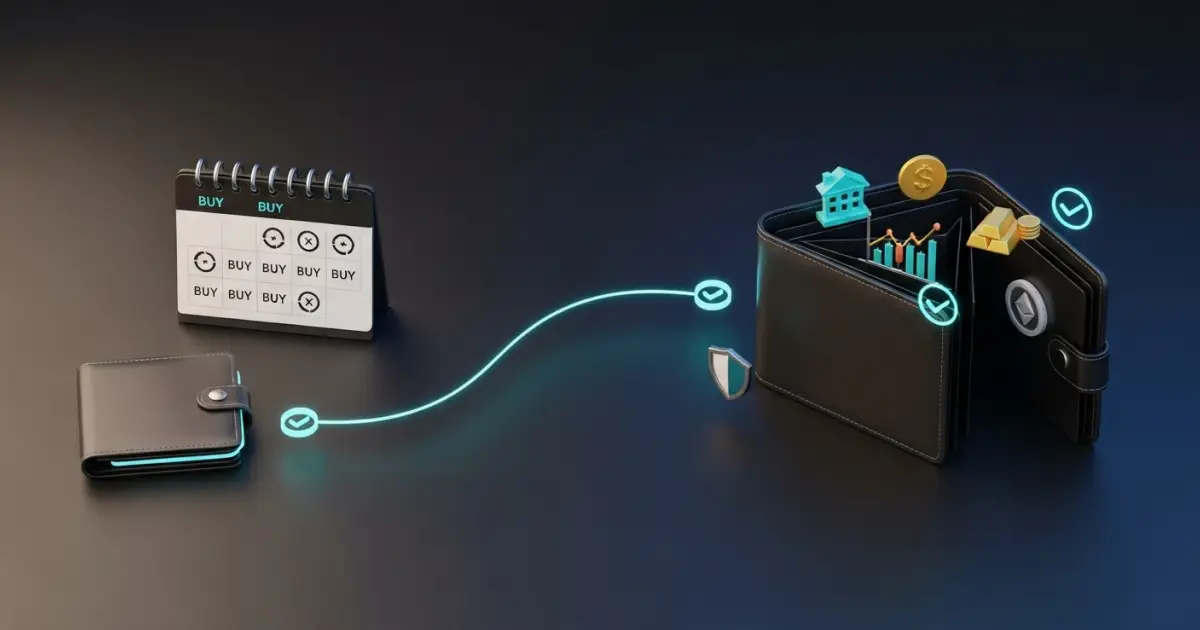
How a crypto demo trading account works: real-time market data drives simulated fills and live margin rules, while the virtual balance stays permanently isolated from your real wallet.
Can You Demo Trade Crypto? Real Market Data vs. Virtual Funds
Yes, and in 2026 the option is close to standard across major derivatives venues. Demo environments moved from a beginner nicety to a core onboarding product, which is why funded balances keep getting larger and coverage keeps widening from perpetuals into spot.
What separates them is product coverage, whether the demo mirrors the live interface, and whether the costs that decide your real P&L are actually charged. This snapshot compares the main routes available as of August 2026:
Platform | Starting virtual balance | Products covered | Costs simulated | Reset policy | KYC to start |
Bitunix Demo Trading | 50,000 USDT, fixed | USDT-M perpetual futures, isolated and cross margin | Maker/taker fees at your live VIP tier, real-time funding, full live liquidation rules | Manual reset to 50,000 USDT at any time | Not required |
Bybit Demo Trading | 50,000 USDT + 50,000 USDC + 1 BTC + 1 ETH | Spot, derivatives, options | Fees and funding applied | Top-up on request below 10,000 USDT equity | Not required |
Binance Demo Trading | Virtual funds; amount not publicly disclosed | Spot + Futures | Trading simulation; market data, order-book pricing, and execution may differ from live trading | Virtual funds can be replenished or reset within the Demo Trading environment | Not required |
OKX Demo Trading | Preset virtual balance | Spot, futures, options, bots | Fees and funding applied | Reset available in-app | Not required |
TradingView Paper Trading | Configurable | Whatever the connected chart covers | Basic; venue-specific costs not fully modeled | Reset in the panel | Not required |
Note the asymmetry. A refillable 50,000 USDT balance and a fixed 3,000 USDT balance teach very different lessons. The larger balance is better for exploring product breadth; the smaller one is closer to the account size most traders actually start with, which makes position sizing feel real. Section four covers how to fix that gap when the platform will not let you size the balance down.
The other split worth checking before you invest three weeks of practice: whether the demo covers the product you actually intend to trade. Bitunix scopes its demo to USDT-M perpetuals only, which is narrow on paper and well targeted in practice, because perpetuals are where leverage, funding and liquidation logic all bite at once. A spot-only simulator will not teach you any of that.
Broader demos that include spot are useful for absolute beginners, but spot practice teaches none of the four mechanics that actually end derivatives accounts.
Why Use a Free Demo Trading Account Before Trading Live
The obvious answer is "so you don't lose money." That undersells it. The real value is that demo trading lets you separate two failure modes that are impossible to untangle once real money is involved: my strategy was wrong and I operated the platform wrong. Those require completely different fixes.
Risk-Free Execution: Mastering Futures Mechanics Without Capital Loss
Execution is a motor skill. In a fast tape, the trader who has to hunt for the reduce-only checkbox is already late.
A structured demo phase should cover, at minimum:
Order types end to end. Market, limit, post-only, stop-market, stop-limit, trailing stop, and take-profit/stop-loss attached at entry. Place each one at least twice and watch how it behaves.
Margin modes. Isolated caps your loss at the margin allocated to that position. Cross draws on the whole account balance and can take everything with it. Traders who learn this distinction live tend to learn it during a liquidation.
Hedge versus one-way mode. In hedge mode you can hold a long and a short on the same contract simultaneously, which is the foundation of most hedging workflows.
The liquidation price. Open a position, then watch where the platform prints your liquidation level. Change the leverage and watch it move. This single exercise teaches more about leverage than any article, including this one.
"Risk-free" here describes your capital during the practice phase and nothing else. It is not a claim about outcomes, and nothing about the underlying market becomes safer once you switch to live.
Testing Leverage and Risk Management in High-Volatility Conditions
Leverage is not a return multiplier. It is a distance-to-liquidation setting, and traders consistently underestimate how little room high leverage leaves.
The August 22 flush illustrates the point exactly. Bitcoin fell roughly 3% from its high near $79,500 — an ordinary intraday move by any standard. It still erased more than $475 million in long positions, because the market had piled into leverage on the way up. The move did not need to be large. The positions were simply too geared to survive it.
Before you touch a leverage slider with real capital, internalize the distances involved. The table below shows the approximate adverse move that puts an isolated-margin position at its liquidation level, ignoring fees and maintenance margin for clarity:
Leverage | Approx. move to liquidation | Survives the Aug 22 fade (-3%)? | Survives the Aug 19 squeeze (-8%, short side)? |
3x | ~33% | Yes | Yes |
5x | ~20% | Yes | Yes |
10x | ~10% | Yes | Marginal |
20x | ~5% | Yes | No |
50x | ~2% | No | No |
100x | ~1% | No | No |
Read the right-hand columns again. At 50x, an ordinary 3% retrace ends the position before your thesis has had a chance to be right or wrong. On August 19, when more than $1 billion of Bitcoin shorts were closed inside roughly an hour and short liquidations across the market approached $2.7 billion in 24 hours, anything above 20x on the short side was mechanically dead.
This is what a demo account is for. Run the same setup at 5x, 20x and 50x across a volatile week and log which ones survive noise that has nothing to do with whether your directional read was correct. Then carry the conclusion into live trading: During news-driven volatility, traders may use perpetual contracts to trade either direction of the move, but the position only survives if leverage and position size are matched to the instrument's actual volatility.
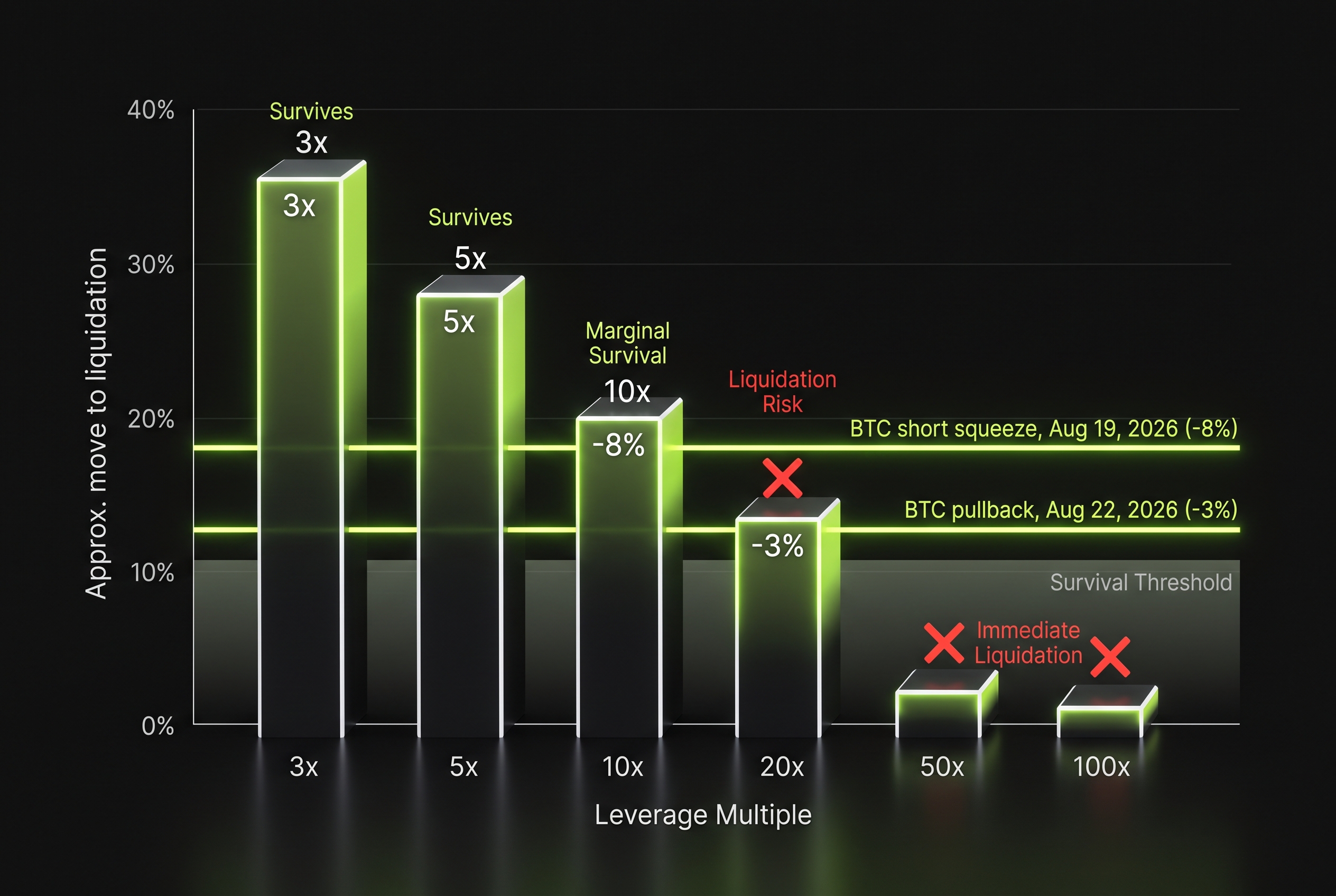
Distance to liquidation by leverage tier, mapped against Bitcoin's actual August 2026 moves: at 50x leverage, a routine 3% retracement is a full liquidation event.
Demo Account Trading vs. Live Trading: The Psychological Gap
Here is the uncomfortable part. Demo account trading reproduces the market almost perfectly and reproduces the trader almost not at all.
Three gaps show up consistently when people cross over:
Position sizing inflation. Virtual capital invites experimentation, which is the point, but it also normalizes sizes you would never take live. A trader comfortable risking 20% of a demo balance often finds that risking 2% of real capital produces more physical stress than the demo trade ever did.
Loss aversion asymmetry. Behavioral research has consistently found that losses register roughly twice as strongly as equivalent gains. That coefficient sits near zero when the money is virtual. Cutting a losing demo trade is trivially easy. Cutting a real one at the same level is the hardest habit in trading.
Absence of opportunity cost. In demo, a blown account is a reset button — In a demo environment, a blown account can usually be reset or replenished. In live trading, drawdown is permanent capital and permanent time, and it changes how you size the next trade whether you want it to or not.
None of this makes demo trading pointless. It makes the sequence matter: use demo to remove mechanical errors and validate a rule set, then use small live size to build the emotional tolerance that no simulator can give you.
How to Do Demo Trading: A 5-Step Getting Started Guide
A demo account left unstructured turns into a video game inside a week. What follows is a program with an entry point, a measurable objective and an exit condition. Budget three to six weeks and treat it like a job.
Step 1: Selecting a Reliable Crypto Demo Trading Platform
Not all simulators teach the same lessons, and a badly built one teaches actively harmful ones. Score any candidate on these six criteria:
Interface parity with live. The demo should be the same order panel with a different balance. If it runs on a stripped-down page, your muscle memory transfers to nothing. Check how you get back, too — a clearly labelled "Back to Live" control matters more than it sounds, because switching modes is exactly where accidental real orders happen.
Product coverage. If you intend to trade perpetuals, a spot-only simulator is the wrong tool.
Fee and funding simulation. Ask whether taker fees and funding payments are actually deducted. If they are not, your demo P&L is systematically overstated and short-horizon strategies will look far better than they are. For example, Bitunix charges demo fees at live VIP rates — 0.02% maker and 0.06% taker at VIP 0 — and books real funding payments into the simulated history, so the P&L you see is already net of the two costs beginners forget.
Liquidation fidelity. This matters more than fill realism. Confirm the venue replicates live maintenance margin and liquidation logic rather than a simplified version, because that is the mechanic most likely to end a live account.
Reset policy. Resets are useful. Unlimited instant resets quietly train you to ignore drawdown, so the discipline has to come from you.
Mobile parity. Most crypto positions get managed on a phone at some point. Bitunix ships demo trading in the iOS and Android app specifically, which is a fair reflection of where the panic-close actually happens.
Step 2: How to Create a Demo Account for Crypto Trading
The process takes a few minutes and is broadly similar across venues. Using Bitunix as an example, the process looks like this:
Register or log in. An email or phone number is enough. Identity verification is not required to reach the demo environment, though Bitunix has required KYC for withdrawals since July 1, 2026, so you will complete it before moving real funds.
Enable two-factor authentication immediately. Do it now, while the account is empty and the habit costs nothing.
Open the Futures page in the app and tap the "…" button in the upper-right corner to open the Quick Access menu.
Tap the Demo Trading icon. On first entry you will see a short onboarding card covering the three things that define the environment: 50,000 USDT in virtual funds, 1:1 matching with live rules, and reset at any time. Tap Start Demo Trading.
Confirm which mode you are in before every session. Bitunix prints a "Demo" label on the page for exactly this reason. Placing a live order believing you are in demo is one of the more expensive beginner mistakes, and switching back and forth all day is how it happens. When you are done practicing, the "Back to Live" button in the upper-right corner returns you to real trading.
Two constraints worth knowing before you build a routine around it. One master account maps to one demo account, so you cannot run parallel demo accounts and report only the one that worked. And copy trading and grid bots are outside the current demo scope, so automated strategies still need backtesting or small live size to validate.
Step 3: Navigating Your Virtual Balance and Dashboard
Spend the first session touching nothing but the interface. Before placing a single order, be able to locate: available balance versus margin balance versus total equity; unrealized P&L on open positions; realized P&L in the trade history; the current funding rate and the countdown to the next funding timestamp; and the position tab showing entry price, mark price, estimated liquidation price and margin ratio.
Funding deserves special attention because it is the cost beginners never model. As of August 24, 2026, the average Bitcoin perpetual funding rate sat around +0.0089% per eight hours, roughly 9.7% annualized, paid from longs to shorts. Hold a leveraged long through a persistently positive funding regime and that bleed compounds against you regardless of direction.
If your simulator synchronizes real funding rates and books the payments, read those entries in the transaction history rather than skipping past them. If it does not, calculate the cost manually and subtract it from your results.
Step 4: Placing Orders, Setting Stop-Losses, and Managing Risk
Now trade, but under written rules. Before each entry, write down four things: the invalidation price, the target, the resulting risk-to-reward ratio, and the position size that keeps the loss at or under 1% of account equity if the invalidation hits.
That last calculation is the whole discipline in one line:
Position size = (Account equity × risk %) ÷ distance from entry to stop
With 10,000 USDT of equity, a 1% risk budget and a stop 2% away from entry, the position is 5,000 USDT of notional. Leverage then becomes a byproduct of that math rather than an input you choose emotionally.
Attach the stop-loss at the moment of entry, in the same order ticket. Not afterwards. The gap between "I'll set it once I see how it trades" and "I'll give it a bit more room" is where accounts die, and demo is where you find out whether you are the kind of trader who widens stops under pressure. Practice the full position workflow while you are there: reviewing margin, fee and estimated liquidation price on the confirmation screen before you tap through, attaching TP/SL after the fill, adding to a position, and closing with one click.
Step 5: Tracking Trade History and Calculating Win Rates
An untracked demo account produces feelings, not evidence. Export or screenshot the trade history weekly and compute the metrics that actually describe an edge:
Metric | How to calculate it | What to look for |
Win rate | Winning trades ÷ total trades | Useful only alongside average R; a high win rate alone proves nothing |
Average R multiple | Average win ÷ average loss, measured in units of initial risk | Above 1.5R gives a low win rate room to work |
Expectancy | (Win rate × avg win) − (loss rate × avg loss) | Must be positive after fees and funding are deducted |
Profit factor | Gross profit ÷ gross loss | Below 1.0 means the system loses money regardless of how it feels |
Max drawdown | Largest peak-to-trough fall in equity | Compare it to the drawdown you know you can sit through live |
Rule adherence | Trades that followed your written plan ÷ total trades | The leading indicator for everything above; target 90%+ |
A 40% win rate with an average 2.5R winner beats a 70% win rate that gives back everything on two oversized losers. Rule adherence decides all of it: a profitable system executed at 60% adherence is not your system, and its results will not transfer to live capital.
Common Pitfalls to Avoid in Crypto Demo Trading
Most demo accounts fail not because the simulator is inaccurate, but because the trader uses it in a way that guarantees the lessons will not transfer. Two patterns account for the majority of it.
The "Monopoly Money" Trap: Taking Excessive Risk with Virtual Capital
Virtual capital has no emotional weight, so behavior drifts. Traders open 100x positions "to see what happens," average down endlessly into losers, and hold through drawdowns they would never tolerate live. The balance recovers or gets reset, and the trader concludes the approach works.
It does not work. It survived because the account had unlimited lives.
Three fixes make demo results transferable:
Size the demo account to your real account. Most demo balances are fixed and cannot be adjusted. So impose the constraint yourself: if you plan to start live with 1,000 USDT, treat only 1,000 of the 50,000 as tradeable and calculate every position size against that figure. A 20% return on a balance fifty times larger than your real capital is not a rehearsal.
Impose a hard stop on resets. One reset, maximum, and only after a written post-mortem on what broke. Many platforms let you reset the virtual balance whenever you want, from the Assets page, and that convenience is exactly the thing to ration. If you would not fund a real account three times in a month, do not reset a demo one three times either.
Trade the size you will actually trade. Not the size the balance permits. This is the single change that makes the psychological handover survivable.
Overlooking Real-World Market Factors (Slippage, Fees, Liquidity)
The second trap is structural. Demo environments idealize execution, and the gap between simulated and real fills falls almost entirely on the trader's side of the ledger.
Slippage. This is the one to internalize, because most demo environments match orders internally against real-time prices without touching the live order book, which means no slippage is applied at all. That is the correct design decision for a simulator, since simulated orders should never distort real market depth. It also means the price on your screen is the price you get, every time, which the live market will not promise you. Correct for it by adding a realistic haircut to every simulated market-order fill and by defaulting to limit orders where your strategy allows.
Fees. Taker fees are small per trade and brutal in aggregate. Thirty round trips a month at 0.06% on both legs is a meaningful annual drag on a small account. Where the demo charges live fee rates, your P&L already reflects this; where it does not, any high-frequency strategy that looks profitable needs re-checking against the real schedule before it goes near live capital.
Funding. Covered above, and worth repeating because it is the cost most simulations skip entirely.
Liquidity and depth. This is the factor traders discover last and pay for most. The August 2026 sequence is a case study. Bitcoin had spent six weeks compressed roughly between $62,000 and $67,000 with realized volatility grinding down — VanEck's mid-August ChainCheck put 30-day realized volatility at 27.2% annualized against a long-run average near 80%. Thin resting supply above the range meant that when the breakout came, price gapped through levels rather than trading through them. A stop-loss resting at $67,000 in that tape does not necessarily fill at $67,000.
Which is why the venue itself is part of your risk management, not a neutral container for it. Order book depth determines your real slippage, and a strategy validated in a frictionless simulator needs a venue with genuine depth to reproduce those results. When you graduate to live size, evaluate market depth and spread on the specific pairs you trade during your actual trading hours, not the exchange's headline volume figure.
Transitioning from Demo Account Trading to Live Crypto Markets
The handover is where most of the value in a demo phase is won or lost. Move too early and you are paying real money for lessons the simulator would have taught for free. Stay too long and you accumulate confidence that has never been stress-tested by loss aversion.
Key Metrics: How to Know You Are Ready to Trade Real Capital
Readiness is a checklist, not a feeling. Practitioners commonly suggest logging at least 30 to 50 practice trades across varied market conditions before switching to live capital, and the "varied conditions" clause carries most of the weight. Fifty trades inside a single quiet range prove nothing about how your system handles a breakout week.
Clear all six of these before funding a live account:
[ ] 50+ demo trades logged, spanning at least one trending phase and one range-bound phase.
[ ] Positive expectancy after realistic costs, with taker fees and funding accounted for rather than assumed away.
[ ] Max drawdown inside your written tolerance, and you know the exact number rather than a vague sense of it.
[ ] Rule adherence above 90%, verified from the trade log rather than from memory.
[ ] No resets in the final two weeks. A blown demo balance in week five resets the clock.
[ ] A written trading plan covering setups, invalidation logic, position sizing and a maximum daily loss limit.
If you fail one, you are not ready. That is not a setback; identifying the failure in a simulator is the entire return on the exercise.
One structural note before you switch: demo volume does not count toward VIP progress on Bitunix, and the same is true on most venues. Your fee tier is earned with live volume only, so do not expect the practice period to buy you anything except skill.
Micro-Trading: Starting Small to Master Real-Money Emotions
Do not go from 50,000 virtual USDT to a meaningful live position in one step. Insert a micro-trading phase, where the size is small enough that the outcome is financially irrelevant and large enough that it is emotionally real. The switch is often only a click or tap, which makes it easy to move too fast. Slow it down deliberately.
Two or three weeks at minimum position size is usually enough to expose the honest gaps. Watch for the tells: checking the position more often than your timeframe justifies, moving a stop after entry, closing a winner early because green numbers feel fragile, sizing up after two wins. Every one of those is invisible in demo and obvious with real money on the line.
Scale in stages, and make each stage conditional. A workable ladder: minimum size until you hold rule adherence above 90% for 20 live trades, then 25% of target size for another 20, then 50%, then full. Any breach of your daily loss limit drops you back a rung. The ladder is boring by design, and boring is the point.

The demo-to-live progression ladder: each promotion from demo account trading to full position size is earned with logged trades and rule adherence, never with a winning streak.
Choosing an Execution Venue: Liquidity, Order Tools, and Strategy Testing
The venue you graduate onto shapes the results of everything you practiced. Three criteria matter more than promotional headlines.
Depth and execution quality. Your simulated fills assumed the price on screen was available. Whether that holds live is a function of order book depth and spread on your specific pairs during your specific trading hours. A derivatives-focused venue built around market depth, tight spreads and minimal slippage will reproduce your demo results more faithfully than one with a long asset list and a thin book. Compare market depth and spreads on the specific pairs you trade rather than relying on headline trading volume.
Risk tooling in the order ticket. The stops and sizing rules you drilled in demo need first-class support live. Look for take-profit and stop-loss attached at entry, hedge mode for running offsetting positions, chart-based order management so you can drag stops on the chart itself, and pre-trade maximum-loss controls. The more of this risk management can be built directly into the order workflow, the less you have to rely on discretionary decisions once the trade is live.
Continued strategy testing after you go live. Practice does not end at the first real trade. Native backtesting and parameter-optimization tools let you keep validating leverage settings and stop-loss thresholds against historical data without cycling back to a simulator, the demo environment stays available for testing an unfamiliar setup before you commit size to it, and structured education through resources fills gaps that a simulator does not surface on its own.
There is also a hedging workflow worth building into the plan early, because it is the natural sequel to everything above. When a rally driven by news runs ahead of itself, spot holders do not have to choose between selling and riding the retrace. Holding the spot position while opening a modest perpetual short of appropriate size offsets downside exposure and locks in book profit — precisely the scenario that played out on August 22, when a 3% fade from the highs liquidated more than $475 million in longs. Practice the mechanics of that hedge in a demo environment first, using the same isolated or cross margin mode you intend to run live. The sizing errors are cheap there and expensive afterwards.
Finally, verify the fundamentals of any venue before funding it: proof-of-reserves disclosures, custody arrangements, security controls, applicable regulatory registrations, and any insurance or user-protection mechanisms. Execution quality is worthless if the platform holding your collateral is not sound.
Putting the Practice to Work
Crypto demo trading solves a specific, bounded problem. It removes mechanical errors, teaches liquidation math at zero cost, and gives you enough logged trades to know whether a rule set has positive expectancy. It does not teach loss aversion, opportunity cost or the discipline to hold a stop when real money is moving against you. Those come from small live size and nowhere else.
The sequence that works: run a structured demo trading account for three to six weeks, log 50-plus trades across different volatility regimes, verify expectancy after realistic fees and funding, then step down to micro live size and climb the ladder slowly. Practice first, trade later — in that order, with the trade log as the evidence.
Weeks like August 19 to 22, 2026, when billions in leveraged positions were erased on both sides of the book inside four days, will keep happening. The traders who survive them are not the ones who guessed direction correctly. They are the ones whose position sizing and stop placement were already automatic before the volatility arrived.
Note: Market data referenced is current as of August 26, 2026, and past market behavior is not a reliable indicator of future results.