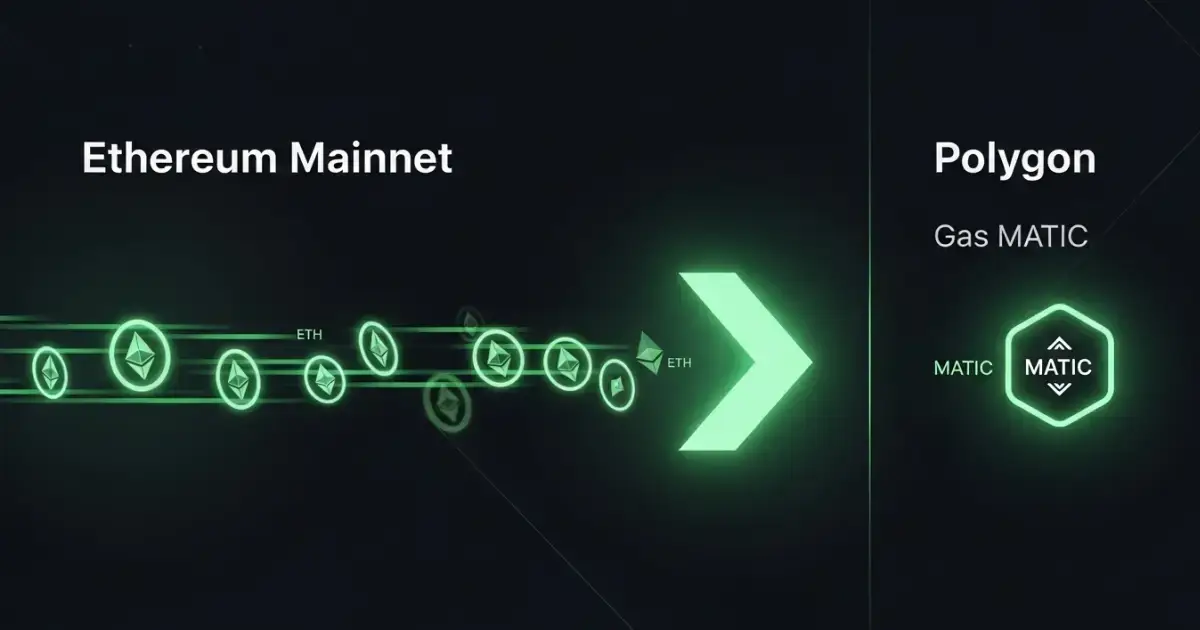
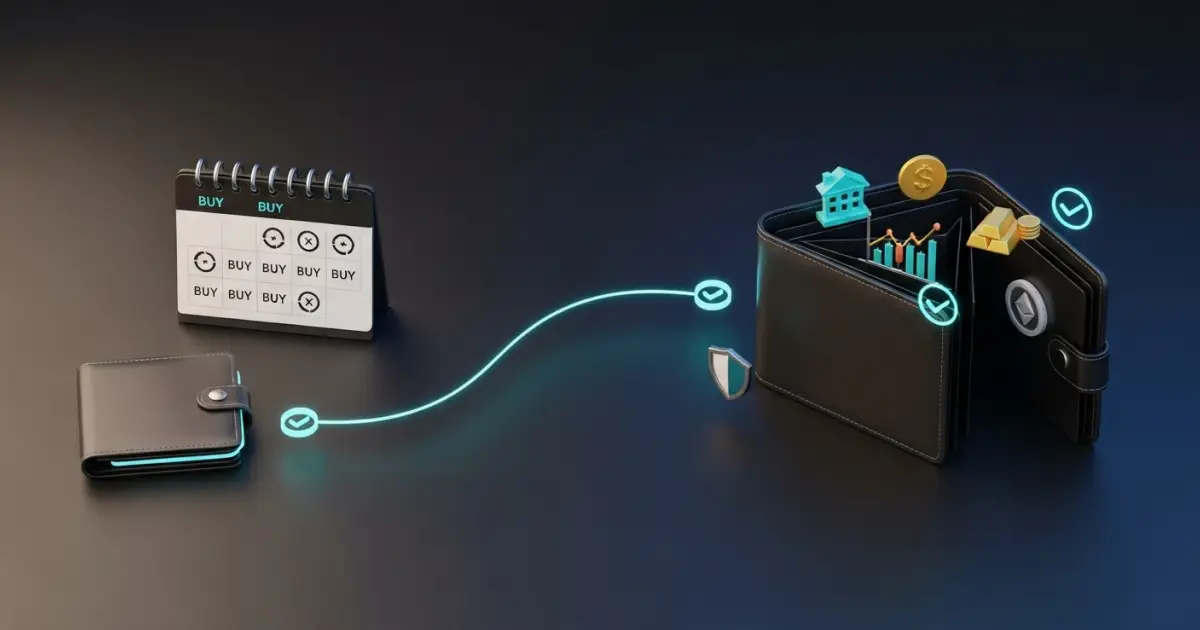
Bitcoin broke out of a weeks-long lull on the morning of August 19, 2026, climbing from around $64,300 to clear $69,500 by the end of the trading session. The rapid upward movement triggered massive cascading liquidations, wiping out over $1 billion in short positions in under an hour. Anyone without crypto price alerts running found out the next morning, after the move was already priced in.
That is the entire argument for automated monitoring, compressed into 60 minutes.
The rally kept going. Bitcoin cleared $72,000 on August 20, printed roughly $77,300 on August 21, and traded near $78,976 on the morning of August 24, according to Fortune's daily pricing snapshots. Across the August 19–20 window, The Kobeissi Letter counted about $3.5 billion in total liquidations, with more than $3 billion of that coming from short positions, and roughly $280 billion added to total crypto market capitalization in 24 hours. Bloomberg, citing CoinGlass, put the single-day short liquidation figure at a record $2.7 billion, the largest in records going back to 2021.
Then the market did what it always does to people who arrive late. On Saturday, August 22, XRP wicked down roughly 37% in minutes and took about $500 million in leveraged longs with it, days after rallying more than 60% in a week.
Quiet for six weeks. Repriced 20% in 48 hours. Flash-crashed on a weekend. In volatile conditions, a reliable alert system isn't just a convenience — it's core trading infrastructure.
To get the most out of your monitoring stack, it helps to understand how price alerts function behind the scenes, how to tailor setups to your specific trading style, and which strategies are actually worth automating. We'll also break down the common configuration traps that compromise alert accuracy, along with how to choose between native exchange tools, charting platforms, and third-party apps.
What Are Crypto Price Alerts and How Do They Work?
At the simplest level, a crypto price alert is a conditional statement that something else is watching on your behalf: if BTC/USDT trades above $80,000, notify me. The interesting part is not the condition. It is everything between the trade printing on an exchange and the notification landing on your phone, because that chain determines whether your alert is a trading tool or a news update.
The Mechanics of Automated Market Monitoring
Every alert system, from a free mobile tracker to an institutional monitoring desk, is built from three components:
A data feed. Where the price comes from. This might be a single venue's order book, a mark price, or a volume-weighted index blended across exchanges. Different sources produce different numbers during volatile moments, sometimes by a full percent or more.
An evaluation engine. What checks the condition, and how often. Tick-by-tick streaming engines evaluate on every trade. Polling engines check every 10, 30, or 60 seconds. Candle-close engines only evaluate when a bar completes.
A delivery channel. Push notification, email, SMS, Telegram, Discord, or webhook.
The evaluation model matters more than most traders assume. A tick-based alert on BTC at $70,000 fires on the first wick that touches the level, including a one-second liquidity sweep that immediately reverses. A close-based alert on the same level ignores that wick entirely and only fires if the candle actually closes above it. Same "price alert," completely different information.
Which price the engine reads is the second variable. During the August 19 squeeze, the gap between last-traded price on individual venues and blended index prices widened noticeably as forced buying hit thin books. If your alert reads an aggregated index but you execute on a specific venue, you are being notified about a price you cannot necessarily trade.
Why Manual Screen-Watching Fails in 24/7 Crypto Markets
Crypto never closes. There are 8,760 hours in a year, and equities traders get a bell; crypto traders get a Saturday like August 22, when XRP lost more than a third of its value while most of the Western hemisphere was doing something else.
Human attention does not scale to that. It degrades in a specific and predictable pattern: focus is high during a position's first hours, drifts during consolidation, and is at its absolute lowest right before the move that matters. Range-bound markets train you to stop looking. Then volatility arrives precisely because everyone stopped looking.
Look at the sequence again. Bitcoin traded around $62,800 on August 14 and roughly $64,300 five days later. Ten days of nothing. Then more than $1 billion in shorts cleared in about an hour on August 19, and the entire repricing to $78,000+ took under 72 hours. There was no version of manual monitoring that caught that reliably. There was only the version where a server was watching.
Server-Side vs. Client-Side Notifications: Understanding Latency
This is the distinction that separates alert systems that work from alert systems that feel like they work.
Server-side alerts live on the provider's infrastructure. The condition is evaluated on their machines, continuously, whether your phone is charging in another room or your laptop is closed.
Client-side price alerts fail far too easily.
Why? Because they rely entirely on your local device state:
Active App: The platform must remain open in your browser or app.
RAM Allocation: Your device can't swap the app out of memory to free up resources.
OS Power Rules: Battery-saver features frequently put background tasks to sleep right before a big market move.
Modern mobile systems routine wipe out background tasks to save battery—which is why lightweight trackers constantly get complaints about missed alerts.
Once an alert fires, the delivery channel adds its own latency and its own failure modes. The table below compares the main delivery methods on the two dimensions traders actually care about: how fast the message arrives, and how likely it is to arrive at all.
Delivery channel | Typical latency | Reliability profile | Best use |
Webhook | Sub-second to ~2s | Highest, if the receiving endpoint is up | Automated execution, bot pipelines |
In-app / push notification | ~1–10s | High, subject to APNs/FCM queuing and Do Not Disturb | Active trading, breakout triggers |
Telegram / Discord bot | ~1–5s | High, but bot rate limits apply during mass triggers | Team monitoring, on-chain flow alerts |
SMS | ~5–60s | Carrier-dependent, degrades under network load | Critical stop-loss and margin warnings |
Email | ~30s–5min | Reliable delivery, unreliable timing | Position reviews, end-of-day summaries |
Notice the pattern: the channels you are most likely to see are not the channels that arrive fastest. A trader who routes breakout alerts to email has effectively built a very sophisticated system for finding out what happened.

How crypto price alerts travel from the exchange matching engine to your phone: server-side alerts stay live even when your device sleeps, while client-side alerts break at the delivery layer.
Simple Price Alerts vs. Condition-Based Market Signals
Most traders start with a number and stop there. That is a reasonable place to begin, and for some strategies it is genuinely enough. But a bare price level tells you that something happened, not what happened, and in a market where a 20% move can be manufactured almost entirely by forced short covering, the difference is the whole trade.
Static Price Triggers: Catching Round Numbers and Key Levels
Static triggers fire when an asset touches an absolute value. They work because markets genuinely cluster around specific numbers:
Psychological round numbers. $70,000 and $80,000 on Bitcoin, $2,000 on Ethereum, $1.50 on XRP. Resting limit orders and stop clusters pile up at these levels, which makes them self-reinforcing.
Structural levels from the recent range. Through early August 2026, Bitcoin was widely tracked as caught between roughly $62,500 support and a $65,000–$70,000 resistance band. Alerts at range boundaries are worth far more than alerts inside the range.
Moving-average confluence. Bitcoin's 200-day simple moving average sat near $69,031 on August 20, a level it had not sustained since October 2025. A static alert placed there was, functionally, a trend-regime alert.
Static triggers are also where most bitcoin price alerts and ethereum price alerts live for casual holders, and there is no shame in that. They are cheap, easy to reason about, and easy to audit later.
Multi-Factor Signals: Factoring in Indicators, Trendlines, and Structure
Condition-based alerts evaluate a state rather than a number. The common categories:
Indicator alerts: RSI crossing 70 or 30, MACD crossovers, moving-average crossovers, Bollinger Band expansion.
Drawing alerts: price touching a diagonal trendline, entering a marked supply zone, or breaking a channel. These matter because trendlines move over time, so the trigger level updates itself.
Candlestick pattern alerts: engulfing bars, hammers, and dojis detected on close, on a timeframe you specify.
Derivatives-context alerts: funding rate extremes, open interest spikes, large liquidation clusters.
On-chain alerts: whale transfers above a size threshold, exchange inflows and outflows.
Things get much more useful once you stack conditions together. Setting a trigger like "Alert me when BTC closes above $80k on the 4H and volume beats the 20-period average" is a world of difference from a simple price ping at $80,000. That extra layer of context cuts out almost all the fake-outs.
Moving Beyond Price: Why Context Matters for Trade Execution
August 19 is the cleanest recent illustration available.
A static alert at $66,000 told you Bitcoin was up. True, and nearly useless. A contextual alert stack told you something far more actionable: short liquidations were running above $3 billion, with shorts representing roughly 92% of all liquidations in that window per CoinGlass data; the Crypto Fear & Greed Index jumped from 41 (Fear) to 59 (Greed) in a single session; and roughly 44,300 BTC had been moved onto exchanges since the rally began, a classic profit-taking footprint.
That composite says: this is a mechanical squeeze with holders distributing into it, which is a very different setup from this is spot demand repricing the asset. One argues for chasing momentum with tight risk. The other argues for waiting for a retest. The price alone could not tell you which.
To make the trade-off concrete, here is how the two alert types compare across the dimensions that affect execution quality:
Dimension | Simple price alert | Condition-based signal |
Setup time | Seconds | 2–10 minutes per condition |
False positive rate | High, fires on every wick | Low, filters noise by design |
Information delivered | "Price reached X" | "Price reached X under Y conditions" |
Best timeframe fit | Any | Depends on the indicator's timeframe |
Failure mode | Alert fatigue, chasing wicks | Over-filtering, missing valid moves |
Typical user | Holders, DCA buyers, casual trackers | Active traders, systematic traders |
Neither is superior in the abstract. A long-term holder who wants to know when Bitcoin drops 25% from its local high does not need indicator confluence. A scalper trading breakouts on the 15-minute chart absolutely does.
How Different Trader Profiles Use Crypto Price Alerts
Alert configuration is downstream of holding period. A scalper and a multi-year holder can watch the same asset, at the same moment, and correctly build two completely incompatible alert stacks. Copying a setup from someone whose timeframe does not match yours is one of the fastest ways to end up ignoring your own notifications.
Day Traders & Scalpers: Volatility Spikes and Immediate Breakouts
Intraday traders care about rate of change more than absolute level. Their alert stack typically includes:
Percentage-move alerts on short windows. A 1.5% move in five minutes on BTC is a regime change; on a mid-cap altcoin it might be background noise. Calibrate per asset.
Volume surge alerts. Volume expansion above a rolling average, which is the earliest honest confirmation that a level break has participation behind it.
Session range breaks. Alerts on the high and low of the Asian session, which frequently define the day's initial liquidity pockets.
Funding rate flips. When perpetual funding swings sharply positive or negative, positioning has become crowded.
Scalpers also need alerts that arrive on the same screen where they can act. A notification that requires unlocking a phone, opening an app, finding the pair, and loading an order ticket has burned 20 to 40 seconds. On August 19, that window covered a meaningful chunk of a $1 billion liquidation cascade.
Swing Traders: Key Support/Resistance Retests and Daily Candle Closes
Swing traders hold for days to weeks, which means their single most valuable alert setting is evaluate on candle close, not on touch.
Ethereum through August 2026 shows why. ETH entered the month near $1,865 with $2,029 flagged as first major resistance. A touch-based alert at $2,029 would have fired on several intraday probes that resolved back down. The close-based version stayed quiet until the structure genuinely changed, then fired on August 20 as ETH rallied close to 20% on the day and settled above $2,200, closing near $2,282.
Priority alerts for this profile:
Daily or 4H closes above/below a defined level
Trendline breaks with a close-confirmation requirement
Retests of a previously broken level from the other side, which is where most swing entries actually live
Weekly candle closes for regime confirmation
Long-Term Investors (HODLers): Major Drawdowns and DCA Triggers
For investors accumulating over years, alerts serve a psychological function as much as a tactical one: they replace daily portfolio-checking with a defined set of conditions worth acting on. Everything else can be ignored without guilt.
Useful configurations here include drawdown alerts from a rolling high (say, 20% and 35% below the 90-day high), DCA level alerts at pre-planned accumulation zones, and portfolio-value thresholds that trigger rebalancing reviews rather than trades.
XRP illustrates the range these alerts have to cover. It entered August 2026 near $1.06 inside a descending channel, rallied more than 60% in a single week, flash-crashed roughly 37% on August 22, and was trading around $1.48 by August 25. An investor with XRP price alerts set at a sensible accumulation zone got a genuine opportunity notification during that wick. An investor with no alerts got a screenshot from a group chat the following Monday.
The table below maps the three profiles to the alert configurations that actually match their decision speed:
Profile | Holding period | Core alert types | Evaluation mode | Sustainable alert volume |
Day trader / scalper | Minutes to hours | % change, volume surge, session range breaks, funding flips | Tick-based | 10–20 active, high turnover |
Swing trader | Days to weeks | S/R closes, trendline breaks, indicator crossovers, retests | Candle close | 5–12 active |
Long-term investor | Months to years | Drawdown %, DCA zones, portfolio thresholds | Daily/weekly close | 3–8 active |
Core Trading Strategies Built Around Crypto Alerts
An alert is not a strategy. It is the trigger for a decision you already made, in advance, when you were calm. The strategies below share that structure: define the condition, define the response, then let the system watch.
The Breakout Confirmation Strategy: Filtering Liquidity Traps
The classic breakout failure is entering on the touch. Price tags a level, stops above it get swept, and the move reverses. Two-stage alerting is the standard fix.
Stage one is an approach alert set slightly before the level, roughly 0.3% to 0.5% away. This is a preparation signal, not an entry signal. It tells you to open the chart, check volume, check the order book, and check whether higher timeframes agree.
Stage two is the confirmation alert, and it requires more than price: a candle close beyond the level, plus volume above its rolling average, plus ideally a hold on the retest.
Bitcoin's break above $72,000 on August 20 is a good case study. Stage one would have fired well before the level. Stage two would have confirmed on the close, with volume that was unambiguous given the scale of forced buying. The trader who entered on the stage-one touch and the trader who waited for stage two ended up in the same direction, but with very different stop placement and very different risk.
When a break of this kind is driven by a news catalyst, volatility usually arrives in both directions before it settles. Traders positioning around that typically use spot or perpetual contracts on platforms like Bitunix to express a view in either direction, with a stop-loss order defined before entry rather than improvised afterward. Leverage compresses the time you have to think, which is precisely what you do not want during a liquidation cascade.

Two-stage breakout confirmation in practice: a touch-based crypto price alert fires on all three scenarios, while a close-plus-volume condition isolates only the confirmed break.
Range-Bound Trading: Alerting Boundary Touches and Reversals
Markets spend most of their lives going sideways. Bitcoin's entire early-August 2026 stretch between roughly $62,500 and $70,000 is the ordinary state of things, not the exception.
Range strategies invert the breakout logic. Instead of waiting for a level to break, you are waiting for it to hold. Practical configuration:
Set alerts slightly inside the range boundaries, not on them, so you get advance warning rather than a post-mortem.
Pair each boundary alert with an RSI or stochastic condition, so you are notified about a boundary touch with exhaustion rather than a boundary touch with momentum.
Always keep a break alert running on the opposite side. Ranges end, usually violently, and usually when positioning is most one-sided. The August 19 squeeze was the end of a range.
Risk Management: Protection Alerts for Stop-Loss and Portfolio Health
This is the category most traders skip, and it is the one that pays for the entire alert stack over a full cycle. Protective alerts monitor your exposure rather than the market:
Stop-proximity alerts that fire when price comes within a defined distance of your stop, giving you a moment to decide whether the thesis is still intact.
Margin ratio alerts on leveraged positions, set well above the liquidation threshold. Across August 19–21, more than $4 billion in short positions were liquidated over the week, per CoinGlass data. A margin alert is a chance to add collateral or cut size while you still have both options.
Portfolio drawdown alerts at the account level, which catch correlated damage that per-asset alerts miss entirely.
Unrealized profit alerts that prompt a review at pre-defined gain levels, which is the only reliable defense against watching a good trade round-trip.
That last one has a specific application in a market that has just run 20% in 72 hours. "Sell the news" is a real and recurring pattern: catalysts get priced in, leveraged bears get flushed, and then the market has to find genuine spot demand to justify the new level. Analysts covering the August rally explicitly flagged that question, noting that forced buyers are not new buyers.
Long-term holders who do not want to sell spot into that uncertainty sometimes hedge instead: opening a proportional short position in perpetual contracts on Bitunix, sized against the spot holding, locks in a portion of the paper gain while keeping the underlying position intact. It is a tool for managing exposure, not a directional call, and it carries its own funding and liquidation risks that need to be sized deliberately.
3 Critical Mistakes to Avoid When Setting Crypto Alerts
Almost every failed alert system fails in one of three ways, and none of them is a technology problem.
Notification Fatigue: The Danger of Over-Monitoring
The first week with a new alert app is euphoric. You set alerts on 30 assets, at five levels each, on three timeframes. Within a fortnight your phone is buzzing continuously, you have swiped away 400 notifications without reading them, and you have trained yourself to ignore the exact channel you built to command your attention.
The fix is an alert budget, treated as a hard constraint:
Cap active alerts at a number you can genuinely read. For most traders that is 8 to 15, not 80.
Tier them by delivery channel. Critical alerts (stop proximity, margin health) get SMS or a dedicated push. Informational alerts get email or a Telegram channel you check on your own schedule.
Delete alerts when the thesis expires. Stale alerts on levels that no longer matter are the primary source of noise in most setups.
Prefer one well-constructed multi-condition alert to five single-condition ones covering the same idea.
Setting Thresholds Too Close to Market Noise
An alert placed inside an asset's normal fluctuation band is not an alert. It is a random number generator with your phone number.
The correct approach scales the threshold to the asset's actual volatility rather than to a round number that feels right. Average True Range (ATR) is the standard tool: measure the ATR on your trading timeframe, then place alert buffers at some fraction of it, commonly 0.3× to 0.5× ATR away from the level you care about.
Volatility is not constant, so this has to be revisited. An alert buffer calibrated during a quiet range will be far too tight in a week where daily moves run 8% to 10%, which is precisely what happened between August 19 and 22. And the XRP flash crash is the extreme case: a 37% wick that reversed within minutes would have triggered every touch-based alert anywhere near it, most of which described a price that no longer existed by the time anyone read them.
Executing Orders Immediately on Price Push Without Volume Confirmation
The most expensive mistake is treating the notification itself as the signal.
An alert says a condition was met. It does not say the condition is durable, that liquidity supports a fill at that price, or that the move is driven by anything other than mechanics. August 19–21 makes that distinction unusually vivid. Analysts covering the rally were direct about it: traders forced to buy back shorts are not concluding that Bitcoin is worth more, they are covering a losing bet, and roughly $3.1 to $3.3 billion of short liquidations explain a large share of why price could move nearly 20% after weeks of compression.
Build a short verification routine and run it every single time before acting:
Check volume. Is the move backed by above-average participation, or is it thin-book drift?
Check the higher timeframe. Does a 15-minute break mean anything on the 4H chart?
Check the derivatives context. Are open interest and funding confirming a real positioning shift, or showing a crowded trade unwinding?
Check spread and depth. In fast markets, the price in the notification and the price you can actually fill at diverge.
That routine takes 30 to 60 seconds. It is the difference between a trigger and a decision.
Choosing the Right Crypto Alert Solution: Third-Party Apps vs. Exchange Native Tools
There is no single best crypto price alert app, because the three main categories optimize for different things: breadth of coverage, depth of conditions, and proximity to execution. Most serious traders end up using two of the three, deliberately.
Mobile Aggregator Apps: Pros and Cons
This category covers dedicated alerting services and the broader crypto price tracker app ecosystem: CoinMarketCap, CoinGecko, Delta, Cryptocurrency Alerting, and similar tools.
Strengths: very wide asset coverage including long-tail tokens, clean portfolio tracking across multiple wallets and exchanges, and usable free tiers. If you want a crypto price alert app free of charge for a handful of levels on major assets, this is where to start. Many also offer a crypto price alerts bot for Telegram or Discord, which is useful for teams and for routing alerts away from your main notification stream.
Limitations: prices are typically blended indices rather than the venue you trade on, so alerts can fire on a level your exchange never printed. Free tiers cap active alerts aggressively. And critically, there is no execution path. The alert arrives, and then you switch apps.
One clarification worth making, because it is one of the most common searches in this space: there is no true native bitcoin price alert on Google. Google Finance displays crypto quotes but does not offer configurable price-threshold notifications, and Google Alerts monitors keywords in published content, not market data. It is genuinely useful for news monitoring, which is a different job. For price thresholds you need a dedicated tool.
Technical Charting Platforms (e.g., TradingView Integration)
Charting platforms are where condition complexity lives. TradingView in particular supports alerts on indicators, custom Pine Script logic, drawing objects, and candlestick patterns, with webhook delivery that can drive external automation.
The constraints are worth knowing before you build your workflow around them. Per TradingView's own support documentation, active alert capacity is tiered: the Premium plan allows 800 active alerts (400 price plus 400 technical), while the Ultimate plan allows 2,000 (1,000 plus 1,000), with lower tiers capped considerably more tightly and free accounts limited to a small number of price alerts with no technical alerts or webhooks. Alerts on lower tiers also expire after a period and must be recreated. Pricing and limits change, so confirm current figures on TradingView's pricing page before committing.
The structural gap is execution. A TradingView alert has to reach your exchange through a webhook, a third-party bridge, or your hands. Every hop adds latency and one more thing that can be down at the worst possible moment.
Native Exchange Alerts: Eliminating Friction Between Signal and Execution
Exchange-native alerts solve the problem the other two categories share: the distance between knowing and doing.
The advantages are structural rather than cosmetic. The alert reads the same price feed that the matching engine uses, so the level in the notification is the level in the book. Tapping the notification opens the order ticket on the correct pair, with your position and margin already in context. There is no webhook chain to maintain and no API key sitting in a third-party service, which also removes a real security surface: any external tool with trade permissions on your account is a permission you have delegated.
The historical trade-off was capability. Exchange alerts used to mean a single price threshold and nothing else, which is why serious traders kept TradingView open in another tab. That gap has narrowed considerably as exchanges have shipped indicator, drawing, and pattern-based alerting natively.
Here is how the three categories compare on the criteria that determine which one belongs in your stack:
Criterion | Mobile aggregator apps | Charting platforms | Native exchange alerts |
Asset coverage | Broadest, including long-tail | Broad, venue-dependent | Assets listed on that venue |
Condition complexity | Basic price and % change | Highest: indicators, scripts, drawings | Moderate to high, improving fast |
Price source | Blended index | Selected venue feed | The venue's own feed |
Path to execution | None, manual app switch | Webhook or manual | Direct, one tap to order ticket |
Free tier usefulness | Good for a few alerts | Very limited | Generally included |
Security surface | Read-only, low risk | API keys if automating | No external key required |
Best role in a stack | Portfolio-wide monitoring | Strategy research and complex conditions | Live trading and risk alerts |
How to Set Crypto Price Alerts: A Four-Step Setup Checklist
Wherever you choose to set crypto price alerts, the configuration process follows the same logic. Working through these four steps in order prevents the majority of alert-stack failures:
Define the decision first, not the level. Write down what you will do if the alert fires. If the honest answer is "look at the chart," that is fine, but label it informational and route it accordingly. If there is no answer, do not set the alert.
Pick the trigger type deliberately. Touch-based for time-sensitive intraday levels, close-based for structural levels. Choose the timeframe explicitly rather than accepting the default.
Set the buffer using volatility, not intuition. Use a fraction of ATR on your timeframe. Recalibrate when volatility regime changes.
Route by priority. Critical risk alerts to the fastest, most intrusive channel available. Informational alerts to a channel you check deliberately. Then set a recurring reminder to prune dead alerts, monthly at minimum.
Advanced Market Monitoring: Upgrading Your Alert Workflow
Everything above assumes the alert is the hard part. For traders operating at any real size, it is not. The hard part is the seconds between the notification and the filled order, and that is where most retail alert stacks quietly leak money.
Why Execution Velocity Matters When an Alert Triggers
Run the arithmetic on August 19. More than $1 billion in Bitcoin shorts were liquidated in roughly one hour, and Bitcoin moved close to 8% on the day, its largest single-day gain since March. In a move of that shape, price is not walking to your level. It is gapping through liquidity pockets as forced buyers lift every offer.
Now count the steps in a typical retail workflow: notification arrives on a tracker app, unlock phone, read alert, open exchange app, authenticate, search the pair, load the chart, verify volume, open the order ticket, set size, set stop, submit. Even executed briskly, that is 30 to 60 seconds. During the fastest phase of that squeeze, 30 seconds was worth real basis points, and the spread you crossed was wider than the one you saw in the notification.
Two things reduce that gap. The first is collapsing the number of surfaces between signal and order, which is the entire argument for keeping your trading alerts on the venue where you actually trade. The second is market depth: on a thin book, a market order during a volatility spike fills materially worse than the quoted price, which is why execution venue quality stops being an abstraction exactly when it matters most.
Exploring Multi-Condition Alert Ecosystems
The direction of travel across the industry is toward alert systems that behave less like notification tools and more like monitoring layers sitting directly on top of the order book.
Bitunix's Super Alert is a reasonable reference implementation of that pattern, organized around eight modules: Templates for reusable configurations, Combo for multi-condition boolean logic, Price, Indicators, Drawing for trendline and zone triggers, Candlestick for pattern detection, TradingView integration for traders who prototype conditions there, and On-chain for wallet-level monitoring. The on-chain module is the least common of these: it monitors specified addresses for transactions above a size threshold (configurable from 100,000 upward), with position direction, frequency, and validity period all set per alert, and delivery routed to Telegram or Discord alongside in-app push.
The practical value is not any single module. It is that a condition built in the Drawing module and a condition built in the On-chain module can be combined in the same Combo alert, evaluated server-side, and delivered to a screen where the order ticket is one tap away. That collapses the research-to-execution chain that would otherwise span three separate products.
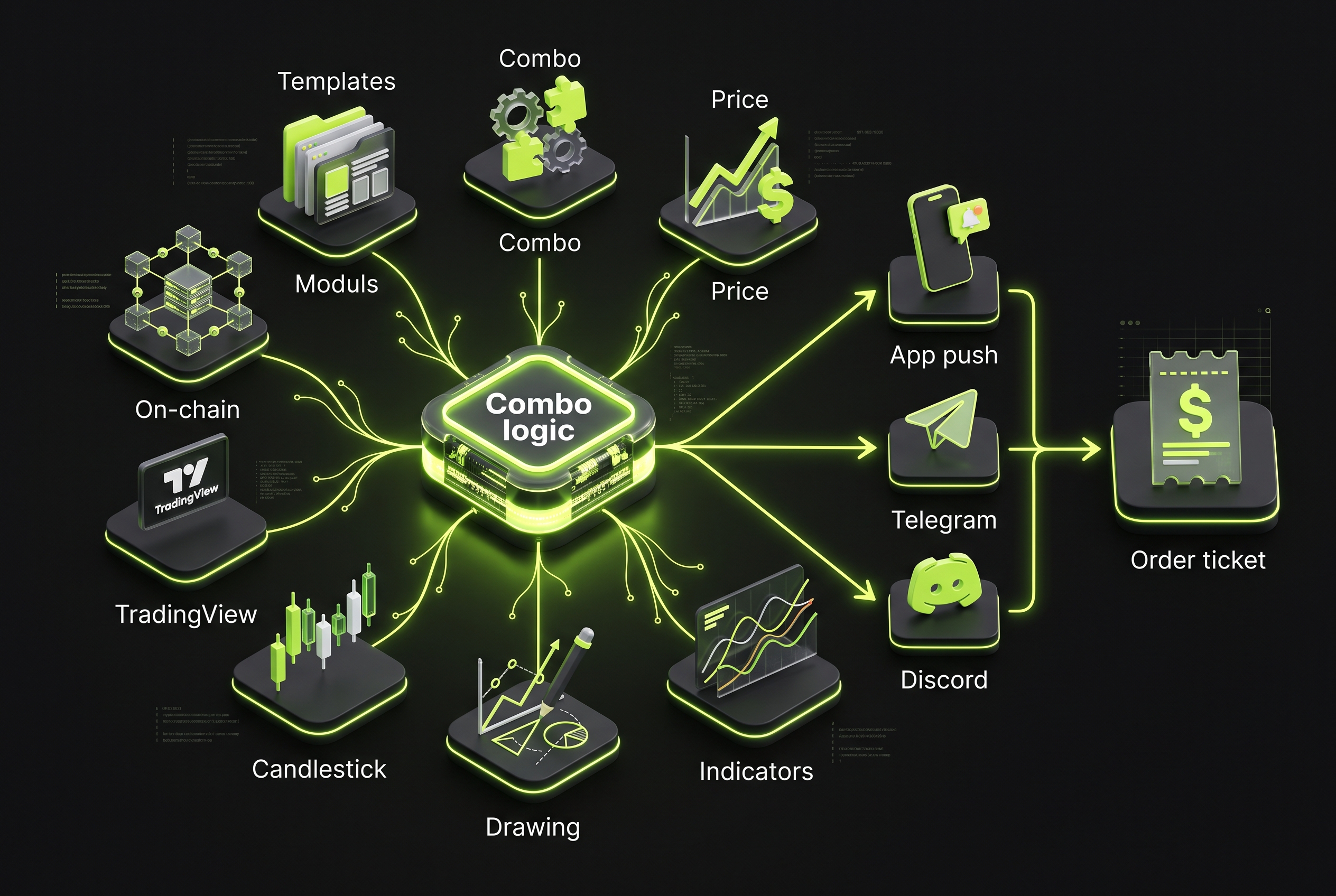
A multi-condition crypto price alert ecosystem: eight trigger modules feeding combined boolean logic, delivered server-side and connected directly to execution.
Turning Alerts Into a Repeatable Process
The traders who get value from crypto price alerts are not the ones with the most alerts. Top traders treat price alerts as a structured, written protocol:
Clear Triggers: Precise market conditions, not vague price zones.
Pre-Planned Execution: Knowing your exact move before the alert even fires.
Tiered Urgency: Routing high-priority setups to push notifications and low-priority ones to email.
Routine Pruning: Deleting dead or outdated alerts every single week.
Start narrow. Pick your three most important levels, define what you will actually do at each, choose touch-based or close-based deliberately, and route them properly. Add complexity only when a simple alert has demonstrably failed you. A stack of eight alerts you read beats a stack of eighty you swipe away, every cycle, without exception.
August 2026 will keep making the case on its own. Six quiet weeks, then $3.5 billion in liquidations in 24 hours, then a 37% weekend wick on XRP. The market does not schedule its volatility around your availability. The point of an alert system is that it does not have to.
Note: All market data is current as of August 25, 2026, and prices cited will have changed.