Have you ever placed a trade, watched it pending, and felt a sinking suspicion that the market moved just before it went through? That the price you got was somehow worse than expected?
What if I told you that hidden within the gears of every blockchain, a high-stakes, digital gold rush is happening 24/7? What if the reason was not only market volatility, but also the way blockchain transactions are processed?
Behind many blockchain networks, there is a competitive marketplace where specialized participants analyze pending transactions and attempt to extract value from transaction ordering. This process is known as Maximal Extractable Value (MEV).
MEV is not a bug or a single type of attack. It is a consequence of transparent blockchain design, where pending transactions can create opportunities for participants who understand transaction flows. Some forms of MEV support market efficiency, while others can negatively affect everyday users through higher costs or unfavorable execution.
Understanding what MEV crypto means, how MEV bots operate, and how traders can reduce related risks is an important part of navigating decentralized markets.
From Stone Tablets to Smart Contracts: What Exactly Is MEV?

In the simplest terms, MEV (Maximal Extractable Value) is the additional value that can be extracted from producing a blockchain block by strategically reordering, including, or excluding transactions.
Originally, MEV stood for Miner Extractable Value, because miners controlled transaction ordering in proof-of-work blockchain systems. After Ethereum transitioned to Proof-of-Stake, transaction ordering power shifted from miners to validators and the broader ecosystem of participants involved in block production.
As a result, the term evolved from "Miner Extractable Value" to "Maximal Extractable Value" to describe a wider range of participants who can influence transaction sequencing.
How Blockchain Transaction Ordering Creates MEV Opportunities
To understand MEV, it helps to understand the role of the mempool. When users submit blockchain transactions, those transactions are usually broadcast to a public waiting area called the mempool before being confirmed in a block.
Because pending transactions may reveal:
the asset being traded
transaction size
expected price impact
gas fee settings
Other participants can analyze this information and attempt to profit by changing transaction order.
For example:
Imagine a public bulletin board where traders post:
"I want to buy 10 apples for $1 each."
A market participant notices another seller offering:
"100 apples for $0.90 each."
The participant can buy the cheaper apples first and then sell them at the higher market price.
In blockchain markets, this process can happen through transaction ordering rather than physical inventory movement. The extracted difference represents MEV.
The Invisible Players: MEV Bots and How They Operate

The primary actors in the MEV ecosystem are often not individual traders but automated programs known as MEV bots.
These bots continuously monitor blockchain activity, searching for profitable opportunities such as arbitrage, liquidations, and transaction-ordering strategies.
A typical MEV process works like this:
1. Detection
A user submits a transaction, such as a large swap on a decentralized exchange (DEX).
Before confirmation, the transaction enters the mempool where it may become visible to MEV searchers.
2. Identification
An MEV bot analyzes pending transactions and identifies opportunities where transaction ordering could create profit.
For example:
A large token swap may move market prices.
A price difference may exist between two exchanges.
A lending position may become eligible for liquidation.
3. Execution
The searcher creates its own transaction and may compete for block placement by offering higher gas fees or using specialized transaction channels.
If successful, the bot captures the available value created by transaction ordering.
MEV Ecosystem Participants Explained
MEV involves several different participants:
Participant | Role |
|---|
Users | Submit transactions such as swaps or transfers |
Searchers | Use algorithms to identify MEV opportunities |
Builders | Package transactions into blocks |
Validators | Propose blocks and confirm transaction order |
This separation has become increasingly important as blockchain ecosystems develop new approaches to improve fairness and transparency.
The Dark Side of MEV: Common Attacks Every Trader Should Know

Not all MEV is beneficial. Some strategies directly affect regular crypto users by creating worse execution prices or additional costs.
Sandwich Attacks (The Most Common User-Facing MEV Attack)
A sandwich attack occurs when an MEV bot identifies a pending trade and places transactions before and after it.
The process usually works as follows:
The bot submits its own transaction before the user's trade.
For example, if a trader is buying a large amount of a token, the bot buys first, pushing the price upward.
The user's trade is processed at a higher price because the bot's transaction changed market conditions.
The bot sells the asset after the user's transaction, capturing the price difference.
The trader becomes the "filling" in the sandwich and receives a less favorable execution price.
Front-Running Crypto
Front-running crypto refers broadly to placing a transaction ahead of a known future transaction to benefit from expected price movement. Sandwich attacks are one type of front-running strategy, but front-running can also appear in other blockchain activities, including:
Arbitrage and Liquidations
Not all MEV is harmful.
Some MEV strategies improve market efficiency.
For example:
If a token trades at:
$100 on Exchange A
$102 on Exchange B
an arbitrage bot may buy from Exchange A and sell on Exchange B. This process helps move prices closer together across markets.
Similarly, liquidation bots in lending protocols can help maintain system stability by removing under-collateralized positions.
The Ripple Effect: How MEV Impacts the Entire Network

MEV competition can create broader effects beyond individual transactions.
Network Congestion
MEV searchers may compete aggressively for block space, increasing transaction fees during periods of high activity.
Failed Transactions
When transaction conditions change before confirmation, users may experience failed swaps while still paying network fees.
Transaction Ordering Competition
Because transaction ordering can influence outcomes, blockchain ecosystems continue exploring solutions that create fairer and more transparent ordering systems.
How MEV Affects Everyday Crypto Traders
For regular users, MEV-related risks often appear as:
Receiving fewer tokens than expected during swaps
Paying higher transaction costs during congestion
Experiencing failed transactions
Needing to adjust slippage settings carefully
MEV is usually not visible on the user interface, which is why understanding execution risks is important when trading on decentralized platforms.
Strengthening Your Trades: What Is MEV Protection in Crypto?
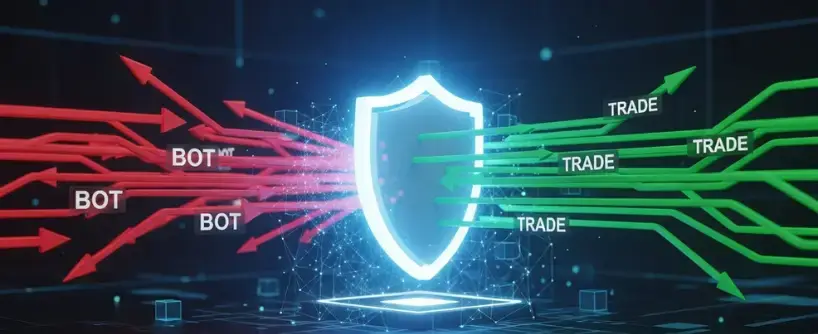
Now for the most important part: how can traders reduce their exposure to MEV attacks?
The crypto ecosystem has developed several approaches to mitigate harmful MEV effects. While no method can completely eliminate all transaction risks, these solutions can help users improve transaction privacy, reduce unnecessary price impact, and make more informed trading decisions.
When choosing an MEV protection method, traders should consider factors such as:
Different solutions provide different levels of protection depending on the trading environment.
Use DEXs with MEV Protection
Some advanced decentralized exchanges use mechanisms such as batch auctions, private transaction relays, or intent-based trading systems to reduce users' exposure to MEV attacks.
For example, batch auction systems group multiple trades together and execute them collectively, making it more difficult for MEV bots to identify and target individual transactions. Private transaction relays prevent transactions from being publicly visible in the mempool before execution.
These approaches can help reduce the likelihood of sandwich attacks and may improve execution quality by minimizing unnecessary price impact.
However, MEV protection does not guarantee a better price in every situation. Traders should still consider liquidity conditions, trading volume, and market volatility before executing transactions.
Private RPCs
Services such as Flashbots Protect provide private RPC endpoints that allow users to submit transactions through private channels instead of broadcasting them directly to the public mempool.
Normally, pending transactions in the public mempool can be observed by MEV searchers. Private RPC solutions aim to limit this exposure by sending transactions directly to participating block builders or validators.
Benefits may include:
Reduced exposure to certain front-running strategies
Lower risk of sandwich attacks
Improved transaction privacy
However, private RPC solutions are only one part of MEV mitigation. They do not remove all blockchain execution risks, and users should understand how each service works before relying on it.
Slippage Adjustments
Adjusting slippage tolerance is another practical way traders can reduce potential MEV impact, especially when using decentralized exchanges.
For example, setting a lower slippage tolerance (such as 0.5% instead of 3%) can make some sandwich attacks less profitable because the bot has less room to extract value from price movement.
However, traders should also understand the trade-off:
Lower slippage settings may reduce MEV exposure
Extremely low slippage may cause transactions to fail during volatile market conditions
Higher slippage settings may improve execution probability but increase potential price impact
A balanced slippage setting depends on factors such as asset liquidity, market volatility, and transaction size.
Additional Ways to Reduce MEV Exposure
Beyond technical protection tools, traders can also reduce MEV-related risks through better transaction practices:
1. Avoid Large Swaps in Low-Liquidity Pools
Large transactions create greater price impact and may attract MEV searchers. Splitting a large trade into smaller transactions or choosing deeper liquidity pools may reduce potential exposure.
2. Review Transaction Details Before Confirmation
Before approving a swap, users should check:
Expected output amount
Minimum received amount
Slippage tolerance
Network fees
Understanding these parameters helps users identify unexpected changes before submitting transactions.
3. Use Platforms With Transparent Execution Models
Different trading platforms use different mechanisms for transaction execution. Understanding whether a platform uses public mempools, private relays, or other routing methods can help users evaluate potential MEV exposure.
The Future of MEV: An Inevitable Force, But a Manageable One

MEV is not simply a bug that can be removed from blockchain networks. Instead, it is a natural consequence of transparent transaction systems where transaction ordering can create economic opportunities.
The challenge for the blockchain industry is not necessarily eliminating MEV entirely, but reducing harmful forms of MEV while preserving beneficial activities such as arbitrage and market efficiency.
Why MEV Is Difficult to Eliminate
MEV exists because blockchain networks need a mechanism to decide:
Which transactions are included in a block
The order in which transactions are processed
How block space is allocated during periods of high demand
As long as transaction ordering has economic consequences, participants will continue searching for opportunities created by that ordering.
Therefore, most MEV research focuses on making transaction ordering fairer and more transparent, rather than attempting to remove MEV completely.
The ecosystem is already exploring different approaches to reduce harmful MEV effects, including:
Encrypted mempools
Improved transaction ordering mechanisms
Private transaction channels
Better separation between block builders and validators
These innovations aim to create a more balanced environment where value created from transaction ordering is distributed more fairly among users and network participants.
Emerging MEV Mitigation Approaches
Proposer-Builder Separation (PBS)
One important development in Ethereum's MEV ecosystem is Proposer-Builder Separation (PBS).
PBS separates the responsibilities of:
Block builders, who organize transactions and create blocks
Validators, who propose and confirm blocks
This separation aims to reduce centralization risks and create a more competitive block-building environment.
Encrypted Mempools
Encrypted mempool designs aim to hide transaction details before confirmation. The goal is to prevent MEV searchers from seeing pending transactions and exploiting transaction information before execution.
However, encrypted mempools remain an area of ongoing research, with trade-offs involving transparency, performance, and implementation complexity.
Intent-Based Trading
Some newer decentralized trading systems use user "intents" rather than traditional transaction submission. Instead of directly specifying every execution detail, users express the desired outcome, and specialized solvers compete to provide execution.
This approach may reduce some forms of MEV exposure by changing how transactions are discovered and executed.
The Final Word: Trade Smarter, Not Harder
The world of MEV crypto can seem complex, but understanding how transaction ordering works can help users better evaluate blockchain trading risks.
MEV influences how transactions are processed, how decentralized markets operate, and why traders may sometimes receive different execution prices than expected.
Key Lessons for Crypto Traders
Understanding MEV does not mean avoiding every possible risk. Instead, it helps users make better-informed decisions by recognizing:
Why transaction execution prices may change
How pending transactions can create opportunities for MEV searchers
Why slippage settings matter
How different trading systems handle transaction ordering
When interacting with decentralized applications, users should consider transaction size, liquidity conditions, execution settings, and available protection mechanisms. By understanding what MEV is, how MEV bots operate, and how MEV protection works, traders can better navigate decentralized markets and make more informed choices.
The next time a transaction executes differently from expectations, remember that multiple factors may contribute to the outcome, including market volatility, liquidity conditions, network congestion, and transaction ordering mechanisms such as MEV.
About Bitunix
Bitunix is a global cryptocurrency derivatives exchange trusted by over 5 million users across more than 150 countries/districts. The platform is committed to providing a transparent, compliant, and secure trading environment for every user. Bitunix offers a fast registration process and a user-friendly verification system supported by mandatory KYC to ensure safety and compliance. With global standards of protection through Proof of Reserves (POR) and the Bitunix Care Fund, Bitunix prioritizes user trust and fund security. The K-Line Ultra chart system delivers a seamless trading experience for both beginners and advanced traders, while leverage of up to 200x and deep liquidity make Bitunix one of the most dynamic platforms in the market.
Bitunix Global Accounts
X | Telegram Announcements | Telegram Global | CoinMarketCap | Instagram | Facebook | LinkedIn | Reddit | Medium