Managing liquidity pool (LP) positions has become significantly more complex as DeFi expands across multiple chains, protocols, and automated market maker (AMM) designs.
A single liquidity provider may hold a stablecoin position on Curve, a concentrated liquidity position on Uniswap v3, a boosted pool on Balancer, and a yield optimizer vault across different networks. Each position has its own fee structure, reward mechanism, token exposure, and impermanent loss profile.
Without a dedicated LP portfolio tracker, it is difficult to answer basic but important questions:
How much is your liquidity position actually worth right now?
Are accumulated fees compensating for impermanent loss?
Which pools are generating real returns?
Which positions require rebalancing or attention?
Traditional crypto portfolio trackers can show wallet balances, but liquidity providers need deeper analytics. LP tracking requires smart contract data, position-level performance analysis, fee attribution, reward tracking, and historical records.
This guide explains how to choose the best portfolio trackers for liquidity pool positions in 2026, compares leading tools for different use cases, and provides practical workflows for monitoring DeFi liquidity strategies more effectively.
Introduction to Portfolio Tracking

Portfolio tracking is the process of monitoring digital assets, DeFi positions, and transaction history through a unified dashboard.
For liquidity providers, portfolio tracking goes beyond checking token balances. LP positions constantly change as trading fees accumulate, reward emissions fluctuate, token prices move, and liquidity ranges become active or inactive.
A reliable crypto portfolio tracker connects wallet addresses, exchange accounts, and blockchain data sources to provide a consolidated view of assets and positions. This allows users to monitor portfolio performance, review historical changes, and understand how each liquidity strategy contributes to overall returns.
In DeFi, accurate tracking is especially important because the displayed APR of a pool does not always represent the final outcome. Trading fees, token incentives, price divergence, and gas costs all influence actual performance.
A proper LP tracker helps answer:
Whether a liquidity position is profitable after impermanent loss;
How much fee income has been generated;
When rewards should be claimed;
Which positions require adjustment.
Why Tracking Liquidity Pools Matters
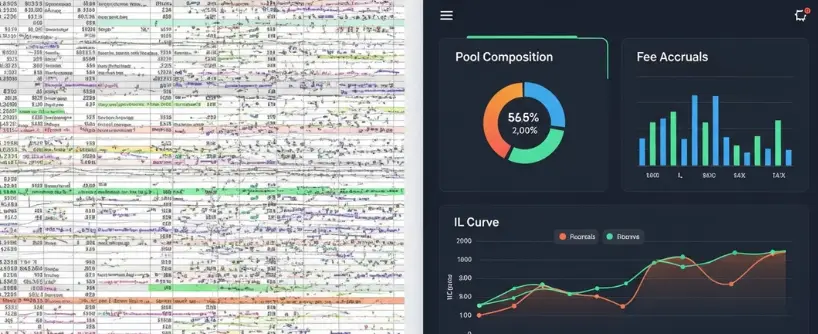
Liquidity pools are the foundation of decentralized exchanges. They allow users to trade assets without traditional order books by using smart contracts that hold liquidity supplied by users.
For liquidity providers, participating in pools creates additional complexity. The value of an LP position depends on multiple variables:
A pool advertising a high APR may not necessarily deliver strong returns. For example, a concentrated liquidity position can generate significant fees when the price remains within range, but the same position may stop earning fees once the price moves outside the selected range.
Effective tracking helps liquidity providers evaluate real performance instead of relying only on headline yield figures.
A complete LP monitoring system should allow users to:
Compare fee income against impermanent loss;
Review historical returns;
Identify underperforming positions;
Track rewards across multiple chains;
Maintain accurate accounting records.
What LP Portfolio Trackers Must Do in 2026

As DeFi strategies become more sophisticated, basic wallet tracking is no longer enough. A capable liquidity portfolio tracker should provide several core functions.
Accurate Position Valuation
A reliable tracker must read blockchain data and calculate the current value of LP positions, including:
For concentrated liquidity positions, the tracker should understand whether liquidity is currently active within the selected price range.
For stablecoin-focused pools, accurate valuation also requires understanding pool mechanics such as token ratios and amplification parameters.
Impermanent Loss and Fee Attribution
Impermanent loss is one of the biggest factors affecting LP profitability.
A useful tracker should separate different sources of return:
Performance Metric | What It Shows |
|---|
Trading fees | Income generated from swap activity |
Token rewards | Additional incentives from protocols |
Impermanent loss | Difference compared with simply holding assets |
Net return | Overall performance after considering major factors |
Tracking these metrics at the individual position level helps liquidity providers understand whether a strategy is actually working.
Multi-Chain Coverage
Modern DeFi users rarely operate on only one network.
A portfolio tracker should support major Layer 1 and Layer 2 ecosystems, including networks where liquidity activity is concentrated.
Important capabilities include:
Consistent asset labeling across chains;
Unified USD valuation;
Cross-chain wallet monitoring;
Support for major DEXs and vault protocols.
Without proper multi-chain support, users may underestimate exposure or miss important positions.
Transaction History and Export
Historical data is essential for both performance analysis and accounting.
A complete tracker should record:
CSV export functionality is especially important because users may need to connect transaction data with accounting software or tax reporting tools.
Alerts and Automation
Liquidity positions often require active monitoring, especially concentrated liquidity strategies.
Useful alerts include:
Price moving outside the selected range;
Significant changes in pool APR;
Reward emissions ending;
Governance changes affecting incentives;
Large position value changes.
Email, Telegram, or webhook alerts can help users react faster without manually checking every protocol dashboard.
How to Choose a Liquidity Pool Portfolio Tracker

Before selecting a tracking platform, evaluate the following factors.
Supported Protocols
The tracker should support the protocols you actively use.
Commonly supported platforms include:
Uniswap v3;
Curve;
Balancer;
PancakeSwap;
GMX;
Aerodrome;
Maverick;
Yield optimizer vaults.
Support for centralized exchanges can also be useful for users who manage both CeFi and DeFi assets.
Chain Coverage
Check whether the tracker supports the networks where your liquidity positions exist.
Common ecosystems include:
Ethereum;
Arbitrum;
Optimism;
Base;
Polygon;
BNB Smart Chain;
Avalanche;
Solana.
Concentrated Liquidity Analytics
Users providing liquidity on Uniswap v3-style AMMs need specialized data.
Important features include:
General portfolio dashboards often lack this level of detail.
Security and Privacy
A portfolio tracker should only need permission to view blockchain data.
Recommended security practices:
Use wallet addresses instead of connecting wallets when possible;
Avoid any tracker requesting token spending approvals;
Prefer open-source or privacy-focused solutions for sensitive wallets;
Protect wallet ownership information.
A tracker should never require custody of your assets.
Data Quality and Refresh Speed
Real-time accuracy matters during periods of high market activity.
A reliable tracker should:
Update prices quickly;
Reflect completed transactions accurately;
Handle network congestion;
Clearly display pending or delayed data.
Export and API Access
Advanced users may need to build custom dashboards or connect data with other systems.
Useful features include:
CSV exports;
API access;
Custom reporting;
Accounting integrations.
Cost Considerations
Many portfolio trackers offer free basic features and charge for advanced analytics.
Consider whether paid features provide meaningful value through:
For active liquidity providers, saving time and reducing accounting mistakes can justify subscription costs.
Challenges of Tracking LP Positions
Tracking liquidity pool positions is more difficult than monitoring traditional crypto holdings because LP assets are constantly changing.
A wallet balance tracker may show the current value of tokens, but it usually cannot explain how that value was generated or whether a strategy is performing well.
Liquidity providers commonly face several challenges:
Fragmented Data Across Multiple Chains
DeFi activity is distributed across hundreds of protocols and networks.
A single user may have:
Liquidity positions on multiple decentralized exchanges;
Staked LP tokens in farming contracts;
Vault shares managed by automated strategies;
Rewards waiting to be claimed.
Checking each protocol separately makes it difficult to maintain an accurate overview.
Misleading APR Calculations
Advertised APR figures often represent only one part of potential returns.
Actual LP performance depends on:
A pool with a high displayed APR may generate lower real returns if token price divergence creates significant impermanent loss.
Lack of Historical Performance Data
Current position value alone does not show whether a strategy has succeeded.
Liquidity providers need historical insights, including:
How much fee income was generated;
How often positions moved out of range;
Whether rebalancing improved performance;
How returns compare with simply holding assets.
Without historical data, it is difficult to evaluate long-term strategy effectiveness.
Different Tracking Requirements Across LP Strategies
Not every liquidity position requires the same level of analytics.
For example:
Strategy Type | Key Tracking Needs |
|---|
Stablecoin pools | Fee income, pool balance, reward emissions |
Uniswap v3 positions | Price range, fee capture, impermanent loss |
Yield vaults | Strategy allocation, APY changes, withdrawal conditions |
Multi-chain portfolios | Asset exposure, chain distribution, transaction history |
The right tracker depends on how a user provides liquidity.
Benefits of Using a Portfolio Tracker
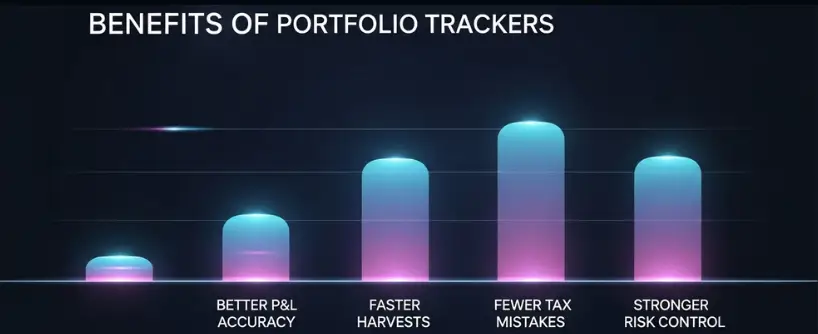
A dedicated portfolio tracker simplifies DeFi management by combining scattered blockchain data into a single interface.
Unified Portfolio Visibility
Instead of opening multiple protocol dashboards, users can view:
Wallet balances;
LP positions;
Staking assets;
Vault deposits;
Reward balances.
This makes it easier to understand total portfolio exposure.
Better Performance Analysis
A good tracker helps liquidity providers compare actual results rather than relying on estimated yields.
Users can analyze:
This provides a clearer picture of whether liquidity strategies are meeting expectations.
Easier Accounting and Tax Preparation
DeFi transactions can quickly become difficult to organize.
Portfolio trackers with transaction history and export tools help users:
Categorize transactions;
Review historical activity;
Prepare records for accounting;
Reduce manual tracking work.
Improved Risk Management
Monitoring tools can help identify potential issues earlier.
Examples include:
Positions moving out of range;
Increasing exposure to a single asset;
Unclaimed rewards accumulating;
Unexpected changes in protocol performance.
Leading Portfolio Trackers for Liquidity Providers in 2026
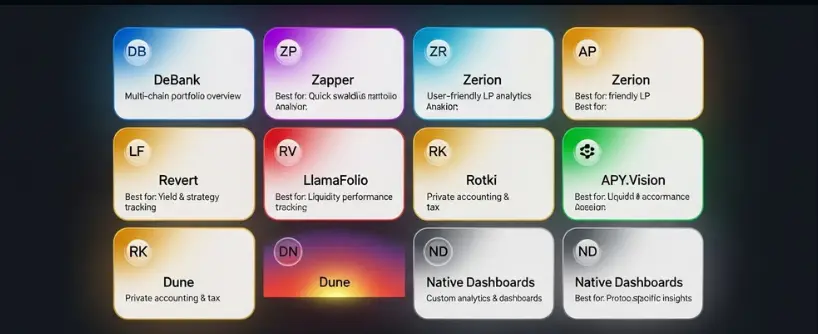
No single platform covers every LP tracking requirement.
Most experienced liquidity providers use a combination of:
A broad portfolio dashboard for overall visibility;
A specialized analytics tool for detailed LP performance;
An accounting or custom reporting solution for historical records.
The following platforms represent some of the most useful options for different use cases.
DeBank: Best for Multi-Chain Portfolio Overview
What It Does Well
DeBank provides a broad view of wallet activity across multiple blockchain networks.
It aggregates:
Token balances;
DeFi positions;
LP tokens;
Staking positions;
NFT holdings.
For users managing multiple wallets, including personal addresses or multisigs, DeBank works well as a daily portfolio monitoring dashboard.
LP-Specific Features
Recognizes many LP tokens and DeFi positions;
Displays available rewards when supported by protocols;
Tracks wallet approvals for security reviews;
Provides a quick overview of cross-chain exposure.
Limitations
DeBank is designed primarily as a broad portfolio tracker rather than a specialized LP analytics platform.
For concentrated liquidity strategies, it provides less detailed information about:
Best For
Users who need a simple way to monitor multiple wallets and DeFi positions from one dashboard.
Zapper: Best for Portfolio Management Workflows
What It Does Well
Zapper combines portfolio tracking with DeFi interaction features.
Beyond viewing positions, users can perform supported actions such as adding liquidity, removing liquidity, or managing assets from one interface.
LP-Specific Features
Detects positions across various DeFi protocols;
Tracks liquidity pools and vault positions;
Provides transaction history and portfolio categorization;
Supports workflow-based DeFi management.
Limitations
Zapper is more focused on accessibility and portfolio actions than advanced LP analytics.
Users requiring detailed concentrated liquidity analysis may need additional tools.
Best For
Users who want both portfolio visibility and simplified DeFi workflows.
Zerion: Best Wallet-Centric Tracking Experience
What It Does Well
Zerion focuses on wallet-based portfolio management.
Its interface is designed for users who want quick visibility across assets, DeFi positions, and transactions.
The mobile experience makes it convenient for monitoring positions while away from a desktop.
LP-Specific Features
Supports many LP tokens and vault positions;
Tracks multiple wallet addresses;
Provides notifications for portfolio changes;
Syncs portfolio data across devices.
Limitations
Compared with specialized LP analytics platforms, Zerion provides limited insight into:
Best For
Users who prioritize mobile access and simple portfolio monitoring.
APY.Vision: LP Analytics and Impermanent Loss Tracking
What It Does Well
APY.Vision is designed specifically for liquidity providers who need deeper performance analysis.
Unlike general wallet trackers, it focuses on understanding the actual results of LP strategies.
LP-Specific Features
Tracks liquidity pool returns;
Calculates fee income;
Estimates impermanent loss;
Provides historical performance charts;
Supports concentrated liquidity analysis.
Limitations
Some advanced features require paid access.
Support for newer protocols may vary depending on available integrations.
Best For
Liquidity providers who need detailed return analysis and want to compare fees against impermanent loss.
Revert Finance: Best for Uniswap v3 Concentrated Liquidity
What It Does Well
Revert Finance specializes in concentrated liquidity monitoring.
It provides detailed insights into Uniswap v3-style positions, including range activity and fee performance.
LP-Specific Features
Tracks active and inactive liquidity ranges;
Shows fee accumulation;
Provides tick-level position information;
Offers alerts for range movements;
Supports certain automation features.
Limitations
Its strength is concentrated liquidity, but it is not designed as a complete multi-chain portfolio tracker.
Users managing diverse DeFi positions may need another dashboard alongside it.
Best For
Active Uniswap v3 liquidity providers who require detailed range monitoring.
LlamaFolio by DeFiLlama: Open, Fast, and Multi Chain
What It Does Well
LlamaFolio provides a lightweight portfolio tracking experience built around DeFiLlama’s broader data ecosystem.
It offers fast visibility into wallets and DeFi positions across multiple chains.
LP-Specific Features
Tracks many DeFi positions;
Connects portfolio data with DeFi ecosystem information;
Provides free portfolio monitoring;
Offers broad protocol coverage.
Limitations
Compared with dedicated LP analytics platforms, LlamaFolio provides fewer advanced features for:
Best For
Users looking for a free and simple multi-chain portfolio overview.
Rotki: Self-Hosted, Privacy-Preserving Accounting
What It Does Well
Rotki is an open-source portfolio tracking and accounting application designed for users who prioritize privacy and data ownership.
Unlike many cloud-based trackers, Rotki processes portfolio data locally, allowing users to maintain greater control over wallet information and transaction records.
It supports:
LP-Specific Features
Tracks LP tokens and staking positions;
Supports transaction reconciliation;
Provides detailed CSV exports;
Helps prepare accounting records.
Limitations
Rotki requires more setup compared with simple web-based dashboards.
Users looking for a quick visual portfolio overview may find it less convenient than lightweight alternatives.
Best For
Teams, professional users, and individuals who need stronger privacy controls and detailed accounting records.
Dune Dashboards: Custom Analytics When You Need an Edge
What It Does Well
Dune provides blockchain data access and customizable dashboards built through SQL queries.
Unlike standard portfolio trackers, Dune allows users to create specific analytics based on their own requirements.
Examples include:
LP-Specific Features
Custom position and fee analysis;
Protocol-specific dashboards;
CSV data exports;
Public or private reporting dashboards.
Limitations
Dune requires technical knowledge or analyst support.
Data availability depends on blockchain indexing and existing queries.
Best For
Funds, DAOs, professional teams, and advanced users who need custom reporting.
Protocol Native Dashboards and Manager UIs
Many DeFi protocols provide their own liquidity management interfaces.
Examples include:
Uniswap position dashboards;
Curve gauge pages;
Balancer pool analytics;
Gamma and Arrakis strategy dashboards;
Yield optimizer interfaces such as Beefy and Yearn.
What They Do Well
Native dashboards often provide the most accurate protocol-specific information because they read directly from smart contracts.
Common features include:
Limitations
Native dashboards only cover individual protocols.
Users managing liquidity across multiple platforms still need a broader portfolio tracker.
Best For
Liquidity providers who need to verify positions or perform protocol-specific actions.
Portfolio Tracker Comparison Snapshot
Different tools serve different purposes. The best choice depends on whether you prioritize portfolio visibility, LP analytics, privacy, or reporting.
Platform | Main Strength | Best Use Case | Main Limitation |
|---|
DeBank | Multi-chain portfolio overview | Daily wallet monitoring | Limited advanced LP analytics |
Zapper | Portfolio management workflows | Managing DeFi actions | Less detailed LP analysis |
Zerion | Wallet-focused experience | Mobile portfolio tracking | Basic LP insights |
APY.Vision | LP performance analytics | Fee and impermanent loss tracking | Advanced features may require payment |
Revert Finance | Concentrated liquidity analytics | Uniswap v3 monitoring | Narrow protocol focus |
LlamaFolio | Free multi-chain tracking | Quick portfolio overview | Limited strategy analytics |
Rotki | Privacy and accounting | Tax records and reconciliation | More complex setup |
Dune | Custom dashboards | Institutional reporting | Requires technical skills |
Native dashboards | Protocol accuracy | Position verification | No unified portfolio view |
Recommended Tool Stack for Different Users
There is no universal “best” LP tracker.
A practical setup depends on the complexity of your liquidity strategy.
User Type | Recommended Setup |
|---|
Beginner LP users | DeBank or LlamaFolio + protocol dashboards |
Active Uniswap v3 users | DeBank + Revert or APY.Vision |
Multi-chain liquidity providers | DeBank/Zerion + specialized analytics tools |
Professional investors | Custom Dune dashboards + accounting tools |
Privacy-focused users | Rotki + self-managed records |
Practical Workflows for Monitoring LP Positions
A good tracking system is not only about choosing tools. It also requires consistent operating habits.
Workflow 1: Daily Liquidity Health Check
Goal: Monitor portfolio changes and identify urgent actions.
Step 1: Review Overall Exposure
Open a broad portfolio tracker such as DeBank or LlamaFolio.
Check:
Total portfolio value;
Asset allocation;
Chain exposure;
Major position changes.
Step 2: Review Pending Rewards
Check whether any positions have:
Avoid unnecessary transactions when gas costs exceed expected benefits.
Step 3: Check Risk Changes
Look for:
Positions moving out of range;
Large token price changes;
Increased exposure to specific assets.
Workflow 2: Concentrated Liquidity Monitoring
Goal: Manage positions that depend on price ranges.
Step 1: Set Range Alerts
Use tools such as Revert or APY.Vision to monitor:
Step 2: Review Position Performance
When a position requires attention, evaluate:
Step 3: Record Strategy Changes
Keep notes about:
Historical notes help evaluate decisions over time.
Workflow 3: Accounting and Compliance
Goal: Maintain accurate historical records.
Step 1: Export Transaction Data
Export activity regularly from your tracking tools.
Include:
Liquidity deposits;
Withdrawals;
Claims;
Swaps;
Bridge transactions.
Step 2: Reconcile Records
Review transaction labels and correct missing information.
Tools such as Rotki or accounting software can help organize complex DeFi activity.
Step 3: Maintain Monthly Reports
Save periodic summaries containing:
Portfolio value;
Major strategy changes;
Performance notes.
Consistent documentation reduces future reconciliation work.
Workflow 4: Treasury and Team Operations
Goal: Monitor larger DeFi portfolios.
For teams managing multiple wallets, a custom dashboard can provide better visibility.
Useful metrics include:
A Dune dashboard can combine multiple wallet addresses and provide a shared reporting environment.
Security and Privacy Considerations
Portfolio trackers should only provide visibility into blockchain activity.
They should never require custody of your funds.
Follow these security practices:
Use Read-Only Access
Whenever possible:
Never Approve Token Spending
A tracking service does not need permission to move assets.
If a website requests:
Token approval;
Transfer permission;
Spending authorization;
stop and verify the platform before continuing.
Protect Wallet Privacy
Portfolio data can reveal valuable information.
Consider:
Using privacy-focused tools for sensitive wallets;
Separating public and private addresses;
Avoiding unnecessary wallet linking.
Verify Tracker URLs
Phishing websites often imitate popular DeFi tools.
Recommended practices:
Bookmark official websites;
Avoid links from unknown sources;
Double-check domains before connecting wallets.
How To Evaluate the Accuracy of a Portfolio Tracker
A portfolio tracker is only useful if the data can be trusted.
Because DeFi positions involve smart contracts, reward mechanisms, and rapidly changing token prices, tracking platforms may occasionally display differences compared with protocol interfaces.
Before relying on a tracker for decision-making, verify its accuracy through several checks.
1. Compare Data With Native Protocol Dashboards
Select several LP positions and compare the tracker data with the original protocol interface.
Check:
Position value;
Token amounts;
Unclaimed fees;
Reward balances.
Small differences may occur due to price updates or indexing delays. Large discrepancies require further investigation.
2. Test After Claims or Rebalances
After performing an action, confirm whether the tracker updates correctly.
Examples:
Claimed rewards should no longer appear as pending;
Removed liquidity should disappear from active positions;
Rebalanced positions should reflect updated ranges.
3. Verify Concentrated Liquidity Calculations
For concentrated liquidity positions, check:
Whether the position is correctly identified as in-range or out-of-range;
Whether fee calculations match protocol data;
Whether historical performance reflects previous range changes.
Specialized tools often provide deeper verification than general portfolio dashboards.
4. Monitor Price Update Behavior
During periods of high market volatility or network congestion, some trackers may display delayed information.
Review whether the platform:
Updates prices consistently;
Shows pending transactions clearly;
Handles temporary indexing delays properly.
Budgeting for DeFi Portfolio Tracking Tools
The ideal tracking setup depends on portfolio complexity and operational requirements.
Free Tracking Setup
Suitable for casual liquidity providers:
DeBank or LlamaFolio for portfolio visibility;
Protocol dashboards for position verification;
Manual CSV exports for records.
Low-Cost Setup
Suitable for active individual LPs:
General portfolio tracker;
APY.Vision for performance analytics;
Additional alert tools when required.
Professional Setup
Suitable for teams, funds, and complex portfolios:
For professional users, the time saved through better reporting and reconciliation can outweigh subscription costs.
Common Mistakes When Tracking LP Positions
Even with good tools, liquidity providers often make operational mistakes.
1. Ignoring Unclaimed Fees
Pending fees are part of LP performance.
Failing to monitor them can lead to:
Missed harvesting opportunities;
Inaccurate return calculations;
Poor position comparisons.
2. Mixing Wallets Without Proper Labels
Managing multiple wallets without clear labels creates confusion.
Use categories such as:
Clear organization makes performance analysis easier.
3. Relying on a Single Tracker
No platform covers every DeFi protocol and strategy type.
A general tracker may show portfolio value but miss detailed LP analytics.
Combining tools often provides a more complete view.
4. Forgetting Bridge Transactions
Cross-chain activity can create accounting problems.
Remember to track:
Bridge transfers;
Wrapped assets;
Token swaps;
Network fees.
5. Not Recording Strategy Changes
Liquidity strategies evolve over time.
Document:
Why a position was created;
Why a range was adjusted;
Why liquidity was removed.
These notes help evaluate whether decisions improved performance.
Glossary
Portfolio tracker: A tool that reads blockchain data from wallet addresses and displays assets, positions, and transaction history in one dashboard.
LP position monitoring: The process of tracking liquidity position value, fee earnings, rewards, and risk factors across DeFi protocols.
Impermanent loss: The difference between providing liquidity and simply holding assets when token prices change relative to each other.
Concentrated liquidity: A liquidity model where users provide funds within a selected price range, commonly used by Uniswap v3-style AMMs.
Gauge: A protocol mechanism that determines how rewards or emissions are allocated to liquidity pools.
Vault optimizer: A smart contract strategy that automates liquidity management, compounding, or yield optimization.
CSV export: A transaction and position data format that can be imported into accounting or reporting tools.
Read-only wallet: A wallet address added to a tracker without granting permission to transfer assets.
Out-of-range: A concentrated liquidity position where the current price moves outside the selected range and stops earning swap fees.
Rebalance: Adjusting a liquidity position by changing price ranges, asset ratios, or liquidity allocation.
Conclusion
Tracking liquidity positions is an essential part of managing DeFi strategies in 2026.
As liquidity moves across more chains, protocols, and automated strategies, relying only on individual protocol dashboards is no longer practical.
The most effective approach is usually a layered toolkit:
Use a broad portfolio tracker such as DeBank or LlamaFolio for daily visibility;
Add specialized analytics tools like Revert or APY.Vision for concentrated liquidity monitoring;
Maintain accounting-focused solutions such as Rotki or custom dashboards for historical records.
A good tracking system does not eliminate DeFi risks, but it provides clearer data for evaluating positions, reviewing performance, and managing operational complexity.
By combining reliable tools with consistent monitoring habits, liquidity providers can make better-informed decisions and maintain stronger control over increasingly complex DeFi portfolios.
About Bitunix
Bitunix is a global cryptocurrency derivatives exchange trusted by over 5 million users across more than 150 countries/districts. The platform is committed to providing a transparent, compliant, and secure trading environment for every user. Bitunix offers a fast registration process and a user-friendly verification system supported by mandatory KYC to ensure safety and compliance.
With global standards of protection through Proof of Reserves (POR) and the Bitunix Care Fund, Bitunix prioritizes user trust and fund security. The K-Line Ultra chart system delivers a seamless trading experience for both beginners and advanced traders, while leverage of up to 200x and deep liquidity make Bitunix one of the most dynamic platforms in the market.
Bitunix Global Accounts
X | Telegram Announcements | Telegram Global | CoinMarketCap | Instagram | Facebook | LinkedIn | Reddit | Medium