Choosing an exchange on headline fees alone can cost you more than you expect. Spread, slippage, withdrawal fees, leverage rules and how an exchange handles account reviews all affect what you keep.
This Bitunix vs MEXC guide works as a side-by-side Bitunix exchange review against a low-fee, listing-heavy rival. It compares fees, coins and markets, leverage, trading tools, safety, KYC and Earn. Each section starts with the key difference and ends with what it means in practice, so you can decide which platform fits the way you trade.
What Are Bitunix and MEXC? A Look at Both Crypto Trading Platforms
Both are offshore centralized exchanges that serve global traders, but they are built for different priorities. MEXC is a broad, listing-heavy platform that competes on price. Bitunix is a derivatives-focused exchange that competes on execution tools and trader protection.
What Is Bitunix?

Bitunix - centralized cryptocurrency exchange founded in 2021 and launched globally in 2022
Bitunix launched in 2021 and focuses on Spot and perpetual Futures trading. It serves millions of users worldwide, lists 1,200+ trading pairs and offers leverage of up to 200x on select pairs.
Its core products are Futures, Spot, copy trading, Easy Earn and TradFi contracts on assets such as gold, silver, oil and selected US stocks. The platform is known for its Ultra Chart Trading workspace, its verifiable Proof of Reserves and a $30M Bitunix Care Fund.
What Is MEXC?
MEXC exchange launched in 2018 and serves millions of users worldwide
MEXC launched in 2018 and says it serves tens of millions of users worldwide. Its main pitch is low fees and fast listings: it advertises 0% maker fees and access to more than 3,000 digital assets.
Beyond Spot and Futures (up to 500x on BTC and ETH), MEXC offers margin trading, trading bots, copy trading, a launchpool, Earn products and tokenized stocks. In June 2026 it also integrated with TradingView so users can place perpetual Futures trades from TradingView charts.
Bitunix vs MEXC Fees: Which Exchange Costs Less for Crypto Trading?
On published base rates, MEXC is cheaper on both Spot and Futures. The gap narrows once you reach Bitunix's VIP tiers, and spread and slippage can change your real cost on either exchange.
Trading fees
| Bitunix VIP 0 | Bitunix VIP 8 | MEXC base |
Spot maker / taker | 0.08% / 0.10% | 0.0048% /0.0180% | 0% / 0.05% |
Futures maker / taker | 0.02% / 0.06% | 0.0000% /0.0260% | 0% / 0.02% |
$10,000 Futures round trip, taker | $12 | $5.20 | $4 |
$10,000 Futures round trip, maker | $4 | $0 | $0 |
Sources: Bitunix fee schedule; MEXC fee guide.
Bitunix: VIP 8 needs 100M USDT in 30-day Spot volume or 500M USDT in 30-day Futures volume. At VIP 8, Futures fees fall to 0% maker and 0.026% taker, and Spot fees fall to 0.0048% maker and 0.018% taker. Traders who are VIP users on another exchange can email their Bitunix UID and a screenshot of their 30-day volume there to request a better VIP level.
MEXC: base rates apply without a VIP level. Holding or paying with MX tokens lowers fees further, and MEXC runs zero-fee promotions on selected pairs.
Deposit and Withdrawal Fees
Crypto deposits are free on both. Withdrawals carry a network fee that depends on the coin and chain. For Bitcoin, Bitunix charges 0.000035 BTC, while MEXC's fee is around 0.0002 BTC and moves with network conditions. MEXC-to-MEXC transfers are free.
If you trade mostly with limit orders, MEXC's 0% maker fee is hard to beat. If you trade Futures with market orders, the difference is a few dollars per $10,000, so order book depth and slippage on your pairs may matter more. Always check the live withdrawal fee before you send funds.
MEXC vs Bitunix Coins: How Many Cryptocurrencies Can You Trade on Each?
MEXC has the bigger catalog by a wide margin and more reported Futures activity. Bitunix lists fewer assets and focuses on liquid majors, popular altcoins and TradFi perpetuals.
CoinGecko data | Bitunix | MEXC |
Spot coins | About 500 | About 1,450 |
Futures pairs | 780 | About 1,290 |
Derivatives rank by open interest | #27 | #5 |
Futures open interest | About $1.5B | About $12.7B |
Source: CoinGecko
Bitunix: covers majors such as BTC, ETH, SOL and XRP, popular altcoins, and TradFi perpetuals on gold, silver, oil and US stocks such as Tesla, traded from the same Futures account.
MEXC: lists a wide range of new and trending tokens. It also offers tokenized US stocks.
If you hunt new or small-cap listings, MEXC gives you more options earlier, though those pairs often have thinner order books. If you trade majors with size, coin count matters less than depth and spread on the pairs you actually trade.
Crypto Futures Trading on Bitunix and MEXC: Leverage, Copy Trading and Tools
Futures is where the two exchanges differ most. MEXC offers more leverage and more automation bots. Bitunix puts more of the trade, and its risk, directly on the chart.
Leverage Limits and Liquidation Risk
MEXC allows more than double Bitunix's maximum leverage. Bitunix pairs its lower cap with tools that size risk before you enter.
| Bitunix | MEXC |
Max leverage, BTC and ETH perpetuals | Up to 200x | Up to 500x |
Position limits | Leverage tiered by position size | Higher leverage, smaller maximum position |
Higher leverage means a smaller price move can close your position. This is roughly how far price can move against you before your initial margin is gone:
Leverage | Margin as % of position | Adverse move that wipes initial margin |
10x | 10% | About 10% |
20x | 5% | About 5% |
100x | 1% | About 1% |
200x (Bitunix max) | 0.50% | About 0.5% |
500x (MEXC max) | 0.20% | About 0.2% |
In practice, liquidation comes earlier because of maintenance margin and fees.
Bitunix: shows liquidation, margin call and break-even lines on the chart. Fixed Risk lets you set your stop and the maximum amount you are willing to lose first, then calculates the position size for you.
MEXC: offers the highest leverage of the two on BTC and ETH, with the maximum position shrinking as leverage rises, per its 500x launch notice.
The leverage ceiling only matters if you plan to use it. Most experienced traders use far lower leverage, so the tools that help you size and manage risk often matter more than the maximum.
Chart Trading
Bitunix Ultra Chart Trading turns the chart into the order ticket. You can:
Place limit, conditional and trailing stop orders directly on the chart.
Drag TP and SL lines for full or partial positions.
Open multiple chart windows side by side, each with its own timeframe, with synced crosshair and symbols.
Use a full set of indicators, drawing tools, chart types and timeframes, synced across web, desktop and app.
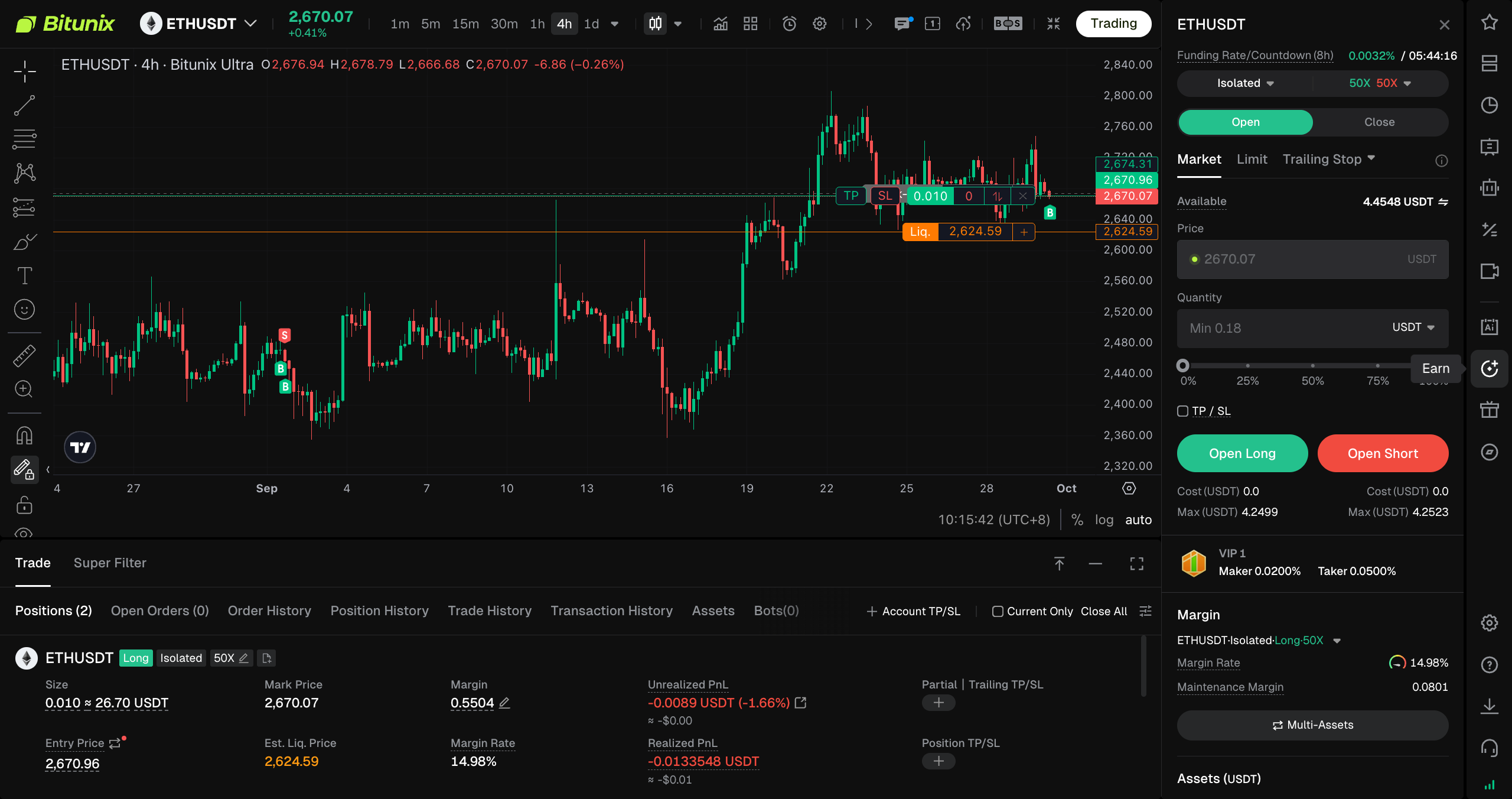
Bitunix Ultra Chart Layout
On most platforms, you read the chart in one place and fill an order form in another. That gap costs time on fast breakouts and leads to fat-finger errors on price. On Bitunix, the level you are looking at is the level you trade. Say BTC is pressing resistance: you drag a limit order to the breakout level, drag your stop below the last swing low, and the liquidation line tells you right away if your leverage is too high, all before you click confirm. Layouts, drawings and indicators sync across web, desktop and app, so a setup drawn on desktop is ready on your phone.
MEXC uses TradingView-powered charts on its own platform. Since June 2026 it also lets users place perpetual Futures trades from inside TradingView. That suits traders who already live in TradingView, but order management on the chart itself is less central to the MEXC interface.
Super Alert: Price, Indicator and Candle Alerts
Both exchanges offer price and indicator alerts. Bitunix Super Alert also watches candlestick patterns and lines you draw, combines several conditions into one alert, and links straight back to Chart Trading.
How Super Alert works on Bitunix
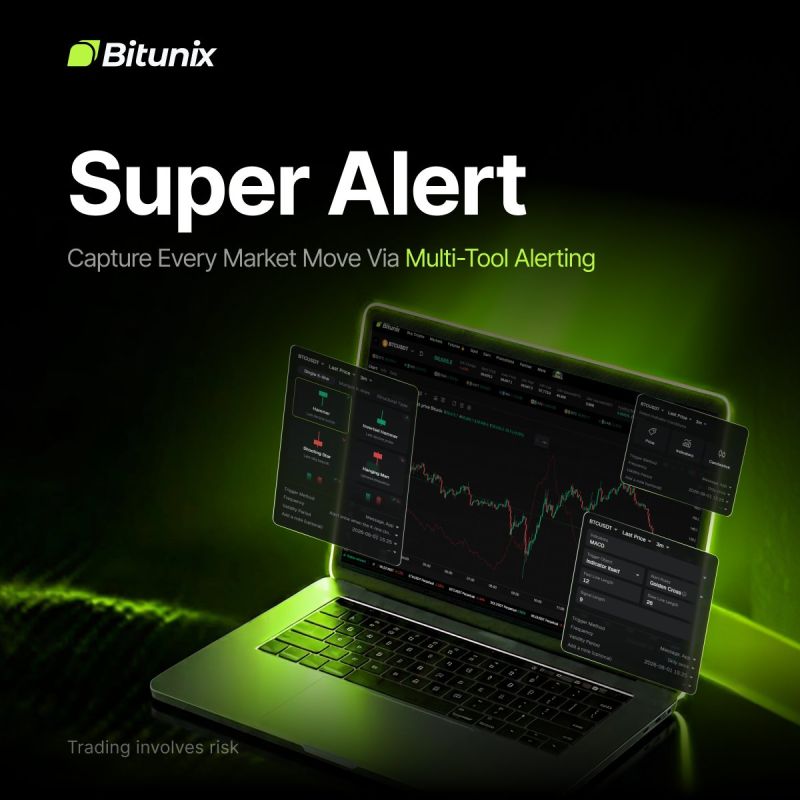
Bitunix Super Alert captures well every market move
Bitunix Super Alert lets the market watch itself. It goes beyond simple price alerts:
Price alerts: a push the moment price hits your level.
Indicator alerts: MACD, RSI, Bollinger Bands and volume signals, including golden and death crosses and MACD divergence.
Candlestick alerts: automatic detection of patterns such as hammers, engulfing candles and morning or evening stars.
Drawing alerts: a ping when price touches or breaks a support, resistance or channel line you drew.
Template and Combo alerts: ready-made strategy templates, or several conditions combined to filter out false signals.
Super Alert and Chart Trading work as one loop. The alert finds the setup, the chart executes it, and the TP/SL and liquidation lines manage the risk. Alerts can also be routed to Telegram and Discord.
How alerts work on MEXC
MEXC's built-in Market Alerts cover price levels and percentage moves, and on Futures add MACD, BOLL and KDJ indicator signals.
What this means for you: If you only need price and basic indicator triggers, both cover it. If you trade patterns or your own trendlines and want fewer false signals, Super Alert's drawing and combo alerts do more of the watching for you.
Copy Trading and Order Types
Both offer Futures copy trading and API access. MEXC also offers built-in grids and DCA bots. Bitunix sets firm risk limits for copy-trading followers.
| Bitunix | MEXC |
Copy trading | Yes; copied trades capped at 10x | Yes; 250x and 500x leverage not supported |
Other trading tools | Multi-Trade for several positions on one pair | Spot grid, Futures grid and DCA bots |
API trading | Yes | Yes |
Bitunix: under its copy trading rules, followers set the copy amount, TP and SL per position, and an optional strategy stop loss (5%–95%). The default profit share is 10%, charged weekly and only on profit. Multi-Trade lets you hold several separate positions on the same pair, each with its own TP/SL.
MEXC: offers Spot and Futures grid bots and DCA bots alongside copy trading. Copy trading does not support the 250x and 500x leverage settings.
If automation is your main workflow, MEXC has more built-in options. If you trade manually or copy others, Bitunix's follower settings let you cap leverage and losses before you start.
Is Bitunix or MEXC Safer? Security, Licensing and Proof of Reserves
Both exchanges provide reserves on-chain and run protection funds. The bigger differences are in regulatory standing and how account reviews have played out for users.
Proof of Reserves and Protection Funds
Both let you verify your balance through a Merkle tree, and both report reserves above 100%. MEXC holds larger funds and reports higher BTC coverage. Bitunix adds institutional custody and ISO-certified security on top of its Care Fund.
Safety measure | Bitunix | MEXC |
PoR method | Merkle tree, live ratios page, open-source verifier | Merkle tree, monthly reports audited by Hacken |
Latest reserve ratios | At or above 100% for BTC, ETH and USDT (live page) | September 2026: BTC 297%, USDT 119%, ETH 111% |
Protection fund | $30M Care Fund held in USDC | Futures Insurance Fund of about 790M USDT; Guardian Fund of 100M USDT plus 2,000 BTC |
Other controls | Fireblocks and Cobo custody, Hacken security testing, ISO/IEC 27001:2022 | Monthly third-party PoR audits |
Higher reserve ratios mean a larger surplus over user balances in those assets. On both exchanges, you can verify that your own balance is included in the Merkle tree. Keep in mind that any PoR is a snapshot of assets against user balances; It does not show every liability a company has.
Licensing and Regulation
Bitunix's public record centers on its registrations in several jurisdictions. MEXC's includes warnings from several regulators and an exit from the Netherlands. Note that the registrations below are mainly anti-money-laundering registrations, which cover compliance duties and are not the same as a full trading license or MiCA authorization.
| Bitunix | MEXC |
Regulatory highlights | Registrations in five jurisdictions, incl. US FinCEN MSB, Canada MSB and Australia AUSTRAC | Warnings from VARA, SFC, FCA, BaFin, FSA and AFM; VARA notice of fines (June 2026) |
US and Canadian residents | Not onboarded | Restricted |
EU / Netherlands | Check the eligibility notice for your country | Offboarding Dutch users; service ends November 16, 2026 |
Bitunix: holds registrations and licenses across five jurisdictions, including a US FinCEN Money Services Business (MSB) registration, a Canada MSB registration and an AUSTRAC digital currency exchange registration in Australia (2026). Bitunix does not onboard users from the US, Canada and other restricted regions.
MEXC: is restricted in many markets. Regulators in Dubai (VARA), Hong Kong (SFC), the UK (FCA), Germany (BaFin), Japan (FSA) and the Netherlands (AFM) have issued warnings that MEXC served their residents without authorization. VARA published a notice of fines relating to MEXC in June 2026. MEXC is also offboarding Dutch users: it recommends moving assets by October 31, 2026, and service ends November 16, 2026.
If you live in the EU, the MiCA transition period ends on July 1, 2026, so availability can change quickly. Check each exchange's restricted-regions notice before you sign up.
Account Restrictions and Risk Control
Every exchange runs risk control to stop money laundering, multi-account abuse and bonus farming. What matters is how clear the rules are and how fast a review ends. MEXC has faced public complaints here; on Bitunix, reviews are tied to anti-money-laundering and source-of-fund checks.
MEXC: in 2025, a trader known as "White Whale" said about $3.1M was frozen under risk control, and another trader reported roughly $2M placed under a 365-day review (Cointelegraph). MEXC said restrictions are triggered by its risk rules, not by how profitable an account is.
Bitunix: runs compliance and source-of-funds reviews when activity triggers anti-money-laundering checks, and its support team is available 24/7 if your account is under review.
On any exchange, these habits reduce the chance of a long review:
Complete KYC before your first deposit.
Use one account per person and avoid shared devices or IPs.
Keep records that show where your funds came from.
Move profits you do not need for margin to your own wallet.
KYC, Fiat On-Ramps and Availability: Who Can Use Each Crypto Exchange?
Older reviews often call MEXC a no-KYC exchange. That is out of date: as of October 2026, MEXC's own Help Center says users must complete KYC to access its products, and it publishes no withdrawal allowance for unverified accounts. Bitunix also asks for KYC before withdrawals. So on both, plan to verify before you deposit.
Here is how verification, fiat access and regional coverage compare:
| Bitunix | MEXC |
KYC before withdrawals | Yes | Yes in most regions |
Verification levels | Level 1 (ID document), Level 2 (advanced, with proof of address); limits shown in your account settings | Primary (ID): 80 BTC/day; Advanced (ID + face scan): 200 BTC/day; Institutional: up to 400 BTC/day |
Fiat on-ramps | Card purchases through third-party providers (81 fiat currencies), P2P (76 fiat currencies), Bitunix Card for spending | P2P (Primary KYC), card and fiat purchases (Advanced KYC, up to $20,000/day) |
Not available in (examples) | US, Canada, mainland China, Hong Kong, Singapore, UAE and other sanctioned regions (23 in total) | US, UK, Canada, mainland China, Hong Kong, Singapore, Malaysia, Kazakhstan and sanctioned regions; exiting the Netherlands |
It's better to plan to verify before you deposit on either exchange. Restricted lists change, so read the eligibility notice for your country first. Using a VPN to get around a restriction breaks both platforms' terms and can lead to a frozen account.
Earn and Rewards: Passive Income Options on Bitunix vs MEXC
MEXC has the wider Earn menu and more frequent promotions. Bitunix keeps Earn simple and puts more weight on lowering trading costs through its VIP program.
Bitunix: Easy Earn offers Flexible and Fixed-Term products on major assets such as USDT, USDC and BTC. Flexible interest starts an hour after you subscribe, compounds automatically and can be redeemed at any time. Fixed-Term interest starts the next day and is paid with your principal at maturity. Bitunix publishes its payout formula, with 15% of interest going to a risk reserve. Beyond Earn, the VIP program starts at 300 USDT, and new users can unlock a Futures bonus (terms apply).
MEXC: Earn includes Flexible Savings, Fixed Savings, Earn Plus for stablecoins, On-chain Earn and Launchpool. It often runs limited-time APR boosters for new users, plus zero-fee events on selected pairs and MX token fee discounts.
Promotional APRs usually apply to small, capped amounts for a short period, so judge them by the dollar amount you can actually earn. If you are mainly an active trader, lower trading fees may be worth more than Earn yields.
Bitunix or MEXC: Which Crypto Exchange Should You Choose?
There is no single winner. MEXC is cheaper on paper and lists more coins; Bitunix gives Futures traders a tighter chart-based workflow and an extra layer of fund protection. The table sums up every category in this guide:
Category | Bitunix | MEXC |
Founded | 2021 | 2018 |
Spot fees (base maker / taker) | 0.08% / 0.10% | 0% / 0.05% |
Futures fees (base maker / taker) | 0.02% / 0.06% | 0% / 0.02% |
Entry VIP tier | 300 USDT in assets | Not needed for base rates |
Assets | About 500 Spot coins and 780 Futures pairs (CoinGecko), incl. TradFi perpetuals | 3,000+ digital assets per MEXC; about 1,450 Spot coins on CoinGecko |
Max leverage | Up to 200x on BTC and ETH | Up to 500x on BTC and ETH |
Charting | Ultra Chart Trading: orders, TP/SL and liquidation lines on the chart, multi-window layouts | TradingView-powered charts; Futures trading from TradingView |
Alerts | Super Alert: price, indicator, candlestick, drawing, combo | Price, percentage-change and indicator alerts |
Automation and tools | Copy trading, Multi-Trade, Fixed Risk | Grid and DCA bots, copy trading, Futures API |
Proof of Reserves | Live page, Merkle tree; ratios at or above 100% | Monthly Merkle tree reports; Sept 2026: BTC 297%, USDT 119%, ETH 111% |
Protection fund | $30M Care Fund | About 790M USDT Futures insurance fund; Guardian Fund of 100M USDT + 2,000 BTC |
Regulatory standing | Registrations in five jurisdictions, incl. FinCEN MSB, Canada MSB, AUSTRAC | Warnings from several regulators; offboarding Dutch users |
KYC to withdraw | Yes | Yes |
Choose Bitunix If You Want a Simpler Crypto Trading Setup
Bitunix fits Futures traders who want the chart to do more of the work, from spotting the setup to managing the position:
You want to trade from the chart. With Ultra Chart Trading, you place limit, conditional and trailing stop orders, drag TP/SL and see liquidation and break-even lines without leaving the price action.
You don't want to watch the screen all day. Super Alert fires on price, indicators, candlestick patterns and your own trendlines, and Combo Alerts stack conditions to cut false signals.
You watch several markets at once. Multi-window layouts with synced crosshair and symbols let you track and trade multiple pairs side by side.
You size by risk, not by feel. Fixed Risk sizes the position from your maximum loss, and on-chart liquidation lines keep leverage in check, with a cap of 200x.
You want protection behind the account. A $30M Care Fund, a live Proof of Reserves page and a VIP tier from 300 USDT.
Choose MEXC If You Want Lower Fees and More Coins
MEXC fits traders whose top priorities are cost and coverage:
You place mostly maker orders and want 0% maker fees on Spot and Futures.
You hunt for new listings and small-cap tokens across a large catalog.
You rely on bots such as grid or DCA strategies.
You live outside MEXC's restricted regions and are comfortable with its regulatory record and risk-control policies.
Conclusion
In the Bitunix vs MEXC matchup, MEXC wins in raw numbers: lower base fees, more coins and higher leverage. Bitunix wins on how you trade: Ultra Chart Trading puts orders, TP/SL and liquidation levels on one chart, and Super Alert watches price, indicators, candlestick patterns and your own trendlines for you. Behind that sits a $30M Care Fund and registrations in several jurisdictions, including FinCEN, FINTRAC and AUSTRAC.
If you mostly place maker orders on small-cap tokens, MEXC's fee and listing edge is real. If you trade Futures on liquid pairs and care about execution, risk control and fund protection, Bitunix is the more focused setup. Many active traders use both, so compare live order books and fees on your own pairs before committing size.
See more: Bitunix vs. Bitget Review: Which Crypto Exchange Is Right for You in 2026