The terms coin and token are often used interchangeably in crypto discussions, but they describe two different types of digital assets.
The key difference comes down to one question:
Does the asset operate on its own blockchain, or does it run on an existing network?
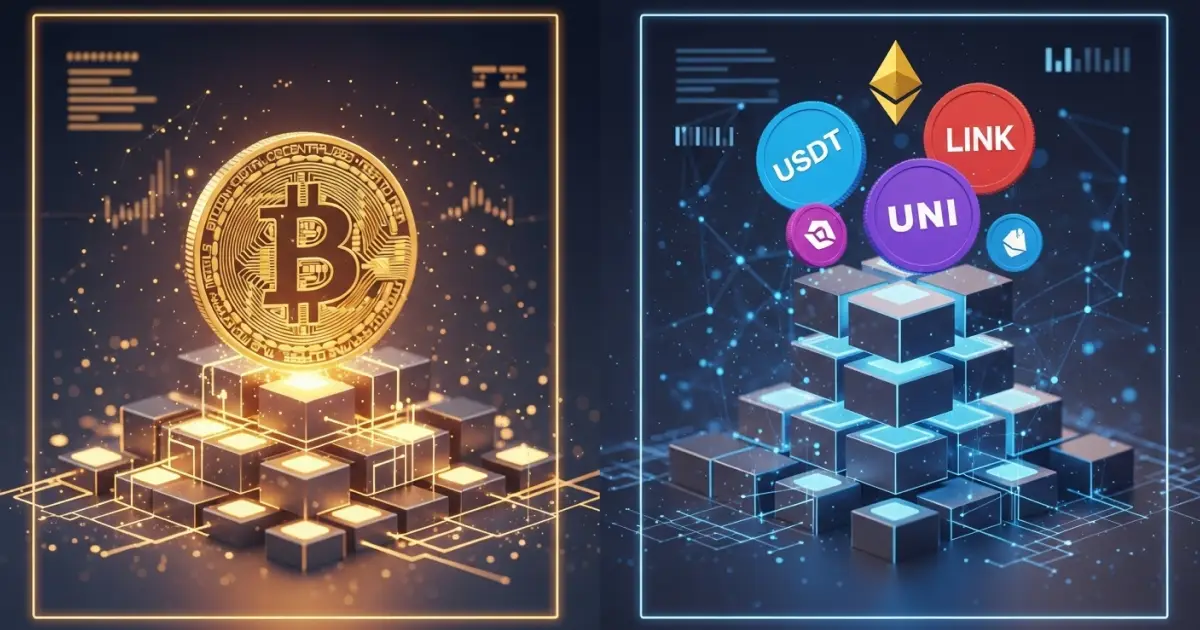
Coins are native assets of their own blockchains. Bitcoin (BTC), for example, operates on the Bitcoin network, while Ether (ETH) is the native asset used by Ethereum. These coins help secure their networks, process transactions, and provide the foundation for blockchain operations.
Tokens work differently. Instead of requiring their own blockchain, they are created on existing networks through smart contracts. USDT, UNI, and LINK are examples of tokens that use blockchain infrastructure built by other networks.
This distinction affects how these assets are created, secured, and used. For investors and crypto users, understanding the difference between coins and tokens makes it easier to evaluate projects, understand risks, and recognize the role each asset plays in the blockchain ecosystem.
What Is a Coin in Cryptocurrency?

A coin is a cryptocurrency that exists on its own blockchain.
Unlike tokens, which rely on another network, coins are part of the core infrastructure of the blockchain they belong to. They are typically used for transaction settlement, network security, and transferring value.
For example:
Bitcoin runs on the Bitcoin blockchain, and BTC is used for transferring value and securing the network.
Ether runs on Ethereum and is required to pay gas fees for transactions and smart contract execution.
SOL powers the Solana network and is used for transaction fees and network participation.
Because coins operate on independent blockchains, creating one requires building the underlying network itself, including:
Key Characteristics of Coins
1. Native Blockchain
The defining feature of a coin is that it belongs to its own blockchain.
Examples:
Coin | Blockchain |
|---|
Bitcoin (BTC) | Bitcoin Network |
Ether (ETH) | Ethereum Network |
Solana (SOL) | Solana Network |
Litecoin (LTC) | Litecoin Network |
A blockchain’s native coin is usually the primary asset used to operate that network.
2. Network Operations and Value Transfer
Coins are generally designed for functions directly related to blockchain activity.
Common uses include:
For example, Bitcoin miners receive BTC rewards for validating transactions, while Ethereum validators stake ETH to help maintain network security.
3. Mining or Staking
Coins are commonly introduced through blockchain-native mechanisms.
Depending on the network design, this may include:
Bitcoin uses mining to secure its network, while Ethereum uses staking after transitioning to Proof-of-Stake.
Examples of Coins
Bitcoin (BTC): Bitcoin is the first cryptocurrency and the most recognized example of a native coin.
Its main functions include:
Ether (ETH): Ether is the native coin of Ethereum.
Unlike Bitcoin, Ethereum was designed as a programmable blockchain. ETH is used for:
Gas fees
Smart contract execution
Staking
Litecoin (LTC): Litecoin was created as an alternative cryptocurrency inspired by Bitcoin.
It uses its own blockchain and focuses on faster transaction confirmation times compared with Bitcoin.
XRP: XRP is the native asset of the XRP Ledger.
It was designed to support fast and efficient transfers, particularly for payment-related use cases.
What Is a Token in Cryptocurrency?

A token is a digital asset created on an existing blockchain.
Instead of building a new blockchain from scratch, developers can use established networks such as Ethereum, Solana, or BNB Chain to create tokens through smart contracts.
This approach allows projects to launch applications, financial products, and digital assets without developing their own blockchain infrastructure.
For example:
USDT exists on multiple networks, including Ethereum and Tron.
UNI is built on Ethereum and is used for Uniswap governance.
LINK operates as the native token of the Chainlink ecosystem but is issued as an ERC-20 token on Ethereum.
Tokens can represent many different things, including:
Access rights
Governance power
Stable value assets
Digital collectibles
Real-world assets
Key Characteristics of Tokens
1. Built on Existing Blockchains
Tokens rely on the infrastructure of another blockchain.
Common examples include:
Token Standard | Blockchain |
|---|
ERC-20 | Ethereum |
BEP-20 | BNB Chain |
SPL | Solana |
Because tokens use existing networks, developers can focus on building applications rather than maintaining a separate blockchain.
2. Created Through Smart Contracts
Most tokens are generated through smart contracts that define:
Total supply
Distribution rules
Transfer conditions
Token functionality
For example, an ERC-20 token contract can determine how many tokens exist and how they can be transferred between wallets.
3. Multiple Use Cases
Unlike coins, which usually support blockchain operations, tokens often serve application-specific purposes.
Common token categories include:
Utility Tokens
Used to access products or services.
Examples:
Governance Tokens
Allow holders to participate in protocol decisions.
Examples:
Stablecoins
Tokens designed to maintain stable value, often through a peg to fiat currencies.
Examples:
NFTs
Non-fungible tokens represent unique digital or physical assets.
Examples:
Digital collectibles
Gaming assets
Digital artwork
Examples of Tokens
Tether (USDT)
USDT is a stablecoin designed to track the value of the US dollar.
Unlike BTC or ETH, USDT does not operate as the native asset of its own blockchain. Instead, it is issued across multiple blockchain networks.
Uniswap (UNI)
UNI is a governance token used within the Uniswap ecosystem.
UNI holders can participate in decisions related to protocol development and governance.
Chainlink (LINK)
LINK supports the Chainlink decentralized oracle network.
It is used within the ecosystem to support services that connect blockchain applications with external data sources.
Decentraland (MANA)
MANA is a token used within the Decentraland virtual world ecosystem.
Users can use MANA for activities such as purchasing digital assets and interacting with virtual experiences.
Token vs Coin: Core Differences
The simplest way to remember the difference:
Coins are the native assets that power blockchains; Tokens are assets built on top of blockchains.
Feature | Coin | Token |
|---|
Blockchain | Runs on its own blockchain | Built on an existing blockchain |
Creation | Requires blockchain development and consensus design | Created through smart contracts |
Main Purpose | Payments, gas fees, network security | Utility, governance, digital assets |
Security | Protected by its own blockchain network | Depends on underlying blockchain and smart contract security |
Examples | BTC, ETH, SOL, LTC | USDT, UNI, LINK, MANA |
Supply Control | Managed through blockchain protocol | Defined by token contract and project design |
Why Does the Difference Between Coins and Tokens Matter?

Understanding whether an asset is a coin or token helps users evaluate how it works and what risks may be involved.
A coin’s value is often connected to the strength of its blockchain network, including adoption, security, and usage.
A token’s value depends more heavily on the application or ecosystem behind it, including:
User demand
Smart contract design
Token utility
Project execution
For example, holding ETH means participating in Ethereum’s native economy. Holding UNI means owning a governance asset connected to the Uniswap protocol.
The difference is not about one being better than the other. Coins and tokens solve different problems within the crypto ecosystem.
Security Differences Between Coins and Tokens

Security is one of the most important differences between coins and tokens because they rely on different protection mechanisms.
A coin is secured by the blockchain it belongs to. The network’s consensus mechanism, participants, and economic incentives work together to validate transactions and prevent malicious activity.
For example:
The security of a coin is therefore closely connected to the strength of its underlying blockchain.
Tokens work differently. Because they are built on existing blockchains, they inherit the security of the network they use. However, they also depend on the design and reliability of their smart contracts.
For example, an ERC-20 token deployed on Ethereum benefits from Ethereum’s infrastructure, but vulnerabilities in the token’s smart contract could still create risks.
When evaluating a token, users should consider:
The security of the underlying blockchain
Smart contract audits and development quality
Token contract permissions
The reputation of the project team
This difference does not mean coins are always safer than tokens. A well-designed token built on a mature blockchain can be highly secure, while a poorly designed coin with weak network adoption may face its own challenges.
How Coins and Tokens Are Created
The creation process is another major difference between coins and tokens.
Creating a Coin
Creating a coin requires developing an independent blockchain.
This means a project needs to build:
Bitcoin, Ethereum, and Solana all required their own blockchain development before their native assets could exist.
Because launching a blockchain requires significant technical resources, projects that create coins usually aim to build independent networks with their own infrastructure and ecosystem.
Creating a Token
Creating a token is generally much simpler because developers can use existing blockchain networks.
Instead of building an entire blockchain, developers can deploy a smart contract that defines:
Token supply
Transfer rules
Distribution mechanisms
Utility functions
For example, developers can create ERC-20 tokens on Ethereum without building a separate blockchain.
This approach has contributed to the growth of:
The lower barrier to creation has also resulted in thousands of tokens entering the market. Therefore, the existence of a token alone does not indicate quality or long-term value.
How Coins and Tokens Are Used
Coins and tokens often serve different roles within crypto ecosystems.
Common Uses of Coins
1. Transaction Payments
Native coins are commonly used to pay blockchain transaction fees.
Examples:
ETH is required for Ethereum gas fees.
SOL is used for transactions on Solana.
BTC can be used for peer-to-peer value transfers.
2. Network Security
Many blockchain networks use their native coins to support consensus mechanisms.
Examples:
In these cases, the coin is directly connected to the operation of the blockchain.
3. Store of Value
Some coins are designed primarily as digital assets for preserving and transferring value.
Bitcoin is the most well-known example, with its fixed supply model and decentralized monetary system contributing to its store-of-value narrative.
Common Uses of Tokens

1. Utility Functions
Utility tokens provide access to products, services, or features within an ecosystem.
Examples:
Platform access
Service payments
Application interactions
A token becomes more sustainable when users need it for actual ecosystem activity rather than only speculation.
2. Governance
Governance tokens allow holders to participate in protocol decisions.
Common governance functions include:
Examples:
3. Stablecoins
Stablecoins are among the most widely used token categories.
Unlike volatile cryptocurrencies, stablecoins aim to maintain a stable value, usually through a peg to fiat currencies such as the US dollar.
Examples include:
They are commonly used for:
Trading
Payments
Cross-border transfers
DeFi applications
4. Digital Ownership
Tokens can represent ownership of digital or real-world assets.
Examples include:
This allows blockchain networks to represent ownership rights in a programmable format.
Regulatory Considerations for Coins and Tokens
The legal classification of crypto assets depends on more than whether an asset is a coin or token.
Regulators typically consider factors such as:
How the asset is distributed
Whether users expect financial returns
The rights provided to holders
The purpose of the asset
A token designed to provide access to a service may be treated differently from a token representing ownership, investment rights, or revenue-sharing mechanisms.
Similarly, a coin’s regulatory treatment may depend on its actual use case and market structure.
For crypto projects, important considerations include:
Transparent token distribution
Compliance with local regulations
Clear communication about token functionality
Responsible marketing practices
The coin vs token distinction provides useful technical context, but it does not determine regulatory status by itself.
Coin vs Token: Investment Considerations
When analyzing a crypto asset, the coin vs token distinction can provide an initial understanding of how the asset functions. However, the classification alone does not determine whether an asset has long-term potential.
A coin with its own blockchain still needs:
User adoption
Network activity
Strong security
Sustainable economics
A token built on another blockchain still needs:
Questions to Ask When Evaluating Coins
Is the blockchain being used?
A technically advanced blockchain may struggle if few users or applications rely on it.
How is the network secured?
Consider:
Consensus mechanism
Validator participation
Network decentralization
Does the native coin have demand?
A coin’s value depends on whether users need it for:
Transactions
Staking
Network participation
Questions to Ask When Evaluating Tokens
Does the token have real utility?
Consider whether users need the token to access products, services, or ecosystem functions.
How is token supply managed?
Important factors include:
Maximum supply
Circulating supply
Vesting schedules
Token unlocks
Is the project creating real demand?
A token supported mainly by speculation may face challenges during market downturns.
A stronger model connects token usage with actual ecosystem growth.
Real-World Examples: Coins and Tokens in Crypto

Understanding the difference between coins and tokens becomes clearer when looking at how major crypto assets are designed.
Bitcoin (BTC): A Native Coin Built for Digital Value Transfer
Bitcoin is the clearest example of a cryptocurrency coin.
BTC operates on its own blockchain and does not rely on another network for transaction processing or security.
Its main characteristics include:
Independent blockchain infrastructure
Proof-of-Work consensus mechanism
Fixed maximum supply of 21 million BTC
Native use for transaction settlement and network security
Bitcoin’s design focuses on creating a decentralized monetary system.
The BTC network does not require additional applications or token systems to function. The coin itself is the core asset that powers the blockchain.
Ethereum (ETH): A Coin That Powers an Application Ecosystem
Ether is another example of a native coin, but its role differs significantly from Bitcoin.
ETH powers the Ethereum blockchain and is required for:
The important distinction is that Ethereum’s native coin supports an entire ecosystem of applications.
Thousands of tokens, decentralized applications, and protocols operate on Ethereum, but they all rely on ETH as the underlying network asset.
Tether (USDT): A Token Designed for Stable Digital Value
USDT demonstrates how tokens can serve a different purpose from native coins.
USDT does not operate as the native asset of its own blockchain. Instead, it is issued across multiple networks, including Ethereum and Tron.
Its primary purpose is not network security or blockchain operation.
Instead, USDT provides:
This shows that tokens can create value by solving specific problems within existing blockchain ecosystems.
Uniswap (UNI): A Governance Token
UNI is an example of a governance token.
Unlike ETH, UNI does not power an independent blockchain. Instead, it is connected to the Uniswap decentralized exchange ecosystem.
UNI allows holders to participate in governance decisions, such as:
The value of UNI depends on the growth and adoption of the Uniswap ecosystem rather than the operation of a standalone blockchain.
Coin vs Token: Quick Comparison Examples
Asset | Type | Blockchain | Main Function |
|---|
Bitcoin (BTC) | Coin | Bitcoin | Digital value transfer and network security |
Ethereum (ETH) | Coin | Ethereum | Gas fees, smart contracts, staking |
Solana (SOL) | Coin | Solana | Network operations and transaction fees |
USDT | Token | Ethereum, Tron, and other networks | Stable digital currency |
UNI | Token | Ethereum | Governance for Uniswap protocol |
LINK | Token | Ethereum | Supporting Chainlink oracle services |
Common Misconceptions About Coins and Tokens
“Coins Are More Valuable Because They Have Their Own Blockchain”
Having an independent blockchain does not automatically make an asset more valuable.
A blockchain needs:
Users
Applications
Network activity
Sustainable economics
A coin with limited adoption may struggle, while a token connected to a widely used application may have significant utility.
“Tokens Are Not Real Cryptocurrencies”
Tokens are an important part of the crypto ecosystem.
Many widely used crypto assets are tokens, including:
Tokens enable developers to create applications and digital assets without building an entirely new blockchain.
“Every Crypto Project Should Create Its Own Coin”
Creating a new blockchain is not always the best solution.
Many projects choose tokens because existing networks already provide:
Security
Developer tools
User infrastructure
Liquidity
Using an established blockchain allows teams to focus on building products rather than maintaining network infrastructure.
“Tokens Are Easier to Create, So They Are Less Reliable”
The easier creation process of tokens creates both opportunities and risks.
On one hand, developers can launch innovative applications faster.
On the other hand, the low barrier to entry means users need to evaluate:
Project fundamentals
Smart contract security
Token distribution
Actual utility
Glossary
Coin
A cryptocurrency that operates on its own blockchain.
Token
A digital asset created on an existing blockchain through smart contracts.
Native Asset
The primary cryptocurrency used by a blockchain network.
Smart Contract
A program stored on a blockchain that automatically executes predefined actions.
ERC-20
A common Ethereum token standard used to create fungible tokens.
Utility Token
A token designed to provide access to products, services, or ecosystem functions.
Governance Token
A token that allows holders to participate in protocol decision-making.
Stablecoin
A token designed to maintain a stable value, usually linked to a fiat currency.
Consensus Mechanism
The system a blockchain uses to validate transactions and maintain network security.
Gas Fee
A transaction fee paid to process operations on a blockchain.
Conclusion
The difference between coins and tokens comes down to one fundamental idea:
Coins power blockchains, while tokens use blockchains.
Coins such as Bitcoin, Ethereum, and Solana operate as native assets that support their own networks. Tokens such as USDT, UNI, and LINK are built on existing blockchains to provide specific functions, from stable payments to governance and decentralized applications.
Understanding this distinction helps users evaluate how crypto assets work, where their value comes from, and what risks may be involved.
However, the coin or token classification alone does not determine whether an asset will succeed. Long-term value depends on factors such as adoption, utility, security, ecosystem growth, and sustainable economic design.
About Bitunix
Bitunix is a global cryptocurrency derivatives exchange trusted by over 5 million users across more than 150 countries/districts. The platform is committed to providing a transparent, compliant, and secure trading environment for every user. Bitunix offers a fast registration process and a user-friendly verification system supported by mandatory KYC to ensure safety and compliance. With global standards of protection through Proof of Reserves (POR) and the Bitunix Care Fund, Bitunix prioritizes user trust and fund security. The K-Line Ultra chart system delivers a seamless trading experience for both beginners and advanced traders, while leverage of up to 200x and deep liquidity make Bitunix one of the most dynamic platforms in the market.
Bitunix Global Accounts
X | Telegram Announcements | Telegram Global | CoinMarketCap | Instagram | Facebook | LinkedIn | Reddit | Medium