If you trade crypto futures, your exchange affects three things directly: what you pay in fees, how well your orders fill, and how much control you have over risk.
Futures trading in crypto means trading contracts that follow a coin's price instead of buying the coin itself. Most crypto futures are perpetual contracts. They have no expiry date, use a funding rate to stay close to the spot price, and let you go long or short with leverage. Leverage enlarges both gains and losses, so fees, tools and risk controls matter more here than in spot trading.
This Bitunix vs WEEX guide compares the two exchanges on fees, markets and leverage, liquidity, trading tools and safety. Each section ends with what the difference means in practice, so you can decide which platform fits the way you trade.
Bitunix vs WEEX Futures: Overall Side-by-Side Summary
Bitunix and Weex are both derivatives-focused crypto exchanges for global traders
Both Bitunix and Weex are derivatives-focused crypto exchanges. Here is how they compare crypto exchange futures features that matter most: cost, market range, tools and safety.
Futures feature | Bitunix | WEEX |
Fees at VIP 0 (maker / taker) | 0.02% / 0.06% | 0.02% / 0.08% |
Easiest way into VIP 1 | 300 USDT in assets | 10,000 USDT average balance |
Max leverage | 200x on BTC and ETH | Up to 400x on select pairs |
Perpetual pairs (CoinGecko) | 780 | 1,044 |
Contract types | USDT-M, USDC-M, Coin-M, TradFi | USDT-M crypto and TradFi |
Open interest (CoinGecko) | About 19,000 BTC | About 148,600 BTC |
Charting | Chart Trading with orders, TP/SL and risk lines on the chart | TradingView-powered charts with drag-to-set TP/SL |
Demo trading | 50,000 USDT, USDT-M perpetuals | 50,000 USDT, BTC and ETH futures |
Copy trading profit share | 10% default, charged only on profit | 10% to 20%, by lead trader level |
Protection fund | $30M Care Fund (USDC) | 1,000 BTC Protection Fund |
Proof of Reserves | Published, with user-level Merkle tree check | Published reserve ratio page |
KYC | Required before withdrawals | Optional, up to 10,000 USDT a day in withdrawals |
Source: From each exchange's fee pages and help center, and CoinGecko's derivatives ranking.
Bitunix vs WEEX Futures: Contract Types, Pairs and Liquidity
Contract Types and Trading Pairs
WEEX gives you more pairs and higher maximum leverage. Bitunix also offers USDC-margined and coin-margined contracts.
| Bitunix | WEEX |
Perpetual pairs (CoinGecko) | 780 | 1,044 |
Margin currencies | USDT, USDC, coin (Coin-M) | USDT |
TradFi contracts | US stocks, gold, silver, crude oil and other metals | US stocks, gold, silver, oil, natural gas, forex, indices |
Max leverage | 200x on BTC and ETH | Up to 400x on select pairs |
Bitunix: offers USDT-M, USDC-M and Coin-M perpetuals. Coin-M contracts are margined and settled in the coin itself, which helps if you want to hedge BTC or ETH holdings without converting to stablecoins. TradFi contracts include US stocks such as Tesla and Nvidia, plus gold, silver and crude oil, and can be traded on weekends. Multi-Assets mode lets you use several coins as margin, and Multi-Trade lets you hold separate positions on one pair, each with its own TP/SL.
WEEX: focuses on USDT-margined contracts and lists about 260 more perpetual pairs, which matters most if you trade smaller altcoins. It also offers TradFi contracts from the same USDT account, and leverage of up to 400x on select pairs, with limits that fall as position size grows.
Higher leverage only helps if you can survive the price swings. At 400x, a move of about 0.25% against you can wipe out your initial margin. At 200x it is about 0.5%, and at 20x about 5%. Liquidation comes even sooner once maintenance margins and fees are counted. For most traders, pair selection and margin flexibility matter more than the leverage ceiling.
Liquidity: Open Interest and Trading Volume
WEEX reports far more activity than Bitunix on CoinGecko, with about 8x the open interest and about 4x the 24h volume.
CoinGecko derivatives data | Bitunix | WEEX |
Rank by open interest | #27 | #6 |
Open interest | About 19,000 BTC ($1.5B) | About 148,600 BTC ($12.1B) |
24h trading volume | About 67,400 BTC ($5.5B) | About 290,600 BTC ($23.7B) |
Perpetual contracts | 780 | ~1,040 |
USD values use a BTC price of about $83,700. Rankings and volumes change daily.
Open interest and volume show how much activity an exchange reports. They do not tell you how well your own order will fill. Before moving size to either exchange, check these on the pairs you trade:
Order book depth within ±0.1% and ±1% of the mid-price
Slippage on a realistic order, such as $10,000 or $100,000
Spread during volatile periods, not only quiet ones
The simplest test is to place the same small order on both and compare the fills.
Futures Trading Fees: Bitunix vs WEEX Maker, Taker and Discounts
Bitunix is cheaper for takers at every VIP level. For makers, the two are equal at VIP 0 and VIP 1, and Bitunix is lower from VIP 2 upward.
Here are the published futures rates for each tier:
VIP level | Bitunix maker / taker | WEEX maker / taker |
VIP 0 | 0.020% / 0.060% | 0.020% / 0.080% |
VIP 1 | 0.020% / 0.050% | 0.020% / 0.075% |
VIP 2 | 0.016% / 0.050% | 0.018% / 0.060% |
VIP 3 | 0.014% / 0.040% | 0.018% / 0.055% |
VIP 4 | 0.012% / 0.0375% | 0.016% / 0.050% |
VIP 5 | 0.010% / 0.035% | 0.016% / 0.048% |
VIP 6 | 0.008% / 0.0315% | 0.014% / 0.045% |
VIP 7 | 0.006% / 0.030% | 0.012% / 0.042% |
VIP 8 | 0.000% / 0.026% | 0.010% / 0.040% |
Sources: Bitunix VIP program; WEEX VIP futures fee notice
What it costs on a $10,000 position, opened and closed:
Order type | Bitunix | WEEX |
Taker in and out, VIP 0 | $12 | $16 |
Taker in and out, VIP 1 | $10 | $15 |
Maker in and out, VIP 0 | $4 | $4 |
At $1M a month in taker volume, the VIP 0 gap adds up to about $200 a month.
How you reach a VIP level:
Bitunix: VIP 1 needs any one of 300 USDT in assets, 100,000 USDT in 30-day spot volume, or 1M USDT in 30-day futures volume. Traders moving from another exchange can also apply for a VIP+1 trial pass by uploading proof of their VIP status there.
WEEX: VIP 1 needs any one of 1M USDT in 30-day futures volume, 500,000 USDT in spot volume, 5,000 WXT held, or a 10,000 USDT average balance. From VIP 8, only trading volume counts.
If you mostly use market orders, Bitunix costs less at every tier, and its VIP 1 is within reach of almost any active account. If you mostly place limit orders at low volume, fees are the same on both. Fees are only one cost, though. Funding payments, spread and slippage often matter more on large or frequent trades.
Futures Trading Tools: Order Types, Charts, Demo Account and Copy Trading
Order Types and Charting
Both exchanges cover the standard futures order types and let you drag TP/SL on the chart. The difference is in the charting setup: WEEX builds on TradingView, while Bitunix uses its own Chart Trading with orders, risk lines and alerts in one view.
| Bitunix | WEEX |
Order types | Market, limit, trigger, trailing stop | Market, limit, trigger, trailing stop |
Chart provider | Bitunix Chart Trading | TradingView-powered |
Drag TP/SL on chart | Yes | Yes |
Liquidation price on chart | Yes | Yes (app) |
Bitunix: Chart Trading lets you place limit, conditional and trailing stop orders directly on the chart, drag TP/SL, and see liquidation, margin call and break-even lines before you commit. You can watch up to 16 charts on one screen. Super Alert adds alerts on price, indicators such as RSI or MACD, candlestick patterns, channels and trendlines you draw, and combo alerts stack several conditions to filter out false signals.
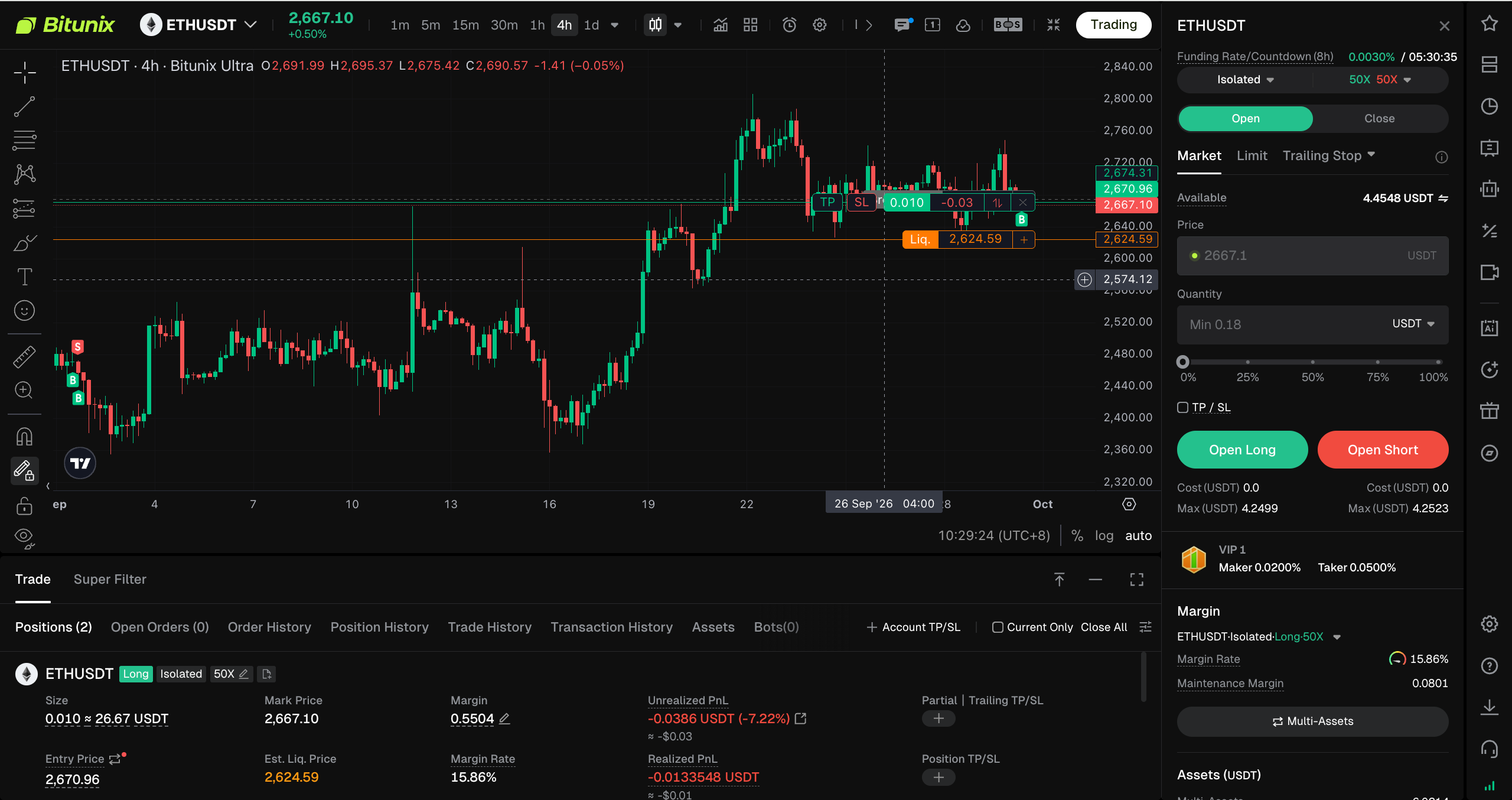
Bitunix Ultra Chart Trading
WEEX: uses TradingView-powered charts, a layout many traders already know. After opening a position, you can drag TP/SL lines on the chart, and the app chart shows your estimated liquidation price.
If you enter from the order panel and set TP/SL afterward, both work well. If you plan trades visually, marking levels, entries and exits on the chart, Bitunix keeps the setup, the order and the risk in one view.
Demo Trading
Both give you 50,000 USDT in virtual funds. Bitunix's Demo Trading covers its USDT-M perpetuals, while WEEX's covers BTC and ETH futures.
| Bitunix | WEEX |
Virtual funds | 50,000 USDT | 50,000 USDT |
Markets | USDT-M perpetuals | BTC and ETH futures |
Topping up | Reset closes all positions and restores the balance | 5,000 USDT top-up when balance is 5,000 USDT or less, every 72 hours |
Bitunix: Demo Trading runs on iOS and Android apps. Funding rates are synced with live trading, liquidation follows the same rules as real trading, and it supports cross and isolated margin with no KYC needed.
WEEX: Demo funds are given to new users for practicing BTC and ETH futures.
Use demo mode to test a strategy on the pairs you plan to trade. Demo fills have no slippage and do not touch the live order book, so treat demo profits as practice, not proof.
Copy Trading
Both offer futures copy trading, with different profit-share models. Bitunix uses a flat 10% default, charged weekly and only on profit. On WEEX, the rate rises with the lead trader's level.
| Bitunix | WEEX |
Profit share | 10% by default | 10% (levels 1–3), 15% (level 4), 20% (level 5) |
How it is set | Default rate, settled every Monday 00:00 UTC | By lead trader level, based on futures assets or WXT holdings |
Bitunix: under its copy trading rules, no profit share is charged for a losing week. Copied trades are capped at 10x leverage, and followers can set an account-level stop loss (5%–95%), cap margin per pair and limit slippage.
WEEX: lead traders move up five levels, starting from 500 USDT in futures assets or 100 WXT. Higher levels unlock more copiers, up to 800, and a higher profit share.
On either platform, check a lead trader's leverage, drawdown and track record before copying, and set your own loss limits where the platform allows it.
Is Bitunix or WEEX Safer for Futures Trading? Protection Funds, Proof of Reserves and Regulation
Both exchanges publish Proof of Reserves and run a dedicated protection fund. The main differences are in fund size, how you can verify reserves, regulatory history and KYC.
| Bitunix | WEEX |
Protection fund | $30M Care Fund, in USDC | 1,000 BTC Protection Fund (about $81M) |
Proof of Reserves | Live page, reserve ratios at or above 100%, Merkle tree check | Published page with reserve ratio by asset |
Bitunix: the Bitunix Care Fund holds 30 million USDC to protect users in extreme events. The Proof of Reserves page shows reserve ratios by asset, and you can confirm your balance is included with the open-source verification tool. User assets are held with institutional custodians Fireblocks and Cobo, and Bitunix is ISO/IEC 27001:2022 certified.
WEEX: the 1,000 BTC Protection Fund covers losses that happen through no fault of the user. It does not cover trading losses, fraud or abuse on the platform, or cases where a user is tricked or approves a transaction by mistake. Claims go to WEEX support within 30 days. WEEX's Proof of Reserves page defines the reserve ratio as platform reserves divided by user holdings, with 100% or more meaning full coverage.
A protection fund is not a futures insurance fund for liquidation losses, and neither fund covers your own trading losses or phishing on your account. A reserve ratio above 100% means the exchange held more of that asset than its users at snapshot time. It is a point-in-time check, not a guarantee of the company's full financial position.
Regulation and KYC
The clearest difference is KYC. WEEX lets you withdraw without verification up to a daily limit, while Bitunix requires KYC before any withdrawal.
Registrations and regulatory record
Bitunix: holds registrations and licenses across five jurisdictions, including a US FinCEN Money Services Business registration, a Canada MSB registration and an Australian AUSTRAC digital currency exchange registration. It does not onboard users from the US, Canada and other restricted regions.
WEEX: in March 2025, the Georgia Department of Banking and Finance issued a final cease-and-desist order finding that WEEX had run an online virtual currency trading platform in the state without a money transmitter license.
KYC and withdrawal limits
| Bitunix | WEEX |
Withdraw without KYC | Not allowed | Up to 10,000 USDT a day |
Daily withdrawal limit with KYC | 500,000 USDT (Level 1), 5,000,000 USDT (Level 2) | Up to 1,000,000 USDT |
KYC needed for | Any withdrawal | Higher limits and fiat purchases |
Sources: Bitunix KYC tiers, Bitunix compliance standards, WEEX KYC page.
Optional KYC is faster to start with, but it does not remove regional restrictions. On Bitunix, plan to verify before you deposit, so withdrawals are not delayed.
Conclusion
Bitunix and WEEX are built for different priorities, so the better choice depends on how you trade.
Choose by cost: Bitunix has the lower taker fee at every VIP level and a VIP 1 tier that starts at 300 USDT in assets. Maker fees are the same at the entry levels.
Choose by market range: WEEX lists about 260 more perpetual pairs, offers leverage up to 400x on select pairs, and reports much larger open interest and volume.
Choose by charting style: both let you drag TP/SL on the chart. WEEX builds on TradingView; Bitunix puts orders, risk lines and multi-condition alerts on its own charts.
Choose by safety and access: WEEX has the larger protection fund and optional KYC. Bitunix lets users verify their balance in its reserves and requires KYC before withdrawals.
Whichever you pick, start in demo mode, size positions by risk, and compare real fills on a small order before you move capital.
Trading futures involves significant risk, including the loss of your entire margin. This article is for information only and is not financial advice.
See more: