MEXC is a high-volume crypto exchange known for its low trading fees and extensive altcoin selection. While its low-cost trading model appeals to active traders, its regulatory record and account restrictions warrant closer scrutiny.
In 2026, regulators in Seychelles and Dubai raised concerns over the licensing and compliance of MEXC's operator, MX Global Ltd. The exchange's risk-control reviews can also restrict trading or withdrawals, potentially affecting users who need reliable access to their funds.
This review examines MEXC's fees, asset selection, regulatory status and account risks to help you decide whether it suits your trading needs.
What Is MEXC? Inside the High-Speed Altcoin Supermarket
Here is the honest take on MEXC:
Why people use it: It lists obscure altcoins faster than any major exchange, has over 3,000 pairs, and offers 0% maker fees alongside aggressive leverage.
The real risks: Constant regulatory warnings worldwide, mandatory KYC on withdrawals, and frequent complaints about profitable accounts getting slapped with sudden 'risk review' holds.
The verdict: Good for small, fast speculative trades on tokens you can't buy elsewhere. Bad for holding large amounts of crypto or long-term custody.
Understanding how MEXC got here explains most of what follows.
From MXC to MEXC Global: The Evolution of a Low-Cap Listing Pioneer
MEXC launched in April 2018 as MXC Exchange and rebranded to MEXC Global in June 2021, the same year Singapore-based John Chen took over as CEO. Chen stepped down in 2022 and the exchange did not publicly name a successor for several years; in April 2026 it appointed Vugar Usi as CEO. The company's press releases are datelined Victoria, Seychelles, and its operating entities include MEXC Global Ltd, MEXC Estonia OÜ and MX Global LTD.
The strategy has not changed since the MXC days: list early, list often, and monetize volume rather than per-trade fees.
The Uniswap-to-CEX Pipeline: How MEXC Lists Trending Tokens Within Hours
MEXC's listing engine is the business model. CoinGecko's 2026 Spot CEX Report counted 1,333 new spot listings between January 2024 and early 2026—roughly 50 per month and about 17% of all new tokens tracked by CoinGecko, against under 5% for most large competitors. Tokens that first trade on a DEX can appear on MEXC the same day.
The flip side is churn. MEXC runs an "ST" warning system: a pair that breaches its risk rules is tagged and can be delisted three days later, after which withdrawals stay open for only 30 days. Monthly ST announcements list dozens of tokens. Early access and early delisting are the same feature viewed from two sides.
Platform Snapshot: Trading Volume Authenticity and User Base Metrics
MEXC claims a user base exceeding 40 million across 170+ countries. In an objective evaluation, this figure represents an unverified promotional metric typical of offshore exchanges, encompassing dormant registrations, referral bots, and multiple accounts created to capture promotional incentives.
Independent tracking confirms genuine scale, though the exchange's volume composition evolved noticeably across 2026. According to CoinGecko's 2026 Spot CEX Report, MEXC experienced an aggressive spot surge early in the year, processing $95.9 billion in spot volume in February 2026 (#2 globally) as its spot market share rose from 5% in early 2024 to approximately 9%. That expansion cooled over subsequent quarters as macro spot volume contracted and liquidity consolidated back into Binance.
By the second half of 2026, the platform's execution engine pivoted decisively toward high-leverage derivatives. CoinGecko's 2026 Q3 Crypto Industry Report notes that while spot turnover softened, perpetual open interest (OI) across top venues rebounded 40.6% past $100 billion.
MEXC capitalized on this shift, expanding its OI by over 40% QoQ to capture a 12% share of top-10 perpetual futures open interest—ranking third globally behind Binance and Bybit. Earlier in May 2026, the platform self-reported $641 billion in combined monthly volume across all products.
Evaluating these figures requires three critical caveats:
Zero-Fee Volume Inflation: MEXC's long-standing zero-maker fee policy removes algorithmic transaction friction, facilitating structural churn and wash trading. A notable portion of reported spot volume reflects low-cost turnover rather than organic end-user demand.
Disproportionate Volume-to-Reserve Ratio: CoinGecko's reserve analytics highlight that MEXC operates with an asset velocity (spot volume relative to verified balance sheet reserves) nearly twenty times higher than custody-heavy institutions like Coinbase. This indicates that its high volume relies on rapid speculative turnover rather than deep, institutional asset custody.
Liquidity Bifurcation & Delisting Churn: While liquidity across BTC, ETH, and major perpetuals is deep, order books on the exchange's long-tail spot assets are thin. Under MEXC's ST (Special Treatment) risk control rules, low-liquidity pairs are routinely flagged and can be delisted within 72 hours, leaving traders exposed to wide spreads, sharp slippage, and an abbreviated 30-day withdrawal window.
Is MEXC Legit? Offshore Registration, Limited Disclosure, and Global Warnings
Whether MEXC is considered "legit" depends largely on your perspective:
From a trader's standpoint: Yes. It possesses an eight-year operational track record, publicly verifiable Proof of Reserves, and deep liquidity across major assets. It is an established exchange with active market operations, not an outright exit scam.
From a regulatory standpoint: It falls short. MEXC operates without Tier-1 financial licenses, and multiple global watchdogs have placed it on unauthorized entity warning lists. Both statements are accurate. MEXC can reliably execute your orders, but you trade primarily on counterparty trust—leaving you without the statutory investor protections offered by fully regulated brokerages if a dispute arises.
Corporate Transparency: Seychelles Domicile and Low-Profile Leadership
MEXC's primary entity, MEXC Global Ltd, is registered in Seychelles, a jurisdiction with no meaningful crypto supervision. The company has never published a full ownership structure. Its own CoinMarketCap profile says the exchange "has maintained a low public profile in terms of founder identity".
Ask who actually owns MEXC, and you won't get a straight answer. While the exchange recently put forward public hires—like CEO Vugar Usi—to front the brand at conferences, the original founders and controlling equity owners remain completely anonymous behind offshore shell structures.
On desks like Coinbase, Bybit, OKX, or Binance, you know exactly whose legal identity and public reputation are tied to the platform. At MEXC, the people who actually pull the levers have zero personal skin in the game. That doesn't mean the platform is an exit scam waiting to happen, but it creates a genuine accountability vacuum: if an account gets locked or withdrawals stall out, there is simply no recognizable owner you can drag into the daylight or hold to account.
Global Regulatory Watchlists: Warnings from BaFin, Japan FSA, Canada and Dubai
The regulatory record is the most verifiable part of any MEXC review. The following table lists the public actions found as of October 2026:
Regulator | Jurisdiction | Action | Date |
Japan FSA | Japan | Warning for unregistered crypto-asset exchange business, repeated after non-compliance | Mar 31, 2023; Nov 28, 2024 |
BaFin
| Germany | Consumer warning: financial services offered without authorisation | Oct 19, 2023 |
Ontario Securities Commission | Canada | Added to investor warning list | May 2025 |
CNMV; Austrian FMA; BC Securities Commission | Spain; Austria; Canada | Unlicensed-operator warnings | 2024–2025
|
VARA | Dubai | Investor alert (Mar 5, 2026), then Notice of Fines against MX Global LTD for unlicensed broker-dealer and exchange services from 2022 to April 2026, with a cease-and-desist | Jun 22, 2026 |
Two legal realities shape how MEXC operates today:
First, in Europe, MEXC lacks a MiCA license, has exited the Netherlands, and processes euro deposits through an outsourced payment processor in Lithuania rather than a licensed subsidiary. In the US, having zero federal or state registrations means American accounts are technically prohibited.
Second, the Dubai fine was significant. Most watchdogs stop at public warnings, but VARA moved straight to a financial penalty. While MEXC complied with the cease-and-desist, the public record confirms they spent four years running an unauthorized exchange in Dubai.
Enforcement Risk: What Happens If an Offshore Exchange Loses Banking Rails?
The real risk with a Seychelles-registered exchange isn't an overnight rug pull. It's getting boxed in. Regulators pressure banks to cut funding rails, Google and Apple yank the app from your phone's regional store, and MEXC blocks your IP to keep their heads down. You usually get a grace period to withdraw what's left, but dealing with that while managing open positions is the last thing you want.
Here is the rule of thumb: only keep an amount on MEXC you wouldn't mind having frozen for a month. Use the platform for its early token listings and fast fills, but treat withdrawals as an automatic routine—not an afterthought.
Is MEXC Safe? Proof of Reserves and the "Abnormal Profit" Clawback Debate
On solvency, MEXC scores well. On whether you will be able to withdraw your own profits on your own schedule, the record is mixed, and that is the question most people mean when they ask "is MEXC safe."
Proof of Reserves: Reserve Composition and Clean Asset Ratios
To prove it isn't trading against customer deposits, MEXC publishes a monthly Proof of Reserves (PoR) audited by Hacken. Traders can take their account hash and manually check the Merkle tree to verify their coins are sitting where they should be.
The latest verified snapshot from October 2026 shows clean over-collateralization across the board:
Asset | Reserve Ratio | User Holdings Covered |
BTC | 294% | 4,282 BTC |
USDT | 122% | 1.69 billion USDT |
USDC | 114% | 171 million USDC |
ETH | 113% | 58,457 ETH |
The high BTC ratio (294%) reflects MEXC parking its own corporate capital in Bitcoin alongside user deposits.
The stablecoin numbers give you the real picture: USDT at 122% and USDC at 114% provide a clean 14–22% buffer over customer balances, covering 1.69 billion USDT and 171 million USDC.
Earlier disclosures from April 2026 listed total reserves of 12,695 BTC, 69,430 ETH, 1.88 billion USDT, and 90.5 million USDC, showing the platform's solvency margin has stayed consistently above 1:1 throughout the year.
The "Abnormal Trading" Clause: Understanding MEXC's Automated Risk Controls
Account restrictions and automated compliance reviews represent the primary operational friction between MEXC and high-volume traders.
Under its October 2026 User Agreement, MEXC retains contractual discretion to place temporary holds on accounts, review execution logs, and delay withdrawals when internal monitoring detects activity flagged as "abnormal, suspicious, or contrary to risk management guidelines." The agreement outlines broad evaluation standards—including trading frequency and non-standard execution patterns—giving compliance teams substantial oversight latitude.
MEXC's official position is that these mechanisms serve strictly as defensive market-integrity safeguards. The exchange maintains that automated parameters focus exclusively on recognized market abuses, including wash trading, self-dealing, latency arbitrage, order spoofing, and automated sybil attacks across linked accounts.
According to corporate communications, the exchange targets a false-positive rate under 0.1%, though multi-account inquiries can involve extended audit timelines. During an official 2025 executive address, COO Tracy Jin reiterated that standard discretionary trading does not trigger automated restrictions.
In market practice, community discussions highlight where operational friction occurs:
Statistical Volume Spikes: Algorithmic systems are calibrated to flag sharp, anomalous increases in account equity, rapid-fire futures scalping, or immediate full-balance withdrawal requests following significant winning positions.
Secondary Verification Triggers: Accounts flagged by anomalous telemetry often require enhanced tier-2 or tier-3 verification before processing off-platform transfers.
Disputed Strategy Adjustments: A fraction of public disputes involve retroactive margin or profit recalculations under exchange rules governing latency exploitation or unauthorized automated execution.
Because proprietary risk formulas and trading logs remain confidential to protect platform integrity, outside participants cannot independently audit specific account decisions. For active derivatives traders, this operational asymmetry means that high-velocity strategies carry the risk of automated compliance pauses, requiring direct coordination with internal support to resolve.
Community Sentiment: Evaluating Feedback Across Trustpilot and Reddit
The community sentiment around MEXC is split down the middle: traders love the zero-fee structure and fast listings, but dread running into withdrawal verification.
In reality, those complaints usually split into two buckets:
Direct policy violations: Many locked users were trading through VPNs from restricted countries like the US, multi-accounting for promo bonuses, or running latency scripts. Those are automated bans under standard terms.
Manual audit delays: For legitimate, KYC-cleared traders, large wins or sudden spikes in volume can trigger unexpected secondary verification. Your capital isn't seized, but getting tickets cleared through support can turn into a multi-week waiting game.
Treat MEXC accordingly: verify early, stick strictly to geographic terms, and run a regular withdrawal routine.
Cold Storage and Insurance: Does MEXC Have an Emergency Recovery Fund?
Yes. MEXC maintains a $100M Guardian Fund held in USDT and BTC with publicly disclosed wallet addresses, plus a separate Futures Insurance Fund that absorbs losses from liquidations that cross bankruptcy price. The exchange has no publicly recorded major hack. On infrastructure security, MEXC is in line with its peers; its weak point is policy, not custody.

MEXC's reserves comfortably exceed user balances; the open question is whether a profitable account can withdraw on its own timeline.
The MEXC 0% Fee Illusion: Spot Rates, High Spreads, and Withdrawal Costs
MEXC's zero-fee pitch isn't a gimmick—on paper, its base rates genuinely undercut every major desk in the industry. The catch isn't what sits on the fee schedule, but what gets left off it: slippage, wider spreads on illiquid books, and withdrawal markups.
Here is how MEXC's baseline retail pricing stacks up against the competition as of October 2026:
Exchange | Spot maker / taker | Futures maker / taker | Max leverage |
MEXC | 0% / 0.05% | 0% / 0.02% | 500x (selected contracts) |
Bitunix | 0.08% / 0.10% | 0.02% / 0.06% | 200x (BTC, ETH) |
Binance | 0.10% / 0.10% | 0.02% / 0.05% | 125x |
Bybit | 0.10% / 0.10% | 0.02% / 0.055% | 125x |
The 0% Maker Fee Strategy: How MEXC Monetizes Beyond Base Trading Fees
Zero maker fees are a liquidity-acquisition tactic, not charity.
MEXC earns from taker fees, from liquidation penalties and margin interest on 1,400+ perpetual pairs, from listing arrangements with projects (its Ventures arm invests in tokens it later lists), from Launchpad and Kickstarter subscriptions, and from the MX token, which users must hold (500+ MX for a 50% fee discount) to get the best rates.
MEXC reported that its zero-fee campaigns across 949 pairs "saved" users $240 million in May 2026 alone, a figure that doubles as an estimate of how much fee revenue it is willing to give up for volume.
Hidden Costs Revealed: Wide Spreads, Thin Order Books, and Slippage
On BTC/USDT, ETH/USDT and the top perpetuals, MEXC's books are deep and the 0% maker rate is a real saving. TokenInsight ranked it first in silver-futures liquidity and highly on ETH-futures slippage in May 2026.
On the other 2,000-plus pairs the economics invert. A micro-cap with a 0.5–2% bid-ask spread costs a market-order trader 10 to 40 times the 0.05% taker fee on every round trip, and a limit order that sits at 0% maker only fills if someone crosses that spread toward you. For altcoin hunters, the relevant cost line is spread plus slippage, and a 0% fee does nothing to reduce it. The way to check is simple: before sizing a position, look at the depth within 1% of mid on both sides.
Futures Margin Rates: Funding Costs and High-Leverage Liquidation
A 0.02% futures taker fee looks like an outright bargain, but execution fees are rarely what drain a high-leverage account. The real balance-sheet drag hides in two places: holding costs and the brutal math of liquidation.
On volatile altcoin perpetuals, holding a position over several funding intervals can rack up cumulative payments that eclipse your round-trip trading fees many times over. But the sharper hazard is ultra-high leverage. MEXC is one of the few venues advertising up to 500x on pairs like BTC and ETH. At 500x, your initial margin is a razor-thin 0.20%.
Once you factor in the maintenance margin requirement and the exchange's liquidation fee, an adverse price flicker of barely 0.10% to 0.15%—essentially ordinary order book noise—triggers an immediate wipeout, with any residual margin absorbed by the desk.
Extreme leverage is a legitimate capital-efficiency tool for market-neutral hedgers and precision scalpers running hard sub-second stops. Used by retail traders as a directional lottery ticket, it simply converts whatever cash was saved on headline fees into instant liquidation revenue for the house.
Cashout Costs: Withdrawal Fees, Minimums and KYC Gating
Crypto deposits are free. Withdrawal fees are set per network and change with chain conditions, which is standard, though fixed per-network fees on expensive L1s can exceed the actual on-chain cost; check the fee page before choosing a network.
The larger cashout cost on MEXC is procedural: since the February 5, 2026 announcement, KYC verification is required to unlock withdrawals at all, and since January 1, 2026 MEXC collects tax identification numbers under CARF reporting. The days of withdrawing meaningful sums without identity checks are over; anyone still relying on older "no-KYC" guides will hit a wall at the exact moment they try to leave.
Trading Altcoins on MEXC: 3,000+ Tokens, Liquidity Risks, and 500x Futures
The massive token catalog is why people sign up for MEXC. If you want early exposure to micro-caps before they hit tier-1 desks, this is where you go.
The Micro-Cap Jungle: Delistings, Low Volume, and Pump-and-Dumps
With 2,700 spot pairs and 1,400 futures contracts covering 3,000+ assets, MEXC functions less like a curated exchange and more like a centralized front-end for on-chain liquidity.
In its February 2026 report, MEXC cited an average peak gain of 1,367% across its top ten new listings. That number looks impressive on a promo graphic, but peak returns tell you nothing about shelf life—the report offers no data on price retention a month after launch.
Across the market, exchange delistings now consistently outpace new listings, and MEXC's recurring "Special Treatment" (ST) notices make the dynamic obvious: tokens are brought in to harvest initial speculative turnover, but when trading dries up, they get phased out just as quickly.
Perpetual Futures Execution: Wicks, Counterparty Depth, and Spread Gaps
Altcoin perps on MEXC carry up to 500x leverage on selected contracts and far less on most of the long tail. Thin futures books mean liquidation cascades show up as long wicks that would not print on a deeper venue; a stop placed just outside recent range on a low-cap perp will frequently be hit by a wick that reverses within the same minute.
MEXC does offer guaranteed stop-loss orders on some futures contracts, which is worth using on illiquid pairs even at the extra cost. On BTC and ETH perps, execution is competitive with Tier-1 venues.
Spot vs. Futures Interface: Desktop Stability During High-Volatility Events
MEXC's web and app interfaces are functional and the app is well rated (4.6 on the App Store at the time of writing). User reports of lag or order rejections cluster around new-listing spikes and macro-driven volatility, which is true of most exchanges but matters more here because new-listing spikes are MEXC's core use case.
Traders running multiple micro-cap positions at once face a second, less obvious problem: MEXC's interface is built around one pair per screen, so monitoring a basket means cycling through tabs at exactly the moment prices are moving fastest.
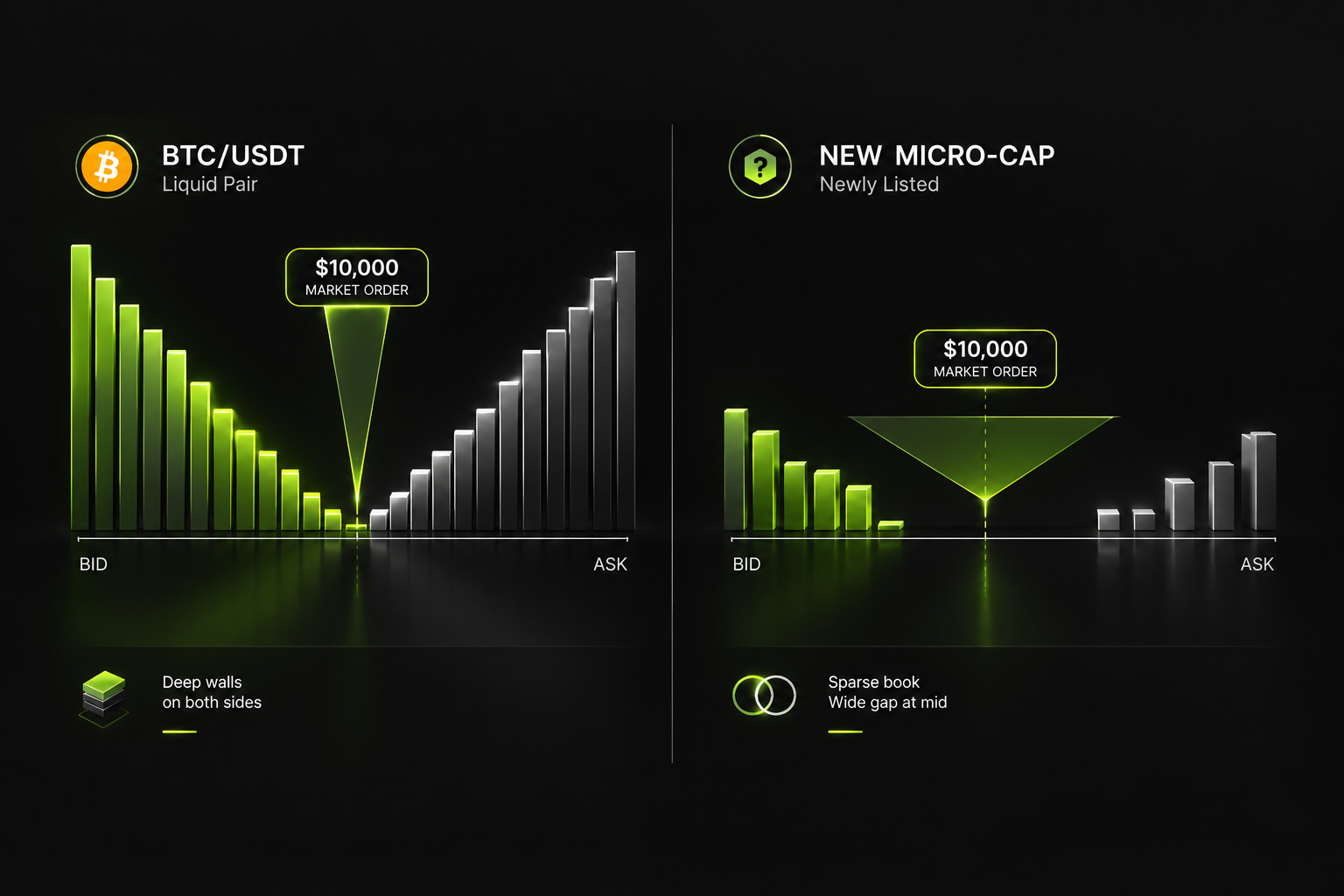
The same market order barely moves BTC/USDT but can walk several percent through a new listing's order book.
MEXC Global Review: Restricted Countries, KYC Requirements, and Account Risks
Before getting drawn in by zero-fee spot trading or the 3,000-token catalog, the baseline question is whether you are permitted to use the platform in the first place—and whether you can pull your capital back out. Regional restrictions and KYC policies are where most retail account friction begins.
Is MEXC Global Available in the US and Other Restricted Countries?
The short answer is no. Under its User Agreement, MEXC explicitly designates the United States, the United Kingdom, Canada, Singapore, Hong Kong, and Mainland China as prohibited jurisdictions, alongside sanctioned regions.
The practical trap for retail traders is the gap between website access and contractual eligibility. In practice, MEXC's interface has historically permitted basic registration and deposits without strict initial IP blocks. However, opening an account does not mean an account is authorized.
MEXC's terms grant the exchange full discretion to require identity verification at the point of withdrawal. If you verify with documents from a restricted jurisdiction—or if backend telemetry ties your session to a banned region—the desk is contractually obligated and entitled to restrict the account pending compliance review.
For US and UK traders, MEXC is officially off-limits. Depositing funds under the assumption that a VPN bypasses these contractual boundaries is the single most common trigger for self-inflicted account lockouts on the platform.
MEXC Global KYC Requirements and Withdrawal Restrictions
MEXC used to be known as one of the few large exchanges where you could trade without KYC, but that setup ended in February 2026. Unverified accounts are now limited to view-only mode—you can look at price charts and read announcements, but deposits, trading, and withdrawals are completely blocked.
For individual accounts, access breaks down into two verification tiers:
Primary KYC: Requires a government-issued ID (passport or driver's license). Once approved, it unlocks standard spot and futures trading, along with an 80 BTC daily withdrawal limit.
Advanced KYC: Adds facial recognition on top of your ID, raising the daily withdrawal limit to 200 BTC.
The transition creates two common issues that traders run into on forums:
The first involves older accounts. If you signed up years ago when verification wasn't required and send funds to your account today, those funds will be stuck until you complete KYC. Past trading history doesn't grant any grandfathered status.
The second involves restricted regions. KYC is designed to enforce geographic limits, not bypass them. If you submit an ID from a prohibited country—such as the US, UK, Canada, or mainland China—verification won't unlock the platform. Instead, it confirms to the exchange that the account is operating from a restricted location, which usually leads to an immediate account freeze and a review process to close it out.
VPN Use, Geoblocking, and Account Access Risks
Using a VPN to mask your IP address does not change your actual eligibility under MEXC's User Agreement. The platform's terms explicitly forbid misrepresenting your location or residence, and the exchange reserves the right to terminate accounts and forcefully close open positions if it detects conflicting data.
A spoofed IP only gets you past the front-end website filter. It does nothing to protect you once the backend risk engine flags an account. If automated systems detect inconsistent connection telemetry—or if you trigger a routine compliance review when requesting a withdrawal—MEXC will ask for proof of identity and residence. If your documents tie back to an excluded country like the US or the UK, a VPN provides zero defense.
For anyone in a prohibited country, using a VPN to trade on MEXC simply creates unnecessary capital risk. If you aren't legally permitted to use the platform in the first place, depositing funds is just an open invitation for a withdrawal hold.
MEXC Copy Trading: High-Risk Multipliers vs. Follower Drawdowns
MEXC's copy trading runs on its futures engine, with lead traders earning a share of follower profits. The design is standard; the incentive problems are structural to copy trading generally and show up clearly here.
The Lead Trader Illusion: Inflated Win Rates via High-Leverage Strategies
Copy trading leaderboards on MEXC are heavily weighted toward headline ROI and win rates—two metrics that are surprisingly easy to manufacture.
The common playbook is simple: run high leverage, take quick profits on small moves, and refuse to cut losing trades. This builds a chart with dozens of consecutive green closes and a flawless 95%+ win rate, right up until an unexpected move wipes out the account in a single candle.
The platform's incentive model magnifies this risk. While standard public copy trading defaults to a 10% profit-share, MEXC allows lead traders in private mode to take cuts as high as 50%. That creates an obvious asymmetric incentive: the lead trader captures up to half the upside during a lucky run, while followers absorb 100% of the capital loss when the position blows up.
If you use copy trading on MEXC, ignore the lifetime ROI badge. Check the maximum drawdown (MDD), average leverage used across open positions, and how long losing trades are allowed to float. Most importantly, look at the trader's own equity committed to the pool—without real skin in the game, you are just funding someone else's high-risk lottery ticket.
Settlement Flaws: How Daily Profit Cuts Hurt Long-Term Follower Portfolios
MEXC settles profit share daily: if a follower's closed positions show a net gain for the day, the lead trader's share is deducted, and the running total then resets to zero. There is no multi-period high-water mark. In practice a follower can pay profit share on Monday's gain, give back more than that on Tuesday, and pay again on Wednesday's smaller recovery, ending the week down while the lead trader has been paid three times.
For long-horizon followers this settlement cadence quietly erodes returns in choppy markets. The fix is to copy only traders with low leverage and consistent position sizing, and to cap allocation at an amount whose daily volatility you can watch without reacting.
MEXC Alternatives: Bitunix, Binance and Bybit Compared
Traders considering MEXC alternatives may be looking for clearer account review procedures, more suitable futures trading conditions, or copy trading features that better match their needs. This guide compares Bitunix, Binance, and Bybit across account restrictions, derivatives trading, fees, and copy trading to help you choose an exchange based on your priorities.
Bitunix vs. MEXC: Trading Tools and Risk Management
Bitunix is a derivatives-focused exchange that prioritizes integrated trading tools over catalog breadth. MEXC offers a wider token selection, lower base trading fees, and higher maximum leverage, while Bitunix differentiates itself through its chart-based trading workflow and risk-planning tools.
Chart-based execution and market screening. Bitunix PC Ultra combines on-chart order placement with Super Filter, which screens perpetual futures using technical indicators, candlestick patterns, and funding-rate conditions. MEXC also supports TradingView-based charting, but Bitunix's integrated workflow connects market discovery, chart analysis, and order placement in one desktop environment.
Advanced market alerts. Both exchanges support price and indicator alerts. Bitunix Super Alert adds candlestick-pattern, drawing, and combined-condition alerts, giving traders more ways to monitor predefined setups without continuously watching every chart. Alerts remain monitoring tools, not guarantees of a trading opportunity or execution.
Position-risk planning. Bitunix Fixed Risk calculates position size from a predefined risk amount, entry price, and stop-loss level. This helps traders plan exposure before entry, although slippage and execution conditions can cause actual losses to exceed the intended amount. MEXC's higher leverage ceiling offers greater leverage flexibility, but maximum leverage alone does not indicate better execution or lower trading risk.
Automated and copy trading. Both platforms offer grid trading and copy trading, but their available strategies, configurations, and settlement rules differ. Bitunix offers Futures Grid and Spot Auto-Invest, while MEXC provides its own grid and DCA automation options. Rather than comparing headline feature names, traders should assess supported markets, profit-sharing calculations, loss treatment, and execution costs.
On fees and market access, MEXC is generally more attractive to traders who prioritize low base fees and a broad selection of tokens. Bitunix may be a better fit for derivatives traders who value integrated market screening, configurable alerts, and structured position sizing.
For a detailed comparison of trading fees, leverage, liquidity, and platform rules, see our Bitunix vs. MEXC comparison.
Binance & Bybit: The Tier-1 Benchmark for Liquidity and Deep Order Books
For BTC, ETH and large-cap perps, Binance and Bybit remain the depth benchmark; their futures taker fees (0.05% and 0.055%) are higher than MEXC's 0.02%, but on size the tighter spread usually more than offsets the fee.
Both are licensed in multiple jurisdictions and both have mandatory KYC. Neither will list a token hours after its DEX debut, which is the trade-off: if your edge is early listings, the Tier-1 venues will not have the pair.
Alternative Comparison Matrix: Listed Assets, KYC, Leverage, and Risk Profile
The following table summarizes where each platform sits on the factors that drive the decision:
Factor | MEXC | Bitunix | Binance | Bybit |
Listed assets | 3,000+ (fastest listings) | ~500 perps + spot majors | ~400 spot, deep perps | ~600 spot, deep perps |
Futures fees (maker/taker) | 0% / 0.02% | 0.02% / 0.06% | 0.02% / 0.05% | 0.02% / 0.055% |
Max leverage | 500x (selected) | 200x (BTC, ETH) | 125x | 125x |
KYC | Mandatory to deposit, trade, withdraw | Tiered; verification raises limits | Mandatory | Mandatory |
Proof of Reserves | Monthly, Hacken-audited | Merkle-tree, 100%+ | Yes | Yes |
User protection fund | $100M Guardian Fund | $50M Care Fund | SAFU fund | Insurance fund |
Regulatory status | Seychelles; VARA fine 2026; warnings in DE, JP, CA, ES, AT | Registrations in 5 jurisdictions (FinCEN, AUSTRAC, Canada MSB); ISO 27001 | Licensed in multiple major jurisdictions | Licensed in multiple jurisdictions |
Main risk | Risk-control freezes; thin long-tail liquidity | Smaller catalog; no MiCA | Higher fees on futures | Higher fees on futures |

MEXC wins on breadth; the alternatives trade breadth for execution quality and predictable withdrawals.
MEXC Pros and Cons: A Reality Check for 2026
Looking past both the promotional claims and the forum friction, MEXC has a well-defined niche: it is built for fast, cost-effective execution across an unmatched token catalog, rather than as a primary long-term custody desk for large capital.
The Core Advantages: Unrivaled Altcoin Selection and Zero-Fee Spot Entry
Listing speed and breadth. Over 3,000 supported assets backed by aggressive listing velocity. Between January 2024 and early 2026, MEXC added 1,333 new tokens—the highest count among major CEXs during that period, according to CoinGecko.
Lowest base fees among major exchanges. 0% maker on spot and futures, 0.05% / 0.02% taker, plus recurring zero-fee campaigns on hundreds of pairs.
Audited reserves. Monthly Hacken-audited PoR with every major asset above 110%, plus a $100M Guardian Fund with public addresses.
Deep liquidity on majors. Top-two global spot share by CoinGecko's February 2026 data; competitive execution on BTC and ETH perps.
High leverage and a full futures toolkit. Up to 500x on selected contracts, guaranteed stop-loss orders, copy trading and demo trading.
The Critical Dealbreakers: Regulatory Isolation, Freeze Precedents, and Spread Drag
No Tier-1 license and an active enforcement record. VARA's June 2026 fine, plus standing warnings from Japan, Germany, Canada, Spain and Austria; no MiCA authorization.
Risk-control freezes. MEXC's terms reserve the right to unilaterally restrict trading and fund movements if an account is flagged for review. In practice, automated triggers—often related to specific trading patterns or sudden fund movements—can lead to lengthy review processes that lack clear operational timelines.
Spread drag on the long tail. Zero fees do not reduce the 0.5–2% spreads typical of new listings; slippage is the real cost of the catalog.
Mandatory KYC with late enforcement. Verification is required for withdrawals, and the request often lands at cashout.
Prohibited for US, UK and Canadian residents. VPN access is a violation that concentrates risk at the withdrawal step.
How to Trade on MEXC Safely: Capital Management and Rapid Cashout Rules
If you use MEXC for its token listings, you have to manage your own risk exposure. The platform won't do it for you, and while these rules won't eliminate account freezes, they ensure a sudden hold doesn't take your entire stack down with it.
Rule 1: Never Treat MEXC as a Vault (The "Trade and Sweep" Principle)
Keep only what you need for today's orders on the platform. The moment a trade hits profit, move those gains off the exchange into your own wallet instead of letting balances accumulate. If a compliance check hits, you want it freezing an active trade balance, not a year of hard-won profits.
Get Advanced KYC out of the way on day one. Waiting to submit an ID until a withdrawal is already stuck in review is how people end up stranded in support queues for weeks.
Also, don't cash out massive lump sums right after a big winning streak. If you just made a quick 5x on a small-cap token, pull it out in steady, reasonable batches over a few days instead of draining the account in a single click. A sudden spike in withdrawal size right after unusual PnL is the fastest way to trip automated compliance filters.
Rule 2: Secure 2FA and Avoid Mixed-IP or VPN Behavior
Use an authenticator app (never rely on SMS), lock down your withdrawal whitelist, and stick to the same device and network connection. Bouncing between a home IP, a mobile network, and three different VPN servers in the same week looks identical to an account takeover to MEXC's risk engine.
If you actually live in a restricted country like the US or the UK, remember that a VPN only changes the IP on your login screen. It does not protect your money. When a compliance check asks for an ID or utility bill on your next withdrawal, an encrypted proxy won't help you clear it. If you aren't legally allowed to trade on the platform, don't keep capital there.
Rule 3: Test Market Depth Before Opening Large Illiquid Futures Positions
Before sizing into any pair outside the top 50, read the order book within 1% of mid on both sides and assume you will need to exit through that same book under stress. On futures, cap leverage to what the pair's liquidity can absorb, use guaranteed stop-loss orders where offered, and treat any position whose liquidation price sits inside the pair's typical hourly range as a coin flip.
Traders who want the same leverage with tighter execution control may prefer to run those positions on a venue built around mark-price liquidation and on-chart risk tools, such as Bitunix, and use MEXC for the listings those venues do not carry.
MEXC Review: The Final Verdict
This MEXC review lands on a clearly defined role within the trading ecosystem: the platform is an active, well-capitalized venue built for cost-efficient altcoin execution, rather than an all-in-one custody solution for core capital.
On balance sheet backing, regular Proof of Reserves updates and a dedicated $100M Guardian Fund address foundational solvency requirements. The actual operational trade-offs reflect its offshore structure: a Seychelles incorporation, past regulatory actions such as the Dubai VARA notice, mandatory identity verification at cashout, and automated compliance triggers on out-of-pattern account activity.
For active traders, the practical approach is straightforward. Leverage MEXC where it holds a verified competitive edge—its unmatched listing turnover and rock-bottom fee tiers. At the same time, apply standard asset-protection discipline: sweep realized trading gains into self-custody as they materialize, reserving high-balance holdings and long-term capital for venues with domestic licensing and dedicated institutional custody infrastructure.
Note: Data checked as of October, 2026 unless otherwise dated.