Choosing the best crypto exchange in the UK in 2026 starts with knowing what you need from it.
For spot investing and local GBP rails, the shortlist has barely changed: Coinbase, Kraken, and Bitstamp remain the standard FCA-registered options. Crypto derivatives are a separate matter. FCA-regulated firms do not offer them to UK retail clients, so the tools active traders compare (perpetual futures, on-chart execution, advanced order types) sit on global platforms such as Bitunix, which are not regulated in the UK and carry none of its protections.
This guide sets out what each option costs, what the FCA has published, how GBP withdrawals work, and which platform features fit which trading style. Every figure is dated, and every claim about a platform is taken from that platform's own published terms or the FCA's own publications. Nothing here is legal, tax or investment advice.
Best Crypto Exchanges in the UK: At-a-Glance Platform Benchmarking
The platforms in this comparison fall into two groups. One is FCA-registered spot exchanges with GBP rails and no retail derivatives. The other is global trading platforms that offer futures and advanced tools, hold no FCA registration and have no GBP rails. The comparison covers both so the differences in cost, protection and tooling are visible side by side.
Quick Verdict: Top Platforms Ranked by Fees, Assets, and Security
The following table compares the platforms UK traders most often shortlist, using entry-tier published fees as of 3 November 2026:
Platform | FCA status | GBP rails | Entry spot fees (maker / taker) | Crypto futures for UK retail | Advantage for this use case |
Coinbase | Registered (CB Payments Ltd) | Faster Payments: free deposits and withdrawals | 0.25% / 0.50% on Coinbase Advanced (since 16 Sep 2026); simple buy adds spread plus fee | No (FCA ban) | Smoothest GBP on/off-ramp; beginner interface plus a pro order book in one account |
Kraken | Registered (Payward Ltd), plus e-money permission | Faster Payments: free deposits, £1.95 withdrawals, near-instant | 0.40% / 0.80% at Tier 1; 0.22% / 0.38% from $10k volume or $20k assets on platform | No (FCA ban) | Deepest GBP order books among registered venues; fee tiers unlock through holdings, not only volume |
Bitstamp | Registered (Bitstamp UK Ltd) | Faster Payments: free deposits, £2 withdrawals | 0.30% / 0.40% | No (FCA ban) | Longest operating record (since 2011); plain order-book trading with GBP pairs |
Bitunix | Offshore exchange; not FCA-authorized or registered in the UK | No direct GBP deposits or UK card purchases | 0.08% / 0.10% spot; 0.02% / 0.06% USDT perpetual futures | Available subject to Bitunix's eligibility requirements and Terms of Service; not covered by FCA protections for regulated firms | Derivatives trading, Chart Trading, PC Ultra, TradFi perpetual futures |
This table is limited to platforms with a current published UK fee schedule. Platform availability in the UK changes, so check the FCA register and each platform's own terms for the latest status.
Methodology: How We Evaluated Security, Liquidity, and Execution Speed
Most UK exchange rankings are driven by affiliate payouts rather than actual trading conditions. To keep this comparison grounded in reality, here is exactly what we evaluated—and what we ruled out.
We assessed every platform against five criteria:
1. FCA registration status: We checked each exchange's UK entity directly on the FCA register and recorded what the register shows. Registration is not a safety guarantee or government endorsement.
2. Standard trading fees: We logged base maker and taker fees alongside the first volume discount tier an active trader could realistically reach. Temporary "zero-fee" launch campaigns were ignored.
3. GBP banking rails: Faster Payments must work both ways. We checked published clearance times and flat cash-out fees, ignoring marketing claims of "instant" settlement.
4. Custody and solvency: Self-reported safety claims mean nothing. We verified live Proof of Reserves, segregated cold storage, backstop emergency funds, and external security audits like ISO/IEC 27001.
5. Execution tooling: Basic market orders are not enough. We evaluated essential risk controls—OCO, trailing stops, and post-only fills—and noted which products each platform offers.
What was left out: Live slippage, support response times, and app store scores.
The reason is simple: snapshot metrics lie. Slippage changes second by second. Help desks inevitably collapse the moment Bitcoin drops 10%. And public review sites are overrun with affiliate bots and angry liquidations. Testing these once and calling it a benchmark produces arbitrary noise, not insight.
Spot Market Leaders vs. Advanced Global Trading Terminals
The two groups do different jobs, so it is more useful to compare them on their own terms than to look for an all-in-one winner.
The regulated spot leaders—Coinbase, Kraken, and Bitstamp—are built around fiat access. They offer direct Faster Payments rails, GBP-denominated pairs, and a UK legal entity you can hold accountable.
The drawbacks are structural. Base trading fees remain steep for retail users. Native GBP order books have only a fraction of global stablecoin depth. And these platforms do not offer crypto derivatives to UK retail clients.
Advanced global terminals like Bitunix are a different category. Bitunix is not authorised or registered by the FCA, has no GBP rails, and is built around derivatives execution: deep USDT order books, perpetual futures, and order controls such as post-only limits, OCO and integrated chart trading.
The trade-off is protection. There is no FCA oversight, no FSCS cover and no recourse through the Financial Ombudsman Service. Bitunix puts it plainly: UK users can access the platform, but without the features and protections available on an FCA-regulated exchange.
UK Regulatory Landscape: FCA Registration, Travel Rule, and Retail Limits
The UK is in the middle of a regulatory transition. Today's rules rest on anti-money-laundering registration and a financial promotions regime. From 25 October 2027, a full FCA authorisation regime replaces them. This section summarises what the FCA has published. It is not legal advice.
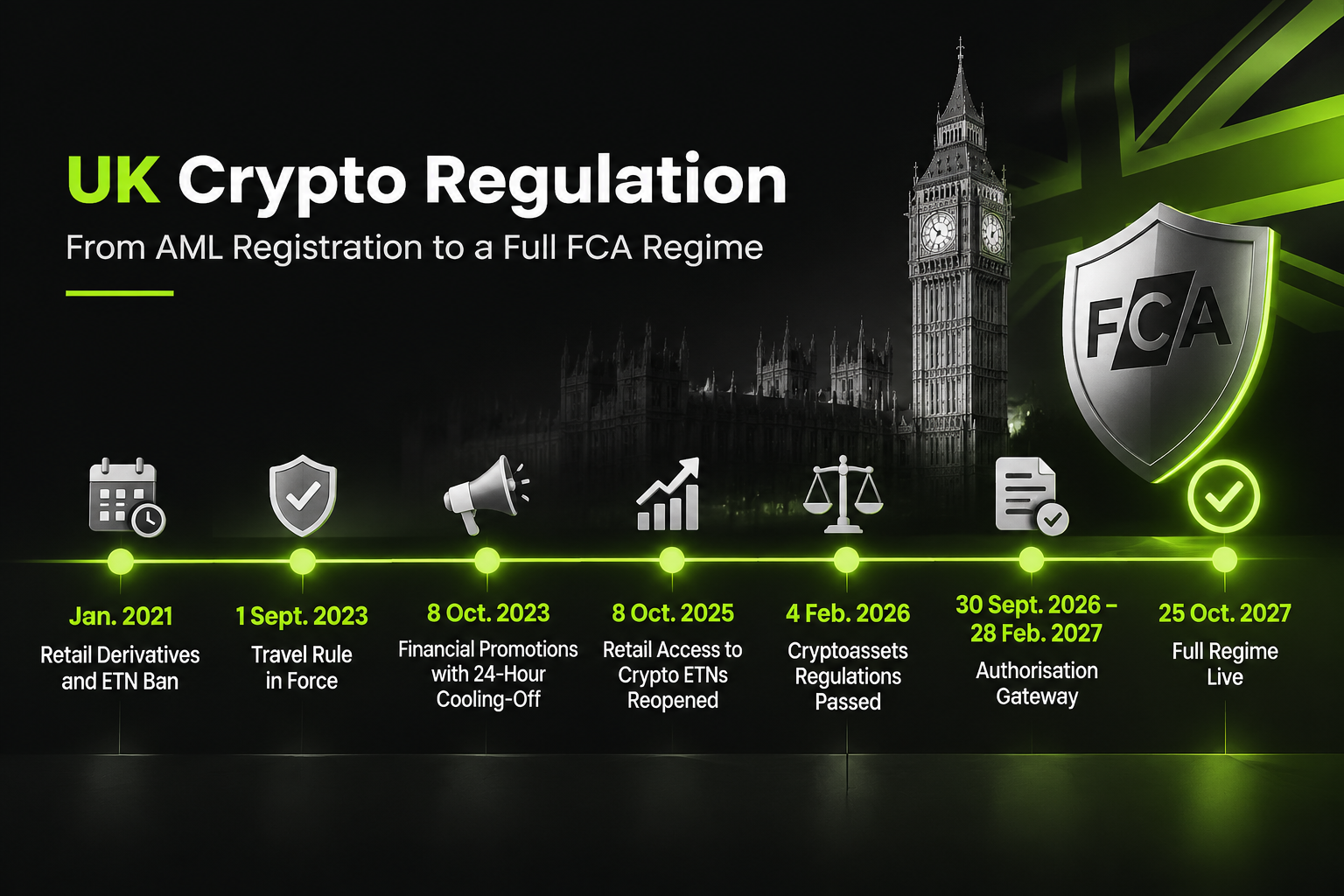
UK crypto regulation moved from AML registration in 2020 to a full FCA authorisation regime that takes effect on 25 October 2027.
FCA Registration Status vs. Full Financial Protections (FSCS Exemptions)
Every UK exchange promotes its "FCA-registered" status. Most traders misread what that actually covers.
Registration under the Money Laundering Regulations is a legal gatekeeper, not a solvency audit. It confirms that the exchange runs acceptable anti-money-laundering checks. That is all. It does not mean the FCA tests the exchange's balance sheet, supervises its custody setup, or protects your trades.
The realities for UK accounts are straightforward:
Zero FSCS cover on crypto. Traditional investments enjoy statutory compensation up to £85,000. Crypto platforms do not. If an exchange fails, you hold no state-backed safety claim. Separate safeguarding rules may apply to fiat held through e-money partners, but your crypto assets carry 100% counterparty risk.
A very narrow complaints path. You cannot take platform trading disputes to the Financial Ombudsman. A missing GBP deposit under an e-money setup might fall within remit; a failed order fill, slippage, or an ill-timed platform outage on a crypto pair never does.
Status changes fast. An FCA entry is not a lifetime pass. Platforms lose permissions, amend their UK corporate structure, or withdraw from the market without warning. A two-minute check on the live FCA register before making a deposit saves unnecessary headaches later.
That dynamic is about to change.
In February 2026, Parliament passed the Financial Services and Markets Act 2000 (Cryptoassets) Regulations 2026, bringing trading venues, custodians, dealers, stablecoin issuers, and staking providers into the FCA's direct statutory perimeter.
The transition is already well underway.
Following its final rulebook in June 2026, the FCA opened the authorisation gateway on 30 September. Platforms have until 28 February 2027 to get their applications in, with full statutory enforcement landing on 25 October 2027.
After that date, "FCA-authorised" takes on an entirely different meaning. It replaces today's basic AML registration with active market-conduct oversight, balance-sheet capital requirements, and enforceable Consumer Duty obligations.
The 24-Hour Cooling-Off Period, Appropriateness Tests, and the Travel Rule
Opening a UK crypto account used to take five minutes. Not anymore.
Since the FCA's cryptoasset financial promotions regime came into force on October 8, 2023, all firms marketing qualifying cryptoassets to UK consumers, including overseas-based businesses, have been required to comply with the applicable financial promotion rules.
1. First comes the 24-hour freeze.
You sign up, verify your ID, and then you wait. No deposits are permitted until a full day has passed. Then comes the compliance screen. You have to declare your investor status and read through unvarnished risk warnings, with promotional giveaways completely ruled out. Finally, you take the appropriateness test. If your answers fail to show you understand that crypto can drop to zero, the platform must show you the door.
2. Asset transfers face the same scrutiny.
The Travel Rule has been active in the UK since September 2023. When you move assets between custodial platforms, sender and beneficiary details must travel with the transaction. What takes seconds on the blockchain can now sit inside an exchange's compliance queue for hours. Sending to your own hardware wallet is not immune either, often requiring a signed cryptographic message to prove you own the keys.
3. The final layer is tax transparency.
From January 1, 2026, UK-based reporting cryptoasset service providers have been required to collect user information and transaction data under the Cryptoasset Reporting Framework (CARF). Their first reports, covering the 2026 calendar year, must be submitted to HMRC by May 31, 2027. Offshore hubs signed up to the OECD framework share that data straight back to Britain.
Your tax rate has not changed. Your anonymity has.
Understanding the UK Retail Derivatives Ban: What the FCA Has Published
The line between spot buying and leveraged trading in Britain is defined by a single clause: COBS 22.6.
The FCA introduced the measure in January 2021 with a clear objective: keeping crypto derivatives away from retail portfolios. It covers the lot. Futures, perpetuals, options, and CFDs are all illegal for regulated UK firms to distribute to ordinary traders.
There has been just one major policy shift. In October 2025, the FCA permitted listed crypto exchange-traded notes (cETNs), giving retail investors a regulated way to gain exposure to Bitcoin and Ether through listed investment products. Yet the watchdog stopped there. The FCA explicitly confirmed that its broader ban on retail access to cryptoasset derivatives would remain in place.
For anyone trading from the UK, the practical takeaways are clear:
Regulated exchanges geofence their books. Domestic venues strip out margin options automatically. You get spot quotes, basic order routing, and nothing more.
Offshore access means zero legal recourse in the UK. Platforms that still provide futures trading operate entirely outside domestic oversight. You trade at your own risk against the platform's balance sheet, without local supervisory monitoring.
If you have questions about how these product restrictions apply to your specific setup, check the FCA's official guidance or consult an independent financial professional.
Cost of Trading: Spot Fees, Hidden Spreads, and Banking Rails
The advertised fee is rarely the fee a UK trader pays. Three layers stack up on every pound that enters and leaves an exchange: the trading fee itself, the spread embedded in "simple" interfaces, and the cost of moving GBP in and out. Comparing exchanges on the first layer alone is how people end up paying 2% to buy Bitcoin on a platform that advertises 0.5%.
Maker vs. Taker Tiers: Uncovering the Real Execution Spread on Major GBP Pairs
On an order-book exchange, a maker order rests on the book and adds liquidity; a taker order fills immediately against it. Takers pay more because they consume liquidity. The gap between the two rates is the first lever a cost-conscious trader can pull, and it is wider than most people expect at the entry tier.
The table below shows what a £2,000 round trip (one buy, one sell, both as market orders) costs at each platform's published entry tier, as of 3 November 2026:
Platform | Entry taker rate | Cost per £2,000 fill | Round-trip cost | First discount tier |
Coinbase Advanced (UK) | 0.50% | £10.00 | £20.00 | From $10,000 in 30-day volume |
Kraken Pro, Tier 1 | 0.80% | £16.00 | £32.00 | 0.60% from $2,500; 0.38% from $10,000 volume or $20,000 held on platform |
Bitstamp | 0.40% | £8.00 | £16.00 | 0.30% from $10,000 |
Bitunix spot (USDT pairs) | 0.10% | £2.00 | £4.00 | 0.09% at VIP 1 (from 100,000 USDT spot volume or 300 USDT balance) |
Bitunix USDT perpetuals | 0.06% | £1.20 per £2,000 notional | £2.40 | 0.05% at VIP 1 |
Your choice of order type matters as much as the exchange itself.
Resting limit orders cut your fee drag in half. At baseline tiers, domestic spot venues charge 0.25% on Coinbase Advanced, 0.30% on Bitstamp, and 0.40% on Kraken Pro. Global execution hubs operate on an entirely different cost structure: Bitunix makers pay 0.08% on spot, and just 0.02% on perpetual contracts.
Fee schedules are not static.
In its 2026 overhaul, Kraken pushed its baseline tier up to 0.40% / 0.80%, but introduced an asset-based alternative. Tiers now track either 30-day volume or portfolio balances. Park $20,000 there, and your rate drops immediately to 0.22% maker and 0.38% taker on trade one. Zero volume required.
Coinbase took the opposite tack for UK Advanced accounts, trimming entry fees to 0.25% / 0.50% while pulling the first volume discount down to a modest $10,000.
Then comes the hidden tax: the bid-ask spread.
Fee comparison tables never account for liquidity depth. Sterling-quoted pairs carry far less volume than global USDT markets, meaning BTC/GBP spreads widen quickly outside peak hours. A retail market order of £2,000 will not notice the difference. A £50,000 market fill will. The slippage across a thinner GBP book can quickly outstrip the actual trading fee, driving active and institutional flow straight into global stablecoin pools.
Funding Your Account: Faster Payments (FPS), Card Purchases, and Deposit Surcharges
How money arrives on the exchange is the second cost layer, and in the UK the hierarchy is clear.
Faster Payments (bank transfer): Free to deposit on Coinbase, Kraken and Bitstamp, usually credited within minutes on business days. This is the baseline every UK trader should use.
Open Banking: An app-to-app push payment authorized directly inside your mobile bank. It settles over Faster Payments rails underneath, but bypasses manual sort codes and frequently unlocks higher transaction ceilings. Speed is virtually instant. The catch is pricing: while standard manual transfers are almost universally free, some platforms pass on a third-party gateway surcharge at checkout.
Debit Card: Convenient and instant, but often the most expensive route. Card purchase fees on UK platforms can range from around 2% to 4%, before any additional spread. A £1,000 card purchase could incur £20 to £40 in fees alone.
Credit Card: Many UK banks block crypto purchases on credit cards outright, and where allowed the fees match or exceed debit card rates.
Platforms without GBP rails sit outside this hierarchy. Bitunix confirms that direct GBP deposits are unavailable and that card purchases are restricted for the United Kingdom, so accounts are funded by transferring crypto from another exchange or wallet. Bitunix does support EUR deposits via SEPA and SEPA Instant for eligible users, but sterling has no direct route.
Why Traditional Incumbents Charge a Premium for "Simple Buy" Interfaces
Almost every major exchange operates a dual-screen model.
Coinbase routes beginners to its default app and active flow to Coinbase Advanced. Kraken separates its basic portal from Kraken Pro. Same wallet. Same custody. Entirely different pricing tiers.
The standard screen quotes one all-inclusive number.
Behind that clean rate sit two stacked layers of friction: a retail spread and an execution fee. Kraken charges a flat 1% trading commission on instant transactions, on top of a variable spread that expands during volatile market hours. Coinbase prices in its own margin spread alongside tiered transaction fees that penalise smaller order sizes. The real-world cost across these simple buy flows ranges between 1.5% and 2% per side—a 300% to 400% premium over direct order-book execution.
That premium buys peace of mind, nothing else.
You skip the bid-ask spread and eliminate partial fills entirely. If you are making an occasional £200 purchase, the minor surcharge is barely noticeable. But if you execute trades regularly, staying on the simple screen makes no financial sense. Flipping to the professional terminal inside your existing account cuts your costs by more than moving to a different exchange ever could.
The Withdrawal Dilemma: Account Freezes, Slow GBP Rails, and User Complaints
Search any UK crypto forum, and one review dominates: withdrawals held indefinitely and accounts locked mid-settlement.
The friction is real. The culprit is misunderstood.
Exchanges are not hoarding your money. Under UK anti-money laundering rules, regulated venues are legally mandated to freeze outbound transfers the second a compliance flag trips—and legally barred from explaining the delay until the review clears.
A regulated UK exchange answers to the law before its users.
Trip an internal compliance wire, and payouts halt immediately. Support goes dead. Staff are legally barred from telling you an investigation is underway, leaving customers stranded with generic canned responses and zero visibility.
Internal risk scoring is a black box. You cannot anticipate a hold.
Preparation is your only real hedge. Keep a chronological audit trail long before cashing out: primary bank statements tracing your sterling deposits, full trade histories from past platforms, and acquisition proof for older coins. When a compliance flag trips, paperwork is the only currency that clears it.
When that happens, deal only with the exchange's official support desk. Do not drip-feed evidence across multiple messages. Provide a single, comprehensive dossier answering exactly what compliance asks for—and wait for the queue to clear.
Best Crypto Exchange to Withdraw Fiat UK: Speed, Fixed Fees, and Bank Routing
Once a withdrawal is approved, the cost and speed of getting GBP back to a UK bank account depend on the rail the exchange uses and the fixed fee it charges. The following table compares published GBP withdrawal terms as of 3 November 2026:
Platform | GBP withdrawal method | Fixed fee | Published processing time | Notes |
Coinbase | Faster Payments to a verified UK bank account | Free | Typically same business day; up to 1 to 3 business days on first withdrawal to a new account | Bank must be linked with a small reference deposit first |
Kraken | Faster Payments (Banking Circle or OpenPayd) | £1.95 | Near-instant; bank-side checks can extend | Minimum £5; SWIFT available at £13 for non-FPS banks |
Bitstamp | Faster Payments | £2 | Same day on business days | Deposits free |
Bitunix | No GBP withdrawal | n/a | n/a | Withdraw crypto to an FCA-registered exchange, then cash out there |
The advantage for frequent fiat withdrawals is clearly Coinbase on price (free) and Kraken on speed (near-instant with a published fixed fee). For a trader cashing out £500 a week, Kraken's £1.95 is 0.39% per withdrawal, which is more than the Pro trading fee at higher tiers; batching withdrawals monthly removes most of that cost.
Bank routing matters more than the exchange's fee page suggests. Some UK banks apply their own holds or limits on inbound payments from crypto firms, and a few block them. A Faster Payment that leaves the exchange in seconds can sit at the receiving bank for a day while the bank reviews it. Checking the bank's published crypto policy before the first large withdrawal avoids the most frustrating version of "slow rails", where neither side can see where the money is.
Note: Bitunix has no GBP withdrawal rail. Withdrawals are made in crypto and are subject to Bitunix's Terms of Service.
Self-Custody Transfers: Security Checks and Common Mistakes
Moving crypto off an exchange to a hardware wallet is the step most UK users underestimate, because the exchange's own security controls and the Travel Rule both apply.
The common friction points are:
1. New withdrawal addresses. Many platforms apply a security delay before a newly added withdrawal address can be used. It is an anti-account-takeover control, so plan for it.
2. Verification steps. An exchange may ask for extra confirmation before a transfer to a self-custody wallet. Requirements differ by platform and are set out in each platform's help centre.
3. Network selection errors. Sending an asset on the wrong network is the one mistake neither the exchange nor the regulator can reverse.
Some platforms have started adding safety valves on the sending side. Bitunix, for example, introduced a Withdrawal Reversal Window in 2026 that gives a user a short period to cancel a withdrawal request before it is finalised. That reduces the cost of a mistyped address, which is the single most common cause of permanent loss on the self-custody path.
Top High-Performance Alternatives for Active Traders
Retail crypto apps are built for casual buying, not active execution.
Trade with any real frequency, and the constraints surface quickly. Fee discounts fail to scale with volume, GBP order books slip on modest size, and domestic product menus remain heavily restricted.
Breaking through those limits involves an unavoidable compromise. Domestic venues inside the FCA perimeter offer lower-fee order books under established regulatory rails, but keep their product scope tight. Offshore execution platforms provide the deep global liquidity and derivatives traders look for—at the price of stripping away every statutory UK protection.
Searching for a Coinbase Alternative UK: Lowering Fees Without Sacrificing Depth
Replacing Coinbase in the UK is an exercise in choosing your frictions. No domestic venue eliminates them entirely.
For most traders, the bottleneck is simple broker markups. The remedy requires no migration at all. Flipping to Coinbase Advanced cuts execution fees to 0.25% maker / 0.50% taker on the existing login. You bypass the retail spread instantly while keeping your banking rails and tax history intact.
Traders scaling volume hit a different wall. Here, Kraken Pro provides the steeper cost curve. While headline rates look uncompetitive, an account balance of $20,000 triggers immediate discounts to 0.22% maker / 0.38% taker from the first trade. Above $250,000 in monthly volume, rates slide to 0.10% / 0.22%. It also offers the broadest roster of direct GBP pairs among registered firms.
Where the issue is interface clutter, Bitstamp remains the veteran alternative. Live since 2011, it avoids retail marketing noise in favour of a disciplined core asset roster. Rates open at 0.30% maker / 0.40% taker over reliable Faster Payments infrastructure.
None of these platforms break out of the statutory fence. FCA oversight guarantees domestic consumer rails, but it enforces hard limits: an absolute ban on retail derivatives, shallower books on large fiat clips, and fee floors well above offshore venues.
Best Crypto Futures Exchange in the UK Context: What the Rules Mean for Platform Choice
For UK retail traders, there is no domestic "best crypto futures exchange". The legal framework settles the question long before fee schedules or engine speeds enter the frame.
The FCA's ban on retail crypto derivatives is absolute. Under domestic rules, no authorised firm may offer leveraged futures, options, or perpetual swaps to retail consumers. Any platform facilitating these contracts sits completely outside the UK regulatory perimeter.
That statutory wall shifts the entire burden of counterparty risk onto the trader.
Evaluating an offshore venue is not a matter of interface preference. It is an exercise in operational risk control:
Jurisdictional exclusion. Circumventing platform geo-restrictions via VPN breaches terms of service. It hands the exchange unilateral grounds to freeze balances and liquidate open positions without warning or right of appeal.
Verifiable solvency. Cryptographically verifiable Merkle-tree proof of reserves, distinguished from unverified, self-reported balance sheet declarations.
Capital backstops. Documented, liquid insurance funds with transparent rules governing auto-deleveraging (ADL) during severe market cascades.
Execution integrity. System uptime, latency consistency, and slippage controls during extreme liquidation events.
Offshore operators illustrate the practical reality of this divide. Platforms that accept UK traffic, such as Bitunix, explicitly reflect their non-authorised status in their product architecture: direct GBP clearing rails and debit card on-ramps are entirely disabled. UK users receive zero statutory protections, forfeit access to the Financial Ombudsman Service, and retain no recourse through the Financial Services Compensation Scheme (FSCS).
The dividing line is definitive: step outside the FCA perimeter, and counterparty solvency rests entirely on the trader's shoulders.
Bitunix Platform Breakdown: Chart-First Workspace and Execution Tools
Bitunix targets active derivatives execution.
Founded in 2021, the venue focuses on terminal ergonomics and competitive taker rates while offering a broad range of tokens.
Chart Trading (and K-Line Ultra). Form-filling is bypassed. Entries, stops, and profit targets are dragged directly across live candles, projecting levels visually before routing to the engine. On mobile, execution runs through the K-Line Ultra terminal.
PC Ultra workspace. Clears the screen for pure price action. Order books and execution panels collapse into hotkey-driven docks, eliminating cursor lag and interface clutter from live charting.
Fixed Risk. Sizes positions dynamically from a hard currency loss limit rather than nominal lot counts. It automates risk discipline, though extreme slippage in thin or fast markets can still breach the cap.
Hedge Mode and Multi-Trade Mode. Hedge Mode permits concurrent two-way exposure on the same contract. Multi-Trade Mode isolates discrete entries on a single ticker, managing each fill independently without blending the average entry price.
Crypto plus TradFi perpetuals. Margins settle in USDT. Bitunix lists perpetual contracts on gold and selected US equities alongside crypto pairs under a shared collateral pool.
Leverage. Maximum limits reach 200x on core pairs, leaving a 0.5% liquidation buffer. Experienced desks use high leverage strictly to minimise idle capital on-exchange, never to amplify gross risk.
Execution fees undercut domestic venues. Perpetual rates open at 0.02% maker / 0.06% taker at VIP 0, compressing to 0.0% / 0.026% at top bands, supported by automated VIP-matching for incoming volume.
For UK market participants, the trade-off is sovereign counterparty risk.
No FCA authorisation. No Faster Payments. No UK card rails.
Traders accept absolute balance exposure with zero FSCS or Financial Ombudsman recourse. Beyond platform solvency, positions face structural market frictions: sudden liquidation from volatility wicks and persistent capital bleed from recurring funding intervals.
Institutional Safeguards: PoR, $50M Care Fund and Trade Monitoring
Security disclosures are the part of any platform a trader should read most carefully, and more so where no home-regulator protection applies.
Bitunix publishes multi-layers of protection:
Proof of Reserves. A Merkle-tree proof-of-reserves page lets any user verify that their balance is included in the published reserve snapshot, with reported reserve ratios above 100%.
$50M USDC Care Fund. A dedicated USDC fund intended to cover user losses from unforeseen platform-level events, raised to $50 million.
Custody and certification. Assets are held with institutional custody providers (Fireblocks and Cobo are named), and the platform holds ISO/IEC 27001:2022 certification for its information security management.
Beyond asset custody, several tools address operational risk and daily execution:
Demo Trading. Paper trading over live order books. With drag-and-drop execution, custom keybindings, and 200x leverage on the table, running a sandbox first prevents fat-finger mistakes before real capital is committed.
Copy Trading. Settles weekly on a net basis (Monday to Sunday UTC). Lead traders take their 10% performance cut only if your account finishes the full seven-day cycle in profit—losing weeks pay zero. Followers can cap capital per pair, override setups with manual stop-losses, and set a 0.1% slippage limit to reject bad fills.
Super Alert. Externalises market surveillance. Modular triggers track price action, indicator signals, drawings, TradingView webhooks, and on-chain wallet movements across the app, Telegram, or Discord. For multi-asset desks, automated telemetry replaces continuous screen time.
Inside PC Ultra, two built-in utilities round out the workspace: Replay Trading steps back through historical candlestick data using virtual funds to test setups against past volatility, while embedded Live Streaming keeps desk commentary on-screen without forcing you to tab away from active positions.
Interface tooling optimizes workflow; it does not alter legal standing. Traders remain entirely exposed to platform-level terms and counterparty solvency.
How to Choose the Right Exchange Based on Your Trading Style
There is no universal venue for UK crypto. Every platform forces a direct compromise between regulatory cover, execution costs, and feature access.
The right setup depends on what you execute each week. Three standard profiles map directly to specific platform architectures:
Trading style | What matters most | Fits inside FCA perimeter | Fits outside FCA perimeter | Main trade-off |
Beginner buying and holding | GBP rails, simple interface, complaints route | Coinbase app, Kraken app | Not needed | Pay the simple-buy premium or learn the order book |
Bitcoin-focused trader in sterling | GBP order-book depth, low taker fees, fast withdrawals | Kraken Pro, Coinbase Advanced, Bitstamp | Bitunix spot via USDT, for deeper books | GBP pairs are thinner; USDT route adds a conversion step |
Active or leveraged trader | Perpetuals, chart-based execution, risk tooling, fee tiers | None (derivatives ban) | Bitunix | No FCA protection; crypto-only funding; liquidation risk |
Best Crypto Exchange for Beginners: Prioritising UI Simplicity and Guided Risk Control
For a first-time UK buyer, the main considerations come to mind include: FCA registration, free Faster Payments, and a clean buying interface. Coinbase and Kraken both fit. Mandatory cooling-off periods, risk warnings, and investor questionnaires are legal requirements rather than proprietary safety features, leaving the decision down to layout preference.
Three habits matter more than the platform choice at this stage. Fund by bank transfer, not card, to avoid a 2% to 4% surcharge. Start with spot only, since ownership of the asset is the simplest thing to understand and there is no liquidation. Keep a dated record of every deposit and purchase from day one, because the first withdrawal and the first tax return will both ask for it.
Beginners have no reason to use leveraged products. Perpetuals, leverage and hedging are tools for experienced traders who understand liquidation risk.
Best Bitcoin Exchange UK: Deep Sterling Order Books vs. Global USDT Pools
UK Bitcoin traders choose between direct sterling books and global USDT liquidity. Venues like Kraken, Coinbase Advanced, and Bitstamp offer direct BTC/GBP pairs that eliminate intermediate stablecoins. Domestic depth easily absorbs four-figure retail orders, but spreads gap out quickly on larger clips and liquidity drops outside UK trading hours.
Offshore USDT pools, such as Bitunix's BTC/USDT spot and perpetual futures markets, offer tighter spreads and deeper continuous order books. The trade-off is operational: trades settle in tether, entering the venue requires currency conversion rather than direct GBP rails, and Bitunix operates without FCA authorisation or domestic investor cover.
For routine, low-frequency tickets, domestic sterling books avoid currency drag and settle cleanly on local rails. Across global USDT venues, headline turnover is secondary; effective execution cost is dictated entirely by resting order depth and real slippage at your target ticket size.
Perpetuals introduce structural risks absent from spot markets. Even when deployed strictly to hedge physical Bitcoin, contracts generate continuous funding-rate drag and face hard liquidation whenever margin thresholds are breached—regardless of the underlying spot balance.
Risk Management: Fixed Risk, TP/SL Engine and Consistent Execution
Professional traders evaluate an exchange on how it behaves in the worst five minutes of the month, not the average day. Three things decide that.
Position sizing discipline. The traditional method is manual: decide the maximum loss, measure the distance to the stop, divide to get size. Tools such as Bitunix's Fixed Risk mode automate the arithmetic so the loss cap is set before entry rather than calculated after. The discipline is the same either way; the tool removes the step where traders round up.
Order engine reliability. A stop-loss is useless if the matching engine lags. Real platform reliability requires server-side order storage, mark-price triggers to prevent bad prints from blowing out positions on thin books, and clear, published collar rules to cap slippage during erratic price swings.
Execution quality. "Slip-free" is a marketing phrase, not a property any order book can guarantee. What a trader can measure is slippage on a market order of a given size at a given time, and the depth sitting within 0.1% of mid. Deeper books mean less slippage, which is why professional execution gravitates to the deepest order books..
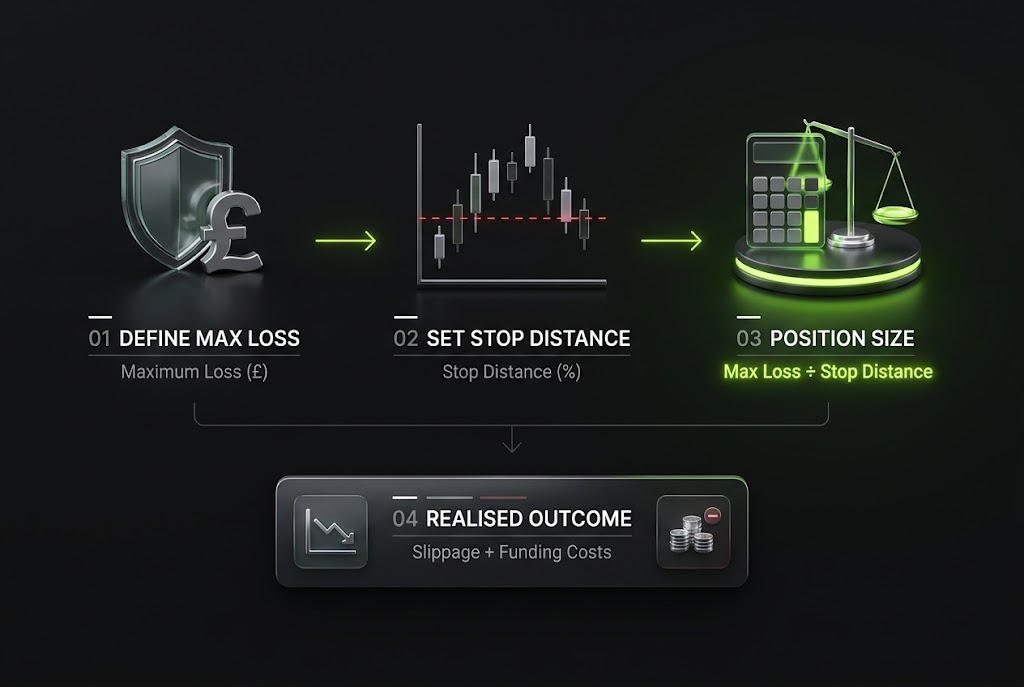
Position size follows from the maximum acceptable loss and the stop distance; slippage and funding costs then move the realised result.
Best Crypto Exchange UK: Verdict and Regulatory Realities
The best crypto exchange UK traders can use in 2026 is a function of what they need from it. For GBP banking, a regulator to complain to, and simple spot buying, the FCA-registered tier (Coinbase, Kraken, Bitstamp) does the job, with Coinbase Advanced and Kraken Pro as the lower-fee interfaces inside those accounts. Perpetual futures and leveraged products are not offered to UK retail clients by FCA-regulated firms.
Global platforms such as Bitunix focus on derivatives tooling and chart-based execution, and should be judged on published reserves, protection funds and terms of service, with the understanding that UK regulatory protections do not apply.
The regulatory perimeter itself remains in flux. With the FCA's comprehensive cryptoasset regime taking effect on 25 October 2027 and the retail derivatives ban under ongoing review. Until that framework settles, platform standing and counterparty exposure can shift rapidly—making an entity's current entry on the FCA register the only reliable baseline before deploying capital.