Picking an exchange from a long feature list is how many traders end up surprised later by fees, country restrictions or a security event. Bitget shows why both sides matter: it has one of the broadest product menus in crypto, and in September 2026 it also suffered one of the year's largest exchange hacks.
This Bitget review covers what the platform offers, what it costs and how safe it is after the incident. It also shows who Bitget suits and when a Bitget alternative may fit you better.
Bitget Review at a Glance: Quick Verdict and Key Facts
Bitget is a large offshore exchange built around derivatives and copy trading. It fits traders who want a wide product menu in one account. It is a harder fit if you weigh recent security history heavily or live in one of its restricted countries.
Bitget - a large offshore exchange built around derivatives and copy trading
Item | Bitget |
Founded | 2018 |
Registered users | 120 million (company figure) |
Markets | 600+ spot tokens; 850+ USDT-M perpetuals, including 350+ stock perpetuals |
Spot fees (base maker / taker) | 0.1% / 0.1% |
Futures fees (base maker / taker) | 0.02% / 0.06% |
Max leverage | Up to 150x on BTC and ETH perpetuals |
Standout products | Copy trading, Unified Trading Account, trading bots, TradFi, Launchpool, Bitget Wallet |
Proof of Reserves | Monthly; September 29, 2026: 131% total ratio across 19 assets |
Protection Fund | 3,705 BTC after the September 2026 incident |
KYC | Mandatory for all users |
Not available in | US, Canada, France, Germany, Austria, Singapore, Hong Kong, Japan, Thailand, Malaysia and other listed countries |
Bitget works well for product breadth and copy trading. Its base spot maker fee is higher than several rivals, and the September 2026 hack is the main point to weigh. The sections below give the details.
Bitget Crypto Trading: Products and Features
Bitget crypto trading covers most of what an active trader needs. Spot and futures sit at the core, with copy trading, bots, TradFi and Earn built around them.
Spot and Futures Trading
Bitget lists 600+ tokens on spot. Spot supports market and limit orders, with no daily trading limit and minimum order sizes that vary by pair.
Futures come in USDT-M, USDC-M and Coin-M form, with more than 850 USDT-M perpetuals alone, including over 350 stock perpetuals. Leverage goes up to 150x on BTC and ETH perpetuals, 125x on pairs such as XRP and up to 100x on most stock perpetuals. New users can face a temporary 5x cap on some pairs during their first 7 days.
High leverage means a small price move can close your position. At 150x, a move of about 0.67% against you can wipe out your initial margin, and liquidation can come sooner once fees and maintenance margin count. Our guide to liquidation price in crypto futures walks through math.
Copy Trading
Copy trading is one of Bitget's best-known features. You follow a lead trader, and their futures positions are mirrored into your account. The rules for followers:
Minimum: at least 50 USDT to start, or the trader's own minimum if higher.
Number of traders: up to 10 at once, each in a separate sub-account.
Leverage: follow the trader's leverage, or set a fixed value from 1x to 10x. Only cross margin is supported.
Risk settings: maximum slippage (default 0.5%, adjustable from 0.1% to 3%), maximum margin per order and a maximum position value.
Profit share: each lead trader sets a ratio, typically 10% to 20% of realized profit. It is charged only when a copied trade closes for profit, using a High Water Mark, so profits are not shared twice.
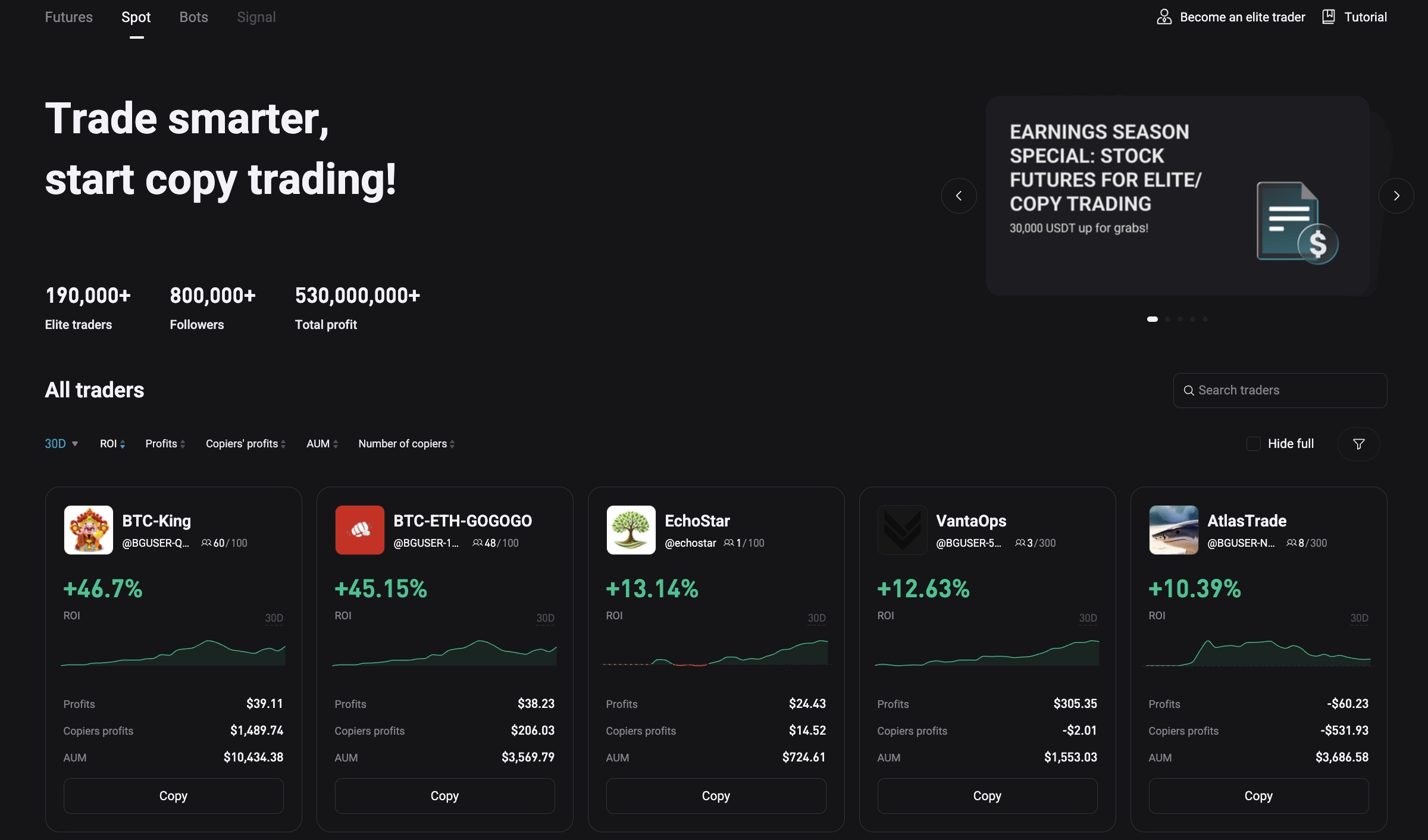
Bitget crypto trading – copy trading lead trader page. Source: Bitget
Settlement runs daily at 00:00 (UTC+8). There is no copy-level stop loss, so followers manage exits with take-profit and stop-loss on open positions.
Copy trading does not guarantee profits. A lead trader's past results say little about the next month, so check maximum drawdown and track record length, not just ROI; see how to choose the best copy trader. For comparison, Bitunix copy trading uses a default 10% profit share, a 10x leverage cap and an optional strategy stop loss.
Unified Trading Account, Bots and TradFi Products
1. Unified Trading Account (UTA)
UTA combines spot, margin and futures in one account. The main differences from a classic account:
Several coins can serve as margin based on a collateral ratio, so BTC can back USDT-M contracts.
Auto-borrow and auto-repay replace manual borrowing.
There is no fixed liquidation price; partial liquidation starts when the margin rate reaches 100% or higher.
UTA can raise capital efficiency, but shared collateral also means a loss in one market can draw on your whole balance.
2. Trading bots
Spot Grid, Futures Grid and Position Grid bots carry no separate subscription fee; Only the standard trading fee applies.
3. TradFi
Bitget opened TradFi to all users in January 2026. It offers forex, precious metals, indices and commodities through an MT5 CFD account margined in USDT, with leverage up to 500x set per product. CFDs carry spreads and overnight swap fees. Bitget also offers tokenized US stocks on spot and stock perpetuals that trade around the clock and settle in USDT. Some TradFi products are restricted in certain countries, and tokenized stocks may not carry full shareholder rights.
Earn, Launchpool and the BGB Token
Launchpool lets you stake BGB or other designated tokens to receive a share of new project tokens. Rewards are issued every hour based on the amount staked and the staking period. The APR shown is an estimate, not a guaranteed return. Each pool may cap how much one user can stake, and only verified users can join.
BGB is Bitget's exchange token, launched on July 26, 2021. Its main uses:
A 20% discount on spot fees when you pay with BGB.
Staking in Launchpool.
Access to Launchpad sales and Super Airdrops.
VIP fee discounts and listing votes.
Holding BGB adds exposure to a single token's price on top of your trading risk. Treat it as a separate decision from using the exchange.
Bitget Wallet and Onchain Tools
Bitget Wallet is a separate, self-custodial wallet. It supports 130+ blockchains, token swaps, cross-chain bridging, dApp connections, fiat purchases and a Bitget Wallet Card. A social login option lets you create a wallet from a Google, Apple or email account without a seed phrase.
Self-custody means you control the keys and carry the responsibility for them. The wallet was formerly BitKeep, which was rebranded in 2023 after Bitget became its controlling stakeholder; BitKeep had a security incident in December 2022. Bitget Wallet was not affected by the September 2026 exchange incident.
Bitget Fees Review: Trading, Deposit and Withdrawal Costs
At the base tier, Bitget's spot fees are the highest of the four exchanges below on maker orders, and its futures fees match Bitunix while sitting slightly above OKX and MEXC. BGB and VIP discounts can narrow the gap.
Spot and Futures Trading Fees
Fees (global base tier, maker / taker) | Bitget | Bitunix | OKX | MEXC |
Spot | 0.1% / 0.1% | 0.08% / 0.10% | 0.08% / 0.10% | 0% / 0.05% |
Futures | 0.02% / 0.06% | 0.02% / 0.06% | 0.02% / 0.05% | 0% / 0.02% |
Rates can vary by region, VIP level, trading pair and promotion. OKX and MEXC charge higher base fees in some regions.
In dollars:
Spot: a $1,000 market buy costs about $1.00 on Bitget. Paying the fee in BGB cuts the rate to 0.08%, or about $0.80.
Futures: a $10,000 BTCUSDT round trip costs about $12 with taker orders and about $4 with maker orders.
VIP tiers lower fees further as your trading volume, account assets or BGB holdings rise, and VIP and BGB discounts can apply at the same time. Fees are only one cost: funding rates, spread and slippage often matter more on large or frequent trades.
Deposit and Withdrawal Fees
Crypto deposits are free on Bitget. Withdrawals carry a network fee that Bitget adjusts automatically with market conditions, so the amount differs by coin and chain. The withdrawal screen shows the exact fee before you confirm.
Two habits keep costs down. Choose a low-cost network your receiving wallet supports, such as TRC-20 or BEP-20 for USDT, and batch small withdrawals, so a flat fee takes a smaller share.
Other product costs are separate. Copy trading adds a profit share, CFD products add spreads and overnight swap fees, and stock perpetuals add funding payments.
Is Bitget Safe? Security, Proof of Reserves and the September 2026 Hack
Is Bitget safe? The answer has two parts: Bitget publishes more reserve data than many exchanges, and it also suffered a major breach in September 2026. Both belong in the picture.
What Happened in the September 2026 Hack
Here is the timeline of the incident (UTC):
Date and time | Event |
Sept 24, 18:31 | Unauthorized transfers begin from some hot and warm wallets |
Sept 24, 19:05 | Reconciliation flags the anomaly; withdrawals are blocked platform-wide |
Sept 25 | Root cause identified; incident reported to law enforcement |
Sept 28, 08:00 | BTC withdrawals resume |
Sept 29, 08:00 | ETH and EVM network withdrawals resume; Proof of Reserves update published |
Sept 30, 08:00 | USDT withdrawals resume; independent investigation reports released |
Oct 2, 08:00 | Other assets, fiat and P2P resume |
The loss figure rose as the review went on. Bitget's first estimate was about $351.6M, which it later raised to $387.5M. The final verified amount is about $388M, taken from 12 of Bitget's own hot and warm wallet addresses.
On the cause, Bitget says attackers exploited a zero-day vulnerability in a third-party security product to obtain high-privilege internal credentials, then injected forged withdrawal commands that bypassed risk controls. Private keys were not compromised and cold wallets were unaffected. Bitget published independent investigation reports from Mandiant and SlowMist, but has not named the vendor or publicly confirmed who was behind the attack.
After the incident, Bitget reset internal credentials, tightened sensitive permissions, disabled the affected vendor functionality and strengthened independent withdrawal verification. It also opened a Recovery Bounty Program that pays 5% of amounts frozen or recovered, subject to terms.
Protection Fund and Proof of Reserves
Protection Fund
Bitget says its Protection Fund covers the financial impact of the incident, that user account balances were unaffected and that the loss will not be passed on to users. In August 2026, the fund averaged about $382M and was backed by 5,500 BTC. After the incident, Bitget committed to restoring it to at least $300M within a week; it now holds 3,705 BTC. The fund's dollar value moves with the BTC price, and some of Bitget's pages still show older figures.
Proof of Reserves
Bitget has published monthly reserve reports since December 2022. Three recent data points:
August 2026 report (45th): 122% total reserve ratio, published September 16.
September 17 update (46th): coverage expanded from 4 to 19 assets.
September 29 update (47th): 131% total reserve ratio across 19 assets, with BTC at 142%, ETH 110%, USDT 107% and USDC 154%. Bitget says the incident did not affect its reserves.
Bitget uses a Merkle tree, so you can check that your own balance is included. A ratio above 100% means the exchange held more of those assets than users had on the platform at that moment. It is not a financial audit and not a guarantee of future solvency.
Regulatory standing. Bitget lists registrations and licences in several jurisdictions, including Australia and El Salvador, and serves UK users through an FCA-authorised partner. It does not list a MiCA authorisation for the EU.
Regulators have also raised concerns. In July 2025, Australia's ASIC warned investors about Bitget's unlicensed crypto futures products, which were offered at up to 125:1 leverage when ASIC limits certain crypto derivatives to 2:1 for retail clients. Bitget's Terms of Use name BTG Technology Holdings Limited as the operator and list prohibited countries, including the US, Canada, France, Germany, Austria, Hong Kong, Singapore, Japan, Thailand, Malaysia and Russia.
How to Protect Your Funds on Any Exchange
No exchange is risk-free, and these habits apply to Bitget and every other platform:
Turn on 2FA with an authenticator app or security key, and set an anti-phishing code.
Keep only trading capital on the exchange and move long-term holdings to your own wallet.
Whitelist withdrawal addresses where the exchange offers it.
Check Proof of Reserves reports and the Merkle tree for your own balance.
Avoid copying a single lead trader with your whole balance, and avoid leverage you cannot afford to lose.
Never share seed phrases or approve unfamiliar wallet connections.
Bitget Review - Pros and Cons: What It Does Well and Where It Falls Short
Bitget's strengths are breadth and copy trading controls; Its weak points are recent security history, base spot fees and access. Here is the balance as of October 2026.
Pros | Cons |
Wide product range: spot, futures, copy trading, bots, TradFi, Earn, Launchpool and a self-custodial wallet under one brand | Recent security incident: about $388M left hot and warm wallets in September 2026, and withdrawals were paused for up to eight days depending on the asset |
Unified Trading Account: one account for spot, margin and futures, with multi-asset collateral | Higher base spot maker fee: 0.1% versus 0.08% on OKX and Bitunix and 0% on MEXC |
Detailed copy trading controls: slippage limits, per-order margin caps, a 1x to 10x fixed leverage option and up to 10 traders at once | Restricted regions: the US, Canada, France, Germany, Austria, Singapore, Hong Kong, Japan and others are on the prohibited list |
Regular reserve reporting: monthly Proof of Reserves since December 2022, with a Merkle tree check | Regulatory warnings: ASIC's 2025 alert on unlicensed futures products in Australia, and no MiCA authorisation in the EU |
Large Protection Fund: backed by BTC, with public wallet addresses | Mandatory KYC: you cannot deposit, trade or withdraw without Level 1 verification |
Transparent incident reporting: a public timeline, independent reports and a phased withdrawal plan | Inconsistent figures: fund sizes and reserve ratios differ between Bitget's own pages, which makes cross-checking harder |
Who Is Bitget Best For? Choosing the Right Crypto Exchange
The right exchange depends on what you trade, where you live and how much weight you give security history. Here is how Bitget fits different traders.
Bitget Suits Copy Traders and Reward Farmers
Bitget fits two groups most clearly:
Copy traders. Slippage caps, margin limits and a fixed 1x to 10x leverage option give followers more control than a plain copy button. Pick lead traders by drawdown and history, and start small.
Reward farmers. Launchpool, BGB benefits and regular campaigns suit users who like to stake and collect new tokens. Remember that APR is an estimate, and token prices can fall faster than rewards accrue.
It also suits traders who want spot, futures and TradFi products in one UTA account and who live in a supported country.
It fits less well if you want the lowest base spot fees, if your country is on the prohibited list, or if you would rather wait for more time to pass after the September 2026 incident before moving funds.
Bitget Alternatives: How OKX, MEXC and Bitunix Compare by Trader Type
If Bitget is not the right match, each of these exchanges serves a different kind of trader, with its own trade-offs:
Trader type | Bitget alternative | Why it fits | What to weigh |
All-in-one user | OKX | Spot, futures, options, bots, Earn and a Web3 wallet; MiCA authorisation in the EU via Malta; futures, spot and bot copy trading | Its operator pleaded guilty to a US charge in February 2025, with penalties above $504M; leverage capped at 100x on BTC |
Fee-focused altcoin trader | MEXC | 0% maker spot fees, around 3,000 assets and up to 500x on BTC and ETH | Warnings from regulators in the UK, Ontario and Japan |
Active futures trader | Bitunix | Ultra Chart Trading, Super Alert, a 50M USDC Care Fund and up to 200x on select pairs | Narrower product range outside futures |
A few practical notes on the choice:
OKX is the closest like-for-like alternative to Bitget for traders who want one account for everything. Read the full Bitunix vs OKX comparison for fees and copy trading details.
MEXC suits traders who care most about fees and token variety. Higher leverage raises liquidation risk.
Bitunix suits futures traders who want to place orders, drag TP/SL and see liquidation levels on the chart through Ultra Chart Trading, plus alerts on price, indicators, candlestick patterns and trendlines. Its Proof of Reserves page publishes monthly ratios, and its futures fees start at 0.02% maker / 0.06% taker.
Many active traders use more than one exchange. Compare live fees and order books on your own pairs before moving size.
>>> See more:
Conclusion
This Bitget review gives you an overview of the platform’s products, fees, security record and regional access. Whether Bitget fits you depends on what you trade and how much risk you are comfortable with, so weigh these factors carefully before you decide. Trading on a single exchange is not a must. Bitget may cover your copy trading or TradFi needs, while a Bitget alternative may suit other parts of your strategy better. Using each platform for what it does best can help you make the most of your trading.
>>> See more: Bitunix vs OKX: Which Crypto Exchange Is the Better Binance Alternative in 2026?