Comparing the Bitunix bonus vs. Bitget bonus starts with one reality check: neither welcome offer hands out withdrawable cash on registration.
If you are looking for a Bitget sign-up bonus with no deposit required, or expecting instant cash upon opening an account, both exchanges work differently. Almost all headline value is issued as futures trial bonuses and fee vouchers—meaning you can withdraw profits earned from trading with those funds, but never the bonus principal itself.
Because rewards unlock in stages after KYC1 verification, a qualifying deposit, and futures volume targets, advertised totals tell you very little on their own. What actually matters is how much net reward a deposit of your size can clear before the task clock runs out, minus the maker and taker fees spent to unlock it.
Below, we break down that exact math for a $100 and a $1,000 first deposit, alongside the verification rules, fee drag, and fine-print traps that can void earned rewards. All figures were verified on November 17, 2026, and remain subject to live campaign terms and regional eligibility.
Quick Verdict: How Both Welcome Offers Stack Up
Bitget concentrates nearly all of its advertised headline value into a single, high-volume challenge built for high-turnover derivatives traders.
By contrast, the Bitunix sign-up bonus spreads smaller rewards across stepped Rewards Hub tasks and mystery boxes that start unlocking at a much lower deposit threshold.
Which offer pays more in practice comes down to two numbers: how much capital you plan to deposit, and how much futures volume you would trade anyway without forcing extra turnover.
At a Glance: Bitunix vs. Bitget Sign-Up Bonuses
As of late 2026, the Bitget sign-up bonus is structured as a welcome pack of up to 6,200 USDT, composed largely of futures trading bonuses gated by steep deposit and taker-volume milestones.
The Bitunix sign-up bonus takes a lower-barrier route, centering on stepped Rewards Hub tasks starting at a 50 USDT net deposit, paired with a low 0.08% base spot maker fee.
On both platforms, unlocking the full task track typically requires registering through an eligible referral or bonus code, and exact reward tiers, KYC1 rules, and availability vary by region and live campaign terms.
Here is how the two welcome packages compare on the terms that actually govern payout:
Comparison Point | Bitunix | Bitget |
Advertised maximum | Up to 10,000 USDT in futures bonuses | Up to 6,200 USDT welcome pack |
Main reward types | | Futures trading bonus Position boost voucher Fee rebate vouchers
|
Entry-level task | 50 USDT first net deposit: Mystery Box worth up to 100 USDT | Check in for 3 days: 200 USDT BTC position boost voucher |
Lowest deposit-and-trade tier | | |
Time window | | New-user tasks run 7 days from sign-up |
Identity verification | KYC1 required before deposits and withdrawals | Level 1 required before deposits, trading, and withdrawals |
Can the bonus be withdrawn? | No—only profits earned from trading with it | No—only profits earned from trading with it |
Takeaway: Bitget's headline ceiling is built for accounts depositing six figures and churning heavy volume in week one. Bitunix's entry tasks are reachable with a modest deposit, though unlocking its top-tier rewards still requires hitting higher deposit and volume milestones listed in the Task Center.
$100 vs. $1,000 First Deposit: What You Actually Unlock
Most new users start with somewhere between $100 and $1,000, making these two deposit sizes the clearest benchmark for what each offer delivers in practice. Here is what each amount unlocks once KYC1 verification is complete:
First Deposit | Bitunix | Bitget |
100 USDT | Clears the first-deposit task (at least 50 USDT net): Mystery Box worth up to 100 USDT First spot or futures trade: second Mystery Box worth up to 50 USDT With an eligible referral or Bitunix bonus code: first futures trade within 7 days adds a 20 USDT futures bonus, and 10,000 USDT in futures volume adds 10 USDT
| Falls below the 1,000 USDT net deposit required for the lowest challenge tier Reachable reward is limited to the 200 USDT BTC position boost voucher from the 3-day check-in task
|
1,000 USDT | | Meets the deposit leg of the 50 USDT tier Bonus releases only after completing 100 USDT in spot volume and 300,000 USDT in taker futures volume within 7 days of sign-up
|
Two fine-print mechanics change how those headline numbers actually play out:
"Up to" is a ceiling, not a guarantee: A Mystery Box advertised at up to 100 USDT pays a variable reward and may contain either a futures bonus or a fee voucher. Treat the stated maximum as a best-case cap rather than a flat payout.
Position boost vouchers are temporary margin, not cash: Bitget's 200 USDT voucher tops up a BTC futures position opened in isolated margin, but you still need your own funds for the required initial margin. When the position closes, liquidates, or expires, the 200 USDT voucher is reclaimed—only net profits stay in your account.
The 1,000 USDT scenario on Bitget is where the fee math matters most. Generating 300,000 USDT in futures volume on a 1,000 USDT balance means turning your account over 300 times in a single week. At 10x leverage, that equals 30 trades of 10,000 USDT each; at Bitget's standard 0.06% taker rate, those trades cost roughly 180 USDT in fees just to unlock a 50 USDT bonus.
The bottom-line math: At $100, Bitunix's entry tasks are immediately reachable, while Bitget's deposit challenge remains locked. At $1,000, Bitget's first tier opens up, but chasing its volume requirement costs more in taker fees than the bonus pays back unless you already intended to trade that volume.
Trading Bonuses vs. Fee Rebate Vouchers: What Can You Keep?
Welcome packs bundle several distinct reward instruments, and each one behaves differently once it lands in your account:
Reward Type | What It Does | Can It Be Withdrawn? | What You Keep |
Futures bonus (Bitunix) / Trading bonus (Bitget) | Credited to your futures wallet; acts as margin and offsets trading fees, funding fees, and losses | No—cannot be withdrawn or transferred to spot | Net profit generated from trading with it |
Position voucher | Opens or boosts a futures position on a set pair and leverage | No—the voucher principal is reclaimed when the position closes or expires | Net profit left after the voucher is reclaimed |
Fee rebate or discount voucher | Offsets part of the trading fee on eligible products | No | Lower trading costs until the balance is used up or expires |
Mystery box | Pays a randomized reward up to a stated ceiling | Usually no—most drops are futures bonuses or fee vouchers | Whatever underlying bonus or voucher the box awards |
The industry-wide rule is straightforward: the bonus is trading credit, and only the profit is yours.
If you trade a 50 USDT futures bonus and finish the week up 12 USDT, that 12 USDT profit can be withdrawn. If a bad trade wipes out the bonus, nothing remains—and your own deposited margin absorbs further losses once the bonus is gone (or shares them proportionally alongside bonus funds, depending on each platform's loss-offset ratio).
How to weigh them: A fee voucher only trims costs on trades you were already going to make, while a futures bonus adds temporary margin buffer—neither is equivalent to receiving withdrawable USDT.
KYC1 Rules, Regional Eligibility, and Fund Safety
A welcome bonus is only useful if you can deposit, trade, and withdraw without hitting an account restriction. Verification rules, regional eligibility, and custody safeguards deserve a quick check before you send a single dollar.

Both Bitunix and Bitget require KYC1 before the first deposit, and task windows are short.
KYC1 Verification and Regional Restrictions Before You Deposit
Both exchanges require basic identity verification before funds can move in or out:
Bitunix: KYC1 is mandatory to unlock on-chain deposits and withdrawals, fiat rails, and P2P trading. It requires a government-issued ID and a live facial check. KYC2 adds proof of address for traders who need higher daily withdrawal limits.
Bitget: Level 1 verification—also a government ID and a facial scan—is required before you can deposit, trade, or withdraw. Welcome rewards are strictly tied to verified accounts, and trading bonuses or vouchers cannot be claimed without it.
Under current policies on both exchanges, KYC1 must be completed before your first deposit can be processed. Because a qualifying deposit is usually the first milestone—and 7-day task clocks often start ticking the moment you register—verifying right after sign-up prevents approval delays from eating into your task window.
Regional eligibility follows the same strict boundary on both platforms. Each exchange restricts access in specific jurisdictions, and individual features—such as perpetual futures, fiat on-ramps, or promotional campaigns—can be geo-blocked even in countries where spot trading is open. Verify that your jurisdiction and your Bitget bonus code or Bitunix referral link qualify under the live campaign terms before registering.
Practical rule: Complete KYC1 on the same day you open your account. It is mandatory on both platforms, and clearing it upfront protects your narrow 7-day window to finish deposit and volume tasks.
Security Track Records, Proof of Reserves, and Protection Funds
Fund safety became a focal point in late 2026. Here is how both exchanges compare on reserve transparency and emergency protection funds:
Safety Metric | Bitunix | Bitget |
Proof of Reserves | Merkle Tree verification with regular updates November 5, 2026 audit reported $269 million in total reserves Core ratios: 161% BTC, 105% ETH, and 106% USDT, with remaining reserves in major crypto assets (all 1:1 or higher)
| Monthly Merkle Tree reports since December 2022 September 29, 2026 audit reported a 131% total reserve ratio across 19 assets
|
Protection fund | Care Fund of $50 million in USDC (updated October 21, 2026) Held at a verifiable public on-chain address
| |
The two protection funds are built around different reserve assets. Bitunix's Care Fund is denominated in USDC, meaning its dollar buffer stays fixed regardless of crypto market swings; it is earmarked for extraordinary platform-level incidents and does not cover ordinary trading losses.
Bitget's Protection Fund is held in BTC, so its dollar value rises and falls alongside the Bitcoin price.
That reserve was put to a major real-world test in September 2026. According to Bitget's official incident disclosures and progress timeline, attackers exploited a zero-day vulnerability in a third-party security tool on September 24, 2026, compromising hot and warm wallets for roughly $388 million.
Bitget confirmed that cold wallets and private keys remained untouched, absorbed the full loss through its Protection Fund without affecting user balances, and restored full withdrawal services in phases by October 2, 2026.
The safety takeaway: Both platforms back user balances above 1:1 with verifiable Merkle Tree proofs and maintain dedicated emergency funds. Whichever exchange you choose, use its Merkle Tree tool to independently verify your own account balance rather than relying solely on headline reserve ratios.
Trading Fees and Leverage Limits: How Costs Eat Into Your Bonus
Every volume-based bonus task generates trading fees, and leverage controls how fast bonus margin can disappear. Together, those two variables decide whether a welcome offer leaves your account ahead or behind.
Spot and Futures Fees: Do You Have to Hold a Platform Token?
Base futures rates are identical across both exchanges, so the immediate gap appears in spot trading and VIP entry thresholds:
Fee & Tier Metric | Bitunix (VIP 0) | Bitget (Standard / VIP 0) |
Spot maker fee | 0.08% | 0.10% (0.08% when paying fees in BGB) |
Spot taker fee | 0.10% | 0.10% (0.08% when paying fees in BGB) |
Futures maker fee | 0.02% | 0.02% (no BGB fee discount) |
Futures taker fee | 0.06% | 0.06% (no BGB fee discount) |
VIP 1 qualification & rate | | |
On a 1,000 USDT spot limit order, the maker fee is 0.80 USDT on Bitunix with no token-holding requirement. Bitget charges 1.00 USDT unless you enable fee payment in BGB, which applies a 20% spot discount and brings the fee down to 0.80 USDT.
That BGB discount also lowers Bitget's spot taker fee to 0.08% (versus 0.10% on Bitunix), though the trade-off is price exposure: you have to buy and hold BGB in your wallet, where its market value can drop while it sits idle.
VIP thresholds also diverge sharply at realistic deposit sizes:
Bitunix's VIP 1 tier starts at just a 300 USDT asset balance, cutting the futures taker fee from 0.06% to 0.05%—meaning a 1,000 USDT depositor qualifies immediately.
Bitget's VIP 1 tier requires a 30,000 USDT asset balance (or 500,000 USDT in 30-day spot volume), and its futures taker rate remains at 0.06% until VIP 2.
Those base rates are what turn a volume target into an out-of-pocket expense. Applying standard taker fees across Bitget's three deposit-and-trade challenge tiers (including their accompanying spot-volume legs) shows the gap between gross reward and fee cost:
Bitget Challenge Tier | Qualification Requirements | Bonus Reward | Est. Taker Fee (at Base Rates) |
Tier 1 | 1,000 USDT net deposit + 100 USDT spot + 300,000 USDT taker futures volume | 50 USDT trading bonus | ~180 USDT (net -130 USDT) |
Tier 2 | 20,000 USDT net deposit + 2,000,000 USDT taker futures volume | 400 USDT trading bonus | ~1,210 USDT (net -810 USDT) |
Tier 3 | 100,000 USDT net deposit + 80,000,000 USDT taker futures volume | 6,000 USDT trading bonus (non-cumulative cap) | ~48,100 USDT (net -42,100 USDT) |
The exact same arithmetic applies to volume-gated tasks on Bitunix, though its entry milestones start much lower. Bitunix's starter Mystery Box unlocks after a 50 USDT net deposit with no trading-volume requirement at all, while its referral milestone of 10,000 USDT in futures volume costs roughly 6 USDT at the 0.06% VIP 0 taker rate (or 5 USDT once VIP 1 kicks in at a 300 USDT balance) to unlock a 10 USDT futures bonus.
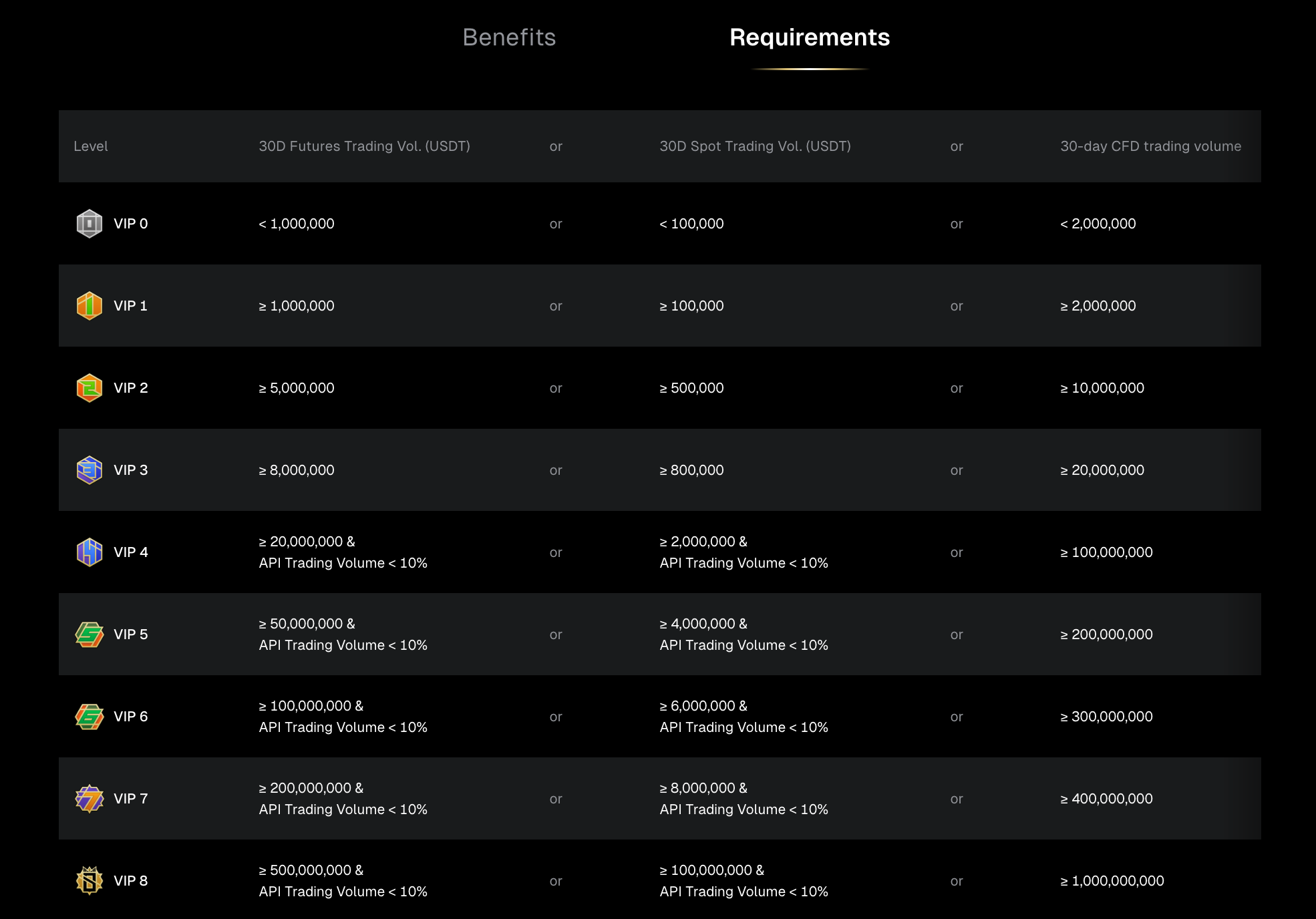
Bitunix VIP 0–8 tier requirements across 30-day futures, spot, and CFD trading volume thresholds.
That leaves a positive net margin if you are trading naturally, whereas larger Task Center milestones should always be run through the same fee check before you commit.
The fee reality:
Base futures rates match on paper, but Bitunix offers lower spot maker fees without requiring a native token and unlocks a 0.05% futures taker rate at a 300 USDT balance.
Bitget only beats Bitunix on spot taker fees if you hold and pay in BGB—and across both platforms, never chase a bonus tier whose required taker fees exceed the reward itself.
Leverage Caps and Margin Rules for Eligible Traders
High leverage multiplies losses just as fast as gains, and maximum caps depend on your jurisdiction and account tier. Where permitted, Bitunix offers up to 200x leverage on BTC/USDT and ETH/USDT perpetuals, while Bitget caps BTC/USDT and ETH/USDT at 150x and most other pairs at 125x or lower.
For a bonus holder, the headline cap matters far less than what high leverage does to a small margin balance. A 50 USDT bonus traded at 200x controls a 10,000 USDT position—meaning an adverse price move of just 0.5% wipes out the entire margin (or roughly 0.67% at 150x). In live trading, liquidation triggers even earlier once maintenance margin and closing fees are factored in.
Margin mode also determines how much of your account is exposed when a trade goes against you:
Isolated margin caps risk at the margin assigned to that single position. Bitget's position boost voucher automatically opens in isolated mode, and if a position combines the voucher with your own margin, your own funds absorb losses first before the voucher cushion is touched.
Cross margin pools your entire futures wallet—including any active bonus—across all open positions, meaning one bad trade can drain both your bonus and your deposited balance.
Loss-deduction order works differently on each exchange as well.
On Bitunix, a futures bonus offsets eligible fees and losses according to the coupon's preset deduction ratio (100%, 50%, or 0%) before drawing solely on your own deposit.
On Bitget, losses and fees are first netted against any trading profits accumulated since the bonus was credited, with the trading bonus covering losses only after those post-bonus profits are used up.
Practical leverage rule: Bitunix provides the higher leverage ceiling on BTC and ETH, but on a bonus-sized balance, sticking to low leverage in isolated mode is what keeps a minor market swing from wiping out your reward on either platform.
Volume Targets and Transfer Rules: 3 Traps That Void Your Rewards
Most forfeited bonuses come down to three avoidable mistakes: treating the headline number as an automatic payout, running out of time on the task clock, and transferring funds out too early. Every one of these traps is written into the fine print on both exchanges.
The "No-Deposit Bonus" Reality vs. High-Volume Milestones
A frequent complaint on Reddit and trading forums is that an exchange sign-up bonus "isn't real money." That criticism is fair, and the easiest way to see why is to look at both ends of the promotional ladder.
At the entry end, traders hoping for a no-deposit sign-up bonus from Bitget will quickly see that starter tasks do not pay out cash. Bitget's current task list offers no USDT payout for registering or verifying alone—identity verification awards reward points, and the three-day check-in unlocks a position voucher that still requires your own margin to open a trade. Bitunix's entry rewards likewise begin only after a net deposit of at least 50 USDT.
At the top end, the headline figure is simply the sum of the highest tiers. Bitget's advertised 6,200 USDT combines the 200 USDT position voucher with a 6,000 USDT trading bonus that requires a 100,000 USDT net deposit, 100,000 USDT in spot volume, and 80 million USDT in taker futures volume—and only taker orders count toward that futures target.
Bitunix's advertised maximum similarly assumes you clear the top deposit and trading milestones in its Rewards Hub.
The filter to apply: Read any headline bonus as the theoretical ceiling for six-figure accounts, then look up the specific tier that matches your actual deposit. That tier is your real welcome offer.
Seven-Day Windows and Manual Claims
Time limits are the second trap, and neither platform gives you much breathing room.
Bitget's new-user tasks must be completed within 7 days of signing up, and unlocked rewards must be claimed within the stated window or they lapse.
On Bitunix, each task displays its own countdown, referral tasks run 7 days from registration, and every reward must be claimed manually in the Task Center before the deadline—unclaimed rewards are forfeited automatically.
Two more rules kick in once a bonus actually lands in your account:
Post-claim expiration: A futures bonus carries its own validity period from the moment of redemption—often around 7 days—and any unused bonus balance is reclaimed once that clock runs out.
No bonus stacking on Bitunix: Only one futures bonus can be active at a time on Bitunix. Redeeming a second futures bonus immediately voids and recalls whatever remains of the bonus currently in use, so finish trading your active bonus before claiming the next one.
"Net deposit" during that 7-day window also trips up careless traders. Both exchanges calculate net deposits as total deposits minus withdrawals across the task period—and on Bitget, internal transfers and card spending count as withdrawals. Moving funds out mid-task can drop your net balance below a tier you already cleared, disqualifying the reward before payout.
The timing rule: Only open your account when you are ready to verify KYC1, fund your wallet, and complete your trades within the same week—and claim each reward manually the moment it unlocks.
Moving Funds Out Early: How One Transfer Can Wipe Out Your Bonus
The third trap is the most expensive. On both Bitunix and Bitget, transferring funds out of your futures account before a bonus is fully used immediately voids the remaining bonus. That rule applies to internal transfers back to your spot wallet just as strictly as it does to external withdrawals.
In live trading, the chain reaction usually plays out like this:
A 50 USDT bonus is credited alongside a 200 USDT deposit, giving you 250 USDT of usable margin.
You open a leveraged futures position that relies on most of that combined margin.
You transfer 100 USDT back to your spot wallet, planning to withdraw it.
The remaining 50 USDT bonus is immediately voided, so your usable margin drops by both the transfer and the forfeited bonus (150 USDT total).
If your open position now falls below its maintenance margin threshold, it is liquidated on the spot.

Transferring funds out of futures while a bonus is active removes both the transfer and the unused bonus from margin.
Bitget's own coupon terms explicitly warn that invalidating a bonus mid-trade through a transfer can trigger forced liquidation or cancel open orders.
Bitunix enforces the exact same rule: any outbound transfer forfeits the remaining bonus balance, and while a position is open, your transferable amount is capped at your own equity minus required position margin.
For a broader look at how these account restrictions fit into the exchange's overall trading ecosystem, check out our complete Bitget review.
Before you move funds: Close your open positions and either finish trading your bonus or let it expire before transferring money out of your futures wallet. If you need to withdraw capital early, verify that your remaining equity can safely cover any open positions without the bonus cushion before hitting transfer.
Trading With Bonus Margin: Smart Risk Controls on Bitunix
A futures bonus gives you extra margin, not a free pass on risk. When you are working with a 20 USDT or 50 USDT voucher, the order tools built into the platform do far more to keep that credit alive than the headline size of the bonus itself.
Set Your Max Loss Before Entering With Fixed Risk Mode
The fastest way to blow a welcome bonus is sizing the first trade too large. Bitunix's Fixed Risk flips the usual order workflow around: instead of guessing a contract quantity, you enter the maximum USDT loss you are willing to accept and your stop-loss price, and the engine calculates the exact position size for you.
Here is how that math plays out on a 50 USDT futures bonus:
Max loss set for the trade: 5 USDT (10% of the bonus)
Entry and stop-loss: Long BTC at 65,000 USDT with a stop-loss at 64,350 USDT (1% below entry)
Calculated position size: 500 USDT notional (roughly 0.0077 BTC)
Margin allocated at 10x leverage: 50 USDT
Estimated round-trip taker fees: ~0.60 USDT (at the 0.06% base rate)
If price hits your stop, your total drawdown comes out to roughly 5.60 USDT including fees—leaving nearly 90% of the bonus intact for your next setup. Keep in mind that fast-moving markets can cause slippage past your stop price, so treat the max-loss input as a planned ceiling rather than a guaranteed fill.
Once a trade is live, Super Alert takes care of monitoring so you do not have to stare at charts through a 7-day bonus window. Rather than setting scattered notifications, you can bundle price levels, indicator signals, channels, candlestick patterns, and chart drawings into one unified alert.
Sizing every entry from a fixed dollar loss keeps a single bad call from wiping out your entire bonus before you get a second shot.
Multi-Chart Trading on PC Ultra and Cross-Market Access
Most new traders knock out their welcome tasks on a phone, which works fine when you are only managing a single position. Once you start tracking multiple pairs at once, Bitunix PC Ultra gives you a full desktop terminal capable of displaying up to 16 charts on a single screen and placing or adjusting orders directly from the chart. If you want a closer look at how both exchanges handle workspace layout and order execution, our full Bitunix vs. Bitget comparison breaks down their trading terminals side by side.
For users in supported jurisdictions, Bitunix also provides access to TradFi markets—including gold, equity indices, and stock CFDs—from the same unified account. Keep in mind that every bonus coupon specifies which instruments it covers, so check the voucher's eligible product list before assuming your futures credit can be used outside crypto perpetuals.
Both perpetual futures and CFDs are high-risk leveraged products. You can lose the entire margin assigned to a position rapidly, and leveraged trading is not suitable for every investor.
A wider multi-chart view sharpens your market timing and cross-asset context, but it does not reduce the underlying leverage risk of the contracts you trade.
Special Notice: The CFD feature is currently available only to users in selected countries and regions. In the future, we will gradually expand the availability of this feature to more countries and regions based on business development needs and local regulatory requirements, providing trading services to more users.
Choosing Between the Bitunix and Bitget Welcome Offers
Neither exchange hands out withdrawable cash simply for creating an account—both welcome packages are structured as trading credit tied to identity verification, net deposits, and trading volume. Which one actually leaves your account better off comes down to your starting balance and how actively you plan to trade in week one:
Bitunix is the better fit if you are starting with a modest deposit (such as $100 to $1,000), want entry milestones you can realistically clear without forcing extra trades, and prefer a 0.08% spot maker fee without buying and holding a platform token.
Bitget is built for high-volume derivatives traders who already intend to deploy five- or six-figure capital and generate heavy taker volume within their first seven days.
Whichever platform you fund first, treat the headline figure as a ceiling rather than a guaranteed payout. Check the live task card in your region, run the taker-fee math before chasing a volume tier, and leave your funds untouched in the futures wallet until your bonus is fully used or expired. Plenty of active traders keep accounts on both exchanges—matching each platform's fee schedule and execution tools to the specific setups they trade.
Disclaimer
This article is for educational purposes only and is not financial or investment advice. Bonus amounts, task requirements, fees, and product availability change frequently and vary by region. Check each exchange's official pages for current terms. Trading digital assets and derivatives involves significant risk, including the loss of all funds used as margin.