For traders moving serious capital through the crypto derivatives market, OKX has become a mandatory liquidity hub. Trailing only Binance and Bybit on global volume trackers, the exchange spent the last few years aggressively transitioning from an unregulated offshore trading pit into an institutionally backed, licensed execution desk.
Cleaning up that reputation was expensive. In February 2025, OKX's operating arm, Aux Cayes, pleaded guilty in Manhattan federal court to running an unlicensed money-transmitting business. The plea deal cost roughly $504 million in fines and forfeitures to close out years of Bank Secrecy Act violations. While sweeping DOJ enforcement knocked out several offshore competitors during that same cycle, OKX absorbed the hit and kept trading. The catch is that the exchange now runs some of the most aggressive, paranoid AML screening in the industry.
If the goal is dodging an FTX-style solvency shock, OKX's paper trail holds up. The platform has posted 48 straight months of Proof of Reserves verifying 100%+ collateralization across client assets, alongside regulatory green lights from Dubai's VARA and Singapore's MAS. Outright balance-sheet collapse simply isn't the risk here.
The real friction is the daily user experience. OKX's automated risk engine is notoriously trigger-happy: switch VPN locations mid-session, deposit from a newly flagged address, or submit an unusual withdrawal size, and your account easily gets flagged for manual compliance review. The software itself suffers from product bloat. By forcing a high-speed derivatives engine into the same app as an on-chain Web3 wallet and multi-chain swap router, OKX built a heavy portal that gets in the way if you just want to manage an active order book.
In short, OKX works if you run size, need deep liquidity with audited reserves, and are comfortable dealing with corporate compliance overhead. If you want a lightweight, low-friction terminal to trade spot coins without identity audits, look elsewhere.
What Is OKX? Platform Architecture, CEX-Web3 Integration, and Background
Backed by New York Stock Exchange parent Intercontinental Exchange (ICE), OKX houses two distinct financial rails under one interface: a custodial centralized exchange (CEX) and a non-custodial Web3 wallet. Evaluating the venue requires separating the two—each carries fundamentally different counterparty risks, execution mechanics, and compliance boundaries.
From OKCoin and OKEx to OKX: Origins, Rebranding, and Brand History
Star Xu built the foundation in Beijing in 2013 with OKCoin, initially a domestic spot exchange, before spinning out OKEx offshore in 2017 to capture the booming crypto derivatives market. That mainland presence ended abruptly in October 2021: following the People's Bank of China's blanket ban on crypto transactions, the exchange cut off onshore retail accounts and migrated its legal and operational apparatus entirely overseas.
In early 2022, the company dropped the "Exchange" suffix, rebranding to OKX to mark a pivot beyond pure order-book matching into self-custody wallets, cross-chain infrastructure, and developer tooling.
Today, OKX routes global flow through a web of segregated corporate entities. Primary international retail flow and offshore derivatives routing run through Aux Cayes FinTech Co. Ltd. in the Seychelles, backed by regulated operational subsidiaries under the Monetary Authority of Singapore (MAS) and Dubai's Virtual Assets Regulatory Authority (VARA), alongside legal entities in Malta and the US.
For those researching historical filings or liquidity data, references to "OKEx" generally point to the same exchange now known as OKX.
One App, Two Worlds: Centralized Exchange (CEX) vs. Self-Custody Web3 Wallet
The OKX app gives users access to both its centralized exchange and its Web3 wallet, but the two handle assets differently.
On the exchange, OKX holds users' funds and processes trades through its order book. The Web3 wallet is non-custodial: users manage their own keys, including through multi-party computation (MPC), and can access decentralized exchanges, bridges and dApps across more than 100 blockchain networks.
That distinction matters if an account runs into trouble. Assets held on the exchange are subject to OKX's account controls and compliance procedures. Assets held in a self-custody wallet are controlled separately, so a restriction on the exchange account does not, by itself, mean those on-chain assets are frozen.
That does not guarantee uninterrupted wallet access, however; the wallet interface and related services may still be subject to regional restrictions or other limitations. In practice, exchange users rely on OKX to hold their funds, while wallet users take on more responsibility for key security and on-chain transactions.
Key Metrics: Global Ranking, User Base, and Trading Volume
Headline registration figures illustrate OKX's retail expansion, but execution data provides a clearer picture of platform liquidity. The company reported surpassing 120 million registered accounts by late 2025, up from 50 million in 2023. However, order book flow shows that capital is heavily concentrated in specific segments of its venue.
According to TokenInsight's Crypto Exchange Report, OKX accounted for 13.88% of all centralized trading volume globally. That activity was driven predominantly by derivatives, which generated 86% of the venue's total turnover. This split gave OKX a 16.42% global market share in futures and perpetual swaps, compared to 7.08% in spot markets. In execution terms, this distribution concentrates market depth and tight bid-ask spreads in major perpetual contracts, while secondary spot pairs see comparatively lighter liquidity.
The platform's capital structure reflects this institutional focus. In March 2026, Intercontinental Exchange (ICE), the parent company of the New York Stock Exchange, confirmed an equity investment in OKX at a $25 billion valuation alongside a board seat. Seven months later, OKX closed an extension to that round at the same valuation, bringing in strategic investments from Circle, Ripple, SC Ventures, and algorithmic liquidity provider Qube Research & Technologies (QRT).
Taken together, the order book metrics and shareholder registry position OKX primarily as an institutional-scale derivatives venue with an accompanying spot market. Systematic funds, basis traders, and active futures accounts benefit directly from its contract depth and clearing infrastructure. For market participants focused exclusively on spot trading, OKX's relative liquidity advantage over dedicated spot venues is less pronounced.

OKX bundles a custodial exchange and a non-custodial Web3 wallet in one app; assets on each side are held under different rules.
Is OKX Legit? Regulation, the $504M DOJ Settlement, and US Status
Assessing OKX's legitimacy requires drawing a firm line between operational solvency and regulatory compliance. The exchange has never suffered an insolvency event, operated an illiquid fractional reserve, or lost customer deposits to a balance-sheet collapse. Its primary regulatory liability, however, stems from a criminal plea in US federal court.
The 2025 DOJ Settlement: Aux Cayes Plea Deal and Compliance Restructuring
On February 24, 2025, Aux Cayes FinTech Co. Ltd., the Seychelles-based entity operating OKX's global exchange, pleaded guilty in Manhattan federal court to one count of operating an unlicensed money transmitting business.
The plea resolved charges covering conduct from 2018 through early 2024, a period in which the platform cleared more than $1 trillion in transactions involving U.S.-linked counterparties without registering with FinCEN, despite terms of service that nominally excluded domestic users. The DOJ also cited more than 5 billion in suspicious transactions flowing through the exchange.
The financial resolution was an 84.4 million fine plus forfeiture of 420.3 million in fees earned from US customers, about $504 million in total. Three details shape how much weight to give this:
The DOJ alleged no customer harm, charged no employees and appointed no monitor.
OKX received a 25% discount on the fine for cooperation and remediation, having hired an external compliance consultant in early 2024.
The charge was a licensing and AML-controls failure, not fraud or misuse of client assets.
The practical consequence for today's users is a far stricter compliance stack, which shows up as tighter KYC, IP checks and the account reviews discussed later in this review.
Global Licensing: OKX US, Europe (MiCA), Dubai (VARA), and Singapore (MAS)
OKX's current licensing footprint is broad by exchange standards:
European Union: Full MiCA authorization from the Malta Financial Services Authority on January 27, 2025, passported across the EEA from a Malta hub (OKX previously held a Class 4 VFA license there).
UAE: A full VARA license for its Dubai exchange, with local AED on-ramps.
Singapore: A Major Payment Institution license from the Monetary Authority of Singapore.
United States: US residents are served by OKX Inc., a FinCEN-registered money services business with state money transmitter licenses, operating from San Jose, California. Texas opened to OKX in September 2026 under a Texas Department of Banking license; New York and the US territories remain excluded.
The larger US story is OKXICE, a 50/50 joint venture with ICE formed in June 2026. On October 4, 2026, it filed with the SEC to run a round-the-clock tokenized US stock venue under the agency's new five-year Innovation Exemption, listing an initial 63 NYSE-listed companies including Nvidia, Apple and McDonald's, with trading on X Layer and settlement in stablecoins.
Launch is subject to a 30-day issuer opt-out window and further regulatory steps; by October 19, at least nine issuers, including Broadcom, Verizon and UnitedHealth, had objected to having their shares tokenized on the venue.
Restricted Jurisdictions, Strict Geofencing, and VPN Enforcement Rules
OKX's compliance disclosure lists 12 restricted countries/districts as of July 2026: Afghanistan, Canada, Cuba, Hong Kong, India, Iran, Japan, Malaysia, Nepal, North Korea, Syria, and Uzbekistan. The ban also covers Crimea, Donetsk, and Luhansk, along with any U.S. state outside OKX Inc.'s licensing map.
The boundary is no longer just legal boilerplate. Where the exchange once looked the other way, access is now cut off at the front door: accounts require verified government ID to trade, while systems automatically block traffic from restricted IP addresses and commercial VPNs.
Reviewers testing from a US IP address report being blocked from the global site entirely, and accounts that show a mismatch between declared residence, IP history and ID documents are a common trigger for mandatory review. Using a VPN to reach the global platform from a restricted location violates the terms of service and is a reliable way to end up with frozen funds.
Security & Asset Solvency: Proof of Reserves, Multi-Sig Audits, and Withdrawal Realities
OKX is safe on the two dimensions that have historically sunk exchanges, solvency and custody, and weaker on a third that matters day to day: access to your own funds when a compliance rule fires.
Custody and Security: Cold Storage Architecture, Multi-Sig, and Risk Protection
OKX keeps the bulk of customer assets in offline cold storage with multi-signature controls, and its monthly reserve reports show that more than 90% of BTC and ETH reserves sit in wallets OKX controls directly rather than with third-party custodians. The exchange has no record of a hack draining customer balances. Its one notable operational incident was in October 2020, when withdrawals were suspended for about five weeks while the founder cooperated with a police investigation in China; the funds were intact and withdrawals resumed. Account-level protections include 2FA, an anti-phishing code embedded in official emails, withdrawal address whitelisting and device management.
Proof of Reserves (PoR): 100%+ Clean Asset Ratio and Monthly zk-STARK Verification
OKX began publishing monthly Proof of Reserves (PoR) reports in November 2022 and has continued to publish them since. Its 48th report, based on a snapshot taken on October 3, 2026, at 12:00 AM UTC+8, disclosed $29.4 billion in primary assets, up 7.3% month over month from $27.4 billion in the previous report. The following table summarizes the reserve ratios and holdings of the assets disclosed in that report.
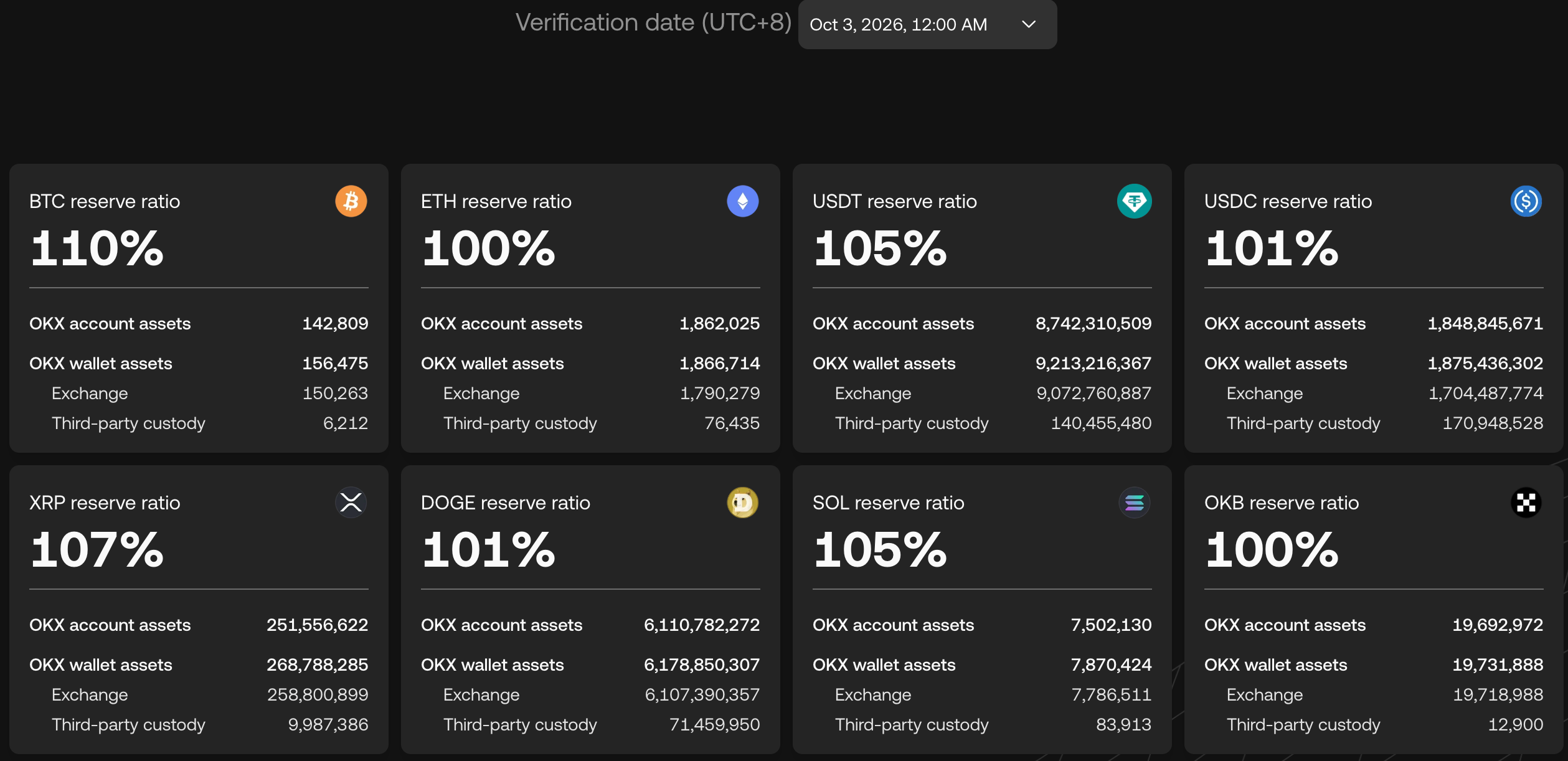
OKX 48th Proof of Reserves report snapshot showing 100%+ reserve ratios across BTC, ETH, USDT, and major crypto assets.
Asset | Customer balances (OKX account assets) | OKX wallet assets
| Exchange
| Third-party custody | Reserve ratio |
BTC | 142,809 | 156,475 | 150,263 | 6,212 | 110% |
ETH | 1,862,025 | 1,866,714 | 1,790,279 | 76,435 | 100% |
USDT | 8,742,310,509 | 9,213,216,367 | 9,072,760,887 | 140,455,480 | 105% |
USDC | 1,848,845,671 | 1,875,436,302 | 1,704,487,774 | 170,948,528 | 101% |
XRP | 251,556,622 | 268,788,285 | 258,800,899 | 9,987,386 | 107% |
DOGE | 6,110,782,272 | 6,178,850,307 | 6,107,390,357 | 71,459,950 | 101% |
SOL | 7,502,130 | 7,870,424 | 7,786,511 | 83,913 | 105% |
OKB | 19,692,972 | 19,731,888 | 19,718,988 | 12,900 | 100% |
Two points separate OKX's program from a marketing-grade PoR. First, the reserve ratio is a "clean" figure: OKX counts only the asset itself, so OKB or other exchange tokens do not pad the BTC or USDT numbers. Second, the method is verifiable by users. OKX publishes the on-chain wallet addresses, builds a Merkle tree of customer liabilities and uses zk-STARK proofs so that each user can confirm their own balance is included without exposing other users' data.
Third-party blockchain analytics firm Hacken evaluated OKX's proof-of-reserves methodology, reviewing more than 655,000 public wallet addresses in a single assessment.
A proof-of-reserves attestation verifies that on-chain holdings match recorded user account balances at a specific point in time. It does not account for wider corporate liabilities, outstanding credit facilities, or off-balance-sheet obligations, distinguishing cryptographic asset verification from a comprehensive financial audit.
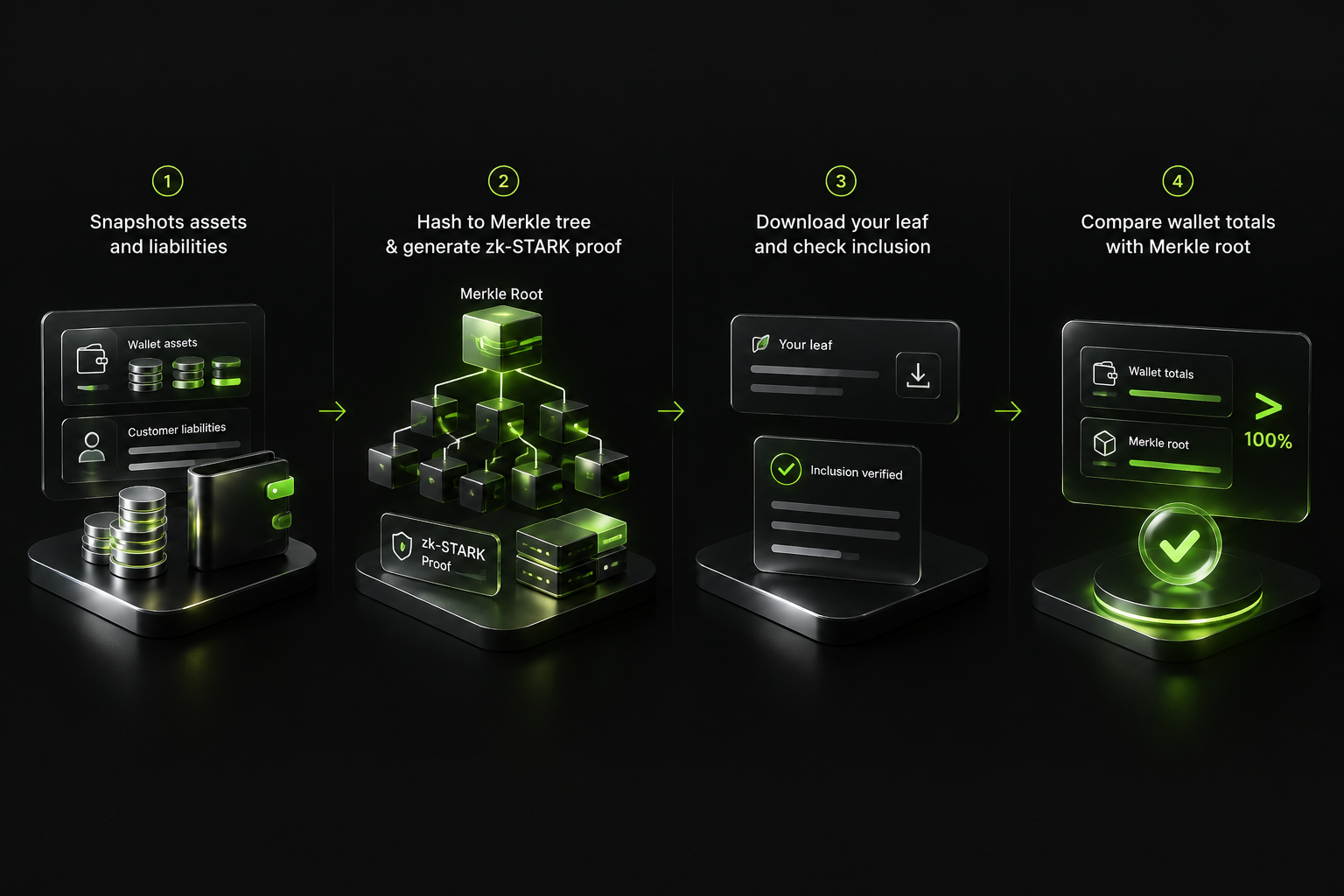
OKX's monthly Proof of Reserves lets each user confirm their balance is included in the liabilities set and that on-chain assets cover it.
Addressing Reddit and Trustpilot Complaints: Why Withdrawals and Accounts Get Held
On Trustpilot and Reddit, user complaints about OKX tend to tell the same story: accounts get locked, withdrawals freeze, and an automated notice informs the trader that the account is under a "mandatory review" for up to 60 days. Trading and payouts are disabled in the interim.
These interruptions are rarely the result of manual staff decisions. Following its $504.7 million settlement with U.S. authorities, OKX retuned its automated compliance engine to near-zero tolerance. In practice, the holds trace back to four recurring triggers:
Tainted crypto trails: Inbound or outbound transactions that cross paths with mixers, sanctioned addresses, or wallet exploits. Blockchain analytics track funds across several intermediary hops, meaning indirect exposure from two or three transfers ago is enough to halt a deposit.
Purchased or borrowed accounts: Operating under someone else's KYC credentials. In January 2026, after an investor complained publicly that OKX had frozen roughly 40,000 USDG across four accounts acquired from third parties, founder Star Xu confirmed the freeze, reiterating that exchange access is legally bound to the verified individual and strictly non-transferable.
Location flags: Mismatches between verified residency records and active login data, including connections detected through commercial VPN nodes.
Sudden large cash-outs: Accounts with modest trading histories that suddenly initiate large withdrawals. These requests automatically trip source-of-funds rules, holding the payout until the user uploads tax returns, pay stubs, or bank statements.
That strict approach has come at a clear cost. In mid-2025, following a wave of public complaints over frozen funds, Xu acknowledged on his verified X account (@star_okx) that the exchange's risk controls were generating a "high rate of false positives."
For OKX, operating under the scrutiny of an independent compliance monitor, the calculation is straightforward: the exchange would rather over-block legitimate retail traders and absorb the public backlash than allow a single high-risk transfer to threaten its regulatory standing.
Preventing Account Locks: Anti-Money Laundering (AML) Flags and KYC Best Practices
Most compliance holds on OKX come down to basic data conflicts. The risk engine scans for contradictions, and traders who keep their records clean rarely see their payouts halted. The playbook is as follows:
Stick to your actual location. Verify the account using real documents from where you live, keep your IP anchored there, and never trade on secondhand accounts.
Document large cash-outs in advance. Heavy withdrawals almost always trigger a source-of-funds inquiry. Keeping bank statements, tax filings, or trade histories on hand is what resolves the hold.
Keep deposit addresses clean. Accepting direct transfers from unknown senders can instantly contaminate an exchange balance.
Keep risky DeFi off the exchange. Use a standalone Web3 wallet for new or unaudited protocols so untested smart-contract exposure never touches your central profile.
OKX Fees Breakdown: Spot Tiers, Derivatives Margins, and Hidden Costs
OKX prices its baseline trading fees aggressively against competitors like Binance and Bybit, scaling down to market-leading rates for institutional volume. Still, posted maker and taker schedules only capture a portion of the real friction traders face on the exchange.
Spot Trading Fees: Tiered Maker/Taker Structure and OKB Discounts
At the baseline, OKX charges 0.08% for makers and 0.10% for takers on spot. That beats the flat 0.10% base at Binance and Bybit before factoring in BNB or MNT discounts.
Climbing the ladder doesn't force a single route: hit the mark in 30-day volume, total assets, or OKB balance, and the system awards the highest bracket met. Top market makers actually get paid to leave resting limit orders as fees turn negative.
But there is a catch: zero-fee promotional pairs generate zero qualifying volume. Traders running high-turnover strategies on free pairs often learn the hard way that their VIP status hasn't budged.
Perpetual Swaps, Futures, and Options Fee Schedules
For USDT-margined perpetuals and expiry futures, regular accounts start at 0.02% maker and 0.05% taker. On April 8, 2026, OKX trimmed those numbers for early VIPs, dropping VIP 1 to 0.016% / 0.045% and VIP 2 to 0.015% / 0.036%, with top-tier VIP 8 makers pulling in a -0.01% rebate on core contracts.
Options sit on their own fee sheet. But if you hold perpetuals, execution fees are usually the smallest part of the bill. When markets trend, funding rates—the periodic payouts between longs and shorts—routinely dwarf what OKX charges to enter or exit. Anyone carrying leverage across several settlement cycles should be budgeting for the funding rate, not the taker fee.
Fiat Deposit/Withdrawal Channels vs. Blockchain Network Fees
Deposits on OKX are free, but withdrawal fees shift with blockchain traffic. Pulling 1,000 USDT over Ethereum costs anywhere from $3 to $8, compared to less than $1 on Arbitrum or Tron. Switching rails before confirming a payout eliminates nearly 90% of the network cost.
Fiat costs depend on the settlement channel. Bank transfers via licensed entities—such as SEPA in the EEA, local rails in Singapore and Dubai, and ACH via OKX Inc. in the U.S.—are generally free or nominally priced. In contrast, card purchases and P2P desks embed 2% to 3.5% in processing fees and wider spreads. Meanwhile, OKX Convert offers tighter USD-stablecoin spreads than card gateways, but trades roughly 0.2% to 0.5% wider than executing directly on the spot order book.
Competitive Fee Benchmark: OKX vs. Bitunix, Bybit, and Binance
The following table compares published base-tier rates for regular users as of October 2026, before token discounts, referral rebates or VIP tiers:
Exchange
| Spot maker / taker
| Perpetual futures maker / taker | Max leverage | Token discount
|
OKX | 0.08% / 0.10%
| 0.02% / 0.05% | 125x | OKB holdings lift VIP tier |
Bitunix | 0.08% / 0.10%
| 0.02% / 0.06% | 200x on select pairs | None required
|
Bybit | 0.10% / 0.10% | 0.02% / 0.055% | 125x | Volume-based VIP tiers |
Binance | 0.10% / 0.10%
| 0.02% / 0.05% (USDC-M 0% / 0.04%) | 125x
| 25% off spot with BNB |
According to the date shown above, on spot, OKX and Bitunix share the lowest base maker rate at 0.08%, and Bitunix applies it without requiring a token holding. On perpetuals, OKX and Binance are a basis point cheaper on the taker side than Bitunix and half a basis point cheaper than Bybit.
For a trader doing 1 million of taker volume a month, that is a 100 difference, which matters for high-frequency accounts and is noise for everyone else. The larger cost gap between venues is usually slippage on thin pairs and funding, which no fee table captures.
OKX Trading Review: Liquidity Depth, Order Execution, and Strategy Bots
Trading is where OKX earns its ranking. The derivatives book is deep enough that execution quality, not fees, is the reason most professional accounts are there.
Spot Markets, Execution Speeds, and Native TradingView Charting
OKX supports hundreds of spot pairs, though order book depth remains heavily concentrated in BTC, ETH, SOL, and top stablecoins. Both web and desktop clients integrate TradingView natively, keeping custom indicators and chart setups intact. The order suite goes well beyond basic limit and market fills, adding post-only, fill-or-kill, trailing stops, icebergs, and TWAPs.
Normal-market execution is crisp, but severe volatility spikes and cascade events have triggered platform lag in the past—a universal issue across centralized exchanges. Anyone relying on sub-second fills during liquidation runs should test API latency directly rather than trust external reviews.
Derivatives Suite: High-Leverage Perpetuals, Expiry Futures, and Spread Trading
OKX's derivatives suite spans linear contracts (settled in USDT and USDC), inverse coin-margined perpetuals, and quarterly as well as bi-quarterly expiry futures. For non-linear exposure, the platform offers European-style options on BTC and ETH, alongside a dedicated spread-trading interface designed for calendar rolls and basis arbitrage. Leverage runs up to 125x on major pairs under a unified account that lets a single margin pool back positions across products.
In March 2026 OKX added stock and index perpetuals (NVDA, AAPL, SPY and QQQ among the first), reaching 121 contracts by late July, and in July 2026 it launched Unified Tokenized Stocks and ETFs for non-US users. Simple Options stopped taking new positions on September 1, 2026, with OKX saying a simpler replacement is planned. The breadth is a strength for multi-strategy traders and a distraction for anyone who mainly wants to execute perpetuals cleanly.
Algorithmic Bots: Grid Trading, Dollar-Cost Averaging (DCA), and Signal Marketplace
OKX's automated trading suite spans spot and futures grid bots, DCA, arbitrage modules, copy trading, and a signal bot driven by TradingView webhook alerts. Bot executions carry identical maker and taker schedules to manual orders, with no algorithmic fee discounts.
While structured for range-bound consolidation and systematic asset accumulation, these tools provide no insulation against directional market exposure; a grid bot navigating an unresolved breakdown will mechanically absorb falling assets and compound drawdowns.
OKX Earn: Simple Earn Yields, On-Chain Staking, and Structured Products
OKX Earn spans flexible stablecoin deposits, proof-of-stake validation (including ETH and SOL), and non-linear structured notes such as dual currency investments and shark fins. Flexible yields track platform margin borrowing demand and remain modest across major assets.
Structured notes, by contrast, package complex derivative payoffs with asymmetric downside triggers that require precise contract analysis before capital allocation. Across all custodial yield instruments, returns remain subordinate to venue solvency, making independent verification via OKX's Proof of Reserves framework a baseline credit consideration.
OKX Wallet Review: Self-Custody, Multi-Chain Swaps, and Web3 Features
OKX Wallet is the strongest part of the OKX product set that most exchange-focused reviews ignore. It is a free, non-custodial wallet available as a mobile app, browser extension and Telegram mini-app, and it does not require an exchange account.
Multi-Chain Architecture: 100+ Blockchains, Seed Phrases, and MPC Security
OKX Web3 Wallet supports over 100 blockchains—spanning major EVM environments, Solana, Bitcoin, TON, Sui, and Aptos—aggregated under a unified portfolio dashboard. Users can generate either a standard BIP-39 seed-phrase wallet or an MPC "keyless" setup.
The MPC architecture distributes key shares across the user's local device, OKX servers, and an encrypted cloud backup, ensuring no single entity controls the full private key while removing reliance on written mnemonics.
While MPC reduces physical compromise and common credential phishing, it establishes an operational reliance on OKX's recovery infrastructure. For cryptographic self-sovereignty independent of exchange systems, users must generate standard seed phrases secured through offline storage.
DEX Aggregator and Cross-Chain Bridge: Routing, Gas Optimization, and Slippage
OKX's integrated DEX aggregator sources liquidity across more than 400 decentralized venues over 60-plus blockchains, utilizing approximately 20 cross-chain bridges.
To mitigate price impact, the routing algorithm fragments larger volume blocks across multiple automated market maker (AMM) pools. Pre-trade execution telemetry details expected settlement output, price impact, and transaction routing before cryptographic authorization.
On top of underlying DEX protocol fees and market spread, the interface levies an incremental platform service surcharge, visible on the confirmation prompt. While OKX matches standalone aggregators like 1inch on Ethereum or Jupiter on Solana across long-tail tokens, high-notional orders warrant parallel price discovery across independent routers.
Web3 Marketplace: NFTs, Inscriptions, Runes, and DeFi DApps
OKX anchors its Web3 marketplace on two primary fronts: cross-chain liquidity aggregation and native access to the Bitcoin asset ecosystem. The terminal pools secondary NFT listings from major networks—waiving platform commissions across select collections—while providing out-of-the-box infrastructure for trading and inscribing Bitcoin Ordinals and Runes. This removes the operational friction of jumping between specialized, fragmented marketplaces.
The interface doubles as a consolidated telemetry desk for decentralized finance. Open positions across dozens of external protocols—spanning liquid staking, money-market lending, and LP pool allocations—feed into a single balance-sheet view.
Long-tail interactions fall to the embedded dApp browser. When an external protocol lacks native API integration, the integrated browser routes the credential handshake and executes the smart-contract call directly, cutting out third-party extensions entirely.
Web3 Gaming and Telegram Mini-Apps: What "OKX Game" Users Discover
The OKX Wallet Telegram mini-app operates strictly as an embedded transaction layer rather than a proprietary gaming venue.
Engineered directly into Telegram's client architecture, the interface serves primarily as an on-chain routing bridge for TON-based mini-apps and tap-to-earn titles. It allows users to query balances and execute contract approvals without routing sessions through external mobile browsers or third-party extensions.
Operational and custodial realities remain entirely unchanged:
Asset Equivalence: Balances mirror the full wallet suite directly on-chain, with zero intermediary wrappers or siloed balances.
Unchanged Threat Model: Streamlined UX shifts only the interface, not the risk. Users retain sole legal and operational liability for key security and malicious approvals.
OKX App Review: Mobile Experience, Interface Modes, and KYC Speed
The OKX app is one of the more polished exchange apps on iOS and Android, and it is where the majority of OKX users trade. Its main weakness is the same as the platform's: it tries to do everything.
iOS and Android Performance: Pro Mode vs. Lite Mode Usability
The OKX mobile application deploys a dual-tier interface framework controlled via an internal toggle:
Lite Mode: Streamlines the environment to core fiat purchase channels, token conversions, and aggregate portfolio monitoring.
Pro Mode: Exposes full central limit order book (CLOB) liquidity, algorithmic and conditional order types, derivatives markets, automated trading bots, and native TradingView charting suites.
Performance Profile: Modern device performance remains stable, with low baseline crash rates. Primary user criticisms remain localized to chart rendering latency during violent market volatility and intrusive promotional banners within the Discover tab.
Instant App Switching: Seamless Transition Between CEX and Web3 Wallet
OKX unifies its centralized venue and Web3 wallet through a top-level UI toggle, routing inter-environment balances via direct on-chain settlement. While this facilitates frictionless liquidity transfers into decentralized yield protocols, it introduces an asymmetric operational boundary: moving from exchange to wallet instantly eliminates counterparty dispute resolution, leaving all cryptographic executions fully irreversible.
Mobile Onboarding: Identity Verification (KYC) Steps and Processing Times
OKX operates as a strict closed-loop KYC exchange: an email or phone number provisions a shell account, but deposit addresses and order books remain locked until identity verification clears.
The compliance pipeline gates access across two distinct tiers:
Level 1: Pairs a government-issued ID with a biometric liveness selfie to unlock baseline crypto deposits and order-book execution.
Level 2: Demands residential proof of address—typically a utility bill or bank statement—to expand withdrawal ceilings and activate domestic fiat rails.
Automated OCR matching clears standard submissions within minutes. Account onboarding backlogs—the dominant driver of negative Trustpilot ratings—stem almost entirely from edge cases where automated matching fails and files drop into manual compliance queues. For US residents, network routing directs users exclusively through OKX Inc., making verified identity an uncompromising prerequisite prior to funding.
OKX News and Ecosystem: OKB, X Layer Network, and OKX Ventures
OKX news in 2026 has been dominated by three threads: a tokenomics reset for OKB, the consolidation of OKX's chain strategy onto X Layer, and the company's push into regulated US markets with ICE. Each has direct consequences for users.
OKX News and Announcements: Listing Updates, Delistings, and Token Migrations
Recent announcements worth knowing before you trade:
October 2026: OKX raised an undisclosed amount at a $25 billion valuation from Circle, Ripple, SC Ventures and Qube; OKXICE filed with the SEC for tokenized US stock trading; OKX hosted its OKX Now product event in Singapore on October 6; CMO and global managing partner Haider Rafique was reported to be leaving by year-end.
September 2026: Texas residents gained access via OKX Inc.; Simple Options closed to new positions on September 1.
July 2026: Unified Tokenized Stocks and ETFs launched for non-US users under Regulation S.
March 2026: Stock and index perpetuals launched; ICE's $200 million strategic investment announced.
January 2026: OKTChain shut down, completing the migration of OKT holders to OKB on X Layer.
OKX regularly updates its supported markets through new listings, spot-pair delistings and token migrations. In 2026, notable additions included PI, XAUT, RLUSD and several newer projects, while delisting notices covered assets such as MAJOR, J, GODS and DORA. Traders should check the official announcements page for the latest trading schedules and asset-specific withdrawal deadlines, as listing availability and delisting procedures can vary by region.
OKB Token Utility, Buyback-and-Burn Track Record, and Value Capture
OKB has three jobs: it raises your fee tier on the exchange, it pays gas on X Layer, and it unlocks certain Earn and launch products. Its supply story changed in August 2025. OKX had run quarterly buyback-and-burn since 2019, reducing an original 300 million supply, then executed a one-time burn of 65,256,712 OKB from treasury and historical repurchases, fixed total supply at 21 million, and upgraded the contract to remove minting and burning functions entirely.
OKB withdrawals to Ethereum were discontinued and holders were asked to migrate to X Layer. The token rose more than 150% on the announcement before retracing. Note that a fixed supply changes scarcity, not demand; OKB's value still depends on exchange activity and X Layer adoption, and it carries the same volatility as any exchange token.
X Layer: The Polygon CDK-Powered Ethereum Layer-2 Rollout
X Layer is OKX's zkEVM Layer-2 built with the Polygon Chain Development Kit. The August 2025 "PP upgrade" raised throughput and cut gas costs, and OKX positioned the chain around DeFi, payments and real-world assets. OKX Wallet, the exchange and OKX Pay are integrated with it, OKX Pay uses it as the default chain, and the proposed OKXICE tokenized stock venue is designed to settle on it.
For users, X Layer is the cheapest path for moving funds between OKX products on-chain; for the ecosystem, it is the bet that OKX's distribution can bootstrap a chain the way Coinbase did with Base.
OKX Ventures: Strategic Web3 Investments and Ecosystem Incubation
For secondary traders, OKX Ventures is an early-stage signal of institutional interest, although not a guarantee of token listings. Seeing the fund on an asset's cap table confirms institutional investment in the project, but does not guarantee tighter initial spreads, Jumpstart launchpad access, or long-term exchange order-book support.
Capital deployment leans heavily toward regulated regional gateways and protocol infrastructure
Licensed Distribution: Co-invested roughly $53 million alongside Korea Investment & Securities to acquire a stake in South Korea's Coinone (May 2026), following an April 2026 strategic entry into Vietnam's CAEX alongside HashKey Capital.
Protocols & Applied AI: Backed Sui-native money market Current, and established a $10 million joint fund with Story targeting commercial IP integration across artificial intelligence models.
Headquartered in Singapore under Jeff Ren, the team launched with $100 million in 2021 and has built a portfolio spanning more than 200 entities.
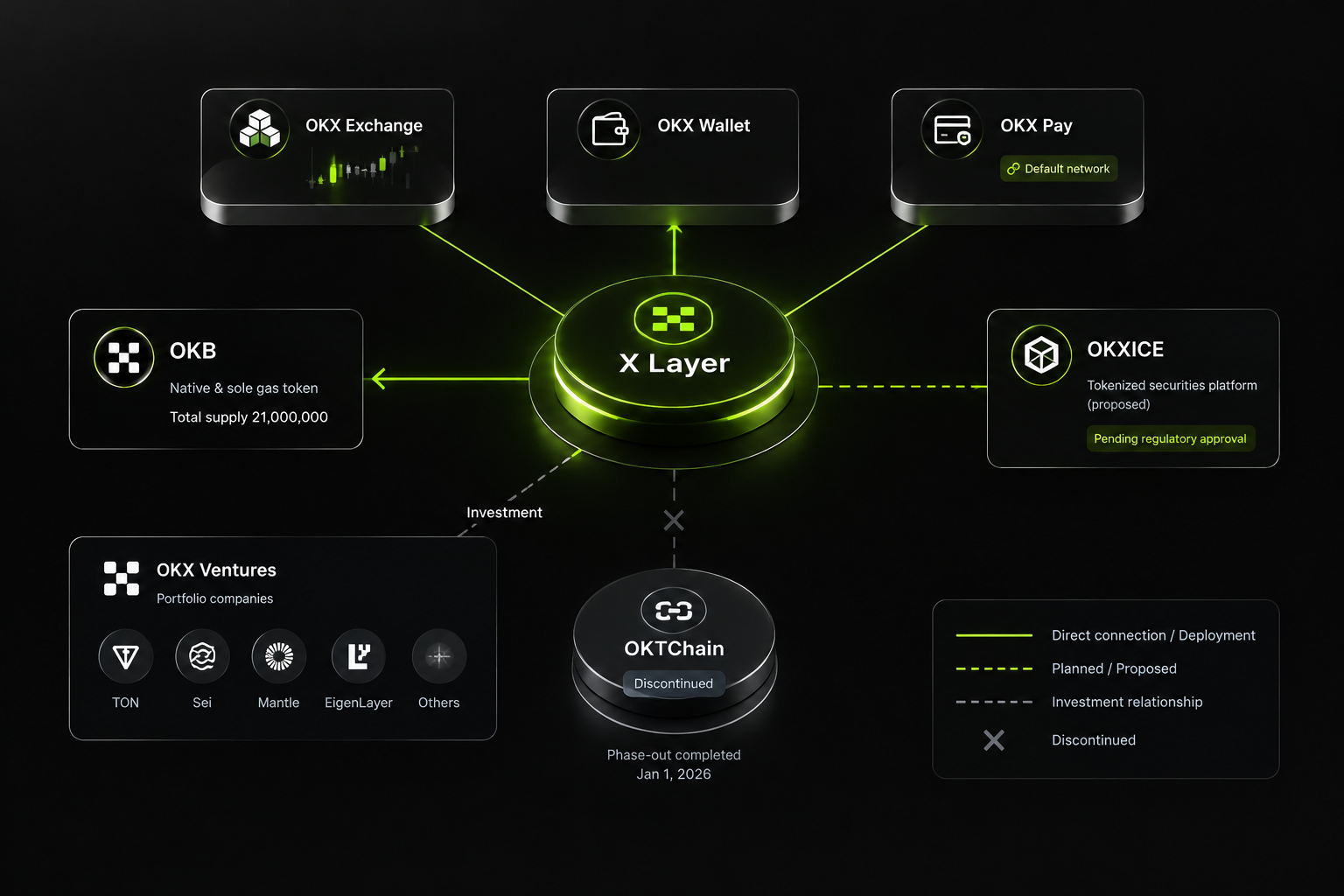
X Layer is now the single chain underpinning OKX's exchange, wallet, payments and tokenized-stock plans, with OKB as its gas token.
The Verdict: Key Strengths vs. Lingering Drawbacks of OKX
OKX's core strengths and operational liabilities are structural functions of the same corporate mandate. The platform's primary moats—deep derivatives liquidity, cross-border licensing, and native Web3 infrastructure—are mechanically counterbalanced by institutional friction: regulatory ring-fencing across major markets, manual compliance delays, and an increasingly crowded interface that blurs the perimeter between central custody and self-sovereignty.
Core Strengths: Deep Liquidity, Top-Tier PoR, and Unified Web3 Suite
Second-largest exchange by volume, with a derivatives book deep enough for institutional size on major pairs.
48 consecutive monthly Proof of Reserves reports with clean, user-verifiable ratios above 100%.
Licenses in the EU (MiCA), Dubai (VARA), Singapore (MAS) and a FinCEN-registered US entity, plus an ICE partnership that signals where the company is heading.
Competitive base fees (0.08% / 0.10% spot, 0.02% / 0.05% perpetuals) with maker rebates at scale.
A self-custody wallet with 100-plus chains and a strong DEX aggregator that stands on its own.
Broad product range: expiry futures, options, spread trading, stock and index perpetuals, bots, Earn and tokenized stocks (non-US).
Core Weaknesses: Regional Availability, Rigorous Compliance, and Interface Complexity
Extensive jurisdictional restrictions (including Canada, Hong Kong, and sanctioned regions), strictly enforced via IP and document verification.
Ongoing regulatory scrutiny in key jurisdictions, which continues to shape its retail and institutional service offerings.
Aggressive automated risk controls that can trigger compliance reviews and account delays, a friction point management has acknowledged and is actively refining.
Localized product limitations, such as derivative access restrictions and leverage caps in heavily regulated regions like the US and parts of Europe.
Feature-dense interface across the app and web terminal, which may introduce friction for traders seeking a minimalist execution layout.
Tiered fee structure that relies heavily on native token (OKB) holdings and trading volume to achieve tier-one competitiveness against zero-token alternatives.
OKX Alternatives: Comparing OKX vs. Bitunix, Binance, and Kraken
No single exchange is the right venue for every trader, and the useful comparison is by use case rather than by overall score. Three alternatives cover the cases where OKX is not the natural fit.
Bitunix: The Agile Alternative for Streamlined Derivatives and Low-Friction Futures
Bitunix deviates fundamentally from OKX's sprawling multi-product footprint, positioning itself as an execution-first, derivatives venue that prioritizes an integrated desktop workflow and systematic risk planning over catalog breadth.
Proprietary Trading Surface & Tooling
Chart-Native Execution & Discovery: Built into its PC Ultra desktop client, traders place, drag-modify, and execute orders directly on native TradingView charts. This works in tandem with Super Filter, which scans perpetual contracts across technical indicators, candlestick setups, and funding-rate conditions without flipping between disconnected browser tabs.
Structured Risk Sizing (Fixed Risk): Inverses traditional order-entry logic by calculating contract sizes backward from a trader’s predefined maximum dollar loss, entry price, and stop-loss level. This mitigates emotional over-leveraging—especially when deploying leverage up to 200x on supported pairs.
Multi-Condition Alerting (Super Alert): Extends baseline price alerts to drawing-line breaks, candlestick patterns, and composite multi-variable triggers directly inside the exchange engine, closing the latency gap between external charting monitors and order execution.
Market Reach, Fee Structure & TradFi:
Bitunix consolidates crypto-native order books and synthetic TradFi liquidity into a unified execution surface, maintaining entry-level fee schedules unencumbered by native platform-token mechanics:
Segment | Asset Scope & Specifications | VIP 0 Baseline Rates | Operational Mechanics |
Spot & Tokenized TradFi | 1,100+ pairs spanning digital assets, tokenized equities, and gold | 0.08% Maker / 0.10% Taker | Zero platform-token staking or minimum balance requirements |
Perpetuals | Linear/inverse contracts with leverage ceilings up to 200x | 0.02% Maker / 0.06% Taker | Unconditional entry pricing tailored for active derivatives execution |
Copy Trading | Synchronized spot and perpetual strategy pools | Profit-sharing model per lead trader | Direct liquidity pass-through into central order books |
Capital Off-Ramp | Integrated Bitunix debit card (Visa network) | Real-time POS conversion rates | Direct point-of-sale settlement without intermediary P2P transfers |
Trust Perimeter & Regulatory Posture:
Solvency & Care Fund: Bitunix publishes monthly 100%+ Merkle-tree Proof of Reserves and maintains a $50 million USDC Care Fund (expanded from its initial $30 million reserve), complete with publicly disclosed on-chain addresses for continuous solvency verification during extreme market dislocation.
Tiered Onboarding: Registered as an MSB with FinCEN (US), FINTRAC (Canada), and AUSTRAC (Australia). In contrast to OKX's strict mandatory Level 1 KYC lock prior to execution, Bitunix maintains a tiered KYC architecture that lowers onboarding friction for initial market access.
Strategic Fit & Execution Realities
The advantage for this use case is a trader who runs leveraged positions actively and wants risk defined on the chart rather than through a menu of products; the trade-off is a smaller ecosystem, with no self-custody wallet or options desk comparable to OKX's. Higher leverage multiplies losses as well as gains, and 200x is a capital-efficiency tool for experienced hedgers rather than a reason to size up.
>>> Related Reading: Bitunix vs OKX: Which Crypto Exchange Is the Better Binance Alternative in 2026?
Binance: Top Competitor for Global Altcoin Liquidity and Institutional Volume
Binance anchors global crypto liquidity, holding the largest single-platform futures open interest (OI) and the #1 ranked ±1% order-book depth on BTC and ETH contracts.
Execution & Depth: Deepest altcoin spot order books and broadest catalog of long-tail perpetuals; lowest execution slippage for large orders.
Fee Structure (VIP 0): Spot at 0.10% / 0.10% (0.075% via BNB deduction); perpetuals at 0.02% maker / 0.05% taker; USDC-margined contracts subsidized at 0% maker / 0.04% taker.
Jurisdictional Perimeter: Corporate operations reorganized under Abu Dhabi's ADGM framework in January 2026. The global platform excludes US residents, and EEA access was restricted in July 2026 following the expiration of the MiCA grandfathering period.
Desk Verdict: The premier venue for altcoin derivatives depth, but structurally inaccessible as a primary desk for US and EU entities.
Kraken: Leading Pick for US Regulatory Safety and Direct Fiat Banking Rails
Kraken's entire value proposition revolves around balance-sheet safety and direct fiat integration, catering specifically to US and European capital that cannot operate on offshore venues. The exchange hasn't lost customer funds since launching in 2011, and its deep banking infrastructure—anchored by native ACH, FedWire, SEPA, and its Wyoming SPDI charter—eliminates the counterparty risks associated with P2P fiat ramps.
That operational conservatism extends directly to the corporate level. In September 2026, parent company Payward formally pushed its highly anticipated IPO back to mid-2027 at the earliest, choosing to prioritize compliance audits and optimal market timing over immediate public liquidity.
For traders, this safety comes at a premium. Base spot execution on Kraken Pro is punitively expensive at 0.25% maker and 0.40% taker. While the futures desk clears at a competitive 0.02% / 0.05%, risk limits are structurally strict, capping leverage at 50x. The venue makes sense as a fiat bridge and core custody account for Western entities, but falls short for high-frequency altcoin traders hunting for triple-digit leverage.
Head-to-Head Comparison Matrix: Features, Leverage, Fees, and KYC Requirements
The following matrix compares the four exchanges on the factors that most often decide where an active trader opens an account:
Factor | OKX | Bitunix | Binance | Kraken |
Primary strength | Derivatives + Web3 wallet | Chart-based derivatives trading | Broad markets + liquidity | Regulation + fiat access |
Spot fee (M/T) | 0.08% / 0.10% | 0.08% / 0.10% | 0.10% / 0.10% | 0.40% / 0.80% |
Perpetuals fee (M/T) | 0.02% / 0.05% | 0.02% / 0.06% | 0.02% / 0.05% | 0.02% / 0.05% |
Max leverage | 125x | 200x (selected pairs) | 125x | 50x |
Markets | Spot, perps, futures, options | Spot, perps, copy trading, TradFi | Broad spot and derivatives | Spot, margin, futures |
Proof of Reserves | Monthly; zk-STARK | Merkle-tree-based | Periodic PoR | Periodic disclosures |
Protection fund | Security Fund (liquidation deficits) | $50M Care Fund
| $1B SAFU | No equivalent fund identified |
Risk tools | Unified margin, bots, conditional orders | Fixed Risk, Chart Trading, Super Alert | Bots, conditional orders, portfolio margin | Stop-loss / take-profit |
KYC | Required; varies by service/region | Requirements vary by service/region | Required | Requirements vary by service/region |
US access | Via eligible US services | MSB registration; availability unverified | Binance.US where eligible | Varies by state/product |
EU access | Verify entity and authorization | Verify authorization | MiCA status requires verification | Via applicable EU entity |
Capital allocation maps directly to execution priorities:
OKX is the default for traders wanting a unified architecture where an institutional exchange and a self-custody Web3 wallet operate in tandem.
Bitunix caters to active derivatives traders who demand chart-native execution and deterministic, pre-trade risk sizing over product breadth.
Binance remains unmatched for liquidity sweeps and deep order books on obscure, long-tail altcoins—where jurisdictional access permits.
Kraken is the non-negotiable anchor for US and European accounts requiring domestic bank rails, regulatory insulation, and balance-sheet durability.
Summary: Is OKX Worth Trading On?
At the end of the day, picking a venue is simple: check where you're legally allowed to trade, then look at how you actually execute.
In supported regions, OKX works well as an everyday desk. You don't have to take audit claims on faith because the zk-STARKs framework lets you verify balance sheets yourself, contract books handle size without slipping, and having a native Web3 wallet saves you from constantly juggling external extensions.
The friction is entirely operational. Automated risk controls can abruptly freeze withdrawals over source-of-funds checks, leaving users in slow, opaque support queues. The terminal interface is also busy out of the box because it loads spot, derivatives, and automated bots simultaneously, though users can easily clean this up by saving a custom workspace.
When traders move away from the all-in-one model, capital splits quickly based on execution needs:
Binance remains the default liquidity pool for moving size in long-tail altcoin perpetuals. However, following its corporate restructuring under Abu Dhabi's ADGM and the end of the EU's MiCA transition period in mid-2026, regulated US and European accounts are structurally locked out of its main order books.
Bitunix targets active derivatives traders by focusing its engineering squarely on the trading screen rather than sprawling ecosystem features. Its value lies in pure terminal mechanics—chart-native order routing, fast execution, and a built-in Fixed Risk tool that lets traders size positions based on an exact dollar risk before hitting the market.
Kraken sits at the opposite end of the spectrum. You accept steep baseline spot fees and a conservative 50x futures cap in exchange for peace of mind. It has operated since 2011 without a single customer loss, plugs directly into ACH, FedWire, and SEPA, and prioritizes regulatory insulation above all else. Parent company Payward delaying its IPO to mid-2027 fits that exact profile: slow, conservative, and built for capital that values clean banking rails and balance-sheet safety over leverage.