BingX copy trading lets you mirror the trades of another trader automatically. You pick a lead trader, set how much to allocate, and the platform opens and closes matching positions in your own account. It sounds simple, but the rules change by product, and the costs are easy to misread.
This guide will help you understand how BingX copy trading works, what it costs and where the risks are. If you are new to the idea, it also shows how to copy trade crypto on BingX and how the platform compares with Bitunix.
BingX Copy Trading at a Glance
BingX offers a large, tiered copy trading marketplace with Spot and Futures options. The trade-offs are profit shares that rise with trader tier, leverage that follows the trader and different rules for each product.
It suits followers who want a wide choice of traders and accept Futures risk.
Category | BingX copy trading |
Products | Spot, USDⓈ-M perpetual Futures, standard Futures |
Cost to copy | No copy fee; a profit share to the trader on net-profitable closed trades |
Profit share | Spot 10%; perpetual 10% to 32% by tier; standard Futures 8% to 13% by tier |
Settlement | Perpetual and Spot: weekly, Monday 00:00 (UTC+8). Standard Futures: daily |
Copy modes (perpetual) | Position Ratio or Per Order (fixed margin) |
Follower trading fee | Perpetual taker 0.05%; standard Futures 0.045% |
Traders you can copy | Up to 20 |
Copiers per trader | Up to 2,000 (perpetual) |
Practice option | VST (virtual USDT) copy trading on standard Futures |
Biggest risk | Leverage copied from the trader; skipped or differently filled orders |
How to Copy Trade Crypto: Guide on BingX
To copy trade crypto on BingX, fund the right account with USDT, choose a lead trader from the Copy Trading hub, set your copy mode and amount, then confirm. Copying starts automatically.
For Futures copy trading:
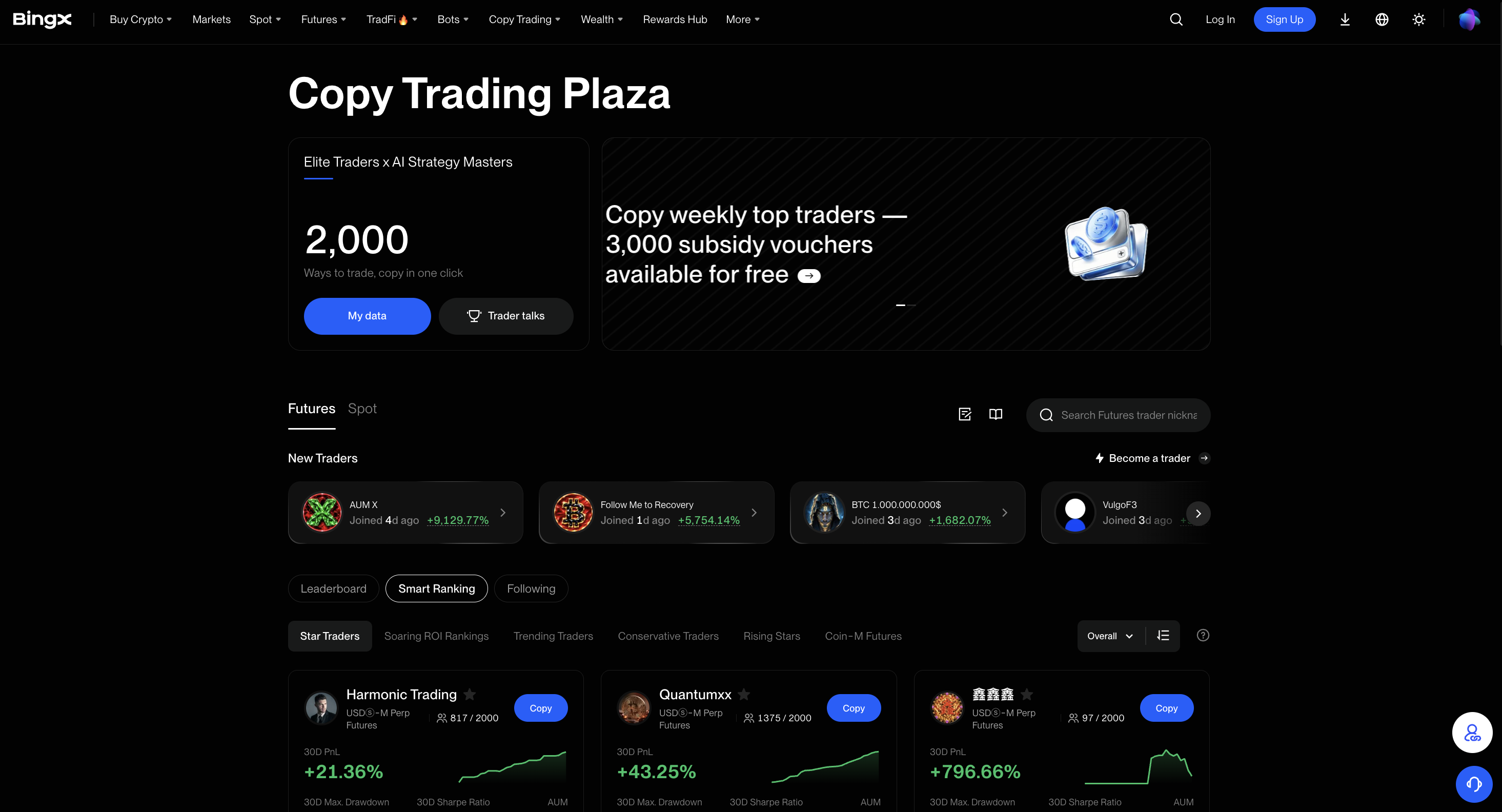
Futures copy trading on Bing X. Source: BingX.com
Fund the account: Deposit USDT into your USDⓈ-M Perpetual Futures account. USDT is the only currency supported for perpetual copy trading.
Find traders: Go to Copy Trading, then Futures Traders. Filter by 30-day ROI, copier count, cumulative PnL or risk level.
Review the profile: Check ROI, win ratio, maximum drawdown and copier data. Hover over an indicator to see its definition.
Pick copy mode and amount: Choose Position Ratio or Per Order. Add optional take profit and stop loss.
Confirm: Click Copy Now.
Monitor: Track positions under My Trades. To stop, choose Stop Copying. Open copied positions close at market price and unused funds return to your Futures account.
For Spot copy trading:
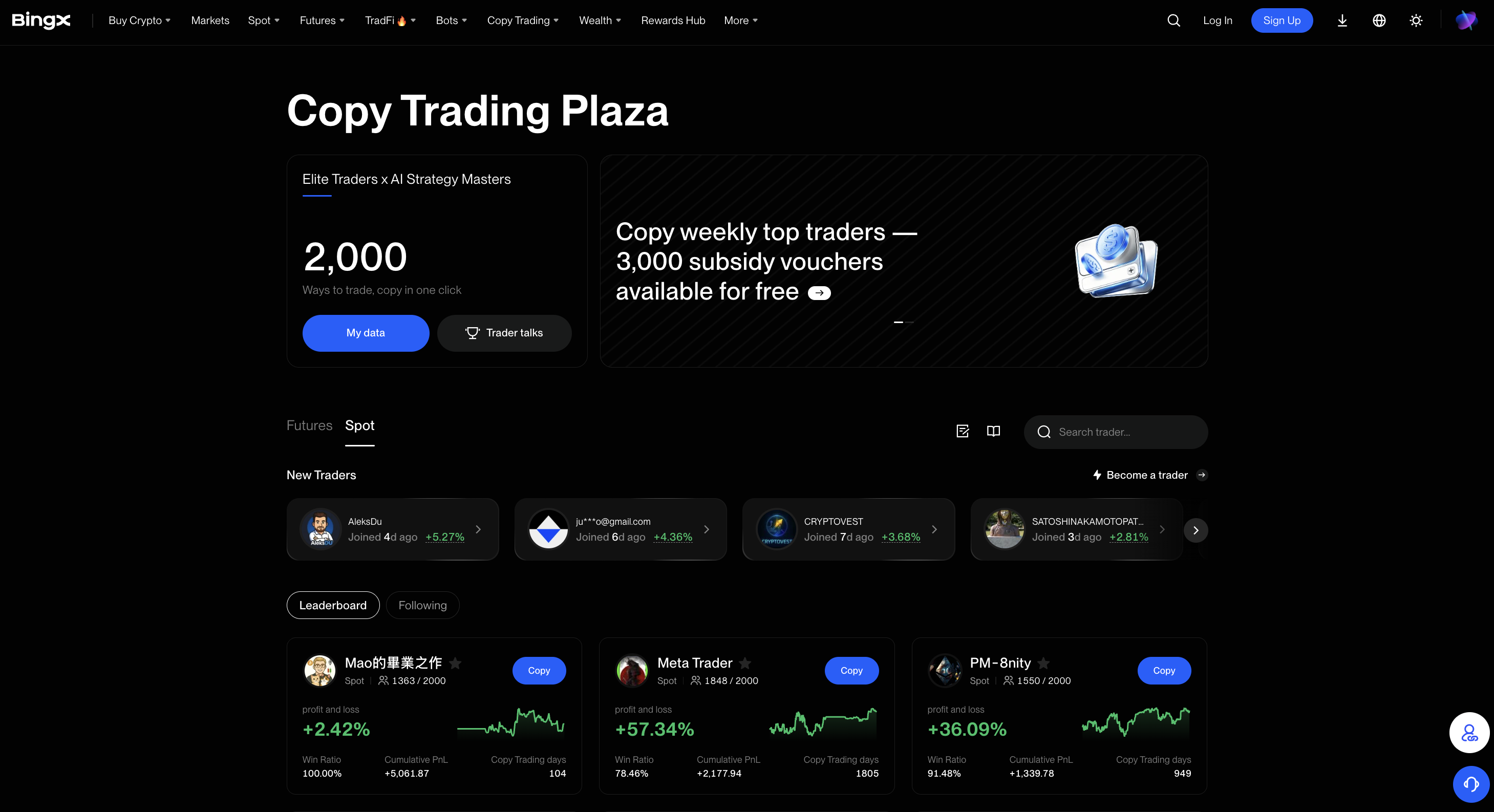
Spot copy trading on Bing X. Source: BingX.com
Go to Copy Trading, then Spot Traders.
Open a trader's profile and click Copy.
Choose your USDT fund account and trade amount per order, and accept the 10% profit share.
Manage or stop copying under 'My Trades', 'Spot Copying'.
On the app, the flow is the same: tap Copy Trading, pick the Spot tab, choose a trader and tap Copy.
Start small. BingX itself recommends small trade sizes at first. If you want a broader introduction, read our guide on how to copy trade crypto.
How BingX Copy Trading Works: Spot and Futures
BingX runs copy trading as separate products. Each has its own rules, profit share and limits.
Feature | Spot | Perpetual Futures | Standard Futures |
Leverage | None | Follows the trader; up to 125x depending on pair and trader | Trader maximum 50x for BTC and ETH (public), 25x for other coins |
Liquidation risk | None | Yes | Yes |
Profit share | 10% flat | 10% to 32% by tier | 8% to 13% by tier |
Settlement | Weekly, Monday 00:00 (UTC+8) | Weekly, Monday 00:00 (UTC+8) | Daily, 00:00 to 00:15 (UTC+8) |
Minimum per trade | 5 USDT per order | As low as 10 USDT | From 2 USDT per order |
Practice funds | Not listed | Trial funds | VST supported |
Spot Copy Trading
Spot copy trading has no leverage and no liquidation. You copy a trader's Spot buys and sells with USDT.
Pairs: 120+ Spot pairs are supported.
Which orders copy: only fully executed market orders. Partially filled or cancelled orders are skipped.
Amount: 5 USDT minimum per order. BingX's pages list different maximums per order, so confirm the current cap on the copy screen.
Cost: a fixed 10% profit share on net gains, charged only when you are in profit.
Data: trader metrics such as 30-day and 180-day ROI refresh every 30 minutes.
Spot copying is the lowest-risk option on BingX because you cannot be liquidated. You can still lose money if the asset price falls.
Futures Copy Trading: Perpetual and Standard Futures
Perpetual Futures
Perpetual Futures is the main product. Since BingX Copy Trading 2.0 (June 2025), each follower gets a separate sub-account, leverage and margin mode match the trader's by default, and multiple open orders merge into one position. Copy data comes directly from perpetual Futures accounts.
You choose between two copy modes:
Mode | How it sizes your trades | Example |
Position Ratio | Mirrors the share of margin the trader uses | A trader uses 300 of 1,000 USDT (30%) at 5x. A copier with 100 USDT uses 30 USDT at 5x |
Per Order | Fixed margin per copied order | 30 USDT per order with 90 USDT in copy funds allows up to 3 concurrent trades |
Other perpetual rules to know:
Opening orders use an IOC limit order with slippage and closing orders use a market order. "Copy with 0 slippage" is off by default and carries a small fee on matched trades.
You can copy up to 20 traders, and a trader can have up to 2,000 copiers.
Copy sub-accounts using VIP 0 fee rates by default.
Take profit and stop loss are optional and can be edited later.
Standard Futures
Standard Futures works on a fixed margin per trade. Copiers can set cumulative loss protection, a maximum copy amount, a daily copy amount and leverage. The follower trading fee is 0.045%, and profit share is settled daily. Standard Futures also accepts VST, BingX's virtual USDT, which makes it the practice route for copy trading.
BingX Copy Trading Fees: Profit Share, Trading Fees and What You Really Pay
BingX does not charge a separate copy trading fee. You pay a profit share to the lead trader, plus normal trading costs on the copied orders.
Profit Share: Rates and Settlement
The profit share depends on the product and the trader's Elite tier.
Tier | Perpetual Futures | Standard Futures | What the trader needs (perpetual) |
Bronze | 10% | 8% | Entry level |
Silver | 16% | 9% | 100+ copiers or 50 USDT 30-day copier profit; 1,000 USDT 30-day average assets |
Gold | 20% | 10% | 500+ copiers and 1,000 USDT 30-day copier profit; 3,000 USDT average assets |
Diamond | 32% | 13% | 2,000+ copiers and 10,000 USDT 30-day copier profit; 20,000 USDT average assets |
How it works in practice:
The share applies only to fully closed, net-profitable positions. Open losses are excluded until closed.
Settlement is weekly on Monday at 00:00 (UTC+8) for perpetual and Spot, and daily for standard Futures.
The share is withheld in advance and returned if the period ends without a profit.
Tiers refresh weekly.
Check the trader's profile for any extra fees before you copy. The profit share and any other charges are shown before you confirm.
Trading Fees and Other Costs
Cost | Perpetual Futures | Standard Futures | Spot |
Copy trading fee | 0 | 0 | 0 |
Follower trading fee | Taker 0.05% | 0.05% | Not listed separately |
Other | Funding on open positions; optional 0-slippage fee | Funding as applicable | None listed |
Slippage is a hidden cost. Your fill can differ from the lead trader's, especially in fast markets.
Worked Example: Your Net Return After Profit Share
Say you copy with 1,000 USDT on perpetual Futures and the trader's closed positions finish a week with a net profit of 50 USDT. The profit share depends on the tier:
Trader tier | Profit share | Paid to trader | You keep |
Bronze (10%) | 10% | 5 USDT | 45 USDT |
Silver (16%) | 16% | 8 USDT | 42 USDT |
Gold (20%) | 20% | 10 USDT | 40 USDT |
Diamond (32%) | 32% | 16 USDT | 34 USDT |
Trading fees come on top. If the copied positions used 5x leverage on 1,000 USDT margin (5,000 USDT notional), a round trip at 0.05% taker is about 5 USDT. If the week closes at a loss, no profit share is paid, but you still bear the loss and the fees.
Note: This is an illustration, not a forecast. Past performance does not predict future results.
How to Choose a Lead Trader to Copy on BingX
Return, Drawdown and Risk Score
Metric | What to check | Rule of thumb from BingX |
ROI (30-day and 180-day) | Is the return steady or one big win? | Compare both windows |
Maximum drawdown (MDD) | Largest peak-to-valley drop | BingX treats an MDD above 30% as a high liquidation risk signal |
Sharpe ratio | Return per unit of volatility | Above 2.0 is a strong signal |
ROI divided by MDD | Return versus pain | At least 2.0 |
Win ratio | Share of winning trades | Pair it with average loss size |
Risk level | BingX's risk filter on the trader list | Lower is more conservative |
ROI alone can mislead. A trader with a high ROI and a 40% drawdown is taking the risk that your account may not survive at your size. BingX defines ROI against a historical high benchmark, and unrealized PnL on the Copied Orders tab can differ from the aggregate Position tab until positions close.
Trader Tier, Track Record and Copier Count
Tier: Bronze to Diamond reflects copier count and copier profit, not skill alone. Higher tiers also take a larger share.
Track record: look at the 180-day view, not only the last 30 days.
Copier count: many copiers show interest, but it says little about risk. Read it next to drawdown.
Style: a trader who focuses on BTC and ETH is easier to follow than one who rotates through small caps.
Public or private: private accounts leave trader lists and Elite benefits.
To become a lead trader yourself, BingX asks for at least 3 trades in 30 days, a win ratio of at least 40% and at least 110 USDT in account assets, then applies through the Recruiting page.
>>> For a longer checklist, read our guide on how to choose the best copy trader and copy trading vs trading bots vs manual trading.
Copy Trading Risks and Limitations
Copy trading removes the need to pick trades. It does not remove the risk.
Market and Leverage Risk
Leverage and margin mode are copied: On perpetual Futures, your position uses the trader's leverage and margin mode by default. Under cross margin, liquidation risk applies to the whole copy sub-account.
Liquidation closes your position: A sharp move can wipe out your copy funds even if the trader's long-term record is good.
Closing is automatic: Stopping a copy closes positions at market price, which can mean a loss.
Higher leverage shortens the distance to liquidation. See our guide to liquidation price in crypto Futures before you copy a high-leverage trader.
Why Copy Orders Can Be Skipped or Differ From the Lead Trader
BingX lists the reasons a copy order may fail or be skipped:
Reason | What it means |
Insufficient margin | Your copy funds cannot cover the order |
Margin mode or leverage mismatch | Your settings differ from the trader's |
Trader's order not fully filled | Only fully executed orders are copied |
Pair not supported for copy trading | The trader used a contract that cannot be copied |
Slippage above your limit | The fill price moved beyond your maximum slippage |
Position value above the maximum | The position hits the cap |
Maintenance or abnormal volatility | System limits or unstable markets |
Trader uses Multi-Assets Mode or One-way Mode | Not supported for copying |
A skipped entry can leave you out of a winning trade, or hold a position when the trader has already closed theirs. It's better to check 'My Trades' page regularly.
Platform and Availability Considerations
Rules change: BingX's parameters page is dated October 2023 and says live settings prevail. Minimums and caps also differ between BingX help pages, so confirm the number on the copy screen.
Check availability first: Confirm that copy trading is open for your country and account before you register or deposit.
Account setup matters: Perpetual copy trading uses a USDT Futures account, and BingX recommends starting with small trade sizes.
No copy trading platform guarantees profit, and past results do not predict future ones.
Bitunix vs BingX Copy Trading: Which Platform Fits Your Strategy?
Bitunix and BingX copy trading are built differently. BingX offers more products and a ranked trader program. Bitunix focuses on USDT-M Futures with a built-in leverage cap.
Bitunix vs BingX Copy Trading Comparison Table
Feature | Bitunix | BingX |
Products | USDT-M Futures | Spot, perpetual Futures, standard Futures |
Leverage on copied trades | Capped at 10x | Follows the trader by default; Futures up to 125x depending on pair and trader |
Follower stop loss | Optional strategy stop loss, 5% to 95% | Optional TP/SL; cumulative loss protection on standard Futures |
Profit share | Default 10% | Spot 10%; perpetual 10% to 32%; standard 8% to 13% |
Settlement | Weekly, Monday 00:00 UTC | Perpetual and Spot weekly, Monday 00:00 (UTC+8); standard daily |
Copy amount | Fixed amount of 10 to 1,000 USDT or ratio of 100 to 100,000 | Per Order or Position Ratio; limits vary by product |
Lead trader entry | From 500 USDT; up to 100 copiers per strategy | 3 trades, 40% win ratio and 110 USDT assets; up to 2,000 copiers (perpetual) |
Practice | 50,000 USDT demo trading, no KYC | VST on standard Futures; trial funds |
The practical difference is the guardrail. Bitunix caps copied trades at 10x, so a lead trader cannot pull your account into 50x or 100x territory. BingX gives followers more freedom, more products and a visible level system. Both apply profit shares only to profitable results. Our broader Bitunix vs BingX comparison covers fees, leverage and security.
On cost, the same 50 USDT weekly profit costs 5 USDT at Bitunix's default 10% share. On BingX, it costs 5 USDT with a Bronze perpetual trader and 16 USDT with a Diamond one. Check each trader's actual rate before you copy. See copy trading fees on Bitunix for the details.
Choose BingX If You Want Scale, Spot Copy Trading and a Demo
You want Spot copy trading with no leverage or liquidation risk.
You want a large trader pool with tiers, ROI, drawdown and copier data to filter on.
You want a practice route through VST on standard Futures before using real funds.
You are comfortable setting your own limits, because BingX copies the trader's leverage by default.
Choose Bitunix If You Want a Simple Fixed-Amount Setup and Chart Tools
You want a hard 10x cap on copied trades and an optional strategy to stop loss.
You prefer a fixed-amount setup with clear limits (10 to 1,000 USDT) or a ratio.
You trade Futures yourself and want Ultra Chart Trading and Super Alert in the same app.
You want to practice first with 50,000 USDT of demo funds, with no KYC.
You can browse lead trader stats on Bitunix copy trading and compare more platforms in our best copy trading platforms of 2026 guide.
Conclusion: Is BingX Copy Trading Worth It?
BingX copy trading is a strong option if you want choice. It covers Spot and Futures, ranks traders by tier, shows ROI, drawdown and copier data, and has no separate copy fee. Spot copying is the gentlest way in, and VST on standard Futures gives a way to practice.
It is not hands-off. Profit shares climb with trader tier, Futures copying follows the trader's leverage, and orders can be skipped or filled at different prices. Your result will differ from the trader's, and you can lose your copy funds.
For Bitunix vs BingX copy trading, the split is simple. Choose BingX for range and Spot copying. Choose Bitunix for a 10x cap, an optional strategy stop loss and a Futures workspace with chart tools. Whichever you pick, start with a small allocation, check the drawdown, copy more than one style if you can and review your trades every week.
See more: Bitunix vs BingX: Fees, Leverage, Copy Trading and Safety Compared