If you are choosing between Bitunix vs BingX, the headline fee is only the start. Both are derivatives-focused crypto exchanges, but they are built for different traders. BingX spreads itself across copy trading, bots, TradFi perpetuals, Earn and a debit card. Bitunix concentrates on the Futures screen itself: placing orders on the chart, watching levels with alerts, and keeping copy trading on a short leash.
This article will break down how both exchanges stack up in day-to-day trading across fees, features, and safety.
BingX Crypto vs Bitunix: Coins, Markets and TradFi Assets Compared
Both exchanges put crypto and traditional assets in the same Futures account. The difference is scale versus focus: BingX lists more contracts, while Bitunix keeps a tighter set inside one workspace.
Spot Coins and Futures Contracts
Bitunix Futures cover three groups of contracts:
USDT-M perpetuals: the main market, with more than 780 contracts and leverage up to 200x on select pairs.
Coin-M perpetuals: margined and settled in the coin itself, useful if you hold BTC or ETH and want to hedge without switching to stablecoins.
TradFi perpetuals: metals, energy and US stocks, traded from the same account as crypto.
Bitunix also supports cross and isolated margin, plus Multi-Trade Mode, which lets you hold several separate positions in the same pair and direction.
On the BingX exchange, crypto trading spans spot, standard Futures and USDT-margined perpetuals, with more than 1,100 Futures pairs listed in its 2026 trading guide. BingX does not publish a current spot coin count.
Headline counts change every week. If you trade smaller altcoins, check that your exact pairs are listed on both exchanges before you move funds.
New to perpetuals? Start with our guide to how Bitcoin Futures work.
TradFi Markets: Stocks, Forex and Commodities
BingX offers the larger TradFi menu; Bitunix offers a smaller set that sits inside its Futures workspace.
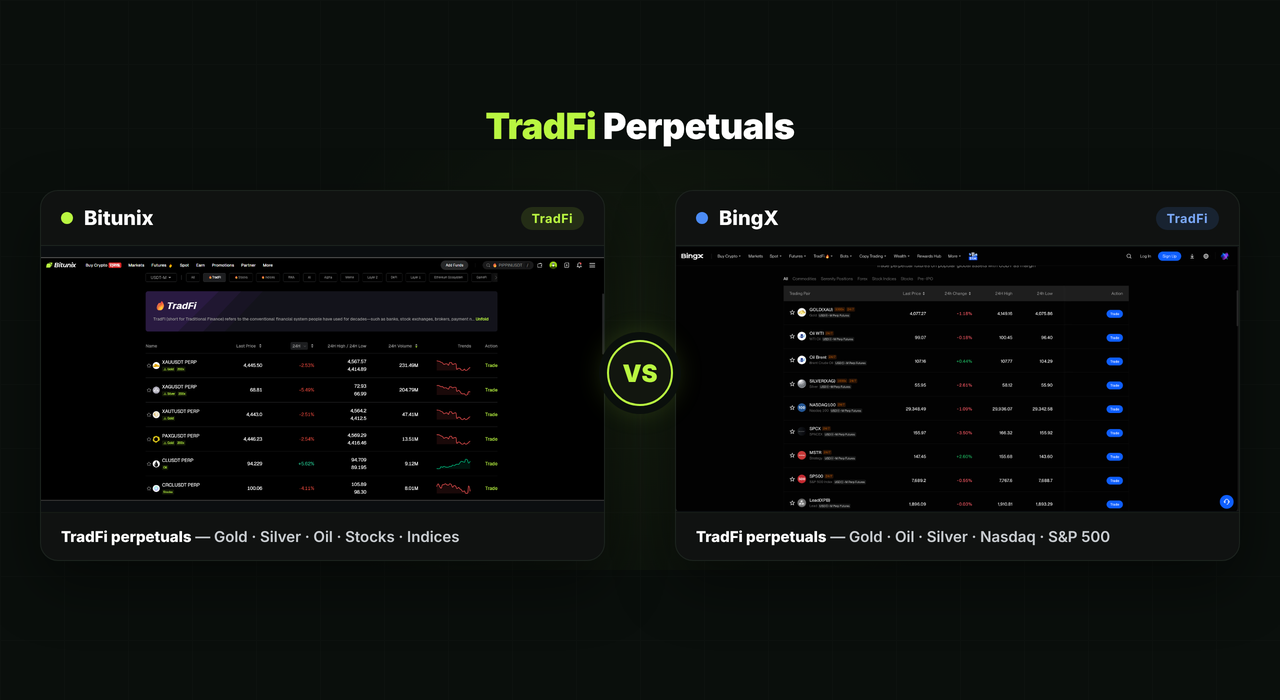
Bitunix tradfi perpetuals vs BingX TradFi perpetual
BingX expanded TradFi perpetuals in January 2026 with commodities such as gold, silver and oil, forex pairs such as EURUSD and USDJPY, stocks such as TSLA and NVDA, and indices such as the S&P 500 and NASDAQ 100. By late August 2026, BingX said it had passed 500 TradFi perpetual listings.
On Bitunix, gold (XAUUSDT), silver, platinum, copper, crude oil, natural gas and US stock perpetuals such as TSLA, NVDA and AAPL trade next to crypto. Bitunix stock perpetuals run 24/7, so you can react to news outside US market hours. For a worked example, see trading Intel with INTCUSDT.
Two cautions apply to any TradFi perpetual. The contract tracks the underlying price, but you do not own the stock or commodity. Funding and weekend pricing can also differ from the traditional market.
Bitunix Exchange vs BingX Exchange Fees: Spot, Futures and VIP Tiers
At the base tier, BingX is cheaper on Futures taker fees and Bitunix is cheaper on spot maker fees. Further up the ladder, the biggest difference is how easily you qualify for each VIP level.
Spot Trading Fees
Spot fees | Bitunix | BingX |
Maker (base) | 0.08% | 0.10% |
Taker (base) | 0.10% | 0.10% |
VIP 1 (maker / taker) | 0.07% / 0.09%, from a 300 USDT balance | 0.035% / 0.06%, under separate spot VIP requirements |
On a $1,000 market buy, you pay about $1.00 on either exchange at the base tier. On a resting limit order, Bitunix charges $0.80 and BingX $1.00.
Futures Trading Fees and VIP Tiers
Futures fees are charged on the full position size, not on your margin. At the base tier:
The Bitunix figures below come from its current fee schedule. The BingX figures come from its VIP fee schedule effective October 25, 2023, the latest perpetual Futures VIP schedule BingX has published.
VIP level | Bitunix maker / taker | BingX maker / taker |
VIP 0 / Regular | 0.020% / 0.060% | 0.020% / 0.050% |
VIP 1 | 0.020% / 0.050% | 0.014% / 0.040% |
VIP 2 | 0.016% / 0.050% | 0.012% / 0.0375% |
VIP 3 | 0.014% / 0.040% | 0.010% / 0.035% |
VIP 4 | 0.012% / 0.0375% | 0.008% / 0.0315% |
VIP 5 | 0.010% / 0.035% | 0.006% / 0.030% |
VIP 6 | 0.008% / 0.0315% | No VIP 6 tier |
VIP 7 | 0.006% / 0.030% | No VIP 7 tier |
Top tier | VIP 8: 0.000% / 0.026% | Supreme VIP: 0.000% / 0.028% |
In dollars, on a $10,000 BTCUSDT position opened and closed:
Base tier, taker in and out: $12 on Bitunix, $10 on BingX.
Base tier, maker in and out: $4 on both.
VIP 1, taker in and out: $10 on Bitunix, $8 on BingX.
So at the same VIP number, BingX's published rates are lower. Bitunix pulls ahead at the very top, where VIP 8 reaches 0% maker and 0.026% taker, below BingX Supreme VIP at 0.028%.
Qualification is where the two ladders split
Bitunix VIP 1 needs any one of a 300 USDT balance, 1M USDT in 30-day Futures volume or 100,000 USDT in 30-day spot volume. BingX VIP 1 needs 10M USDT in 30-day perpetual volume or 50,000 USDT in assets, and Supreme VIP needs 600M USDT in volume. For a smaller account, Bitunix discounts arrive much sooner.
If you already hold VIP status elsewhere, Bitunix lets you request a matching VIP level by sending a screenshot of your VIP tier and 30-day volume on the other exchange. For the full ladder, see Bitunix Trading Fees Explained.
Trading fees are only one cost. Funding payments, spread and slippage often matter more on large or frequent trades.
Deposit and Withdrawal Fees
Crypto deposits are free on both exchanges. Withdrawals carry a network fee that depends on the coin and chain:
Bitunix: 0.000035 BTC for a Bitcoin withdrawal, per its withdrawal fee page. On a 0.05 BTC withdrawal, that is about 0.07%.
BingX: no deposit fee; withdrawal fees vary by coin and network and are shown on the withdrawal page before you confirm.
On either platform, pick a low-cost network your wallet supports, such as TRC-20 for USDT, and batch small withdrawals, so the flat fee takes a smaller share.
Bitunix vs BingX Futures: Leverage, Chart Trading and Alerts
This is where daily experience differs most. Both exchanges let you place orders from the chart; Bitunix adds a deeper alert system, while BingX offers higher leverage caps and more contracts around it.
Maximum Leverage: 200x vs Up to 500x
Bitunix allows up to 200x on select pairs, including BTCUSDT, ETHUSDT and gold (XAUUSDT). Most other pairs sit between 20x and 75x.
BingX's 2026 perpetual Futures guide advertises up to 500x on crypto perpetuals, and its TradFi rules allow up to 500x on forex, commodities and indices, but only up to 25x on stock perpetuals. On both platforms, the real cap depends on the pair and shrinks as your position grows.
The table shows roughly how far price can move against you before your initial margin is gone, ignoring fees and maintenance margin:
Leverage | Margin as % of position | Adverse move that wipes initial margin |
10x | 10% | ~10% |
20x | 5% | ~5% |
100x | 1% | ~1% |
200x (Bitunix max) | 0.50% | ~0.5% |
500x (BingX max) | 0.20% | ~0.2% |
In practice, liquidation comes earlier because of maintenance margin and fees. At 200x or 500x, a normal one-minute candle can close your position, so the cap matters far less than your position size and stops placement. For math, see our guide to liquidation price in crypto Futures.
Chart Trading: Place, Modify and Close Orders on the Chart
Both exchanges let you trade from the chart. Here is how the published features compare:
Chart feature | Bitunix | BingX |
On-chart orders | Limit, conditional and trailing stop orders | Limit, market and TP/SL orders via Chart Order |
Drag to adjust | Drag TP and SL lines | Drag open, TP and SL lines (not for market orders) |
Risk levels on chart | Liquidation, margin call and break-even lines | Not shown in BingX's Chart Order guide |
Multi-chart view | Up to 16 chart windows | Not described in BingX's guides |
Chart tools | Ultra Chart | Ultra TradingView: 108 indicators, 86 drawing tools, 16 candlestick styles |
Bitunix Ultra Chart Trading turns the chart into the order ticket. You can place limit, conditional and trailing stop orders on the chart, drag TP and SL lines to move exits, and see liquidation, margin call and break-even levels before you commit. Multi-chart layouts let you watch several markets at once.
BingX's Chart Order lets you place limit, market and TP/SL orders on the candlestick chart, drag the open, take-profit and stop-loss lines, and set size with a slider. Its Ultra TradingView upgrade, released in June 2026, adds in-chart execution on mobile, including position reversal, on top of 108 indicators and 86 drawing tools.
The practical gap is small: Bitunix shows your risk levels on the chart and supports multi-chart layouts; BingX brings a TradingView-style tool set and one-tap reversal to mobile. Either way, check size, leverage and stop distance before you confirm.
If you are new to order types, start with market, limit and stop orders explained and how to read candlestick charts.
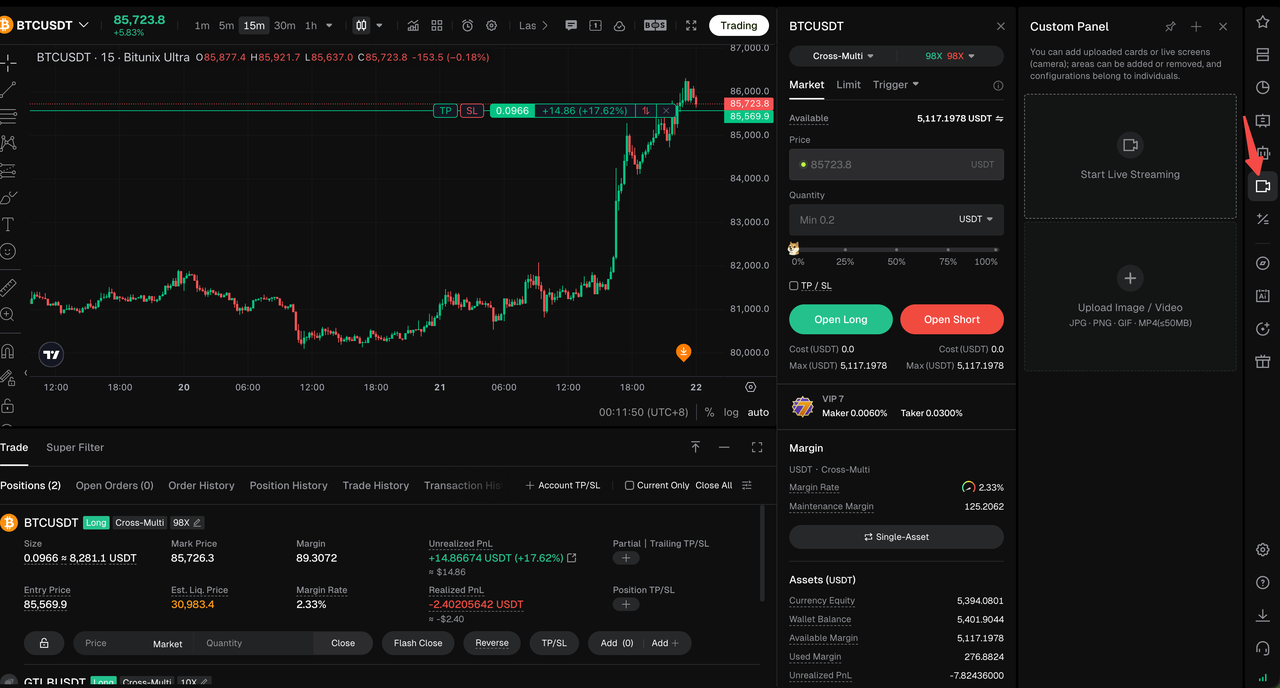
Bitunix Chart Trading
Super Alert: Price, Indicator and Candle Alerts in One System
Bitunix Super Alert covers six alert types:
Price alerts: a push notification when price hits your level.
Indicator alerts: signals from MACD, RSI, Bollinger Bands, volume or moving averages.
Candlestick alerts: automatic detection of candlestick patterns.
Drawing alerts: a notification when price touches or breaks a support, resistance or channel line you drew.
Template alerts: ready-made strategy setups you can switch on.
Combo alerts: several conditions combined to filter out false signals.
For example, you can set a Drawing Alert on a resistance line and add an RSI condition in a Combo Alert, so you are notified only when both are true.
BingX offers native price alerts in its app, with up or down triggers and a choice of how often they fire. Traders who need indicator-based alerts can send TradingView alerts to BingX through webhooks, which takes extra setup. If alerts drive your workflow, test both on a demo account first.
Copy Trading and Automation: Bitunix vs BingX
Both exchanges take social and automated trading seriously. The difference is in the guardrails: how much leverage a copied trade can use, how you cap losses, and how many tools you get beyond copy trading.
Copy Trading
Bitunix puts a hard cap on copied leverage; BingX gives followers more freedom and a ranked lead-trader program.
Copy trading rule | Bitunix | BingX |
Leverage on copied trades | Capped at 10x | Followers set their own leverage |
Follower loss controls | Optional strategy stop loss (5%–95%), slippage tolerance | TP/SL, cumulative loss protection, dynamic stop loss |
Profit share | Default 10%, settled every Monday 00:00 UTC | Varies by lead trader level |
Lead trader levels | Entry from a 500 USDT initial copy amount; up to 100 copiers per strategy | Elite Copy Traders Program: Bronze, Silver, Gold, Diamond, reviewed weekly |
Follower capacity | Up to 20 active copy strategies | Multiple lead traders |
The 10x cap is the practical difference. On Bitunix, a lead trader cannot pull your account into 50x or 100x territory, whatever they use themselves. BingX lets you set leverage yourself and gives you a visible level system to shortlist traders, but that freedom also means more room for mistakes.
On both platforms, profit sharing applies only when a period ends in profit, and past returns do not predict future ones. Check maximum drawdown and track record length, not just ROI.
You may be interested:
Bots, Demo Accounts and API
Bots
BingX offers Spot Grid (from 10 USDT), Futures Grid (up to 20x), Spot Infinity Grid and a Martingale (DCA) bot. Bitunix offers a Futures Grid bot. If bots are your main workflow, BingX has the wider menu.
>>> See more: 10 Common Crypto Trading Bot Mistakes
Demo trading
Both let you practise without risking real funds:
Bitunix gives you 50,000 USDT in virtual funds that you can reset at any time. Demo covers USDT-M perpetuals, with funding rates synced to the live market, and needs no KYC.
BingX gives new users 100,000 VST in a Futures demo account. If the balance drops below 20,000 VST, you can request a top-up once every 7 days, and there is a daily cap on simulated trades.
Demo fills have no slippage and do not touch the live order book, so treat demo profits as practice, not proof.
>>> See more: How to Practice Futures Trading with Demo Funds
API access
Bitunix publishes API documentation for Futures and spot, and BingX also supports API trading. Check each exchange's rate limits and which markets are open to API orders before you build a strategy around them.
Earn, Funding and Payment Options: Bitunix vs BingX
Beyond trading, the two exchanges differ most in how much of your wallet activity they try to cover. BingX builds out a full Wealth section; Bitunix keeps Earn simple and adds a card.
Earn Products
Bitunix Easy Earn offers flexible savings, with interest paid hourly and reinvested, and fixed-term savings over set periods such as 7, 14 or 30 days. Redeeming a fixed-term product early forfeits its interest. Bitunix also offers Dual Investment with Buy Low and Sell High products.
BingX Earn covers Flexible and Fixed products, Shark Fin, Dual Investment, a Loan section and BXUSD, which BingX backs with U.S. Treasury funds. BingX requires Advanced KYC for Wealth products.
Advertised yields on both platforms are variable, change without notice and are not deposit-insured. Dual Investment can convert your deposit into another asset at the target price, so it is not principally protected. If you only want to park stablecoins between trades, compare the live flexible rate and redemption terms on both platforms for the asset you hold.
Deposits, Fiat, P2P and Cards
Payment feature | Bitunix | BingX |
Crypto deposits | Free | Free |
Buy with card | Visa and Mastercard | Visa and Mastercard: 1.50% fee for EEA cards, 3.30% for non-EEA cards |
Bank transfer | SEPA (EUR) deposits | Depends on region |
P2P | No fees for buyers or sellers; KYC required | Available; KYC required |
Crypto card | Bitunix Visa card: cashback from 1% at VIP 1 up to 8% at VIP 8 (capped at 1,000 USDT per month) | BingX Visa debit card: free virtual card, $180 metal card, 2%–5% cashback by card and tier |
For buying crypto with fiat on Bitunix, see our guides to buying Bitcoin safely, using SEPA and Bitunix P2P.
On Bitunix P2P, escrow protects the crypto side of a trade, and crypto bought through P2P is held for 24 hours before you can withdraw it. Escrow cannot guarantee that a bank transfer clears or that your bank will not review it, so always pay from an account in your own verified name.
Security, KYC and Availability: Bitunix Exchange vs BingX Exchange
This part of the Bitunix vs BingX comparison covers how each exchange protects funds, what it asks of you before you can withdraw, and where you can legally use it.
Is BingX Safe? Is Bitunix Safe? Proof of Reserves and Fund Protection
Both exchanges publish Merkle-tree Proof of Reserves above 100% and keep a dedicated protection fund. BingX's record includes a 2024 hot-wallet incident; Bitunix has no publicly reported breach.
Safety measure | Bitunix | BingX |
Proof of Reserves | Merkle tree, monthly snapshots, open-source verifier. October 1, 2026: BTC 156%, ETH 108%, USDT 105% | Merkle tree, monthly snapshots. July 15, 2026: BTC 142.82%, ETH 126.48%, USDT 131.83%, USDC 124.41% |
Protection fund | Bitunix Care Fund: 50M USDC (launched at 30M USDC in October 2025) | Shield Fund: US$150 million |
Custody | Fireblocks and Cobo | Multi-signature authorization with tiered cold, warm and hot wallets |
Certifications | ISO/IEC 27001:2022 | PCI DSS 4.0.1 and ISO/IEC 27001 |
Security incidents | None publicly reported | Hot-wallet incident, September 2024 |
A reserve ratio above 100% means the exchange held more of that asset than users had on the platform at the snapshot time. It is a point-in-time check, not a guarantee of the company's full financial position. You can check the latest Bitunix ratios on its Proof of Reserves page and verify your own balance with the open-source tool.
On September 20, 2024, BingX detected abnormal outflows from its hot wallets and paused withdrawals. Major-asset withdrawals reopened the next day, and BingX said its reserves would fully cover any losses. BingX did not publish a loss figure; reported estimates range from about $43 million to $52 million. One incident is not a verdict on today's controls, but it is a fact worth weighing when you decide how much to keep on any exchange.
No exchange is risk-free. Turn on 2FA, whitelist withdrawal addresses and keep idle funds in your own wallet. Our overview of Bitunix compliance, KYC and risk controls covers the Bitunix side in more detail.
KYC and Regulation
KYC
KYC is the clearest policy difference: Bitunix requires verification before any withdrawal, while BingX allows limited withdrawals without it.
KYC rule | Bitunix | BingX |
KYC before withdrawals | Required | Not required up to the unverified limit |
Unverified account | Withdrawals locked until Level 1 | Withdraw up to 20,000 USDT per 24h; deposits, full trading, fiat and Wealth need Advanced KYC |
Verified level | Level 1 (ID and selfie): up to 500,000 USDT per 24h | Advanced KYC: up to 5,000,000 USDT per 24h |
Higher level | Level 2 (proof of address): up to 5,000,000 USDT per 24h | No higher level listed |
BingX's KYC benefits can vary by region, so check the table in your own account before relying on the unverified limit.
Regulation
Bitunix is registered with the U.S. Financial Crimes Enforcement Network (FinCEN) as a Money Services Business and continues to add registrations in other jurisdictions. A registration is not an invitation to every market: Bitunix does not onboard residents of the United States or Canada, among other restricted regions.
BingX’s EU entity, MEGE zweite GmbH (operating as BingX EU), holds a MiCA crypto-asset service provider authorisation from Austria’s Financial Market Authority, granted in October 2026, which it can passport to other EEA countries. Outside the EU route, BingX’s restricted list includes the United States, Canada, the United Kingdom, the Netherlands, Singapore, Hong Kong and Mainland China.
Restricted lists change, so read each exchange's eligibility notice for your country before you open an account. Using a VPN to get around a restriction breaks both platforms' terms and can get your account frozen.
Bitunix or BingX: Which Crypto Exchange Should You Choose?
Pick based on how you trade, not on which brand is bigger:
Choose Bitunix if you trade Futures by hand and want orders, TP/SL and liquidation levels on one chart, Super Alert for price, indicator and drawing conditions, a 10x cap on copied trades and VIP discounts from a 300 USDT balance.
Choose BingX if you want a wider ecosystem: 500+ TradFi perpetuals, more grid bots, Wealth products, a card with tiered cashback and limited withdrawals before KYC.
Many active traders keep an account on both, using one for execution and the other for products the first does not offer.
Bitunix vs BingX: Full Comparison Table
Category | Bitunix | BingX |
Spot fees (base maker / taker) | 0.08% / 0.10% | 0.10% / 0.10% |
Futures fees (base maker / taker) | 0.02% / 0.06% | 0.02% / 0.05% |
Top Futures VIP tier | VIP 8: 0% / 0.026% | Supreme VIP: 0% / 0.028% |
VIP 1 entry | 300 USDT balance, or 1M USDT Futures volume | 50,000 USDT assets, or 10M USDT perpetual volume |
Futures contracts | 780+ perpetuals, incl. Coin-M and TradFi | 1,100+ Futures pairs, 500+ TradFi perpetuals |
Max leverage | Up to 200x on select pairs | Up to 500x on some perpetuals |
Chart trading | Ultra Chart Trading with TP/SL, liquidation and break-even lines | Chart Order and Ultra TradingView |
Alerts | Super Alert: price, indicator, candlestick, drawing, template, combo | Price alerts; TradingView webhook alerts |
Copy trading | 10x cap, optional strategy stop loss, default 10% profit share | Elite lead-trader levels, follower-set leverage, loss protection |
Bots | Futures Grid | Spot Grid, Futures Grid, Spot Infinity Grid, Martingale |
Demo trading | 50,000 USDT, resettable, USDT-M perpetuals | 100,000 VST, Futures |
Earn | Flexible, fixed-term, Dual Investment | Flexible, fixed, Shark Fin, Dual Investment, BXUSD, Loan |
Proof of Reserves | Oct 1, 2026: BTC 156%, ETH 108%, USDT 105% | Jul 15, 2026: BTC 142.82%, ETH 126.48%, USDT 131.83%, USDC 124.41% |
Protection fund | Care Fund, 50M USDC | Shield Fund, US$150M |
KYC | Required before withdrawals | Unverified withdrawals up to 20,000 USDT per 24h |
Regulation | US FinCEN MSB registration | MiCA CASP authorisation (EU entity, Austria FMA) |
Conclusion
In the Bitunix vs BingX matchup, the right answer depends on what you value. BingX has lower base Futures taker fees, higher leverage caps, a much larger TradFi menu, more bots and Earn products, a card with tiered cashback and a withdrawal limit before KYC. Its September 2024 hot-wallet incident is part of its record, alongside a US$150 million Shield Fund, monthly Proof of Reserves and a new MiCA authorisation in the EU.
Bitunix is the more focused Futures workspace. Ultra Chart Trading puts orders, TP/SL and liquidation levels on one chart, and Super Alert watches price, indicators, candlestick patterns and your own trendlines. Copy trading caps copied positions at 10x, VIP 1 starts at a 300 USDT balance, and the ladder runs to 0% maker at VIP 8. A 50M USDC Care Fund and monthly Proof of Reserves above 100% sit behind the account.
If you trade Futures by hand and want in-app alerts and copy trading guardrails, open a Bitunix Futures account and start with demo funds. If you want a broad multi-product platform and a large TradFi list, BingX covers more ground. Either way, compare live fees and order books on your own pairs before committing size.
>>> See more: Bitunix vs OKX: Which Crypto Exchange Is the Better Binance Alternative in 2026?