In 2026, evaluating Bitunix vs Bitget reflects a fundamental split in trading priorities. Bitunix focuses squarely on execution quality—while it supports spot markets, its core engineering is dedicated to futures performance, specialized interfaces like its PC Ultra terminal, and flat fee schedules that never force you to hold a native platform token. Bitget leans into ecosystem breadth, leveraging the market's largest copy trading network, extensive altcoin listings, and multi-tier fee discounts driven by BGB.
When volatility spikes, promotional perks don't protect your positions. What actually determines your bottom line comes down to four operational realities: order book depth during liquidation cascades, fee drag when you don't hold proprietary tokens, how copy-trading profit splits handle drawdown periods, and verifiable on-chain reserve backing.
Below, we audit both platforms across the mechanics that dictate where your capital works best.
Bitunix vs Bitget: The 2026 Benchmark and Quick Verdict
Bitunix and Bitget share an identical baseline futures schedule—0.02% maker and 0.06% taker—yet diverge on nearly every operational layer surrounding it.
Bitget represents the expansive crypto conglomerate: 800+ spot tokens, native trading bots, Web3 wallet integration, the industry's largest copy-trading marketplace, and a BTC-denominated Protection Fund that was replenished past $300M following a $387.5M hot-wallet breach in September 2026.
Bitunix, by contrast, strips away ecosystem bloat to double down on derivatives execution. It delivers up to 200x leverage on BTC and ETH perpetuals, an unbundled flat fee model with zero platform token requirements, a publicly verifiable $50M USDC Care Fund on-chain, built-in Fixed Risk position sizing, and a dedicated desktop terminal supporting 16 flexible charting layouts tailored for active market monitoring.
The comparison below was checked against both exchanges' fee pages, help centers, Proof of Reserves pages and official announcements as of October 26, 2026. Fee tiers and fund valuations change, so the live pages remain the final word.
Direct-Answer Block: 60-Second Data Sheet
The following table summarizes the six dimensions that matter most when choosing between the two exchanges:
Dimension | Bitunix | Bitget |
Protection fund | $50M USDC at one disclosed on-chain address (raised from $30M on Oct 21, 2026) | $300M+ in BTC after the Sept 30, 2026 replenishment; averaged $382M in Aug 2026 |
Max perpetual leverage | 200x on BTC/USDT and ETH/USDT | 125x |
Market coverage | ~550 listed coins; 1,100+ markets across spot and perpetuals; gold, indices and stock CFDs | 800+ spot tokens; ~300 derivatives markets; tokenized stocks; bots; Earn |
Base fees (spot / futures) | 0.08% / 0.10% spot; 0.02% / 0.06% futures | 0.10% / 0.10% spot (0.08% paying in BGB); 0.02% / 0.06% futures |
VIP 1 entry | 1,000 USDT balance or 1M USDT 30-day futures volume | ~$30,000 in assets, $500k spot or $5M futures 30-day volume, or a BGB holding |
Copy-trading settlement | Weekly (Mon 00:00 UTC) on net realized P&L; 10% default ratio | High-water mark; settled only when the copy account is flat; 10%–20% by trader tier |
Desktop workflow | PC Ultra: Chart-first layout with expandable order book/depth, custom side panels, Super Filter, and Super Alert. | Standard web terminal with TradingView charts and trading bots |
Identity verification | Level 1 (one government ID, minutes) unlocks trading and 2,000,000 USDT/day withdrawals | Level 1 (ID plus face check) required to deposit, trade or withdraw |
Where each platform has a clear advantage:
Bitget's advantage scenarios: access to long-tail spot tokens, automated grid and DCA bots, a one-stop Web3 wallet ecosystem, and a copy-trading pool with the widest choice of lead traders.
Bitunix's advantage scenarios: intraday derivatives trading on major pairs, maximum capital efficiency at 200x, a base fee schedule that does not depend on holding or paying with a platform token, and a native multi-chart terminal for traders who watch several timeframes at once.
Architectural Philosophy: Agile Derivatives Engine vs Expansive Crypto Conglomerate
The two platforms approach exchange design from opposing philosophies.
Bitget, founded in 2018, positions itself as a "Universal Exchange" serving a reported 125 million users across 150 regions. Its ecosystem covers spot, margin, USDT-M, Coin-M, and USDC-M futures, trading bots, Earn, Launchpool, tokenized equities, gold and index copy trading, alongside a self-custody Web3 wallet. The clear advantage is consolidation—virtually any digital asset operation happens under one master account. The cost is interface density, where the primary futures screen constantly competes for screen space with peripheral features.
Bitunix cuts the other way. Launched in 2021, it has scaled to 5 million users in 150+ countries by keeping the workspace lean. The chart stays at the center. You still get perpetual futures, spot, and copy trading, paired with select TradFi assets like gold, equity CFDs, and the Bitunix Card. But there is little bloat. With roughly 15 monthly releases, engineering stays glued to execution speed and interface response. The practical contrast is clear: Bitunix builds depth inside the trade window; Bitget builds breadth outside of it.
Order Book Stress Test: Real-World Liquidity and Spread Stability in Volatile Conditions
Liquidity is the one dimension no fee table captures—it has to be tested live. Bitget ranked second in CoinGlass's H1 2026 crypto derivatives liquidity rankings, reflecting the deep order books its scale brings across both majors and mid-cap perpetuals.
Bitunix focuses its liquidity more selectively: it holds solid rankings across CoinMarketCap, CoinGecko, CoinGlass, and DefiLlama by concentrating tight spreads and book depth on core trading pairs, even if it skips Bitget's sheer long-tail breadth.
Three checks separate marketing from execution quality on either exchange:
1. Quoted spread on BTC/USDT and ETH/USDT during a scheduled event such as a CPI print or FOMC decision, not during a quiet Sunday session.
2. Visible depth within 0.1% of mid-price. A 50,000 USDT market order should clear without walking the book; on long-tail altcoins, Bitget's larger book will usually absorb more size.
3. Fill versus mark price on a stop-market order during a fast move. The gap between the two is the real cost of a volatile session, and it is often larger than the maker/taker fee itself.
Solvency and Asset Security: Auditing the Reserves and Emergency Funds
Both exchanges publish Merkle-tree Proof of Reserves above 1:1 and both keep a dedicated reserve for extreme events. The differences are in how those reserves are denominated, how large they are relative to hot-wallet exposure, and what each exchange's security history actually shows.
Proof of Reserves Under the Microscope: Merkle-Tree Cadence and 1:1 Asset Backing
Bitunix's October 5, 2026 PoR update reported $239M in total reserves held strictly above 1:1, with 85.6% concentrated in tier-one liquid assets (BTC, USDT, and USDC). Earlier snapshots from March 2026 showed collateralization ratios of 109% for BTC, 100% for ETH, and 109% for USDT—all independently verifiable via a self-service Merkle-tree tool and tracked on CoinMarketCap, CoinGecko, and DefiLlama.
Bitget maintains a monthly reporting cycle covering BTC, ETH, USDT, and USDC. Its February 2026 report posted an overall reserve ratio of 169%, following a January snapshot of 254% for BTC, 161% for ETH, 113% for USDC, and 100% for USDT. Bitget's higher coverage figures largely reflect its sizable corporate BTC treasury held against a user base whose deposit liabilities are predominantly stablecoin-heavy.
The takeaway: both are over-collateralized on their core assets. The number to watch on Bitget is the first post-breach monthly snapshot; on Bitunix it is the cadence, since updates are regular but not fixed to a calendar.
Protection Funds Dissected: Bitunix $50M Care Fund (USDC) vs Bitget Protection Fund ($300M+ in BTC)
The two funds are built on different premises, and the following table lays out the differences that matter in a crisis:
Dimension | Bitunix Care Fund | Bitget Protection Fund |
Launched | October 2025 at $30M USDC | 2022 at $300M, backed by 5,500 BTC |
Current size | $50M USDC (raised Oct 21, 2026) | Replenished to $300M+ on Sept 30, 2026 |
Denomination | USDC only | BTC (valuation moves with the BTC price) |
Verifiability | Single disclosed address, checkable on Etherscan | Published wallet addresses, monthly valuation reports |
Stated coverage | Exceeds the full value of Bitunix's hot wallets | Covered the September 2026 breach loss; topped up afterward |
Peak and trough | Only increased since launch | $725M peak (May 2025); fell below $200M after the Sept 24, 2026 breach |
A stablecoin fund has one property a BTC fund cannot offer: its dollar value does not fall when the market does. The moment a protection fund is most likely to be needed is a liquidation cascade or a security event during a sell-off, and that is exactly when a BTC-denominated reserve is worth less in USD terms.
Bitget's fund averaged $382M in August 2026 and then absorbed a $387.5M loss in September, which is why it needed a replenishment commitment within a week.
The counterargument is scale. Bitget's fund is six times larger than Bitunix's in nominal terms and backs a much larger user base, and a BTC reserve compounds in bull markets. The fair comparison is fund size relative to hot-wallet exposure, which Bitunix states it fully covers, rather than the headline figure.
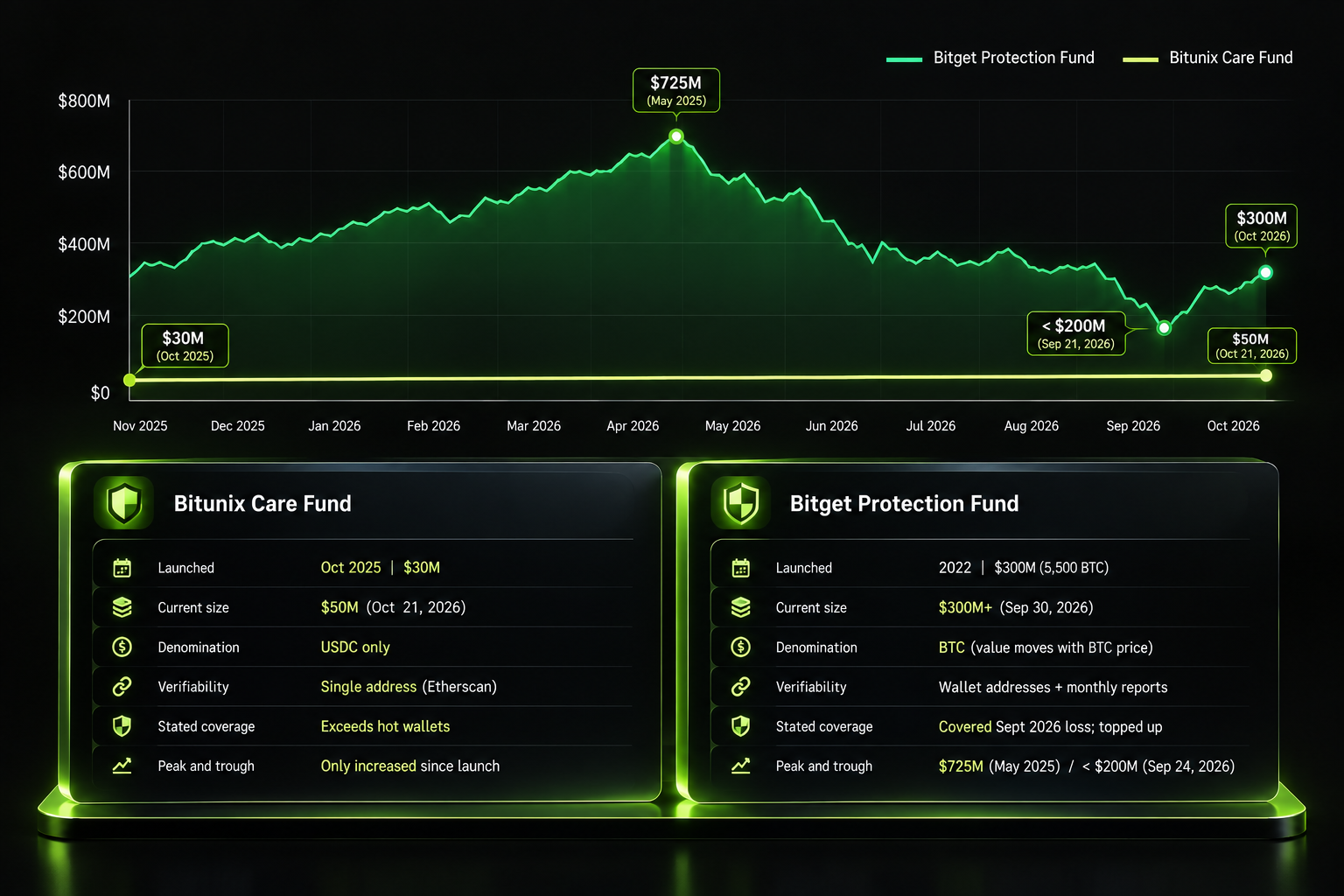
Bitunix's USDC Care Fund holds a fixed dollar value, while Bitget's BTC-denominated Protection Fund moves with the market and dipped sharply after the September 2026 breach.
Is Bitunix Legit? Examining Solvency Audits, Cold Storage Architecture, and Security History
Bitunix is a legitimate, solvent exchange with a clean security record. It has published Merkle-tree Proof of Reserves since 2024, uses institutional custody infrastructure from Fireblocks and Cobo with the majority of assets in cold storage, runs 24/7 risk monitoring, and has no publicly reported security breach to date. After the October 10–11, 2025 market crash, Bitunix paid out roughly $8M in user compensation before formalizing the Care Fund, which is the kind of behavior a protection fund is meant to encode.
Bitget had never recorded a security breach prior to September 24, 2026. That ended abruptly. Exploiting a zero-day vulnerability in a third-party security tool, attackers obtained internal credentials and injected forged withdrawal commands directly into the platform's hot and warm wallets. In total, roughly $387.5M was drained across seven blockchains. Cold storage and master private keys were not compromised.
Bitget paused withdrawals for four days, resumed them in phases from September 28 to October 2, and said the loss was covered by the Protection Fund. No user balance was lost, and the exchange's handling of the incident was widely judged competent.
For a trader, the useful reading is not "one was hacked and one was not." It is that both exchanges have now shown what their reserves and processes do under stress: Bitget by absorbing a nine-figure loss, Bitunix by paying out after a market event and then doubling its fund. The remaining difference is that Bitunix's Care Fund has never been drawn down and holds its value in dollars.
The True Cost of Trading: Flat Fee Schedules vs BGB Holding Tiers
On paper the two exchanges tie on futures fees. The real difference is how you get below the base rate: Bitunix lowers fees through balance or volume alone, while Bitget's discounts run through its BGB token and through VIP thresholds that start much higher.
Base Maker/Taker Schedules: Transparent Flat Pricing vs Platform Token Lockups
The following table compares the published schedules at the entry tier and at the top tier:
Fee Item | Bitunix | Bitget |
Spot maker / taker (base) | 0.08% / 0.10% | 0.10% / 0.10% |
Futures maker / taker (base) | 0.02% / 0.06% | 0.02% / 0.06% |
Token-based discount | None required | 20% off spot fees when paid in BGB (0.08%); BGB holdings also count toward VIP level |
VIP 1 threshold | 1,000 USDT balance, or 1M USDT 30-day futures volume, or 100k USDT spot volume | ~$30,000 in assets, or $500k spot / $5M futures 30-day volume, or ~5,400 BGB |
VIP 1 futures fees | 0.02% / 0.05% | Lower than base; exact rate on the live VIP page |
Top tier | VIP 7: spot 0.01% / 0.0325%; futures 0.006% / 0.03% (≥200M USDT 30-day futures volume or ≥3M USDT balance) | VIP 7: 0% maker on spot and futures (≈$10M assets, $100M spot or $1B futures volume) |
The mechanics behind the numbers matter more than the numbers. Bitget's cheapest path for a mid-sized account is to hold BGB, which means the fee discount is funded by taking price risk in an exchange token. If BGB falls 30%, the saving on a year of fees can be wiped out by the position used to earn it. Bitunix's VIP ladder has no token component: a 1,000 USDT balance moves a futures taker from 0.06% to 0.05%, which is a 17% cut at a threshold most active traders already clear.
For very high-volume accounts the picture flips. Bitget's top tier reaches a 0% maker rate, which Bitunix does not match, so a market-making or high-frequency desk that can clear $1B a month in futures volume is cheaper on Bitget.
Hidden Execution Drag: Funding Rate Spikes, Dynamic Spreads, and Slip Rates
Funding is the cost most traders underestimate. Both exchanges settle funding every eight hours on major perpetuals (Bitget uses four-hour intervals on some newer listings), and the rate is set by the market, not the exchange. During a one-sided rally, funding on a major pair can exceed a full day of taker fees, so the comparison that matters is funding on the specific pair you trade, visible on CoinGlass, rather than the fee table.
Spread and slippage are the second drag. A 0.01% difference in maker fee on a 50,000 USDT order is 5 USDT; crossing a spread that is one tick wider, or walking a thin book during a liquidation cascade, costs several times that. This is why the liquidity checks in section 1 belong in any fee comparison.
Network Withdrawal Fees: Cost and Processing Benchmarks Across USDT, BTC, and ETH
Deposits cost nothing on either platform.
Withdrawals come down to the chain you pick. Neither exchange tacks on an arbitrary platform surcharge; both pass through the real-time gas costs of the underlying network. That gap is obvious in practice. Moving USDT over TRC-20 costs a tiny fraction of an ERC-20 transfer, while native BTC and ETH fees simply float with base-layer traffic.
Bitunix also allows internal transfers between Bitunix accounts without an on-chain fee. Because the published figures change with gas conditions, the live withdrawal fee page on each exchange is the only reliable reference at the time you move funds.
The 50,000 USDT Trade Test: Calculating Total Round-Trip Friction Across Both Platforms
The following table runs the same 50,000 USDT round trip through both fee schedules at the entry tier:
Scenario (open + close, 50,000 USDT each side) | Bitunix | Bitget |
Futures, taker both sides, base tier | 60 USDT (2 × 0.06%) | 60 USDT (2 × 0.06%) |
Futures, maker both sides, base tier | 20 USDT (2 × 0.02%) | 20 USDT (2 × 0.02%) |
Futures, taker both sides, VIP 1 | 50 USDT (2 × 0.05%), unlocked by a 1,000 USDT balance | Needs ~$30,000 in assets or $5M monthly volume to unlock |
Spot, maker both sides, base tier | 80 USDT (2 × 0.08%) | 100 USDT (2 × 0.10%), or 80 USDT if fees are paid in BGB |
Three conclusions follow.
First, on futures at the base tier there is no cost difference at all.
Second, on spot, Bitunix is 20% cheaper for makers unless you hold and spend BGB, in which case the two match.
Third, the first meaningful discount is far easier to reach on Bitunix, and it carries no token exposure.
For a scalper executing 20 taker round trips a day, reaching VIP 1 on Bitunix shaves roughly 200 USDT off daily costs compared to the base rate. That adds up fast. Numbers like that dictate where high-frequency capital actually migrates.
Futures Execution and Margin Efficiency: 200x Leverage vs Altcoin Depth
The derivatives matchup hinges on two distinct priorities. Bitunix pushes higher maximum leverage alongside a built-in, loss-first position sizing calculator. Bitget answers with a far deeper contract catalog and native strategy bots. Neither design is inherently superior. Each serves a fundamentally different trading style.
Derivatives Catalog Breadth: Core Pairs vs Long-Tail Token Listings
Bitget runs roughly 300 derivatives markets across USDT-M, Coin-M and USDC-M futures, adds new perpetuals on recent listings at 50x to 100x, and extends copy trading to gold and indices. If your edge is in newly listed or mid-cap tokens, that breadth is the deciding factor.
Bitunix lists 1,100+ markets across spot and perpetuals, with USDT-M and USDC-M perpetuals and a zero-fee USDC/USDT spot pair for moving between margin currencies. Its TradFi line covers gold, indices and stock CFDs inside the same account. The catalog is deep on majors and large caps, and thinner on the long tail.
Leverage Realities: Capital Efficiency of Bitunix 200x Margins vs Bitget 125x Limits
Bitunix allows up to 200x on BTC/USDT and ETH/USDT perpetuals; Bitget's maximum is 125x. The following table shows what that means for a 50,000 USDT position at full leverage:
At maximum leverage | Bitunix (200x) | Bitget (125x) |
Initial margin required | 250 USDT (0.5%) | 400 USDT (0.8%) |
Adverse move that consumes initial margin | 0.5% | 0.8% |
Maintenance margin (first tier) | Published on the Bitunix risk-limit page | 0.40% on BTC/USDT |
To an active trader, 200x leverage is a capital tool, not a target. In a tight intraday range, it allows a scalper to command the same notional exposure while locking up 37% less initial margin. That difference matters. The freed-up balance stays liquid on the account to take concurrent setups or fund active hedges.
The cost is a narrower buffer: a 0.5% move against a fully levered position is a few minutes of BTC volatility on a news day. Both exchanges reduce the maximum leverage as position size grows through tiered risk limits, and Bitget caps new users' sub-accounts at 5x on most pairs for their first seven days.
High leverage multiplies losses as fast as gains. The capital-efficiency argument only holds for traders who size positions from a defined stop-loss, which is where the risk tools below come in.
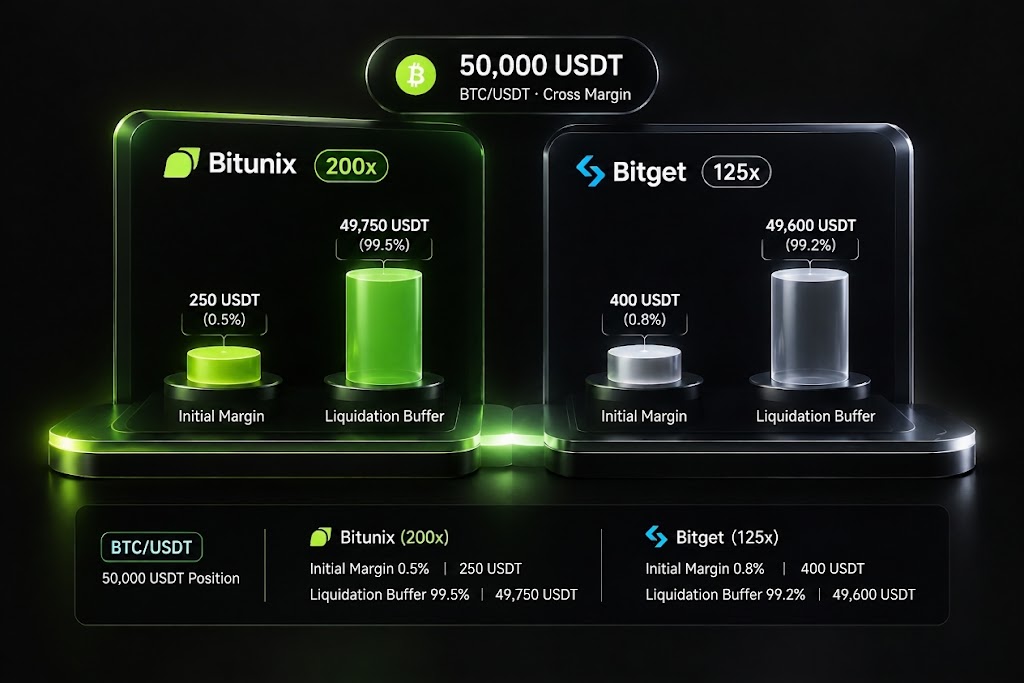
At 200x, a 50,000 USDT position needs 250 USDT of margin and moves to liquidation on a 0.5% adverse move; at 125x, it needs 400 USDT and can absorb 0.8%.
Fair Indexing and Mark Price Defense: How Liquidation Engines Prevent Flash Spikes
Both exchanges liquidate against a mark price derived from a multi-exchange index plus a funding basis, not against their own last traded price. That design is what stops a single thin order book from printing a wick that liquidates positions which were never underwater on the broader market.
On either platform, the checks worth making before sizing up are the same: which exchanges feed the index, how maintenance margin steps up with position size, whether partial liquidation runs before full liquidation, and how the insurance fund and auto-deleveraging queue are handled when a liquidation closes below bankruptcy price.
Risk Control Suites: Bitunix Fixed Risk Architecture vs Bitget Conditional Triggers
Bitunix's Fixed Risk tool inverts the usual order of operations: you enter the maximum loss you are willing to take in USDT, and the platform derives the position size from your stop level rather than the other way around. Take-profit and stop-loss levels can be set by dragging lines on the chart, each position is mapped separately on the chart rather than merged, and isolated-margin zones can be managed inside a cross-margin account so that a high-risk trade cannot draw down the main balance.
Bitget's risk controls follow the conventional model: take-profit and stop-loss orders, trailing stops, conditional triggers, and a suite of automated strategies (spot and futures grid, Martingale, CTA and auto-invest bots) that execute rules without manual intervention. Advanced execution orders such as TWAP are not offered.
The difference is philosophical. Bitunix builds the risk decision into the entry; Bitget gives you more automation after the entry. A discretionary trader who sizes every trade from a stop will prefer the former; a systematic trader running grids will prefer the latter.
Copy Trading Dissected: Weekly Net Settlement vs High-Water-Mark Settlement
Copy trading is where the two exchanges' rulebooks differ most, and where the rules decide how much of a follower's profit actually stays with the follower. Bitget runs the larger marketplace; Bitunix runs the simpler settlement calendar.
The Lead Trader Dilemma: How Profit-Sharing Models Can Reward Closing Winners and Holding Losers
The structural flaw in early copy-trading programs was settlement per closed trade. If a lead trader earns a share every time a winning position closes, the incentive is to close winners quickly and leave losing positions open, where they never trigger a settlement. The follower pays profit share on gross wins while carrying an unrealized loss that may eventually be larger than the wins.
The industry's two answers to that problem are the high-water mark (profit share only on new profit above the account's previous peak) and periodic net settlement (profit share only on the net result of a defined period). Bitget uses the first; Bitunix uses the second. Both close the loophole; they differ in timing and in how open positions are treated.
Mechanics of Bitunix Weekly Net Settlement: Real-World Follower Protection
Bitunix calculates profit share on a fixed weekly calendar. The calculation period runs from Monday 00:00 UTC to Sunday 23:59 UTC, and settlement lands at Monday 00:00 UTC. During the week, the system tracks the follower's net realized P&L across every copied position; the pending share is the greater of that net figure multiplied by the ratio, or zero. Losses realized on Tuesday offset gains realized on Thursday, so a lead trader who closes three winners and two larger losers in the same week collects nothing.
The operating rules behind that mechanism:
Default ratio: 10% of net realized profit for the period.
No share on a losing week: if net realized P&L is negative, nothing is charged.
Liquidation safeguard: if deducting the share would push an open position toward liquidation, settlement is postponed and combined with the next period.
Visibility: the estimated share is frozen and shown separately in the follower's available balance during the week.
Limits: followers can copy up to 10 lead traders at once; each strategy is capped at 100 copiers, with fixed-amount and fixed-ratio copy modes and a 0.1% slippage tolerance on copied orders.
The 100-copier cap is the quiet protective feature. It prevents a single strategy from being over-followed to the point where copied orders move the book against the followers themselves.
Trader Discovery Pools: Bitget's Massive Selection vs Bitunix's Capped Strategies
Bitget's futures copy trading applies a high-water-mark rule: profit share is charged only on P&L above the account's previous settled peak, so losses must be recovered before any new share accrues. Settlement for futures runs daily but only when the copy account holds no open positions; if positions are open, the settlement skips and the unsettled amount rolls forward. Spot copy trading settles weekly (Monday 08:00 UTC+8), and stopping a copy or an elite trader closing a portfolio triggers an immediate settlement. Ratios are set by elite-trader tier, from 10% at Bronze to 20% at Legend, with gold and indices copy trading capped at 30%.
The following table summarizes how the two models treat a follower:
Rule | Bitunix | Bitget |
Settlement basis | Net realized P&L for the calendar week | New profit above the account's high-water mark |
Settlement timing | Weekly, Monday 00:00 UTC | Daily for futures when the account is flat; weekly for spot; immediate on stop-copy |
Charge on a losing period | None | None; losses must be recovered first |
Ratio | 10% default | 10%–20% by trader tier; up to 30% on gold/indices |
Lead-trader pool | Smaller; 100 copiers per strategy | Industry's largest; 180 days of per-copier P&L history |
Open positions at settlement | Share postponed only if deduction would risk liquidation | Settlement skipped until positions are closed |
Two honest observations. Bitget's model is as protective as Bitunix's against the close-winners-hold-losers problem, and its marketplace gives a follower far more choice and far longer track records to study.
Bitunix banks on predictability. Settlements happen once a week at a fixed hour. Profit-sharing defaults to a flat 10%, and strict caps on follower counts keep order sizes small enough to fill without severe slippage. Bitget is built for users who want endless options. Bitunix is built for those who want clear math and zero surprises on their accounting calendar.

Bitunix nets all realized gains and losses within the Monday-to-Sunday window before applying the 10% share; Bitget charges only on profit above the account's previous peak.
Trading Terminals and Workflow: Bitunix PC Ultra vs Standard Workspace
The workstation is where Bitunix's derivatives-first design shows most clearly, and where Bitget's breadth shows least. Both run TradingView-powered charts; the difference is how many of them you can run at once and what the platform does with them.
Terminal Showdown: Bitunix PC Ultra 16-Screen Native Suite vs Standard Web Interfaces
Bitunix showcased its desktop terminal, PC Ultra, at TOKEN2049 Singapore in October 2026. The workstation reflects the platform's chart-first design. At its core is the Chart Trading interface, which lets users toggle between 16 distinct display layouts to match how they structure their multi-pair workflow. Each chart panel operates independently—configured with its own timeframe, price type, and indicator template—while supporting synchronized crosshairs and symbol matching.
Execution happens right on the chart. Traders can stage, adjust, and cancel orders directly on the canvas, with all drawings and templates syncing instantly across desktop, web, and mobile. To keep the workflow in a single window, PC Ultra also embeds native live streaming for market commentary.
Two native tools sit directly on top of the layout system. First is Super Alert. It folds basic price pings, technical indicators, channels, candlestick patterns, and manual drawings into a single rules engine. A trader can set an alert on a hand-drawn trendline or require two separate technical triggers to fire at once.
Then comes Super Filter. It acts as a live screener, scanning the market against selected criteria to surface viable pairs before you route them into an active chart grid. For a trader watching several timeframes across several pairs, the practical effect is replacing a paid third-party charting subscription with the exchange's own terminal.
Bitget's web terminal is a conventional single- or dual-chart workspace with TradingView charts, a unified trading account across spot, margin and futures, and a bots tab for grid, Martingale and CTA strategies. The setup is efficient if you only trade a pair or two.
Workspace adaptability is the bottleneck. Bitunix lets traders choose from 16 distinct interface layouts to match their specific workflow; Bitget keeps you inside a largely fixed screen. Anyone who needs a tailored charting workspace has to keep a third-party tool open on the side.
Mobile Execution Under Pressure: App Responsiveness, Lag During Peak Volume, and Order Confirmation
Both apps carry the full product set, including copy trading and demo trading, and both have been used through several high-volatility sessions in 2026. Bitunix's app mirrors the desktop's chart-first model: take-profit and stop-loss levels are set by dragging lines on the chart, each position maps as its own entry on the chart, and layouts carry over from PC Ultra. Bitget's app adds bots, Earn and the Stocks/TradFi tab to the trading screens.
Latency under peak load is impossible to assess from a fee page and varies by region and network. The reliable method is to run the same stop-market order on both demo accounts during a scheduled data release and compare fill times and confirmation lag; both exchanges offer demo trading for exactly this purpose.
Account Friction, KYC Mandates, and Real Withdrawal Performance
Both platforms mandate KYC before trading. Neither permits unverified accounts. The divergence is purely operational: how many data points are demanded at Level 1, and how quickly the verification engine turns an onboarding submission into an active, tradeable wallet.
Onboarding Friction: Lightweight Fast-Track Access vs Mandatory Full KYC
Bitunix's Level 1 verification takes one government-issued ID and is typically completed in about five minutes. Once approved it unlocks full spot and futures trading and a 2,000,000 USDT daily withdrawal limit. Level 2 adds proof of address and raises the limit to 5,000,000 USDT per day; larger limits are handled by ticket. Credit card purchases require verification.
Bitget ended unverified access on September 1, 2023. Passing Level 1 demands a government ID and a facial scan. Unverified profiles hit a hard stop across the board: no funding, no trading, and zero transfer capability, internal or external. Clearances are audited rather than automated.
Both platforms ultimately operate the same tiered playbook, using entry-level gates for baseline friction and escalating AML reviews for larger capital movements. Bitunix's first tier is lighter and faster, and its limits at that tier are high; Bitget's first tier is stricter and mandatory for any activity. A trader who wants to open an account during a market move and be positioned within the hour will find Bitunix's path shorter; a trader who values a fully verified counterparty base will see Bitget's mandate as a feature.
Real-World Withdrawal Timelines: Network Speed, Hot-Wallet Queuing, and Manual Review Triggers
Routine crypto withdrawals clear hot wallets near-instantly on both venues. In normal conditions, the underlying chain dictates transaction speed, not the exchange. Delays trace back to three operational friction points: base-layer congestion, cold-storage replenishment for outsized sums, and automated risk flags forcing manual compliance review. These flags trip under predictable conditions—sudden shifts in withdrawal frequency, new destination addresses added right after security profile changes, or transfer sizes that break historical account baselines.
Bitget's September 2026 exploit remains the sole documented event involving an exchange-wide withdrawal freeze. Outbound transactions halted completely for four days before a phased, asset-by-asset recovery: BTC resumed on September 28, ETH on September 29, USDT on September 30, and all remaining token markets cleared by October 2.
Bitunix has no recorded withdrawal suspension, and its Care Fund is stated to exceed the value of its hot wallets, which is the balance a user is actually withdrawing against.
Resolving Account Reviews: How Institutional Audits and Flagged Transactions Are Handled
Withdrawal holds follow an identical pipeline on both venues.
The sequence is standardized: an automated lock notice, an itemized request for supporting documents—typically source of funds or proof of address—and a compliance sign-off prior to asset release. Support availability is comparable. Bitunix runs 24/7 desks in more than 10 languages, while Bitget maintains continuous round-the-clock coverage.
Resolution speed comes down to prep work. Clearing higher verification tiers before capital moves and maintaining whitelisted withdrawal addresses are the only reliable defenses against friction, keeping legitimate large transfers from tripping automated account-takeover heuristics.
The Trade-Off Matrix: Which Trader Archetype Fits Which Exchange?
Universal recommendations do not apply.
The two platforms cater to divergent trading mechanics. Venue selection comes down to specific workflow requirements rather than generic feature tallies. The following table maps four core trader archetypes to the exchange best aligned with their flow, isolated by the primary deciding factor:
Trader profile | Better fit | Deciding factor |
Scalper / high-frequency day trader on majors | Bitunix
| 200x margin efficiency, VIP 1 at a 1,000 USDT balance, 16-chart terminal with Super Alert |
Long-tail altcoin hunter | Bitget | 800+ spot tokens, fast new-listing perpetuals, Launchpool and Earn around the holdings |
Passive copy-trading follower | Depends | Bitget for choice and long track records; Bitunix for a flat 10% ratio and one weekly settlement |
Systematic / bot trader | Bitget | Native grid, Martingale and CTA bots; TWAP still absent on both |
The Scalper and High-Frequency Day Trader: Low Latency, 200x Margins, and Terminal Capabilities
This trader pays fees dozens of times a day, sizes from a stop, and watches several timeframes at once. Bitunix's combination of a 0.05% taker rate from a 1,000 USDT balance, 200x on BTC and ETH, Fixed Risk sizing and a 16-window layout maps directly onto that workflow. Bitget's base fee is identical, but reaching its first discount requires a materially larger account or a BGB position.
The Long-Tail Altcoin Hunter: Staking Ecosystems and Spot Token Diversity (Bitget's Edge)
This trader's returns come from being early to new tokens and from yield on holdings between trades. Bitget's spot catalog is roughly 50% larger than Bitunix's, new perpetuals arrive quickly, and Launchpool, Earn and the Bitget Wallet keep idle capital working. Bitunix's narrower catalog is a real limitation here, and no fee advantage offsets a token that simply is not listed.
Both settlement models protect followers from paying on gross wins. The choice is between breadth and simplicity: Bitget's marketplace offers more lead traders with up to 180 days of copier-level P&L history, while Bitunix offers a fixed 10% ratio, a single weekly settlement at Monday 00:00 UTC, and a 100-copier cap that keeps strategies executable. A follower who intends to diversify across many lead traders will prefer Bitget; one who wants a cost that is easy to forecast will prefer Bitunix.
The Final Verdict: How to Split Your Capital Across Both Exchanges for Risk Diversification
Venue selection is a risk-hedging problem.
Bitunix is built for focused derivatives execution, unencumbered fee schedules, and heavy multi-chart layouts. Bitget is the natural hub for wide-market spot catalogs, built-in bots, and copy-trading liquidity.
Running both in parallel is the standard professional playbook. Keep active futures sizing and custom alert triggers on Bitunix; deploy automated spot accumulation on Bitget. Never store uncommitted balance on either exchange.
Counterparty risk does not scale down with exchange market share. Binance's $6.3B breach in October 2026 proved that even the industry's biggest balance sheet can suffer catastrophic credential exposure. Keeping all your eggs in one exchange basket is an unforced operational error.
Verify before sizing up. Track effective fee tiers, confirm on-chain solvency via Proof of Reserves, and inspect protection fund reserves directly. Leverage that outruns your stop-loss limit is not an advantage—it is pure portfolio hazard.
>>> See Also: Bitunix vs Bybit, Bitunix vs OKX, Bitunix vs MEXC and Bitunix vs WEEX Futures.