Bybit and Bitunix solve completely different problems. Bybit remains the heavyweight incumbent: it offers a massive, all-encompassing ecosystem for spot, Earn, and Web3. However, if you are strictly an active derivatives trader, Bitunix offers a refreshing alternative.
Rather than competing on total platform scale, Bitunix focuses entirely on the execution workflow. It differentiates itself through user-centric UI choices and dedicated contract-trading tools—like PC Ultra and Super Alert—designed to give traders better charting and reaction times without the platform clutter. Bybit is the broader crypto bank; Bitunix is the specialized trading terminal.
The rest of this Bitunix vs Bybit comparison for 2026 breaks each of those claims down with current numbers.
Executive Summary: Bitunix vs Bybit Side-by-Side Comparison
Before going product by product, it helps to see where each platform sits in the market and how the headline numbers line up.
Core Platform Roles: The Agile Challenger vs Tier-1 Industry Giant
Bybit represents the entrenched establishment: 80 million users, massive order depth, and an all-encompassing ecosystem spanning Launchpads, Earn programs, and TradFi perps. It's an undeniable powerhouse, but it behaves like a massive financial conglomerate. The interface carries a lot of operational weight, and strict onboarding friction is baked in from day one.
Bitunix (5M+ users across 150+ regions) isn't trying to out-size Bybit — it's out-maneuvering it on trader experience. Designed ground-up for contract traders, Bitunix prioritizes execution speed and screen workflow over ecosystem bloat.
You see this in the UX choices: up to 200x leverage, pre-trade controls with Fixed Risk, and native screen tools like PC Ultra, Super Filter, and Super Alert that keep traders focused on the tape rather than clicking through endless menus. While you won't find thousands of obscure spot tokens here, active perps traders get a streamlined, ultra-responsive desk built entirely around their daily habits.
Comprehensive Comparison Table: Fees, Leverage, KYC, Security, and UI
The following table summarizes the main differences between Bitunix and Bybit as of October 2026:
Dimension | Bitunix | Bybit |
Spot fees (VIP 0, maker/taker) | 0.08% / 0.10% | 0.10% / 0.10% |
Futures fees (VIP 0, maker/taker) | 0.02% / 0.06% | 0.02% / 0.055% |
Max leverage (BTC/ETH perps) | Up to 200x | Up to 100x (standard perps) |
VIP 1 entry threshold | 1,000 USDT balance or 100k USDT 30-day spot volume | Roughly $100k in assets or volume tier |
KYC to trade | Email registration; Level 1 unlocks withdrawals | Level 1 KYC mandatory before any new trade |
Proof of Reserves | Live Merkle-tree PoR, 100%+ ratios, ~$186M reserves | 36 published reports, 100%+ ratios, >$16.5B mainstream assets |
Protection fund | $50M USDC Care Fund (user asset protection) | Contract Insurance Fund pools (liquidation shortfall coverage) |
Charting terminal | Dedicated PC Ultra Workstation:
• Proprietary chart-first desktop layout built for active execution
• Native tactical tools: Chart Trading, Super Filter, Super Alert, and pre-trade Fixed Risk
• Integrated TradingView charting & market data support | Standard TradingView Integration:
• Conventional tier-1 exchange multi-panel layout
• Modular TradingView indicator suite & order books
• External broker API connectivity |
TradFi access | CFDs (forex, metals, indices, shares, commodities) in a unified account; stock perpetuals | TradFi Perpetuals plus separate MT5 CFD account (500+ instruments) |
Card | Visa, 1–8% cashback (capped 1,000 USDT/month), up to 11.6% APR on idle USDT | Mastercard, 1–10% cashback tiers; Bybit EU card offers 1% uncapped |
Copy trading profit share | Up to 10% | 10% (crypto); rank-based for TradFi |
*Note: Fee data from each platform's published schedule; PoR figures from each platform's latest disclosure. Verify live values before trading.
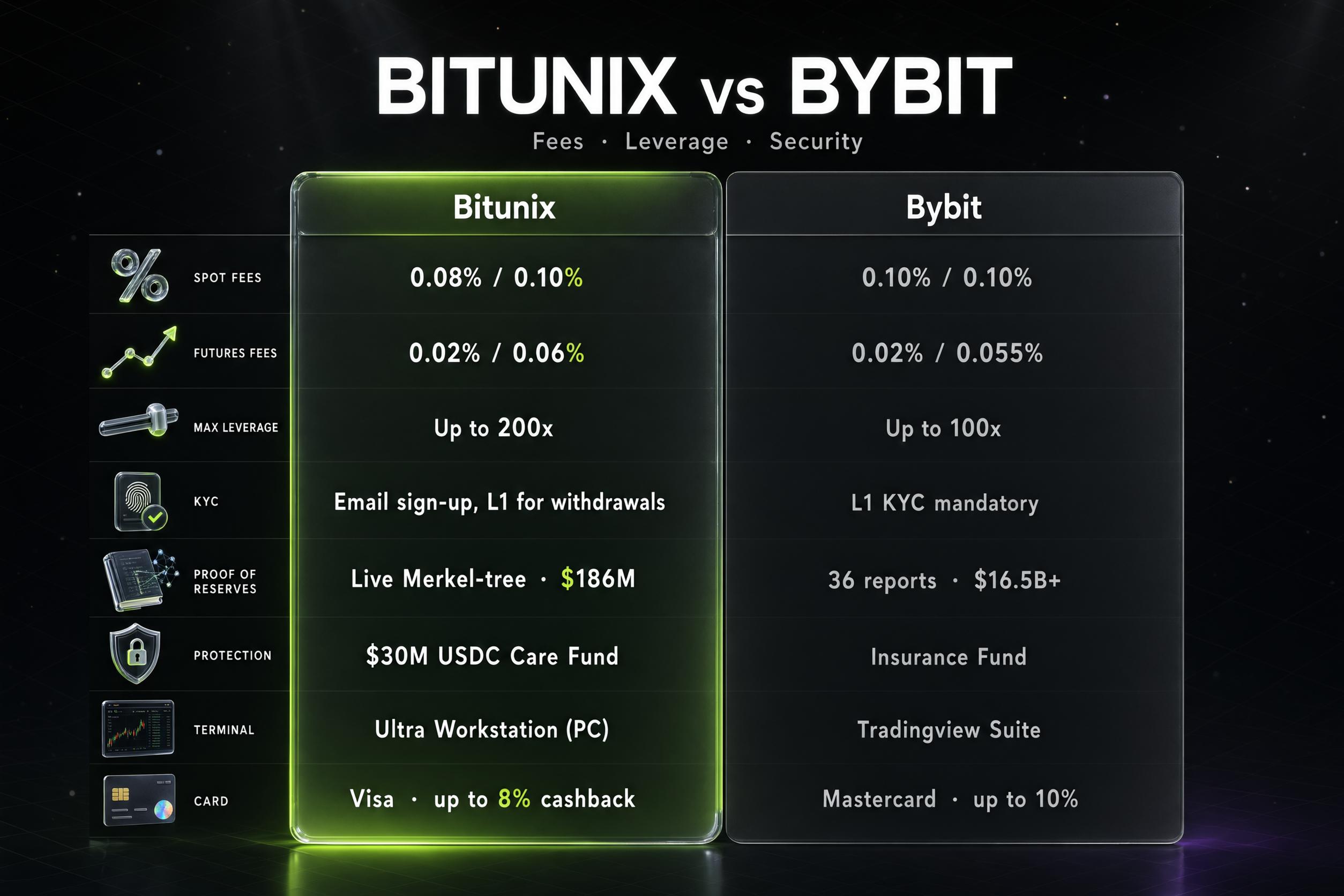
Bitunix charges 0.08% spot maker and supports 200x leverage; Bybit charges 0.10% spot maker and caps standard perps at 100x.
Quick Pros and Cons: Key Strengths and Trade-Offs
Neither platform wins every category. The strengths below are the ones that show up in day-to-day trading rather than in marketing copy.
Bitunix Strengths & Limitations: PC Ultra, 200x Leverage, and CFDs vs Smaller Spot Depth
Strengths
Sub-Market Spot Fees: VIP 0 spot maker fee sits at 0.08% (20% below the 0.10% industry baseline) with zero platform-token lockup or staking prerequisites.
The Most Accessible VIP Tier: VIP 1 unlocks with just a 1,000 USDT account balance, bypassing the typical $50,000–$100,000 institutional balance or volume hurdles.
Extreme Capital Efficiency: Offers up to 200x leverage on major perpetual contracts, built for disciplined traders who size positions strictly by calculated risk rather than posted margin.
Pro Execution Terminal (PC Ultra): A chart-first, terminal-grade interface featuring quick keyboard navigation (Esc, Space, arrow keys), Super Filter market scanners, and eight distinct Super Alert triggers — all fully free.
Built-in Execution Discipline: Features native Fixed Risk order types that calculate and lock maximum allowable dollar loss before entry, paired with interactive drag-and-drop TP/SL lines right on the chart.
Unified Crypto & TradFi Infrastructure: Seamless access to both crypto perpetuals and traditional macro CFDs within a single margin balance, backed by negative balance protection on CFD positions.
Limitations
Thinner Long-Tail Spot Depth: Order books for low-cap and long-tail altcoins are lighter than Bybit's, leading to noticeable slippage on large market orders.
Leaner Passive Yield Suite: Earn features (Easy Earn, Dual Investment) are built as simple parking spots for active trading capital, lacking Bybit's sprawling institutional structured-finance menu.
Challenger-Scale Reserve Base: While fully solvent with verified 100%+ Proof of Reserves (PoR), Bitunix's total balance sheet is modest compared to the multi-billion-dollar reserves of tier-one incumbents.
Jurisdiction-Specific CFD Access: TradFi and crypto CFD products are subject to strict regional regulatory compliance and remain unavailable in several major restricted jurisdictions.
Bybit Strengths & Limitations: Premier Liquidity and Broad Earn Products vs Mandatory KYC & Complex UI
Strengths
Tier-One Global Liquidity: Consistently ranks among the top three global derivatives exchanges by volume, delivering tight spreads and resilient order-book depth across BTC, ETH, and major alts, even during high-volatility cascade events.
Marginal Base Taker Edge: Futures taker fee sits at 0.055% at the standard VIP 0 tier—half a basis point (0.005%) lower than Bitunix's 0.060%.
Unified Margin Infrastructure (UTA): Its Unified Trading Account enables cross-margining across spot, perpetuals, dated futures, and options within a single collateral pool, maximizing portfolio capital efficiency.
Comprehensive Passive Yield & Launch Ecosystem: Operates an expansive Earn suite (flexible, fixed, and structured yield) alongside high-profile Launchpad and Launchpool allocations for direct access to new token listings.
Post-Incident Financial Resilience: Bybit maintained normal withdrawal operations following its February 2025 security breach, which resulted in approximately $1.46 billion in stolen assets. The exchange subsequently replenished its ETH reserves and continued processing user withdrawals. However, only a fraction of the stolen funds had been recovered by August 2026, making asset recovery and long-term security improvements important factors in evaluating its risk profile.
Limitations
Strict Mandatory KYC Verification: Enforces mandatory Level 1 identity verification prior to any trading or deposit activity, eliminating frictionless or light-onboarding workflows.
Higher Base Spot Maker Fee: Standard VIP 0 spot maker fee is set at 0.10%—25% higher than Bitunix's baseline 0.08%.
100x Leverage Cap on Core Perps: Standard order-book perpetuals cap leverage at 100x; accessing 200x requires utilizing separate structured instruments (such as Smart Leverage) rather than direct native trading.
High Interface Density: Designed as an all-in-one financial portal for retail, institutions, and Web3 users, making the default interface visually crowded and requiring manual customization for chart-first trading.
Regional Product Restrictions: Advanced peripheral features—including TradFi/CFD modules and the crypto debit card—remain unavailable in the European Economic Area (EEA) and other restricted jurisdictions due to local regulations.
Onboarding and Privacy: Flexible Access vs Mandatory KYC
How fast you get from signup to first trade, and what you have to disclose to get there, is where the two platforms diverge most visibly.
KYC Tiers and Verification: Light-Verification Options vs Strict Identity Verification
Bybit pulled the plug on unverified trading back in May 2023, turning KYC into a strict gatekeeper. If you don't verify, you can't touch the order books—your account is immediately locked into 'close-only' mode, meaning you can pull your funds out, but you can't open a single new position. Just to get trading, you have to clear Level 1 with a government ID and a facial scan.
Bumping your daily withdrawal ceiling past 1M USDT requires Level 2 proof of address, and clearing that pipeline can take anywhere from fifteen minutes to two full days. If you're looking to jump on a setup immediately, that upfront delay matters.
Bitunix handles its three-tier KYC model differently, and the practical difference comes entirely down to sequencing. Under KYC 0 (email registration), you can quickly spin up an account and access the platform to catch a setup without handing over your documents upfront. The compliance gatekeeper only steps in when it's time to move your money: Level 1 (ID and selfie) is strictly required to unlock withdrawals, granting a generous 500,000 USDT daily cap, while Level 2 (proof of address) pushes that limit to 5 million USDT.
In short: Bybit demands your paperwork before you place a trade; Bitunix lets you execute the trade first, reserving the friction for when you actually cash out.
On Bitunix you can register, explore the terminal, run Super Filter scans and set alerts before submitting documents, then verify when you are ready to move funds out. Actual limits display on your account page and depend on security methods enabled (email, phone, Google Authenticator), regional rules and account risk scoring.
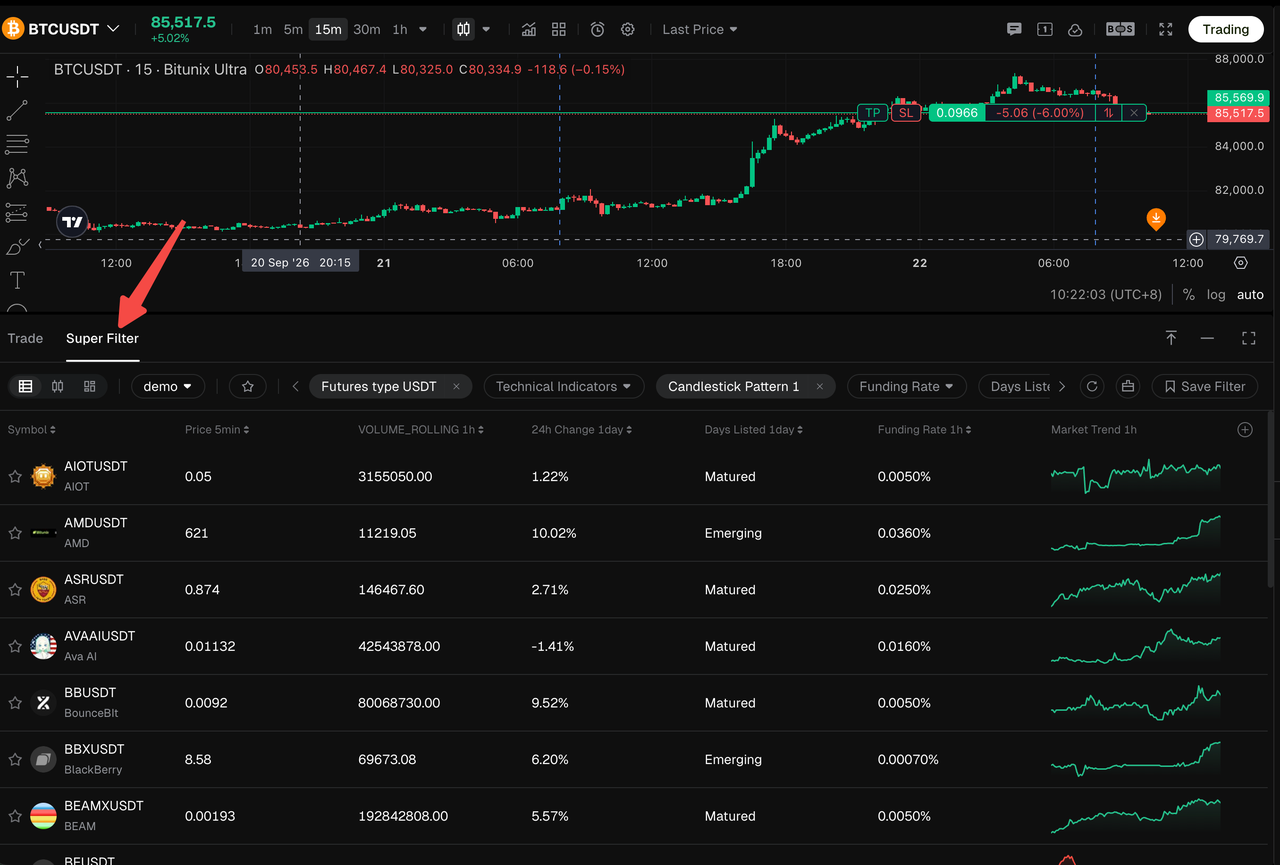
For traders in Bitunix's supported regions, this is a materially lighter path. It is not "no KYC": both platforms require identity verification before withdrawing, and both apply regional restrictions.
Account Setup Speed: Time-to-First-Trade Comparison for Global Users
Independent 2026 reviews report Bitunix Level 1 approvals in minutes via its Sumsub-powered flow. In practice, Bybit processes most Level 1 verifications near the lower end of its stated 15-minute to 48-hour window. Yet the operational friction lies in the gatekeeping sequence rather than the processing duration.
By requiring compliance clearance prior to order routing, Bybit introduces execution latency. Bitunix, by contrast, decouples initial execution from identity verification, allowing immediate market entry. For time-sensitive volatility events, this sequencing disparity far outweighs baseline turnaround times.
Security & Solvency: Proof of Reserves and Protection Funds Compared
Both platforms rely on Merkle-tree cryptography and maintain dedicated backstop pools, but they play in entirely different weight classes.
Proof of Reserves (PoR): Comparing Merkle-Tree Audits and 100% Solvency Transparency
Bybit's solvency model is all about brute balance-sheet strength. Its 36th PoR audit in mid-2026 showed over $16.5 billion in core holdings, maintaining a consistent over-collateralization cushion across the board. USDT reserves sat at 106%—backing roughly 5.55 billion in user liabilities with 5.89 billion in cold wallets—while BTC and ETH consistently hovered above full backing (105% and 101%, respectively). It's the kind of fortress balance sheet built to reassure institutions that the floor isn't falling out during a liquidity crunch.
Bitunix runs a live Proof of Reserves tracker using a Merkle root hash system, letting users confirm their balances are included in the snapshot directly on the site. The platform reported 500 BTC in public reserves and total reserve assets above $186 million in 2026, with ratios above 100% across major assets. Reserve data is also mirrored on CoinMarketCap, CoinGecko and DefiLlama.
The honest reading: both exceed 1:1 backing on tracked assets. Bybit's base is far larger because its user base is far larger. What matters for an individual trader is whether the ratio holds above 100% and whether you can verify your own balance in the tree. Both pass that test.
Emergency Safeguards: Bitunix $50M Care Fund vs Bybit Contract Insurance Fund
These two funds are often compared as if they were equivalent. They are not.
Bybit's Insurance Fund is built around one critical objective: eating liquidation shortfalls during sudden flash crashes so profitable traders don't get hit with auto-deleveraging (ADL). In December 2025, Bybit gave this system a major structural overhaul, ditching the single general pool for specialized risk silos. By creating a ring-fenced New Listing pool to absorb volatility during a perp's first 30 days, alongside a dedicated Portfolio pool for correlated contracts, the exchange boosted per-contract coverage by over 200%—drastically reducing the risk of premature clawbacks on winning positions.
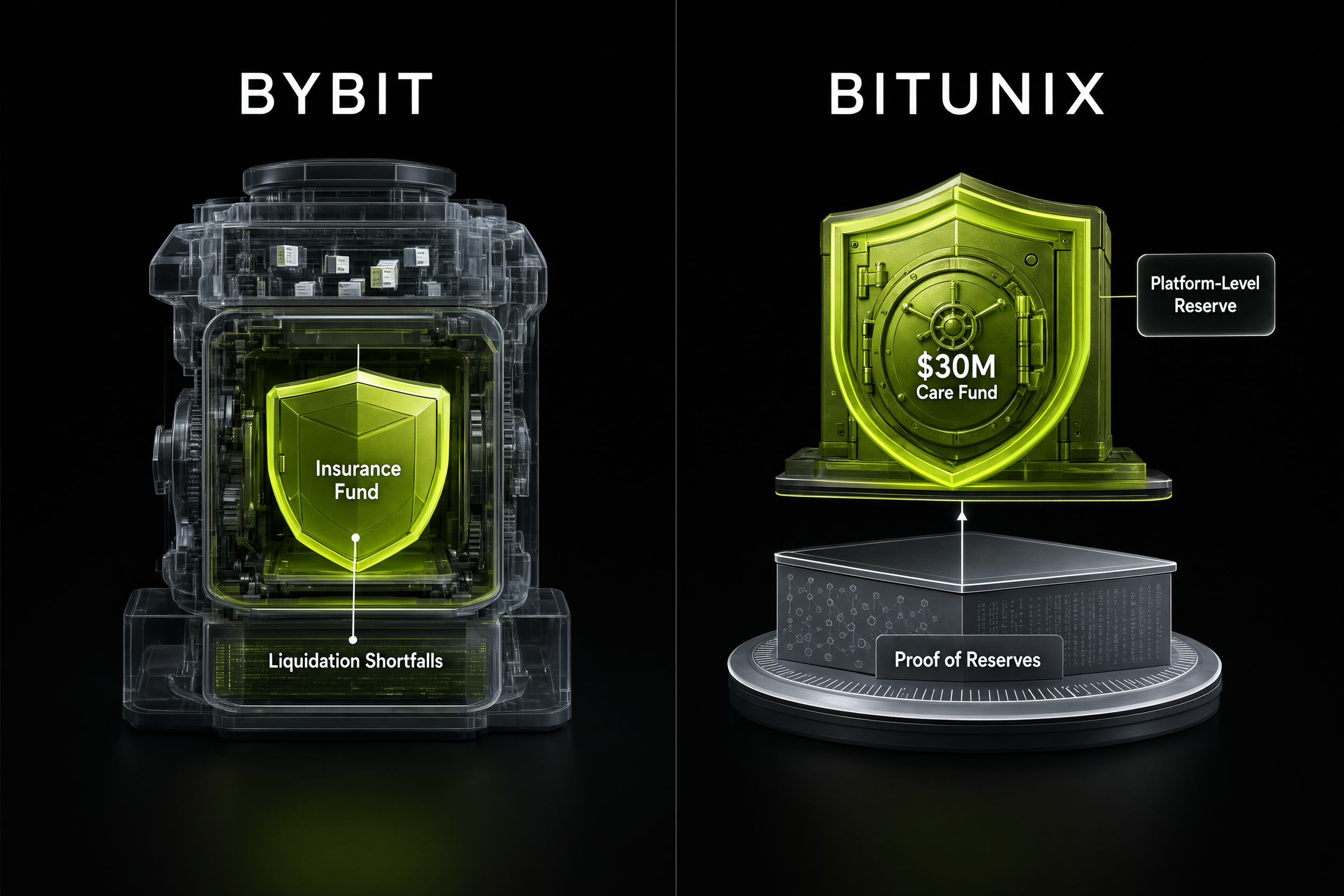
Bybit's Insurance Fund covers liquidation shortfalls; Bitunix's $50M Care Fund is a platform-level reserve on top of Proof of Reserves.
Bitunix's Care Fund is a $50 million USDC reserve held to protect user assets during extreme events such as liquidity shocks or operational incidents. It sits on top of PoR rather than inside the liquidation engine. Bitunix also runs a standard futures insurance mechanism for liquidation shortfalls, so the Care Fund is an additional layer, not a substitute.
If you trade high leverage on new listings, Bybit's pool design is directly relevant to your ADL risk. If you hold larger balances on-platform, Bitunix's Care Fund addresses a different failure mode: platform-level stress rather than position-level stress.
Custody Standards: Cold Storage Architecture, Multi-Signature Protection, and Account 2FA
Cold-storage multi-sig is standard across both desks, but the regulatory wrappers differ. Bitunix partners with institutional custodians (Fireblocks, Cobo), backs its stack with ISO/IEC 27001 compliance, and maintains multi-jurisdictional MSBs (US FinCEN, Canada, AUSTRAC).
Bybit carries the heavier institutional weight, operating under Dubai's VARA framework and EU MiCAR authorization.
For user defenses, standard 2FA and withdrawal whitelists apply to both. Bitunix adds automated KYT address filtering on withdrawals to catch tainted counterparty wallets, plus localized biometric palm-scanning.
Bybit's February 2025 Security Breach: Financial Recovery and Security Accountability
On February 21, 2025, Bybit suffered a major security breach that resulted in approximately $1.46 billion in stolen cryptocurrency. The FBI attributed the attack to North Korea-linked cyber actors known as TraderTraitor. The incident exposed vulnerabilities involving third-party wallet infrastructure and transaction-signing processes, highlighting the risks that can arise even when an exchange maintains substantial reserves and security controls.
Bybit subsequently maintained normal withdrawal operations and continued meeting customer withdrawal requests. In an October 2026 interview, CEO Ben Zhou said the exchange had covered the financial losses from the attack through operating revenue, including trading fees, by the end of 2025. This represents financial loss coverage by the business, not the recovery of the stolen cryptocurrency itself.
Separately, Bybit reported on August 7, 2026, that approximately $48.4 million in stolen assets had been recovered and more than $30.5 million frozen across over 28 exchanges and custodians. Frozen assets should not be counted as recovered funds, as their return remains subject to further legal and investigative action. Bybit also announced legal action against North Korea, its Reconnaissance General Bureau, the Lazarus Group, and other parties allegedly involved in moving the stolen assets.
More recently, on October 30, 2026, Zhou stated that Bybit had not been affected by the security incidents circulating on social media at the time, and that its trading and withdrawal services were operating normally. While these developments demonstrate the exchange's financial and operational response, the 2025 breach remains an important consideration when evaluating its custody architecture, third-party infrastructure exposure, and security controls.
Fee Breakdown: Spot and Perpetual Futures Costs (Bitunix vs Bybit)
Bitunix vs Bybit fees come down to a split decision: Bitunix takes spot trading costs, Bybit edges baseline futures takers, but Bitunix makes tier progression far more accessible for active, sub-institutional balance sheets.
Spot Trading Fees: Base Maker/Taker Rates and VIP Progression
The following table compares entry-level spot fees and the first VIP step on each platform:
Tier | Bitunix (Maker / Taker) | Bybit (Maker / Taker) | Key Takeaway |
VIP 0 (Base / Retail) | 0.0800% / 0.1000% | 0.1000% / 0.1000% | Bitunix saves 20% on maker fees with zero platform-token lockups. |
VIP 1 (First Step) | 0.0700% / 0.0900% (Requires 1,000 USDT balance) | 0.0675% / 0.0800% (Requires $100,000 balance or $1M spot volume) | Bitunix is 100x more accessible; Bybit offers marginally lower rates once unlocked. |
Top Tier | 0.0048% / 0.0180% (VIP 8) | 0.0050% / 0.0150% (Pro 6; monthly volume >= $1B) | Maker rates converge around ~0.005%; Bybit holds a slight edge on institutional taker fees. |
Run the numbers on a $50,000 monthly spot volume, half maker and half taker. On Bitunix at VIP 0, that costs $45; on Bybit, it costs $50. Qualify for Bitunix VIP 1 with just a 1,000 USDT balance, and it drops to $40. The 20% base maker discount is unconditional: no native token to hold, no specific fee-payment currency.
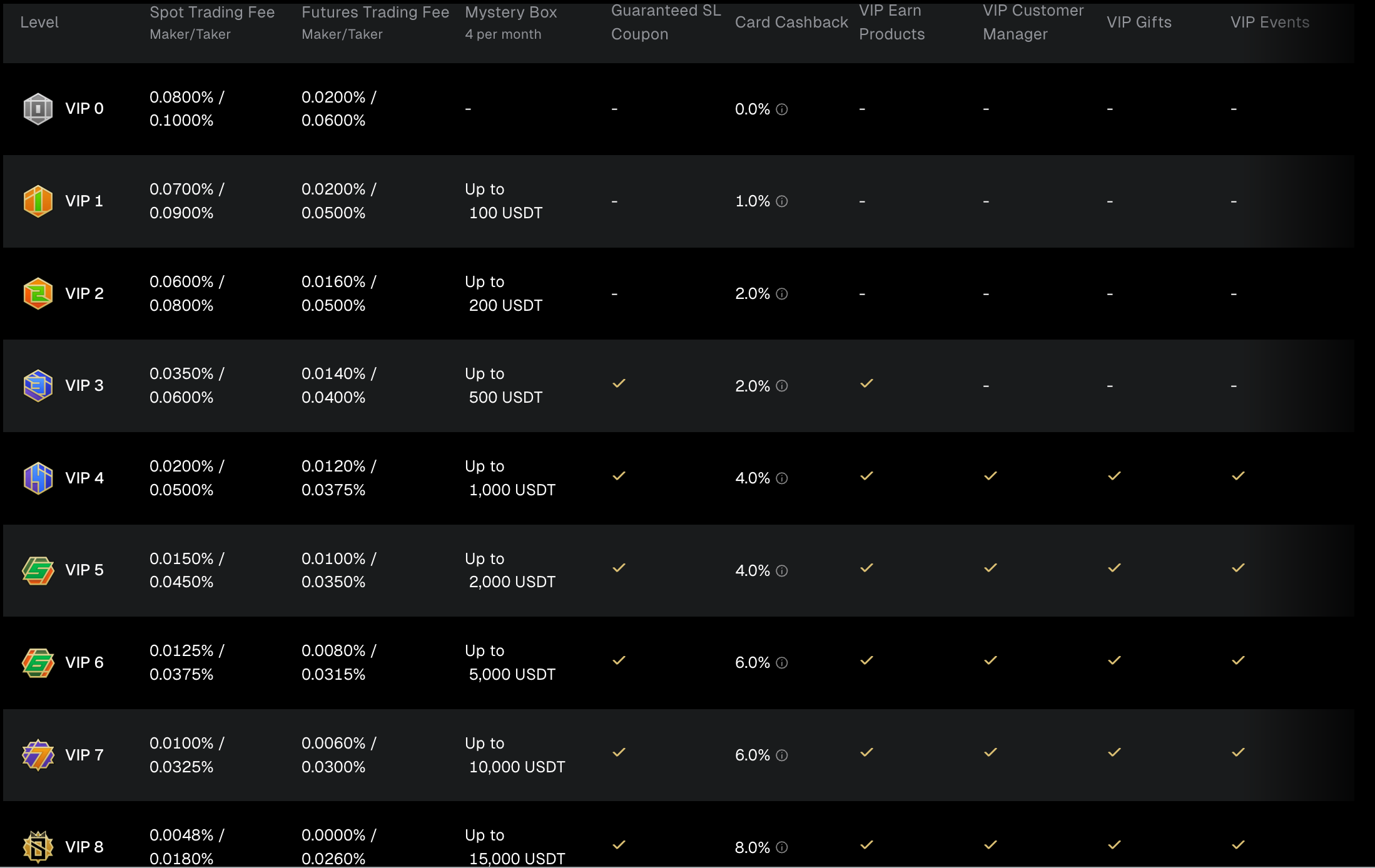
Chart of Bitunix VIP fees and benefits, listing trading fee discounts, up to 15,000 USDT mystery boxes, and exclusive earn products across different VIP tiers.
Bybit's base spot rates are standard, and its discounts arrive only with massive scale. Bitunix VIP 1 requires just 1,000 USDT in balance or 100,000 USDT in 30-day spot volume; the equivalent Bybit tier demands roughly $100,000 in assets or $1,000,000 in volume.
Perpetual Contract Costs: Funding Rate Mechanics and Futures Taker Benchmarks
Both platforms charge 0.02% maker on USDT perpetuals at base tier. Taker is 0.055% on Bybit and 0.06% on Bitunix, a half-basis-point gap. On a $100,000 taker entry that is $55 versus $60.
Funding mechanics are identical in structure: eight-hour settlement, rate derived from the premium index, paid between longs and shorts. Bybit's deeper books tend to keep funding on majors closer to neutral during calm periods; on smaller caps, funding on both venues is driven by positioning rather than venue.
The VIP ladder changes the picture for active traders. Bitunix VIP 1 cuts futures taker to 0.05%, matching or beating Bybit's base. Bitunix VIP 7 reaches 0.006% / 0.03%; VIP 8 reaches 0.00% maker.
Deposit and Withdrawal Charges: On-Chain Processing Fees Compared
Neither platform charges a deposit fee for crypto. Withdrawal fees on both are network-based and vary by chain. Bitunix supports SEPA deposits, card purchases, P2P and third-party on-ramps; Bybit has a broader fiat footprint, including bank rails through its EU entity and an extensive P2P market. For most traders, the cost difference on transfers is negligible compared with the fee difference on trades.
Charting & Terminal UX: Bitunix PC Ultra vs Bybit Trading Interface
This is the category where the two platforms are least alike, and where the choice depends on how you trade rather than how much.
The PC Ultra Advantage: Native Multi-Chart and Streamer-Ready Workspaces
Bitunix strips away interface clutter with PC Ultra, an environment engineered for technical screen-traders. Instead of crowding the screen with data tables, K-lines take center stage. Secondary modules hide inside on-demand drawers, driven by intuitive hotkeys: Esc for clean full-screen charting, Space to toggle order inputs, and arrows to cycle through active positions. Multi-chart split screens and the Super Filter K-line matrix let you monitor cross-asset momentum effortlessly.
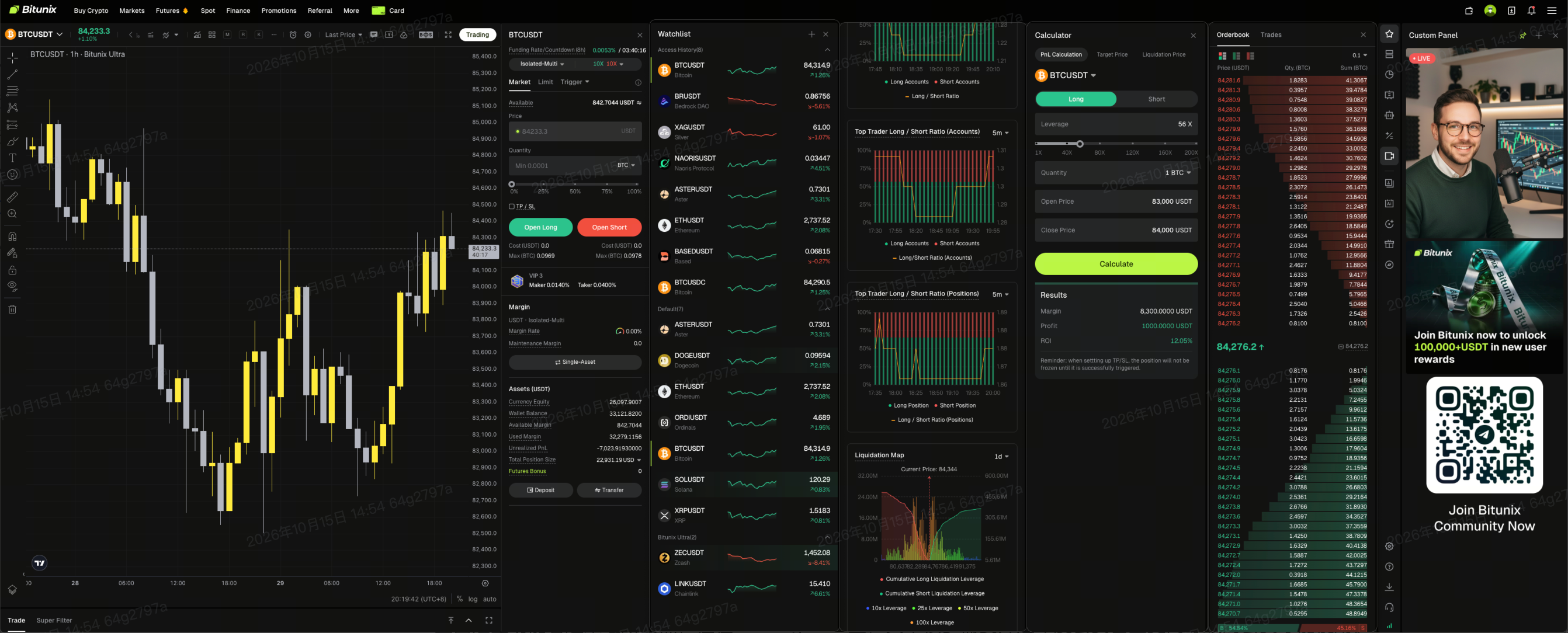
Bitunix PC Ultra interface with live BTC charts, order book, and an integrated streamer Custom Panel.
For creators, Bitunix integrates a dedicated broadcast panel: one live camera feed plus two media cards pinned beside the candles, saved directly to your account. It eliminates cumbersome OBS overlays, guarantees your camera never blocks a breakout candle, and preserves your margin settings and active orders across layout swaps.
Bybit sticks to the traditional tier-1 blueprint. Everything is displayed at once—books, tape, depth, and order forms packed into a single multi-panel grid. It's powerful for multi-tasking across a multi-monitor rig, but rigid for chart-focused execution or live broadcasting, lacking any built-in tools for webcam integration or stream branding.
Visual Order Execution: Bitunix Drag-and-Drop TP/SL vs Bybit Traditional Order Forms
Bitunix Chart Trading places orders from the chart itself: type a quantity and a grey preview appears before you choose direction; drag the take-profit line above price and the system reads it as a long. Market, limit and trigger orders support preview, with right-click and plus-icon menus for direct chart execution. Linked partial TP/SL and the Fixed Risk order (set maximum loss in USDT, and position size is derived from the stop distance) extend this into risk management.
Bybit supports TP/SL on the chart and has a solid order form with conditional, TWAP and iceberg types, but the primary workflow remains form-driven. Traders who think in price levels rather than quantities will find Bitunix's approach closer to how they already plan trades.
Market Discovery: Bitunix Super Filter Candlestick Scans vs Bybit Chart Widgets
Bitunix builds market discovery natively into the desk with Super Filter. Instead of outsourcing surveillance to outside platforms, it scans all perpetual pairs against combinable conditions: 5–200 period MAs, RSI, MACD, ADX, 19 candlestick setups, plus live funding-rate bias and turnover rank. Matches display flexibly as a table, a heatmap, or a tiled K-line grid—keeping your entire scanning-to-charting workflow inside a single view. Clicking any ticker immediately pulls up its chart without triggering an accidental order, and custom filter presets sync straight to your PC Ultra watchlist. It is completely free across all accounts.
Super Alert handles the execution monitoring with eight alert types: Price, Indicator, Drawing, Candlestick, Combo, Template, on-chain movements, and TradingView webhooks. The most practical for technical traders are Drawing Alerts—which follow the slope of an angled trendline rather than just a flat price level—and Combo Alerts, which only fire when multiple conditions align at once. Alerts route directly to the web terminal, mobile app, email, Telegram, or Discord.
Bybit provides reliable baseline charting and standard price alerts, but running synchronized multi-chart grids or complex indicator screening usually requires traders to pay for an external TradingView subscription. Bitunix’s practical advantage is simple: it bakes that screening and multi-chart stack directly into the platform at no extra cost.
Derivatives & Margins: 200x Capital Efficiency vs Deep Liquidity
Leverage caps and order-book depth are two sides of the same question: how much exposure can you take, and what does it cost to enter and exit it.
Maximum Leverage Limits: Bitunix 200x Margining vs Bybit 100x Caps
Bitunix supports up to 200x leverage natively on core perpetual contracts. Bybit caps standard USDT perpetuals at 100x for BTC and ETH—scaling down quickly on altcoins—and isolates 200x into a separate, structured "Smart Leverage" product rather than offering it directly on vanilla order books.
While 200x sounds like pure gambling to newcomers, disciplined traders treat high leverage as a tool to put up less money as collateral.
Think of margin like a rental deposit: to control a $10,000 Bitcoin position at 100x leverage, you have to lock up $100 on the exchange. At 200x, that deposit drops to just $50. You capture the exact same price action, but half your capital never leaves your personal custody. If an exchange ever runs into a systemic crisis or liquidity freeze, your counterparty exposure is strictly capped at that $50 deposit.
The unavoidable tradeoff is liquidation distance: at 200x, the liquidation price sits razor-close to your entry, leaving almost zero tolerance for adverse price wicks. Crucially, neither venue lets traders run maximum leverage on massive position sizes—both Bitunix and Bybit enforce tiered maintenance margin schedules that automatically step leverage down as position notionals scale up. But for nimble traders running tight invalidations or tactical hedges, Bitunix provides the flexibility to tie up significantly less capital upfront.
Order Book Depth and Slippage Handling in Extreme Market Volatility
Bybit's liquidity moat is impossible to overlook. Sitting comfortably as the industry's second-largest exchange by volume, its BTC and ETH books absorb massive market orders with virtually zero slippage. That raw depth is backed up at the clearing level: the December 2025 insurance fund overhaul was engineered specifically to curb auto-deleveraging (ADL) during violent market cascades, directly addressing the systemic stress tests seen during the October 2025 liquidation crunch.
Bitunix ranks highly on Coinglass and CoinGecko derivatives tables and publishes tight spreads on majors, but on mid- and small-cap pairs its depth is thinner than Bybit's. A trader moving six-figure size through altcoin perps will see the difference. A trader moving five-figure size through BTC, ETH, SOL and the top-50 will not.
Where Bitunix compensates is in execution tooling: Fixed Risk, guaranteed stop-loss coupons, trailing stops, scaled orders and multi-asset isolated margin are all built into the same terminal.
TradFi Ecosystem & Cards: Bitunix CFDs and Card vs Bybit Services
Both platforms now reach beyond crypto. The difference is in how the TradFi layer is structured and where the card programs operate.
Bridging TradFi and Crypto: Bitunix Unified CFDs vs Bybit's Split TradFi Model
Bitunix TradFi Solves a major headache for crypto traders: you don't need to open a complicated traditional brokerage account just to trade stocks or forex. Using the exact same USD balance from your crypto wallet, you can trade major forex pairs (like EUR/USD), Gold, Silver, the S&P 500, and massive blue-chips like Apple or Tesla right on the Bitunix platform.
The rules are simple. Leverage is preset (for example, 100x leverage means you only need 1% margin to enter a trade). You can hedge by going long and short at the same time, and since it follows traditional markets, these specific trades sleep on the weekends. If a trade goes terribly wrong, 'negative balance protection' guarantees you’ll never owe the platform money—your balance just stops at zero. Best of all, right now there are zero trading commissions; you only pay the tiny spread between the buy and sell price. And if you absolutely must trade stocks on a Saturday, Bitunix offers special 'stock perpetuals' that stay open 24/7.
Bybit runs two products. TradFi Perpetuals cover US stocks, gold, silver and crude oil on the standard perpetual engine (24/7, funding rates, up to 20x on stock perps). The former "TradFi" product, renamed CFD in July 2026, runs on a dedicated MT5 CFD Account separate from the Unified Trading Account, with 500+ instruments and leverage up to 500x on forex. It is powered by Infra Capital (Mauritius FSC) and is not available in the EEA.
The practical difference: Bitunix keeps TradFi in one account with one margin view; Bybit offers more instruments but splits them across two accounts and two margin systems.
Crypto Off-Ramp Utility: Bitunix Card vs Bybit Card Limits and Cashback
The following table compares the two card programs on the terms that affect everyday spending:
Feature | Bitunix Card | Bybit Card |
Network | Visa (130M+ merchants) | Mastercard |
Cashback | 1–8% by VIP tier or monthly spend, capped 1,000 USDT/month | 1–10% by tier (global); 1% uncapped on Bybit EU card |
Yield on balance | Up to 11.6% APR on idle USDT, no lock-up | Not a core feature |
Issuance / annual fees | None; 100 USDT activation balance (remains yours) | Virtual free; physical ~$5 |
Wallets | Apple Pay, Google Pay, GrabPay, LINE Pay, Alipay, WeChat Pay | Google Pay, Apple Pay (region-dependent) |
Regional note | Cashback excluded for EEA/UK merchants | EEA served via Bybit EU; unavailable in several regions |
Bitunix pairs cashback with yield on the resting balance, which Bybit does not match. Bybit's top tier pays higher cashback for VIP users and its EU program has no monthly cap. Both require KYC and charge standard FX markups on non-USD transactions.
>>> Related Reading: 7 Advantages of Getting a Bitunix Card
Copy Trading Systems: Profit-Sharing Ratios and Master Trader Selection
Both platforms cap crypto copy-trading profit cuts at 10% of follower net profit, but how they actually handle settlements and risk on the ground is noticeably different:
1. How Profit Share Is Settled
Bybit: Uses a High-Water Mark rule on TradFi copy trading. Lead traders must crawl out of past drawdowns before they can collect profit share on new wins.
Bitunix: Settles on a strict weekly net-profit cycle. This protects followers from a common trick where lead traders quickly scalp winning trades to skim profit shares while letting massive drawdowns sit open in floating loss. If your net week is red, nobody gets paid.
2. Follower-Side Risk Controls
Bybit: Lean heavily toward hands-off execution where you're along for the lead trader's ride.
Bitunix: Gives followers practical overrides. You can set personal stop-loss and take-profit limits on copied positions—if the leader goes on tilt and refuses to cut, your position still exits at your preset number. There is also a slippage cap that kills orders rather than letting you absorb horrible fills in choppy tape.
3. Navigating the Trader Pool
Bybit: Offers a much deeper roster, but the legwork is on you. Sifting through 99%-win-rate accounts that are secretly blowing up on martingale strategies takes real effort.
Bitunix: A visibly smaller pool with fewer niche styles, but it takes far less time to audit a trader's real track record and drawdown history.
Copy trading only automates execution. Neither exchange removes leverage risk, and bad trades will still liquidate accounts.
Bybit vs Bitunix: Which Platform Fits Your Trading Needs?
Don't look at this as an either/or choice. Bybit is an institutional liquidity clearinghouse; Bitunix is a focused, screen-trader workstation. They solve two fundamentally different problems.
When to Trade on Bitunix
If your daily focus is execution speed, clean charting, and multi-asset exposure, Bitunix is the more practical setup:
Clean spot rates without token exposure: You get a flat 0.08% maker fee on day one. You don't have to buy, stake, or hold an exchange token just to dodge high trading fees.
Capital-efficient margins on perps: 200x leverage isn't about reckless gambles—it cuts your required margin in half compared to 100x. On tight hedges or short-term scalps, that keeps the bulk of your capital safe in your own cold storage instead of sitting exposed on the platform.
Work off the charts and drop the TradingView bill: PC Ultra turns the chart into your execution terminal—complete with drag-and-drop orders and upfront Fixed Risk controls. Combined with built-in Super Filter scanning and Super Alert trendline triggers, you don't need a paid TradingView plan to monitor setups.
Stream without the OBS headache: A native dock embeds your webcam and promo cards right beside the chart. It eliminates clunky OBS browser layers and guarantees your camera never covers price action.
Trade forex, gold, and US equities from one wallet: TradFi gives you zero-commission, spread-only CFDs settled in USD, plus 24/7 stock perpetuals for weekend trading—no separate offshore brokerage needed.
Execute first, handle paperwork later: KYC 0 lets you jump into an active trade immediately. Compliance steps in at the exit (Level 1 ID check unlocks withdrawals), meaning you aren't stuck waiting for document approvals when a setup is moving.
When to Stick with Bybit
If your edge relies on deep liquidity, unified portfolio margin, and passive yield, Bybit remains the industry standard:
Minimal slippage on altcoin size: As the global number two by volume, Bybit’s order books absorb large clips across mid- and small-cap perps with very little price impact.
Unified cross-margin engine (UTA): If you run complex books combining spot, linear perps, inverse contracts, and crypto options under a single collateral pool, Bybit’s Unified Trading Account is best-in-class.
Ecosystem yield and Launchpads: If a meaningful chunk of your returns comes from Earn vaults, Launchpools, or structured savings products, Bitunix cannot match Bybit's catalog.
Large-Scale Reserves and Established Risk Infrastructure: Bybit publishes regular Proof of Reserves reports, maintains a substantial reserve base, and operates a dedicated insurance fund to manage liquidation shortfalls. Its response to the February 2025 security breach also demonstrated its ability to maintain customer asset coverage, although the incident highlighted risks associated with third-party wallet infrastructure and asset custody.
Upfront compliance gate: Keep in mind that Bybit enforces strict, mandatory KYC from the jump. You must clear Level 1 verification before placing your first trade.
Bitunix vs Bybit: At-a-Glance Comparison
The table below maps common trader profiles to the platform with the clearer advantage:
Trader profile | Better fit | Why |
Spot-heavy, mid-sized account | Bitunix | 0.08% maker, VIP 1 at 1,000 USDT |
Futures taker, large altcoin size | Bybit | 0.055% taker, deepest books |
Hedged book, capital-constrained | Bitunix | 200x margining, Fixed Risk |
Yield and new-listing access | Bybit | Earn, Launchpad, Launchpool |
Chart-first or streaming workflow | Bitunix | PC Ultra, Super Filter, custom panel |
Crypto + TradFi in one margin view | Bitunix | Unified CFD account |
Maximum TradFi instrument range | Bybit | 500+ CFD instruments via MT5 |
Everyday crypto spending with yield | Bitunix | Card cashback plus 11.6% APR |
For many active operators, the pragmatic answer is running both: use Bybit as the deep-liquidity balance sheet for large swings, long-term holds, and staking, while using Bitunix as the agile daily terminal for screen-time charting, tactical hedging, and commission-free TradFi access.
*Special Notice: The CFD feature is currently available only to users in selected countries and regions. In the future, Bitunix will gradually expand the availability of this feature to more countries and regions based on business development needs and local regulatory requirements, providing trading services to more users.