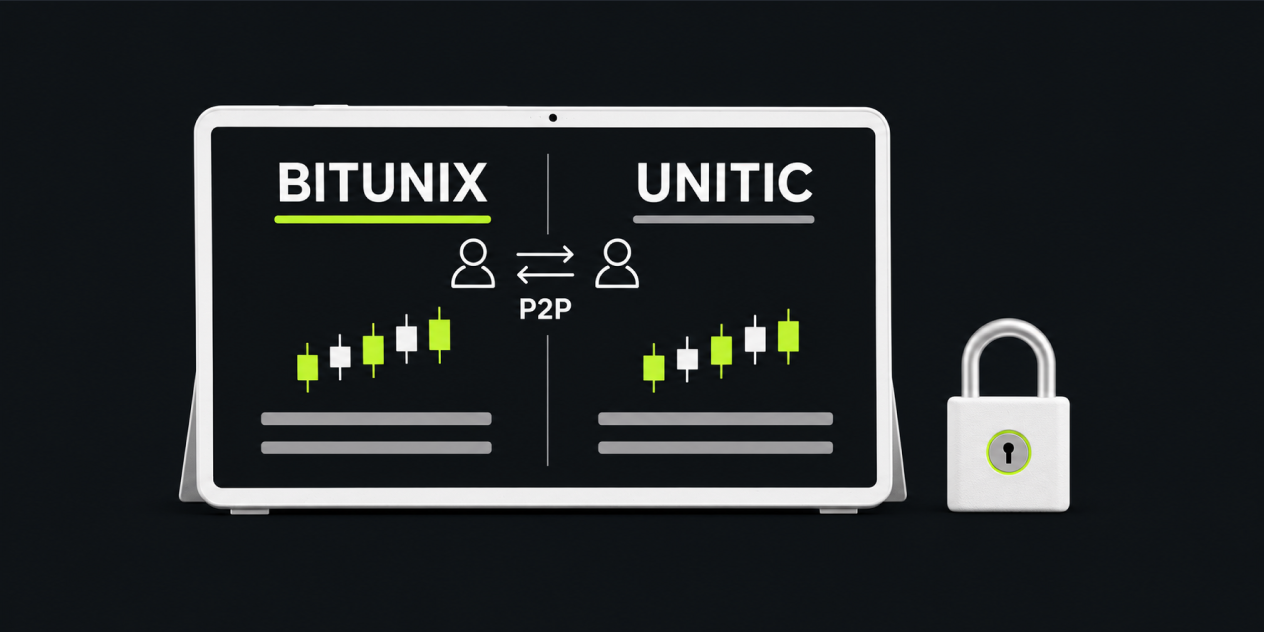
If you are new to crypto, picking an exchange can feel like comparing two apps that look the same. Bitunix and Unitic both offer spot and Futures trading from one account, but they are built differently. Unitic is a smaller exchange that puts spot, Futures, Earn, trading signals and a USDT OTC desk in one app. Bitunix launched in 2021 as a derivatives exchange with a P2P market that charges no platform fee.
This article breaks down Bitunix vs Unitic across P2P, trading fees, leverage, tools and safety, so you can see which one fits the way you trade. It is also a quick Bitunix review for anyone comparing the best crypto exchanges.
Bitunix vs Unitic at a Glance: Key Differences in One Table
Bitunix vs Unitic - Detailed comparison for Traders
Bitunix is a stronger option for traders seeking zero-fee P2P liquidity, granular Futures charting tools, and publicly verifiable reserve ratios. Unitic appeals to users looking for an integrated OTC desk, staking products, and built-in market signals in one interface.
Category | Bitunix | Unitic |
P2P | P2P market, no platform fee, escrow, Appeal button | USDT OTC desk |
Spot fees (base maker / taker) | 0.08% / 0.10% | 0.1% to 0.6% |
Futures fees (base maker / taker) | 0.02% / 0.06% | - |
Max leverage | Up to 200x on select pairs | Up to 125x, USDT-M perpetuals |
Chart tools | Ultra Chart Trading, Super Alert | Real-time charts, advanced orders, TradeIQ signals |
Earn | Earn products | Flexible staking and savings |
Proof of Reserves | BTC 156%, ETH 108%, USDT 105% | - |
Protection fund | Bitunix Care Fund, 50M USDC at launch | - |
Bitunix vs Unitic P2P: Which Platform Is Best for P2P Trading?
Bitunix offers a structured P2P marketplace with zero platform fees, automated escrow, and a formal dispute appeal process. Unitic’s homepage directs users to a USDT OTC desk instead, which operates on a bilateral quote model rather than an open peer-to-peer order book.
In a P2P marketplace, you transact directly with verified counterparties rather than the exchange itself:
Select an offer: A merchant posts an advertisement specifying exchange rates, order limits, and accepts local payment methods.
Escrow lock: Once you place an order, Bitunix locks the seller's crypto in escrow to prevent unauthorized withdrawal during settlement.
Fiat transfer: You send fiat payment directly to the seller off-platform (such as via bank transfer).
Release: Upon confirming receipt of funds, the seller releases the escrowed crypto to your account. If a discrepancy occurs, you can trigger an appeal for customer support intervention.
An over-the-counter (OTC) desk functions differently: you request a quote directly from the exchange desk for larger block orders, agree on the rate and settlement terms privately, and execute the trade against the desk rather than individual users.
>>> To see the Bitunix side step by step, read our P2P Trading Guide, the P2P Bitcoin buying guide or open the Bitunix P2P market. Our earlier Bitunix vs Unitic comparison guide gives a shorter overview.
Supported Currencies and Payment Methods
Bitunix P2P supports 76 fiat currencies alongside a wide range of regional payment rails.
P2P basics | Bitunix | Unitic |
Product | Peer-to-peer (P2P) marketplace | USDT OTC desk |
Fiat currencies | 76 fiat currencies (fee rules explicitly reference RUB, UAH, KZT, IDR, and BDT) | Check inside the Unitic app |
Crypto you can trade | USDT | USDT on the OTC desk |
Payment methods | Local bank transfers and e-wallets (varies by region and currency) | Check inside the Unitic app |
Account verification | Mandatory KYC; payment account name must match verified identity | KYC (Check inside the Unitic app) |
Before placing an order on Bitunix P2P, ensure your bank or e-wallet account matches your verified KYC name. Bitunix prohibits third-party payments; sending or receiving funds via an unverified third-party account can trigger a P2P suspension of at least 15 days, with the sender assuming liability for any resulting loss. Standard bank transfer fees imposed by your financial institution may still apply on either platform.
P2P Fees, Limits and Dispute Handling
Platform Fees: Bitunix P2P charges zero platform fees to either buyers or sellers, though external bank or payment gateway charges may apply. Unitic does not publish fixed OTC fees on its homepage, so confirm the net settlement amount in writing with the desk before transferring funds.
For the full wording, read the Bitunix P2P FAQ and the P2P service policy.
Unitic's homepage does not quote OTC fees. Ask the desk for the final amount you receive, in writing, before you send funds.
Order Limits: On Bitunix, individual merchants define their own minimum and maximum trade limits per listing. On Unitic’s OTC desk, minimum order thresholds are set by the desk upon inquiry.
Release Windows & Security Holds: Bitunix sellers must release escrowed crypto within 15 minutes of payment confirmation. Newly purchased P2P assets are subject to a 24-hour (T+1) security hold, during which withdrawals, internal transfers, and P2P sales are temporarily restricted.
Disputes: If an issue arises on Bitunix, communicate first via the in-order chat; if unresolved, click Appeal and upload payment proof for support adjudication. Recovery is not guaranteed if protocol steps are bypassed. Unitic advertises a Help Center and 24/7 support, though traders should clarify OTC dispute procedures prior to transacting.
Always retain screenshots of order chats and bank receipts, and never settle trades outside the official platform. Bitunix strictly prohibits off-platform settlements, marking an order as paid prematurely, and operating multiple accounts. Similarly, Unitic warns that staff will never contact users via phone, text, or email to request sensitive credentials.
Trading Features: Spot, Futures, Fees and Tools Compared
Bitunix publishes a complete multi-tier fee schedule, whereas Unitic does not display a public fee table on its homepage. On centralized order books, maker orders add liquidity (such as resting limit orders) and typically incur lower fees than taker orders, which remove liquidity immediately (such as market orders).
Spot and Futures Markets
Bitunix focuses on derivatives. Unitic mixes spot, Futures, Earn and signals.
While spot trading involves buying and selling the underlying digital asset directly, Futures contracts track asset prices using leverage—allowing traders to control position sizes larger than their posted margin.
Bitunix Futures has these contract groups:
USDT-M perpetuals: The main market, with leverage up to 200x on select pairs.
USDC-M perpetuals: Launched in December 2025. You can use USDC as margin.
TradFi contracts: gold, silver, oil and US stock perpetuals in the same account. See gold (XAUUSDT) or our guide to trading Intel with INTCUSDT.
Unitic provides spot trading alongside USDT-M perpetual Futures capped at 125x leverage, supplemented by flexible staking/savings (Earn) and TradeIQ market signals. Bitunix also offers native Earn products. Regardless of platform, treat third-party or built-in trading signals as analytical references rather than guaranteed outcomes.
Leverage & Liquidation Risk: Higher leverage narrows your margin for error. Excluding fees and maintenance margin, a 100x position exhausts its initial margin on roughly a 1% adverse price move, 125x on ~0.8%, and 200x on ~0.5%. Conservative leverage between 2x and 5x is generally more sustainable for newer derivatives traders. For the math, see liquidation price in crypto Futures.
Trading Fees
Bitunix publishes a complete multi-tier fee schedule, whereas Unitic does not display a public fee table on its homepage. On centralized order books, maker orders add liquidity (such as resting limit orders) and typically incur lower fees than taker orders, which remove liquidity immediately (such as market orders).
Fees (maker / taker) | Bitunix | Unitic |
Spot, base | 0.08% / 0.10% | 0.1% to 0.6% |
Spot, VIP 1 (300 USDT balance) | 0.07% / 0.09% | Check inside the Unitic app |
Futures, base | 0.02% / 0.06% | Check inside the Unitic app |
Futures, VIP 1 | 0.020% / 0.050% | Not published |
Futures, VIP 5 | 0.010% / 0.035% | Not published |
Futures, VIP 8 (top tier) | 0.000% / 0.026% | Not published |
Here are some dollar examples on Bitunix:
Spot ($1,000 trade): Costs $1.00 as a market taker or $0.80 as a resting limit maker (compared to $1.00–$6.00 under a flat 0.1%–0.6% fee structure).
Futures ($10,000 round trip, Base Tier): Costs $12.00 for taker-in/taker-out execution, or $4.00 for maker-in/maker-out.
Futures ($10,000 round trip, VIP 8): Drops to $5.20 for taker-in/taker-out execution.
Bitunix unlocks VIP 1 at a 300 USDT account balance or via 30-day trading volume thresholds, and traders migrating from other exchanges can apply for a VIP upgrade by submitting their UID and 30-day volume proof. Crypto deposits are free on Bitunix, while withdrawals incur standard blockchain network fees. For high-volume traders, funding rate intervals and order-book slippage often impact net P&L more than nominal maker/taker rates.
>>> Read more: Bitunix Trading Fees Explained.
Trading Tools: Execution, Alerts and Automation
Where Unitic leans on its TradeIQ module for analysis, Bitunix focuses on letting you act without leaving the chart.
Ultra Chart Trading: every order type — limit, conditional, trailing stop — lives on the price chart itself. Drag TP/SL levels visually and confirm only after you see your liquidation price, margin-call zone and break-even line on the same screen.
Multi-layer alerts (Super Alert): stack conditions before a notification fires. Combine a drawing-based trigger (a trendline break, for instance) with an RSI threshold so you skip false signals. Six alert categories are available: price, indicator, candlestick, drawing, template and combo.
Automation: a Futures Grid bot handles range-bound strategies, and full API documentation supports custom bots and data feeds.
Copy trading: followers choose a lead trader on Bitunix copy trading, set a strategy stop loss and stay within a 10× leverage cap. Read more about how to copy trade and choosing a copy trader.
Demo mode: practice Futures with 50,000 USDT in virtual funds. Walk through the setup on how to practice Futures trading with demo funds.
Unitic advertises real-time charts, advanced order types, iOS/Android mobile apps, API connectivity, and its TradeIQ module for expert analysis, real-time alerts, and performance tracking. Traders who rely heavily on custom alerts should test both interfaces with small balances before scaling up. New to order types?
Start with market, limit and stop orders explained.
How Safe Is Bitunix? Security Compared With Unitic
Evaluating exchange custody comes down to how assets are stored, what reserve data is verifiable, and what institutional safeguards exist. Keeping funds on any centralized platform carries inherent custodial risk.
Security Features and Proof of Reserves
Safety measure | Bitunix | Unitic |
Proof of Reserves | Merkle tree with a public page and a verifier. Oct 1, 2026 snapshot: BTC 156%, ETH 108%, USDT 105% | - |
Protection fund | Bitunix Care Fund: 50M USDC at launch, held in USDC | - |
Custody | Cobo and Fireblocks | Advanced security & encryption |
Audits and standards | Hacken and Salus audits; ISO/IEC 27001 standards | 99.9% uptime and 24/7 support |
Bitunix states that it does not re-hypothecate or leverage customer deposits. A Proof of Reserves ratio above 100% confirms that on-chain reserves exceeded user balances at the snapshot time (e.g., 156% BTC means 1.56 BTC held per 1 BTC owed), though it represents a point-in-time asset check rather than a full corporate liability audit. Users can independently verify their account inclusion on Bitunix’s Proof of Reserves page.
On either platform, enable two-factor authentication (2FA), withdrawal address whitelisting, and anti-phishing codes, and keep long-term holdings in self-custody. Our overview of whether Bitunix is safe for trading lists the protections in detail, and Bybit Review shows how we read a reserve ratio on another exchange.
Which Exchange Should You Choose?
No single venue tops every category among the best crypto exchanges, so align your choice with your primary trading style. If you are searching for a binance alternative, prioritize the specific workflow you rely on most.
Choose Bitunix if:
You buy or sell USDT via P2P and want zero platform fees, escrow protection, and a documented dispute appeal process.
You trade perpetual Futures manually and want order entry, TP/SL lines, and liquidation levels integrated on one chart.
You rely on multi-condition alerts across price levels, indicators, candlestick patterns, and trendlines.
You value a low VIP 1 entry threshold (300 USDT balance) and publicly verifiable Proof of Reserves.
Look at Unitic if:
You prefer dealing with a single OTC desk for larger USDT block settlements.
You want built-in trading signals (TradeIQ) and flexible staking/savings bundled inside the same app.
Up to 125x leverage on USDT-M perpetuals fits your risk parameters.
Bitunix Review in Brief: Stands out for zero-fee P2P, chart-based Futures tooling, up to 200x leverage on select pairs, a 300 USDT VIP 1 entry, public Proof of Reserves, and demo trading. The main trade-off for P2P buyers is the mandatory 24-hour withdrawal hold on newly purchased assets. If you are new, start on demo, trade small, and read how Bitcoin Futures work before you add leverage.
Unitic in brief
Combines spot, Futures, Earn products, signals, and a USDT OTC desk in a single app. Limitations include the absence of a public fee schedule or Proof of Reserves dashboard on its homepage and limited independent third-party coverage.
Whichever venue you select as your best crypto trading platform, test order execution and withdrawal flows with a small deposit first.
Disclaimer: Data in this comparison is compiled for reference from Bitunix’s published documentation, Unitic’s official homepage, and third-party aggregators. Fee schedules, leverage caps, reserve ratios, and supported regions change frequently; verify live terms directly on each platform before trading
Conclusion
Ultimately, Bitunix vs Unitic comes down to specialization. Bitunix delivers a transparent fee ladder, zero-fee P2P trading, up to 200x leverage with copy-trading risk caps, and publicly verifiable Proof of Reserves. Unitic offers an all-in-one setup combining spot, Futures, flexible Earn products, signals, and an OTC desk.
If your workflow centers on P2P fiat on-ramps and chart-driven execution on BTC, ETH, and major perpetuals, Bitunix is the stronger fit. If you prefer an OTC desk paired with in-app signals and staking, Unitic is worth evaluating. Compare live order books, fee schedules, and merchant quotes on your target pairs before committing significant capital.
>>> See more: Bitunix vs BingX: Which Crypto Exchange Fits Your Trading Style?