

What is the Futures Bonus?
The Futures Bonus is a trial margin benefit that traders can use when opening positions in perpetual futures contracts. It is completely independent of the user’s own funds and can be used as trading margin or to offset trading losses, funding fees, and other transaction fees.
When a position is closed at a loss, the corresponding loss and related fees will first be deducted from the Futures Bonus voucher. If the position is closed with a profit, no additional fee will be charged for using the Futures Bonus. The bonus will always be used before the user’s own equity. The Futures Bonus itself cannot be withdrawn, but any realised profits generated by trading with the Futures Bonus can be withdrawn.
Core mechanism: deduction ratio and bottom line rules
The platform supports custom deduction ratios for losses and fees, such as 50%, 100% or 0%. These ratios apply only when a position generates realised losses or when related expenses are settled.
- Equity first deduction: Losses are shared between the Futures Bonus and the user’s equity according to the configured ratio. The portion assigned to the Futures Bonus is deducted from the bonus voucher, and the remaining portion is deducted from the user’s equity.
- Bottom line protection: If the user’s equity is fully exhausted and falls to zero, in order to reduce the risk of margin calls and excessive losses in extreme market conditions, any remaining losses will be covered entirely by the Futures Bonus. At this point, the original deduction ratio becomes invalid and the system switches to 100% deduction from the Futures Bonus.
- It is prohibited to use futures bonus to open reverse positions for hedging. Violations may trigger the platform's risk control mechanism, and the platform reserves the right to take further actions.
Futures Bonus Deduction Rules
I. Example of profit settlement when using Futures Bonus
| Item | Futures Bonus deduction rate 0% scenario | Futures Bonus deduction rate 50% scenario | Futures Bonus deduction rate 100% scenario |
|---|---|---|---|
| Initial principal (own funds) | 30 USDT | ||
| Initial Futures Bonus | 20 USDT | ||
| Open position | Use 50 USDT margin (30 USDT principal + 20 USDT Futures Bonus) to open a 1 000 USDT perpetual futures position with 20x leverage. | ||
| Position closing | BTC price rises and the position is closed with a realised profit of 20 USDT. | ||
| Settlement result | Your principal: 30 USDT (unchanged, fully withdrawable). Futures Bonus: 20 USDT (unchanged, cannot be withdrawn). Your profit: 20 USDT (fully yours, can be withdrawn). | ||
| Conclusion | Final account balance: 50 USDT (30 USDT principal + 20 USDT realised profit) plus 20 USDT in Futures Bonus. Using the Futures Bonus increases available margin and helps users earn more potential income. | ||
| Profit distribution core rules | The Futures Bonus itself does not participate in profit distribution. All realised profits are credited to the user’s own funds. | ||
| Key rule notes | 1. The Futures Bonus can only be used to offset eligible trading losses and fees. 2. Any realised profits generated while using the Futures Bonus can be withdrawn as normal. 3. The face value of the Futures Bonus remains available after each settlement and can continue to be used for subsequent trading loss or fee deductions until it expires. | ||
II. Trading loss deduction rules example explanation
Different loss scenarios when the deduction ratio is set to 0%
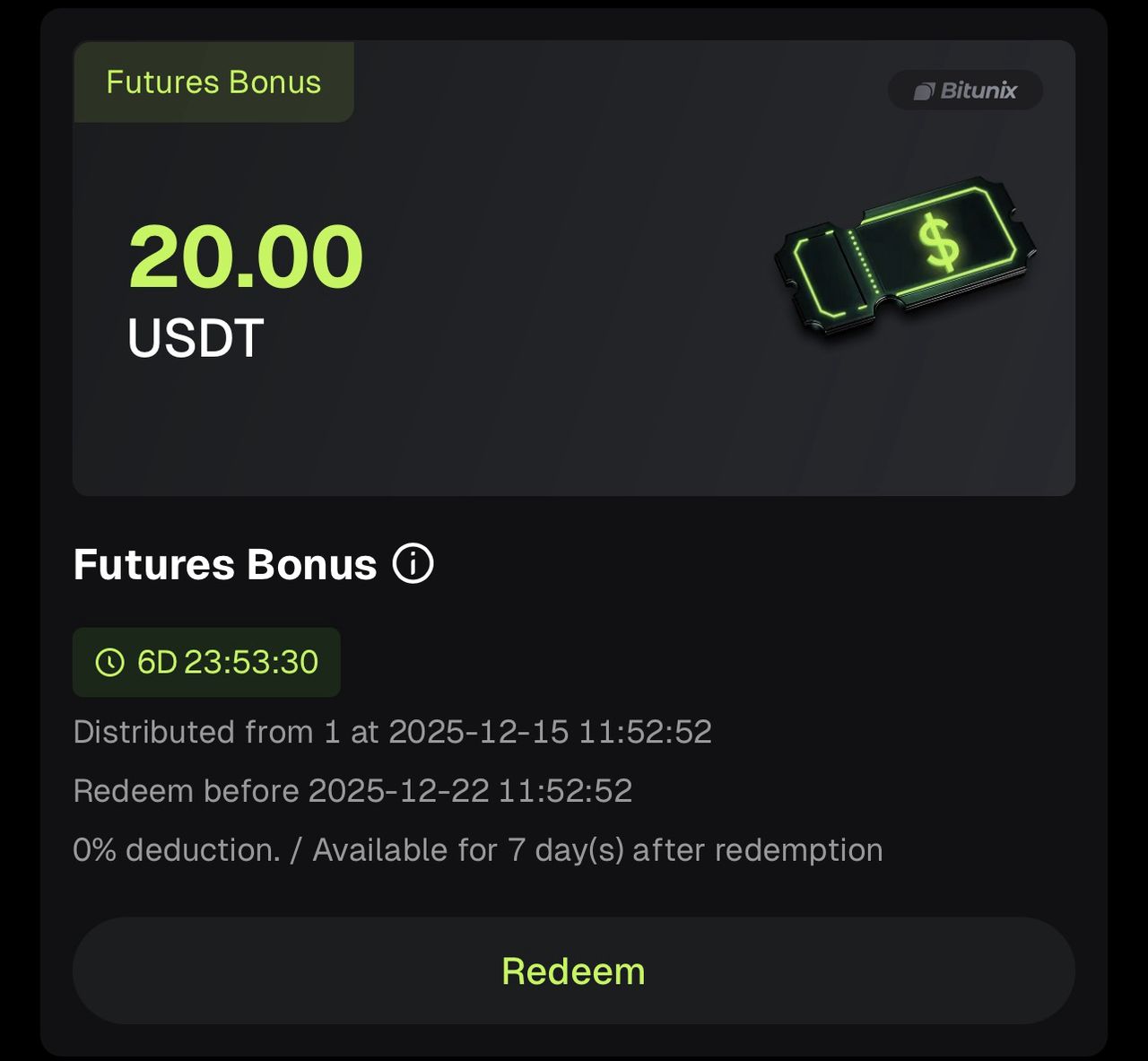
| Item | Regular loss scenario | Forced liquidation (total capital loss) scenario | Extreme price spike scenario (loss exceeds total capital) |
|---|---|---|---|
| Initial principal (USDT) | 20 | 20 | 20 |
| Initial Futures Bonus (USDT) | 20 | 20 | 20 |
| Total initial capital (USDT) | 20 + 20 = 40 | 20 + 20 = 40 | 20 + 20 = 40 |
| Total loss (USDT) | 10 | 40 (total loss of all capital) | 50 (example: loss exceeds total funds by 10) |
| Formula: loss borne by Futures Bonus (USDT) | 20 × 0% | 20 × 0% → triggers bottom line rule, so 0% ratio becomes invalid and changes to 100% deduction → 20 × 100% | 20 × 0% → triggers bottom line rule, so 0% ratio becomes invalid and changes to 100% deduction → 20 × 100% |
| Result: loss borne by Futures Bonus (USDT) | 0 | 20 | 20 |
| Formula: actual loss of principal (USDT) = total loss − loss borne by Futures Bonus | 10 − 0 | 40 − 20 | 50 − 20 (principal can only bear 20, the excess is borne by the exchange) |
| Result: loss borne by principal (USDT) | 10 | 20 (full loss of principal) | 20 (full loss of principal) |
| Final remaining principal (USDT) | 20 − 10 = 10 | 20 − 20 = 0 | 20 − 20 = 0 |
| Final remaining Futures Bonus (USDT) | 20 − 0 = 20 | 20 − 20 = 0 | 20 − 20 = 0 |
| Excess loss (USDT) | − | − | 50 − 40 = 10 (this excess loss is borne by the exchange) |
Note: For Futures Bonus with a 0% deduction ratio, the default deduction order is: first deduct losses from the user’s own funds, then deduct from the Futures Bonus.
Different loss scenarios under a 50% deduction ratio
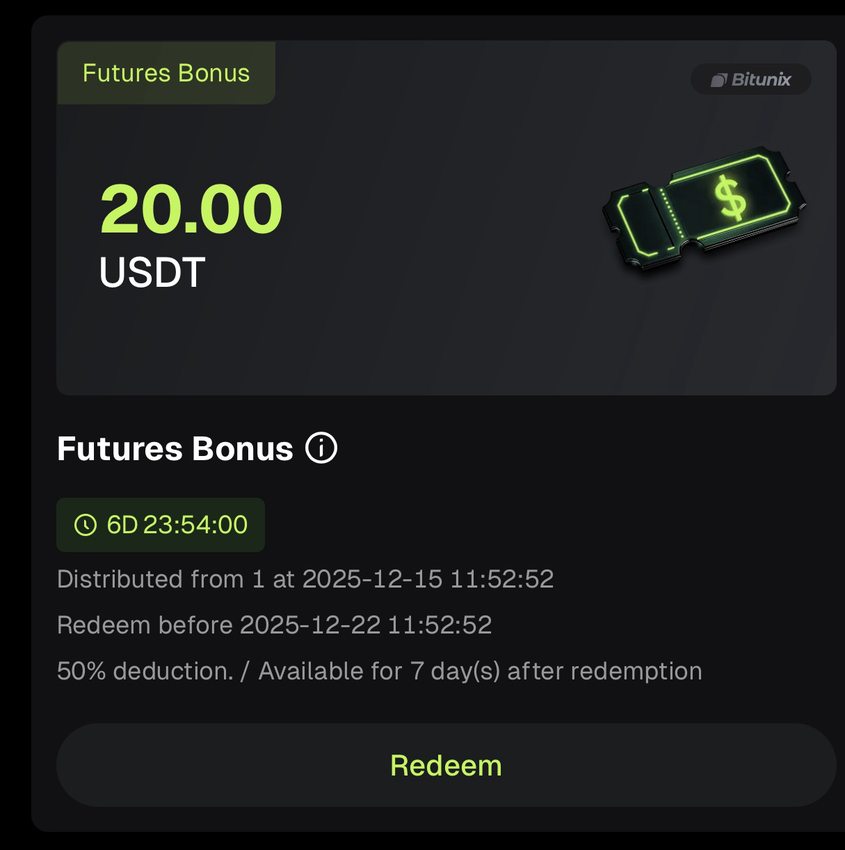
| Item | Regular loss scenario | Forced liquidation (total capital loss) scenario | Extreme price spike scenario (loss exceeds total capital) |
|---|---|---|---|
| Initial principal (USDT) | 20 | 20 | 20 |
| Initial Futures Bonus (USDT) | 20 | 20 | 20 |
| Total opening capital (USDT) | 20 + 20 = 40 | 20 + 20 = 40 | 20 + 20 = 40 |
| Total loss (USDT) | 20 | 40 (total loss of all capital) | 50 (example: loss exceeds total funds by 10) |
| Futures Bonus loss calculation formula (USDT) | 20 × 50% | 20 × 50% → 50% deduction ratio is invalidated by the bottom line rule and switches to 100% deduction → 20 × 100% | 20 × 50% → 50% deduction ratio is invalidated by the bottom line rule and switches to 100% deduction → 20 × 100% |
| Result: loss borne by Futures Bonus (USDT) | 10 | 20 | 20 |
| Formula: actual loss borne by principal (USDT) = total loss − loss borne by Futures Bonus | 20 − 10 | 40 − 20 | 50 − 20 (the principal can only bear 20, the excess is borne by the exchange) |
| Result: loss borne by principal (USDT) | 10 | 20 (full loss of principal) | 20 (full loss of principal) |
| Final remaining principal (USDT) | 20 − 10 = 10 | 20 − 20 = 0 | 20 − 20 = 0 |
| Final remaining Futures Bonus (USDT) | 20 − 10 = 10 | 20 − 20 = 0 | 20 − 20 = 0 |
| Excess loss (USDT) | − | − | 50 − 40 = 10 (this excess loss is borne by the exchange) |
Note: For Futures Bonus with a 50% deduction ratio, the deduction order is: deduct losses from the Futures Bonus first, then deduct losses from the user’s own funds.
Different loss scenarios under a 100% deduction ratio
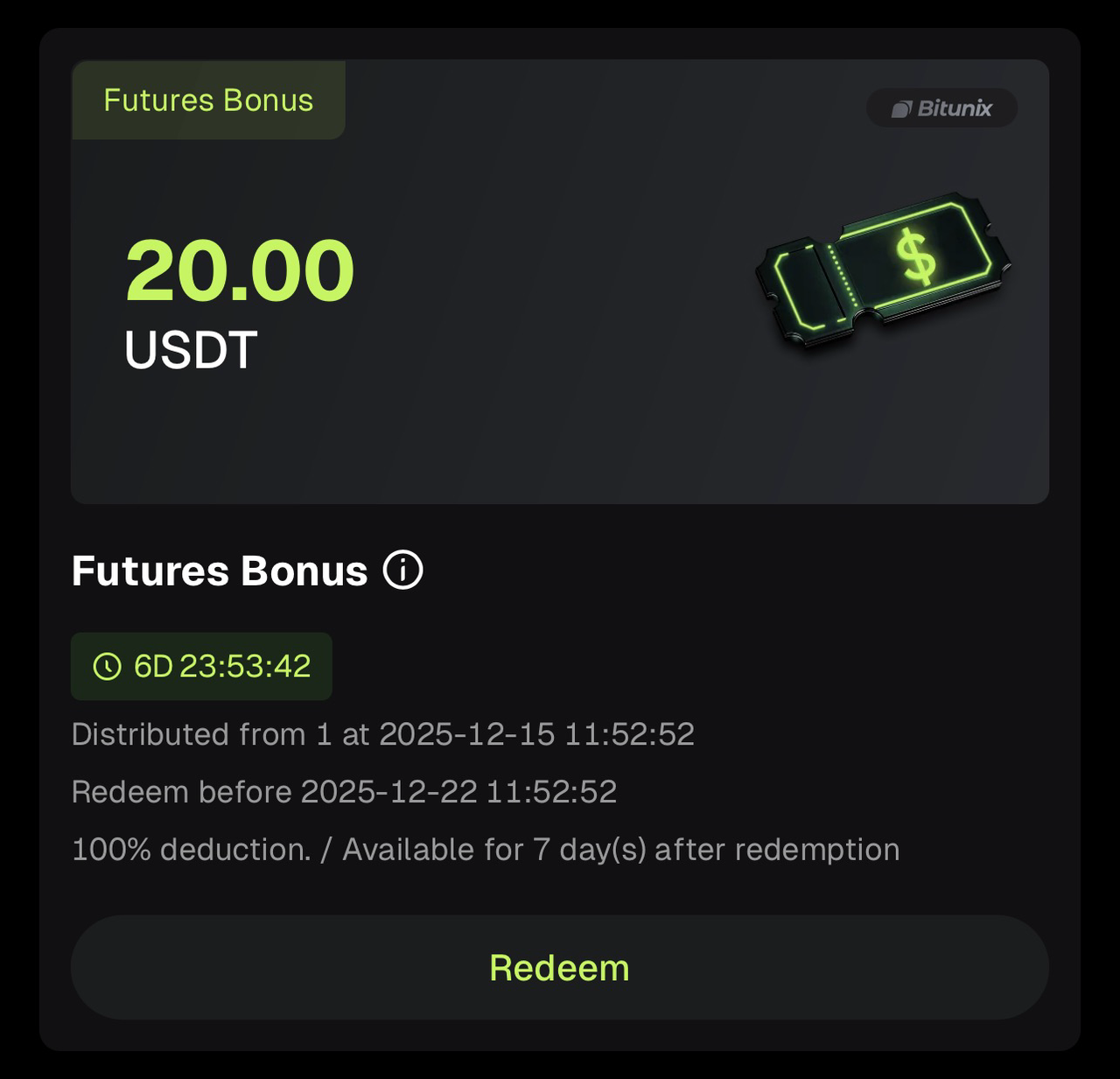
| Item | Regular loss scenario | Forced liquidation (total capital loss) scenario | Extreme price spike scenario (loss exceeds total capital) |
|---|---|---|---|
| Initial principal (USDT) | 20 | 20 | 20 |
| Initial Futures Bonus (USDT) | 20 | 20 | 20 |
| Total opening capital (USDT) | 20 + 20 = 40 | 20 + 20 = 40 | 20 + 20 = 40 |
| Total loss (USDT) | 20 | 40 (total loss of all capital) | 50 (example: loss exceeds total funds by 10) |
| Futures Bonus loss calculation formula (USDT) | 20 × 100% | 20 × 100% | 20 × 100% |
| Result: loss borne by Futures Bonus (USDT) | 20 | 20 | 20 |
| Formula: actual loss borne by principal (USDT) = total loss − loss borne by Futures Bonus | 20 − 20 | 40 − 20 | 50 − 20 (principal can only bear 20, any excess is borne by the exchange) |
| Result: loss borne by principal (USDT) | 0 | 20 (full loss of principal) | 20 (full loss of principal) |
| Final remaining principal (USDT) | 20 − 0 = 20 | 20 − 20 = 0 | 20 − 20 = 0 |
| Final remaining Futures Bonus (USDT) | 20 − 20 = 0 | 20 − 20 = 0 | 20 − 20 = 0 |
| Excess loss (USDT) | − | − | 50 − 40 = 10 (this excess loss is borne by the exchange) |
Note: For Futures Bonus with a 100% deduction ratio, the deduction order is to deduct losses from the Futures Bonus first, then deduct losses from the user’s own funds.
Different loss scenarios with no equity (0% deduction ratio)
| Item | Regular loss scenario | Forced liquidation (total capital loss) scenario | Extreme price spike scenario (loss exceeds total capital) |
|---|---|---|---|
| Initial principal (USDT) | 0 | 0 | 0 |
| Initial Futures Bonus (USDT) | 20 | 20 | 20 |
| Total opening capital (USDT) | 0 + 20 = 20 | 0 + 20 = 20 | 0 + 20 = 20 |
| Total loss (USDT) | 10 | 20 (total loss of all capital) | 30 (example: loss exceeds total funds by 10) |
| Futures Bonus loss formula (USDT) | 10 × 0% → 0% deduction ratio is automatically invalidated by the bottom line rule and switches to 100% deduction → 10 × 100% | 20 × 0% → 0% deduction ratio is automatically invalidated by the bottom line rule and switches to 100% deduction → 20 × 100% | 20 × 0% → 0% deduction ratio is automatically invalidated by the bottom line rule and switches to 100% deduction → 20 × 100% |
| Result: loss borne by Futures Bonus (USDT) | 10 | 20 | 20 |
| Actual loss borne by principal (USDT) = total loss − loss borne by Futures Bonus | 10 − 10 | 20 − 20 | 30 − 20 (principal is 0 and cannot bear the excess) |
| Principal loss result (USDT) | 0 | 0 | 0 |
| Final remaining principal (USDT) | 0 | 0 | 0 |
| Final remaining Futures Bonus (USDT) | 20 − 10 = 10 | 20 − 20 = 0 | 20 − 20 = 0 |
| Excess loss (USDT) | − | − | 30 − 20 = 10 (excess loss is borne by the exchange) |
Note: For users who have not deposited any own funds, the effect of a 0% deduction ratio and a 100% deduction ratio is exactly the same.
Core summary
The maximum cost of the Futures Bonus is borne by the platform and is capped at its face value (for example, 100 USDT). Different deduction ratios provide different levels of protection for the user’s own funds.
- Deduction ratio greater than 0% (for example 50%, 100%) The Futures Bonus works as a “shock absorber”. It shares part of the trading loss and slows down the drawdown of the user’s own equity.
- Deduction ratio equal to 0% The Futures Bonus works as a “safety buffer” that is not used under normal conditions and is only triggered after the user’s own principal has been fully exhausted. To prevent excessive losses caused by margin calls and sharp price spikes in extreme market conditions, any remaining loss will then be fully covered by the Futures Bonus. At this point, the original deduction ratio becomes invalid and automatically switches to a 100% deduction from the Futures Bonus.
III. Transaction fee deduction rules example explanation
Transaction fees are deducted in the following order: first the Fee Discount Voucher, then the Futures Bonus. The process is as follows:
- Fee Discount Voucher priority Use the Fee Discount Voucher first to reduce the total transaction fee according to its agreed discount rate.
- Futures Bonus deduction Any remaining fee after applying the Fee Discount Voucher will be deducted according to the configured deduction ratio of the Futures Bonus.
- Additional notes Both the Fee Discount Voucher and the Futures Bonus have their own deduction ratios and validity periods. Any unused or unallocated portion that has expired will be automatically reclaimed by the platform.
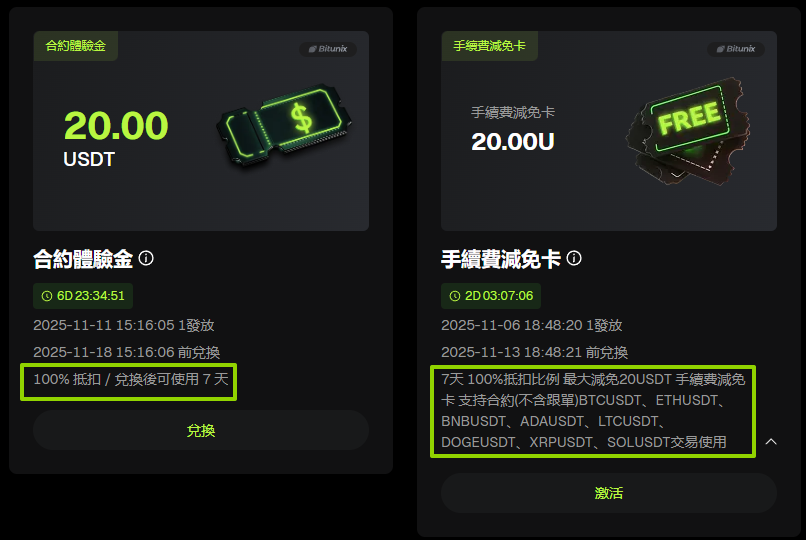
Note: The deduction ratios in the examples above are for reference only. The actual deduction ratio is subject to the settings announced by the platform or agreed in the user account. If the available Futures Bonus balance is insufficient, any remaining unpaid fee will be deducted from the user’s own principal.
| Deduction item | Futures Bonus deduction ratio 0% scenario | Futures Bonus deduction ratio 50% scenario | Futures Bonus deduction ratio 100% scenario |
|---|---|---|---|
| Total trading fee (USDT) | 40 | 40 | 40 |
| Fee Discount Voucher amount (USDT) | 20 | 20 | 20 |
| Fee Discount Voucher deduction ratio | 100% | 100% | 100% |
| Fee deduction from Voucher (USDT) | 20 | 20 | 20 |
| Futures Bonus amount (USDT) | 20 | 20 | 20 |
| Futures Bonus deduction ratio | 0% | 50% | 100% |
| Formula for remaining fee after Voucher (USDT) | Total trading fee minus Voucher deduction = 40 − 20 | Total trading fee minus Voucher deduction = 40 − 20 | Total trading fee minus Voucher deduction = 40 − 20 |
| Remaining fee after Voucher (USDT) | 20 | 20 | 20 |
| Formula for fee deducted by Futures Bonus (USDT) | Futures Bonus × deduction ratio = 20 × 0% | Futures Bonus × deduction ratio = 20 × 50% | Futures Bonus × deduction ratio = 20 × 100% |
| Fee deducted by Futures Bonus (USDT) | 0 | 10 | 20 |
| Formula for final fee paid by user (USDT) | Total trading fee − Voucher deduction − Futures Bonus deduction = 40 − 20 − 0 | Total trading fee − Voucher deduction − Futures Bonus deduction = 40 − 20 − 10 | Total trading fee − Voucher deduction − Futures Bonus deduction = 40 − 20 − 20 |
| Final fee paid by user (USDT) | 20 | 10 | 0 |
Terms and Conditions for the Use of Futures Bonus
- Usage scenarios: The Futures Bonus can be used as margin to open futures positions, offset transaction fees, cover trading losses, and pay funding or capital costs.
- Capital attributes: In the trading system, the Futures Bonus and your own capital (denominated in USDT) are combined to form your available margin.
- Non-withdrawability: The Futures Bonus itself is virtual capital that can only be used to offset eligible trading fees and losses. It cannot be withdrawn directly. However, any realised profits generated by using the Futures Bonus can be withdrawn in USDT.
- Validity period restriction: The Futures Bonus normally has a validity period of 7 days. Any unused or unallocated amount after expiry will be automatically reclaimed by the platform.
- Deduction priority: When settling trading losses, fees, and capital costs, the Futures Bonus is consumed before your own principal, according to the configured deduction ratio.
- Cumulative profit priority coverage: If you receive a Futures Bonus, make a profit first, and later incur a loss, the earlier realised profit must first be used to cover the loss. Any remaining loss after offsetting the cumulative profit will then trigger deduction from the Futures Bonus. For example, if you first make a profit of 10 USDT, then later lose 15 USDT, only the remaining 5 USDT loss will be covered by the Futures Bonus.
- It is prohibited to use futures bonus to open reverse positions for hedging. Violations may trigger the platform's risk control mechanism, and the platform reserves the right to take further actions
Learn more:
How To Use Futures Bonus on Bitunix?
Disclaimer
This article is not intended to provide
(I) investment advice or investment recommendations;
(Ii) an invitation or solicitation to buy, sell or hold digital assets;
(Iii) Financial, accounting, legal or tax advice. The digital assets held (including stablecoins and NFTs) involve high risks and may fluctuate significantly. You should carefully consider whether trading or holding digital assets is suitable for you based on your financial situation. Please consult your legal/tax/investment professionals for your specific situation. It is your responsibility to understand and comply with local applicable laws and regulations.