Choosing between Bitunix vs BloFin on headline fees alone is how many Futures traders end up paying more than they planned. Both are derivatives-focused crypto exchanges with the same base Futures fees, so the real differences sit elsewhere. This guide puts the two side by side using each exchange's own fee schedules, help center rules and product pages. It doubles as a short BloFin review and Bitunix exchange review, so you can see where each platform is stronger and which trade-offs matter for your style.
Bitunix vs BloFin Futures: Markets, Contract Types and Leverage Compared
Both Bitunix and BloFin are derivatives-focused exchanges with crypto and TradFi perpetuals in one account. In a Bitunix vs BloFin Futures comparison, the clearest gaps are contract count, margin types and how much leverage each allows on crypto, metals and stocks.
Bitunix vs BloFin Futures comparison in 2026
Futures Markets, Contract Types and Trading Pairs
Bitunix Futures covers three groups of contracts:
USDT-M perpetuals: the main market, with leverage up to 200x on select pairs.
Coin-M perpetuals: margined and settled in the coin itself, useful if you hold BTC or ETH and want to hedge without switching to stablecoins.
TradFi perpetuals: gold, silver, platinum, palladium, copper, crude oil and natural gas, plus US stock perpetuals such as Tesla, Apple, Nvidia, Amazon, Meta, MicroStrategy and Intel, and ETF perpetuals on QQQ and SPY.
Bitunix lists more than 780 perpetual contracts and supports cross and isolated margin, a multi-asset margin mode and Multi-Trade Mode for holding several separate positions on one pair.
On the BloFin exchange, perpetuals come in USDT-M, USDC-M and Coin-M form, with more than 520 contracts live. More than 100 of them track US stocks and ETFs, alongside gold, silver, platinum, palladium, copper, oil and natural gas. Stock perpetuals run around the clock with funding every 8 hours, but BloFin limits them to reduce orders outside US market hours.
Beyond Futures, BloFin runs Spot trading, Spot and Futures copy trading, trading bots, Earn products and a Launchpad on the same platform.
Markets | Bitunix | BloFin |
Perpetual contracts | 780+ | 520+ |
Margin types | USDT-M, Coin-M | USDT-M, USDC-M, Coin-M |
TradFi coverage | Metals, energy, US stocks, QQQ and SPY | Metals, energy, 100+ US stocks and ETFs |
Stock perpetuals trading hours | 24/7 | 24/7, reduce-only outside US market hours |
BloFin offers more stock tickers and a USDC-margined market; Bitunix lists more contracts overall and keeps stock perpetuals fully tradable outside US hours. If you trade smaller altcoins, check that the exact pairs you follow are listed on both.
Maximum Leverage
Bitunix allows up to 200x on BTCUSDT, ETHUSDT, gold and silver. BloFin allows up to 150x on BTC and ETH, 125x on large caps such as XRP and SOL, and lower caps on smaller altcoins.
Leverage cap | Bitunix | BloFin |
BTC and ETH | 200x | 150x |
Gold (XAUUSDT) | 200x | 100x |
US stock perpetuals (e.g. NVDA, META) | 50x | 20x |
ETF perpetuals (QQQ / SPY) | 75x / 75x | 20x / 50x |
Higher leverage means a smaller move against you can close your position. The table shows roughly how far price can move before your initial margin is gone, ignoring fees and maintenance margin:
Leverage | Margin as % of position | Adverse move that wipes initial margin |
10x | 10% | ~10% |
20x | 5% | ~5% |
100x | 1% | ~1% |
150x (BloFin max on BTC and ETH) | ~0.67% | ~0.67% |
200x (Bitunix max) | 0.50% | ~0.5% |
In practice, liquidation comes earlier because of maintenance margin and fees. The difference between 150x and 200x is small next to the difference between 20x and 100x, so position size and stop placement matter more than the cap.
For the math behind liquidation levels, see our guides to liquidation price in crypto Futures and how Bitcoin Futures work.
Bitunix vs BloFin Fees: Which Crypto Exchange Costs Less for Futures Trading?
At the base tier, the two are tied to Futures and Bitunix is slightly cheaper on Spot. Up the VIP ladder, the picture splits: BloFin cuts maker fees faster, while Bitunix keeps cutting taker fees further and is far easier to qualify for.
Spot Trading Fees
Spot fees | Bitunix | BloFin |
Maker (base) | 0.08% | 0.10% |
Taker (base) | 0.10% | 0.10% |
Entry VIP tier | VIP 1 from a 300 USDT balance: 0.07% / 0.09% | VIP discounts apply across markets |
Higher-fee tokens | Standard rates | 0.20% on high-risk tokens |
On a $1,000 market buy, you pay about $1.00 on either exchange at the base tier. On a resting limit order, Bitunix charges $0.80 and BloFin $1.00.
Futures Trading Fees and VIP Tiers
Futures fees apply to the full position size, not your margin. Here are the published rates for each tier:
VIP level | Bitunix maker / taker | BloFin maker / taker |
VIP 0 / Regular | 0.020% / 0.060% | 0.020% / 0.060% |
VIP 1 | 0.020% / 0.050% | 0.006% / 0.050% |
VIP 2 | 0.016% / 0.050% | 0.004% / 0.045% |
VIP 3 | 0.014% / 0.040% | 0.002% / 0.0425% |
VIP 4 | 0.012% / 0.0375% | 0.001% / 0.040% |
VIP 5 | 0.010% / 0.035% | 0.000% / 0.035% |
VIP 6 | 0.008% / 0.0315% | No VIP 6 (top tier is VIP 5) |
VIP 7 | 0.006% / 0.030% | No VIP 7 |
VIP 8 | 0.000% / 0.026% | No VIP 8 |
In dollars, on a $10,000 BTCUSDT position opened and closed:
Base tier, taker in and out: $12 on both exchanges.
Base tier, maker in and out: $4 on both.
VIP 1, taker in and out: $10 on both. With maker orders it is $4 on Bitunix and about $1.20 on BloFin.
Which exchange is cheaper depends on how you trade. BloFin's maker rates fall faster from VIP 1 to VIP 5, which favors limit-order traders who qualify. Bitunix has the lower taker rate at VIP 3 and VIP 4 and a longer ladder down to 0.026% taker at VIP 8.
Qualification is the bigger gap. Bitunix VIP 1 needs any one of a 300 USDT balance, 1M USDT in 30-day Futures volume or 100,000 USDT in 30-day Spot volume. BloFin VIP 1 needs 50,000 USDT in assets, 10M USDT in 30-day Futures volume or 1M USDT in Spot volume. If you already hold VIP status on another exchange, Bitunix lets you request a matching level by sending a screenshot of your VIP tier and 30-day volume.
For the full Bitunix ladder, see Bitunix Trading Fees Explained. Fees are only one cost: funding payments, spread and slippage often matter more on large or frequent trades.
Deposit and Withdrawal Fees
Crypto deposits are free on both exchanges. Withdrawals carry a network fee that depends on the coin and chain:
Bitunix: 0.000035 BTC for a Bitcoin withdrawal, per its withdrawal fee page. On a 0.05 BTC withdrawal, that is about 0.07%.
BloFin: fees are dynamic, depend on the network and change with congestion. The exact amount appears on the withdrawal screen before you confirm.
On both platforms, pick a low-cost network your wallet supports, such as TRC-20 for USDT, and batch small withdrawals, so the flat fee takes a smaller share.
Futures Trading Tools: Chart Trading, Super Alert, Copy Trading and Bots
Both exchanges let you work from the chart, set in-app alerts and automate trades. Bitunix puts more risk information on the chart and caps copied leverage; BloFin offers more order types, more bots and TradingView-driven execution.
Tool | Bitunix | BloFin |
Orders from the chart | Limit, conditional and trailing stop orders | Chart-based order and TP/SL placement on web |
Risk levels on the chart | Liquidation, margin call and break-even lines | Not shown in BloFin's guides |
Order types | Market, limit, conditional, trailing stop, TP/SL | Market, limit, trigger, TP/SL, trailing stop, TWAP, reverse; Post Only, FOK, IOC, GTC |
In-app alerts | Super Alert: price, indicator, candlestick, drawing, template, combo | Price, indicator, drawing, channel and combined alerts, with templates |
Alert-to-trade automation | Not offered | Signal Bot executes TradingView alerts via webhook |
Charting | Ultra Chart with multi-chart layouts | Built-in charts with TradingView Pine Script custom indicators |
Chart Trading: Place, Modify and Close Orders Directly on the Chart
Bitunix Ultra Chart Trading turns the chart into the order ticket. You can:
Place limit, conditional and trailing stop orders directly on the chart.
Drag TP and SL lines to set or move your exits.
See liquidation, margin call and break-even levels on the chart before you commit.
Use multi-chart layouts, up to 16 windows, to watch several markets at once.
BloFin has also added chart-based order and TP/SL placement to its web trading screen. Its biggest strength is the order menu: market, limit, trigger, TP/SL, trailing stop, TWAP and reverse orders, with Post Only, FOK, IOC and GTC options. TWAP splits a large order into smaller pieces over a set period, which suits bigger sizes. BloFin charts also accept custom indicators written in TradingView's Pine Script.
If you are new to order types, start with the market, limit and stop orders explained, and brush up on how to read candlestick charts.
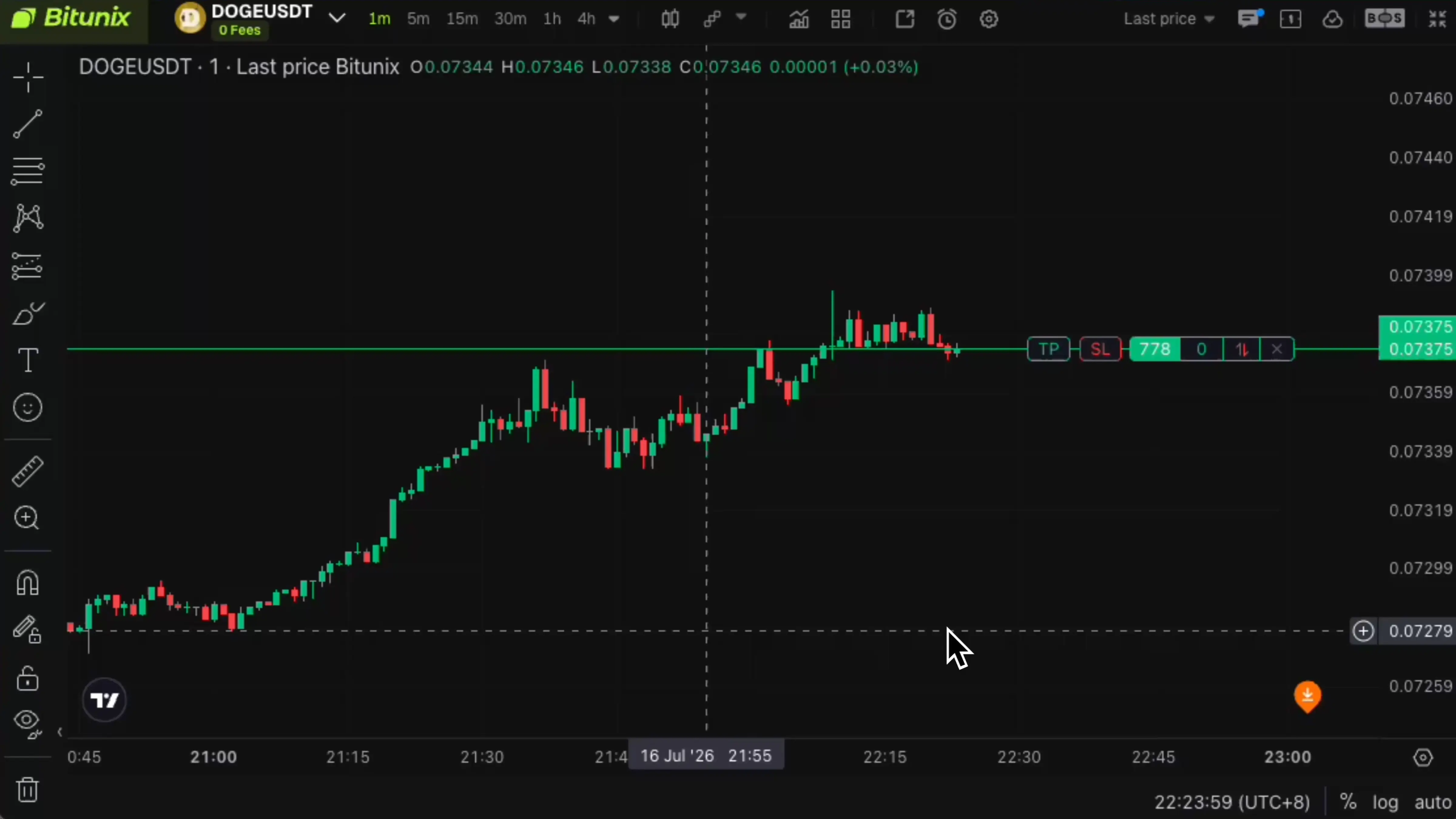
Bitunix Chart Trading shows entry, TP/SL on one chart.
Super Alert: Price, Indicator and Candle Alerts in One System
Bitunix Super Alert covers six alert types:
Price alerts: a push notification when price hits your level.
Indicator alerts: signals from MACD, RSI, Bollinger Bands, volume or moving averages.
Candlestick alerts: automatic detection of candlestick patterns.
Drawing alerts: a notification when price touches or breaks a support, resistance or channel line you drew.
Template alerts: ready-made strategy setups you can switch on.
Combo alerts: several conditions combined to filter out false signals.
For example, you can set a Drawing Alert on a resistance line and add an RSI condition in a Combo Alert, so you are notified only when both are true.
BloFin launched a similar in-app alert system in October 2026, with price, indicator, drawing, channel and combined alerts plus templates. The main difference on paper is candlestick-pattern detection, which Bitunix lists and BloFin does not. BloFin also offers a separate route: its Signal Bot connects to TradingView alerts through webhooks and places the trade for you. That suits traders who already run TradingView strategies, but it needs a paid TradingView plan and webhook setup.
Copy Trading: Bitunix vs BloFin
Both offer Futures copy trading; BloFin adds Spot copy trading, while Bitunix adds a hard leverage cap on copied trades.
Copy trading rule | Bitunix | BloFin |
Markets you can copy | USDT-M Futures (supported pairs) | Futures and Spot |
Copy modes | Fixed amount: 10–1,000 USDT per order; Fixed ratio: 100–100,000 USDT | Smart Copy, Fixed Amount, Fixed Ratio; 100–100,000 USDT |
Leverage on copied trades | Capped at 10x | Smart Copy follows the trader; other modes let you follow or set a fixed leverage |
Follower risk controls | Optional strategy stop loss (5%–95%), slippage tolerance, max margin per pair | Per-trade TP/SL, total investment limit, auto-stop after 20 failed copies |
Lead traders you can follow | Up to 20 active strategies | Up to 10 at once |
Profit share | Default 10%, settled weekly (Monday 00:00 UTC) | Default 10%, up to 20%; weekly payout on Monday |
The practical difference is the leverage guardrail. Bitunix caps copied trades at 10x, so a lead trader cannot pull your account into 50x or 100x territory. BloFin leaves that choice with you, and lets you compare lead traders by ROI, maximum drawdown, AUM, win rate and Sharpe ratio. On both platforms, profit share applies only when the period ends in profit, so check maximum drawdown and track record, not just ROI.
You may be interested:
Trading Bots, Demo Accounts and API Access
Bots
BloFin offers 6 bots: Futures Grid, Futures DCA, Signal and TWAP on the Futures side, plus Spot Grid and Spot DCA. Bitunix offers a Futures Grid bot. If automation is your main workflow, BloFin has a wider menu. Before you run any bot, read 10 common crypto trading bot mistakes.
Demo trading
Both let you practise without risking real funds:
Bitunix gives you 50,000 USDT in virtual funds that you can reset at any time. Demo covers USDT-M perpetuals, with funding rates synced to the live market, needs no KYC and runs in the Bitunix app on iOS and Android.
BloFin gives Spot demo accounts 1 BTC, 5 ETH and 5,000 USDT, and Futures demo accounts 5,000 USDT. You can reset each account up to 5 times a day.
Demo fills have no slippage and do not touch the live order book, so treat demo profits as practice, not proof.
>>> See more: How to Practice Futures Trading with Demo Funds
API access
Both support API trading. Bitunix publishes API documentation for Futures and Spot. BloFin offers REST and WebSocket APIs with IP-bound keys and separate read, trade and transfer permissions.
Bitunix Exchange Review vs BloFin Review: Security, KYC and Availability
This Bitunix exchange review and BloFin review focus on how each platform protects funds, what it asks of you and where you can use it. Both publish Merkle-tree Proof of Reserves above 100% and use Fireblocks custody; The main differences are a dedicated protection fund and the KYC rules for withdrawals.
Is BloFin Safe? Security Measures, Protection Funds and Proof of Reserves
Safety measure | Bitunix | BloFin |
Custody | Fireblocks and Cobo | Fireblocks |
Proof of Reserves | Merkle tree, monthly snapshots, open-source verifier. October 1, 2026: BTC 156%, ETH 108%, USDT 105% | Merkle tree, 1:1 reserve policy, user self-check. May 15, 2026: BTC 149.67%, ETH 162.97%, USDT 105.77% |
Protection fund | Bitunix Care Fund: 50M USDC | No dedicated user protection fund listed |
Certifications | ISO/IEC 27001:2022 | ISO 27001 and PCI DSS |
Account security | 2FA | Google Authenticator, passkeys, anti-phishing code |
Both exchanges let you check that your own balance is included in the Merkle tree. A reserve ratio above 100% means the exchange held more of an asset than users had on the platform at snapshot time. It is a point-in-time check, not a guarantee of the company's full financial position.
Bitunix publishes its latest ratios on its Proof of Reserves page and backs users with a dedicated Care Fund, which launched at 30M USDC in October 2025 and now holds 50M USDC. BloFin runs a 1:1 reserve policy with Merkle verification and adds passkey login and anti-phishing codes at the account level. No exchange is risk-free, so turn on 2FA and keep idle funds in your own wallet.
KYC, Regulation and Where You Can Use Each Exchange
KYC is the clearest policy difference: Bitunix requires verification before any withdrawal, while BloFin allows limited withdrawals without it.
KYC rule | Bitunix | BloFin |
KYC before withdrawals | Yes | Not required up to the basic limit |
Basic level (no ID) | Withdrawals locked until Level 1 | 20,000 USDT per 24 hours; Futures trading with no limit stated |
Level 1 | ID document and selfie; up to 500,000 USDT per 24 hours | Personal information verification; up to 1,000,000 USDT per 24 hours |
Level 2 | Proof of address; up to 5,000,000 USDT per 24 hours | Address proof; up to 2,000,000 USDT per 24 hours |
According to regulations, Bitunix is registered with the U.S. Financial Crimes Enforcement Network (FinCEN) as a Money Services Business and continues to add registrations in other jurisdictions. A registration is not an invitation to every market: Bitunix does not onboard residents of the United States or Canada, among other restricted regions.
BloFin's Terms of Use set Hong Kong as the seat of arbitration under HKIAC rules and states that BloFin is not regulated by Dubai's VARA and cannot serve residents of Dubai or the UAE. The Terms list about 40 restricted jurisdictions, including the US, Canada, mainland China, India and Singapore.
Restricted lists change, so read each exchange's eligibility notice for your country before opening an account. Using a VPN to get around a restriction breaks both platforms' terms and can lead to a frozen account. Our overview of Bitunix compliance, KYC and risk controls covers the Bitunix side in more detail.
Bitunix vs BloFin Comparison Table: Side-by-Side Overview of Both Exchanges
The table sums up every category in this guide:
Category | Bitunix | BloFin |
Spot fees (base maker / taker) | 0.08% / 0.10% | 0.10% / 0.10% |
Futures fees (base maker / taker) | 0.02% / 0.06% | 0.02% / 0.06% |
Futures fees at VIP 1 | 0.02% / 0.05% | 0.006% / 0.05% |
Top published VIP tier | VIP 8: 0% / 0.026% | VIP 5: 0% / 0.035% |
VIP 1 entry | 300 USDT balance, or 1M USDT Futures volume | 50,000 USDT assets, or 10M USDT Futures volume |
Perpetual contracts | 780+ | 520+ |
Contract types | USDT-M, Coin-M, TradFi (metals, energy, US stocks, QQQ, SPY) | USDT-M, USDC-M, Coin-M, TradFi (metals, energy, 100+ US stocks and ETFs) |
Max leverage | Up to 200x (BTC, ETH, gold, silver) | Up to 150x (BTC, ETH) |
Charting | Ultra Chart Trading: orders, TP/SL and liquidation lines on the chart | Chart orders on web; Pine Script custom indicators |
Alerts | Super Alert: price, indicator, candlestick, drawing, template, combo | Price, indicator, drawing, channel, combined; Signal Bot for TradingView |
Copy trading | Futures; 10x cap; strategy stop loss; default 10% profit share | Futures and Spot; up to 20% profit share; follower-set leverage |
Bots | Futures Grid | Six bots: Futures Grid, Futures DCA, Signal, TWAP, Spot Grid, Spot DCA |
Demo trading | 50,000 USDT, USDT-M perpetuals | Spot and Futures demo accounts, 5 resets a day |
Proof of Reserves | Oct 1, 2026: BTC 156%, ETH 108%, USDT 105% | May 15, 2026: BTC 149.67%, ETH 162.97%, USDT 105.77% |
Protection | Care Fund, 50M USDC | 1:1 reserve policy |
KYC | Required before withdrawals | Optional up to 20,000 USDT per 24 hours |
Regulation | US FinCEN MSB registration | Terms: not regulated by Dubai's VARA; arbitration in Hong Kong |
Conclusion
In the Bitunix vs BloFin matchup, the two are closer than most comparisons suggest. Base Futures fees are identical, both now offer in-app alert systems, and BloFin's maker rates drop faster across its first VIP tiers. BloFin adds more bot types, TWAP orders, Spot copy trading, a TradingView Signal Bot and optional KYC up to a withdrawal limit.
Bitunix is built around the Futures workspace. Ultra Chart Trading shows TP/SL and liquidation levels on the chart, and Super Alert adds candlestick-pattern detection to price, indicator and trendline alerts. Leverage goes up to 200x, copy trading caps copied positions at 10x, and a longer VIP ladder lowers taker fees further. A 50M USDC Care Fund and monthly Proof of Reserves sit behind the account.
If you place mostly maker orders and want a wide bot menu, TWAP orders or Spot copy trading, BloFin is built for that. If you trade Futures by hand and want liquidation lines on the chart, a leverage cap on copied trades and a dedicated Care Fund, Bitunix Futures is the most focused setup. Many active traders use both, so compare live fees and order books on your own pairs before committing size.
>>> See more: Bitunix vs OKX: Which Crypto Exchange Is the Better Binance Alternative in 2026?